Small Business Management
 Call Kai
 Learn
Learn Practice Test
 Spaced Repetition
 Match
Match Flashcards
 Knowt Play
1/104

Earn XP
Description and Tags
C. Amato - Pitt
Name | Mastery | Learn | Test | Matching | Spaced | Call with Kai |
|---|
No analytics yet
Send a link to your students to track their progress
105 Terms
Sole Proprietorship
A business owned and operated by one individual
most common form
has unlimited liability
Partnership
a form of business organization defined by the Uniform Partnership Act as an association of two or more persons who carry on as co-owners of a business for profit
Corporation
a legal entity, created by the state, whose assets and liabilities are separate from its owners ( AKA limited liability)
C Corporation
A corporation taxed separately from owners; subject to double taxation
S Corporation
a corporation taxed as though it were a partnership with restrictions on shareholders
(A corporation where profits pass through to owners and are taxed once)
LLC (Limited Liability Company)
form of ownership that provides limited liability and taxation like a partnership but places fewer restrictions on members
(A business structure with limited liability and flexible taxation)
Unlimited Liability
Owners are personally responsible for all business debts
Limited Liability
Owners are only liable up to the amount they invested
Public Corporation
A corporation whose stock is traded publicly
Private Corporation
A corporation owned by a small group and not publicly traded
Entrepeneur
A person who risks time, money, and effort to develop for profit an innovative product or way of doing something
Small Business
Independently owned business with fewer than 500 employees that is not dominant in its competitive area
Franchise
A license to sell another company’s products or use its brand
Franchisee
The buyer/operator of a franchise
Franchiser
The company that sells the franchise
Equity Financing
When a business raises money by selling ownership in a company
Debt Financing
Borrowing money that must be repaid over time
Venture Capital
Investment in new or early-stage businesses (startups) in exchange for partial ownership
Business Plan
a precise statement of the rationale for a business and a step-by-step explanation of how it will achieve its goals
Bartering
Trading goods/services without money
Management
process of achieving organizational goals by using its resources effectively and efficiently in a changing environment
Efficiency
Using minimum resourcees
Effectiveness
Achieving intended results
Planning
Setting objectives and deciding how to achieve them
Organizing
Structuring resources and tasks to accomplish objectives in an efficient manner
Leading (Directing)
Motivating and guiding employees to achieve objectives in an efficient manner
Controlling
Evaluating performance and correcting actions/activities to keep the organization on course
Top Management
Executives responsible for overall organization
Middle Management
Implements strategies
Front-line Management
Supervises daily operations
Technical Skills
the specialized knowledge and training needed to perform jobs related to particular areas of management
Human Relations Skills
the ability to deal with people both inside and outside the organization
Conceptual Skills
the ability to think in abstract terms and to see how parts fit together to form the whole
Analytical Skills
the ability to identify relevant issues, recognize their importance, understand relationships, and perceive underlying causes
SWOT Analysis
Evaluates Strengths, Weaknesses, Opportunities, and Threats
TOWS
Uses SWOT to create strategies
*rearranged version of SWOT (it’s just applying SWOT)
ex) how do we use our strengths to take advantage of opportunities and defend against threats
BCG Matrix (Boston Consulting Group Matrix)
Classifies products by market share and growth
functions of SWOT vs TOWS vs BCG
SWOT: diagnose
TOWS: strategize
BCG: invest decisions
Needs Improvement Analysis
general evaluation of performance gaps
Goal-Setting Inventory
Tool to define and track goals
Functional Departmentalization
Groups jobs by function
Product Departmentalization
Organized by product lines
Geographic Departmentalization
organized by geographic location
Customer Departmentalization
arrangement of jobs around the needs of various types of customers
Centralized Organization
a structure in which authority is concentrated at the top
Decentralized Organization
an organization in which decision-making authority is delegated to lower levels
Span of Management
Number of employees a manager supervises
Tall Organization
Many layers of management
Flat Organization
Few layers of management
Motivation
internal drive that directs a person’s behavior toward goals
Morale
Employee attitude toward job, employer, and/or colleagues
Intrinsic Reward
Internal Satisfaction after attaining a goal
Extrinsic Reward
External rewards received from someone else(money, recognition)
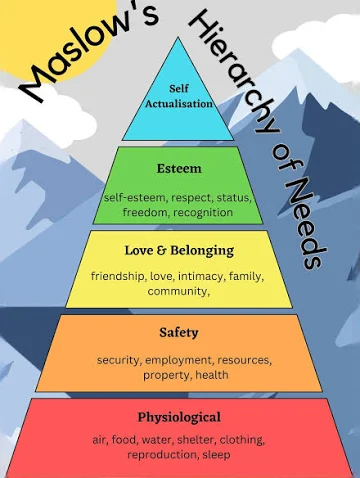
Maslow’s Hierarchy
Needs: physiological —> safety —> social —> esteem —> self-actualization
*hierarchy pyramid works bottom to up!
Hygiene Factors
Work Conditions (pay, safety)
Theory X
Workers dislike work
Theory Y
Workers enjoy work
Theory Z
Emphasizes participation
Equity Theory
Fairness affects motivation
Expectancy Theory
Motivation depends on expected outcome
Goal-Setting Theory
Goals improve performance
Job Analysis
the determination, through observation and study, of pertinent information about a job
Recruiting
forming a pool of qualified applicants from which management can select employees
Selection
Choosing employees
Training
Teaching job skills
Development
Improving long-term skills
Turnover
Employees Leaving
Collective Bargaining
Negotiation between unions and management
Profit Sharing
Employees receive portion of profits
Marketing
a group of activities designed to expedite transactions by creating, distributing, pricing, and promoting goods, services, and ideas
Market Segmentation
a strategy whereby a firm divides the total market into groups of people who have relatively similar product needs
Stock
shares of a corporation that may be bought or sold
Cooperative (Co-op)
an organization composed of individuals or small businesses that have banded together to reap the benefits of belonging to a larger organization
S Corporation
a corporation taxed as though it were a partnership with restrictions on shareholders
Mission Statement
A statement of an organization’s fundamental purpose and basic philosophy
Objective
the end results desired by an organization
Departmentalization
the grouping of jobs into working units usually called departments, units, groups, or divisions
market segmentation vs departmentalization
Market Segmentation = organizing CUSTOMERS
Departmentalization = organizing EMPLOYEES
Primary Data
marketing information that is observed, recorded, or collected directly from respondents
Secondary Data
information compiled inside or outside an organization for purposes other than the current situation
Target Market
specific group a company focuses on
4 P’s
Product, Price, Promotion, Place
Porter’s 5 Forces
the five fundamental competitive pressures that determine an industry’s long-term profitability
List Porter’s 5 Forces
Bargaining Power of Suppliers
How much control suppliers have over price/inputs
Threat of Substitute Products or Services
Can customers switch to something else easily?
Threat of New Entrants
How easy is it for new competitors to enter the market?
Bargaining Power of Buyers
How much power customers have to demand lower prices
Rivalry Among Existing Competitors ⭐ (most important)
Level of competition between current firms
What are Porter’s 5 forces helpful in determining?
determine how competitive an industry is
determine how profitable a business can be
Forces
the competitive pressures that shape profitability
Factors
the conditions that influence how strong each force is
Vertical Integration
when a company expands along its supply chain
Horizontal Integration
When a company expands by merging with competitors at the same stage
what are the 5 important questions when determining “Strategy”?
Who
What
When
Where
Why
Psychographic in Marketing
Why customers buy
Demographic in Marketing
who customers are
Geographic in Marketing
Where customers are located
Behavioral in Marketing
how customers act
Market Validation
proof you selected the correct target market
Operations Management
activities involved in transforming resources into goods and services
Inputs
resources such as labor, money, materials, energy
Outputs
goods, services, or ideas produced
Supply Chain Management
connecting and integrating all parties in distribution to satisfy customers
Bottleneck
a constraint that slows down a process (important in supply chain)