6 glycolosis and glycogen breakdown
 Call Kai
 Learn
Learn Practice Test
 Spaced Repetition
 Match
Match Flashcards
 Knowt Play
1/83

There's no tags or description
Looks like no tags are added yet.
Name | Mastery | Learn | Test | Matching | Spaced | Call with Kai |
|---|
No analytics yet
Send a link to your students to track their progress
84 Terms
What is metabolic pathway regulation?
The control of enzyme activity to match metabolic demand and maintain homeostasis.
Why must metabolic pathways be regulated?
To avoid energy waste, prevent futile cycling, control metabolite levels, and respond to physiological needs.
What are the four major mechanisms of metabolic regulation?
Allosteric regulation, covalent modification, transcriptional regulation, and substrate availability.
What is allosteric regulation?
Regulation by molecules binding to a site other than the active site, changing enzyme activity.
What is covalent regulation?
Regulation by reversible chemical modification, usually phosphorylation/dephosphorylation.
What is transcriptional regulation?
Long-term control by changing enzyme synthesis at the gene expression level.
What is substrate availability regulation?
Control of pathway activity depending on substrate concentration.
Why are irreversible steps important in pathway regulation?
They act as major control points because they cannot easily reverse.
What is reciprocal regulation?
When opposing pathways are regulated in opposite directions.
Why is reciprocal regulation important?
To prevent futile cycling and energy waste.
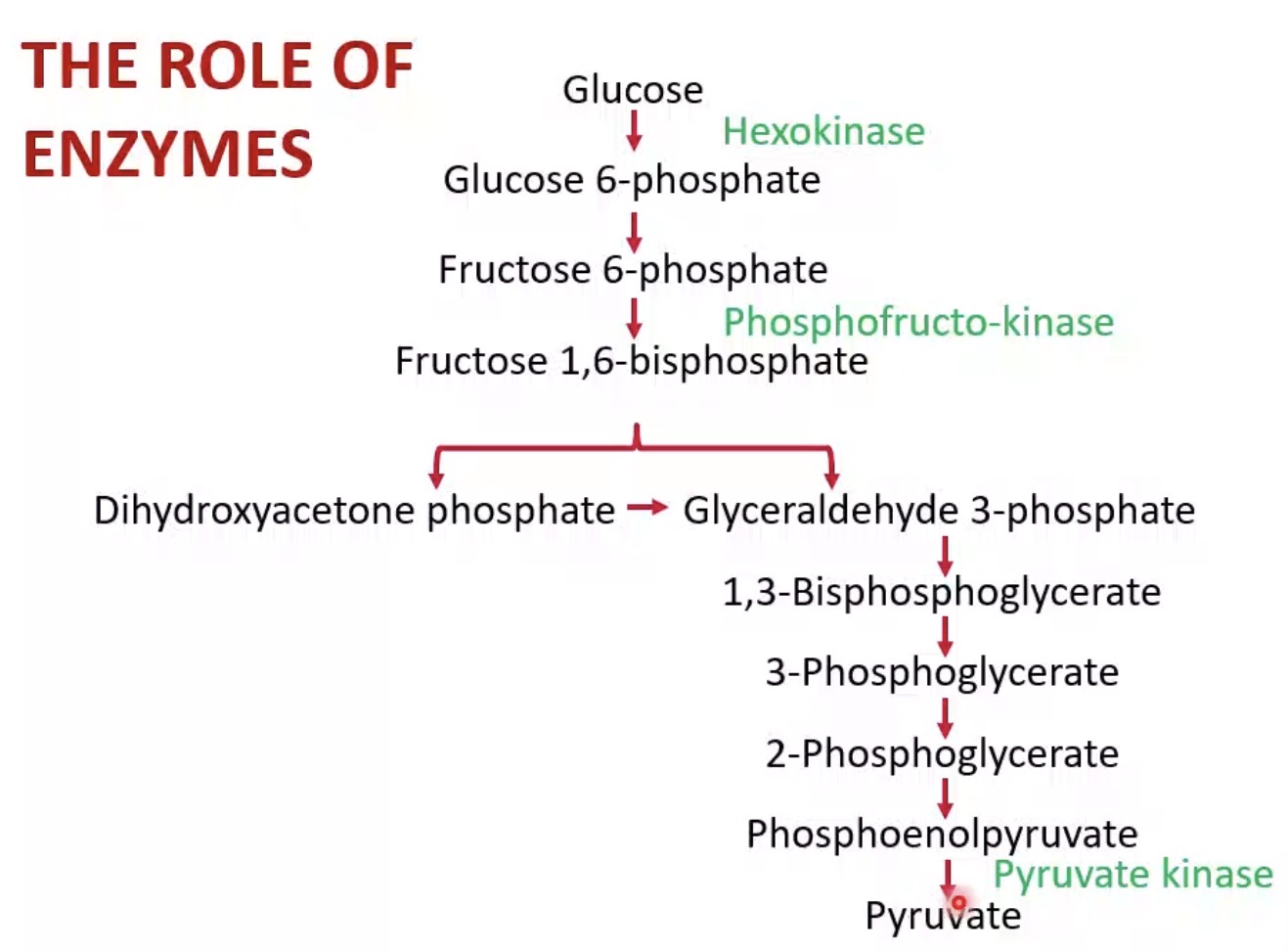
What is glycolysis?
The breakdown of glucose to pyruvate to generate ATP.
What is gluconeogenesis?
The synthesis of glucose from non-carbohydrate precursors.
Why are glycolysis and gluconeogenesis reciprocally regulated?
To prevent both pathways operating simultaneously.
What hormone stimulates glycolysis in the fed state?
Insulin.
What hormone stimulates gluconeogenesis in fasting?
Glucagon.
What is the role of ATP in metabolic regulation?
Signals high energy status and inhibits energy-producing pathways.
What is the role of AMP in metabolic regulation?
Signals low energy status and stimulates ATP-generating pathways.
What is citrate a signal for?
High energy/building block availability.
How does citrate affect metabolism?
It inhibits glycolysis and promotes anabolic pathways.
What is fructose 2,6-bisphosphate?
A powerful regulator that stimulates glycolysis and inhibits gluconeogenesis.
How does fructose 2,6-bisphosphate affect phosphofructokinase-1?
It activates PFK-1.
How does fructose 2,6-bisphosphate affect fructose 1,6-bisphosphatase?
It inhibits the enzyme.
Why is fructose 2,6-bisphosphate important?
It coordinates glycolysis and gluconeogenesis.
What enzyme produces fructose 2,6-bisphosphate?
Phosphofructokinase-2 (PFK-2).
Why is PFK-1 considered a major control point?
It catalyses an irreversible committed glycolytic step.
What activates phosphofructokinase-1?
AMP, ADP, fructose 2,6-bisphosphate.
What inhibits phosphofructokinase-1?
ATP and citrate.
Why does ATP inhibit PFK-1?
Because high ATP indicates sufficient energy.
What does AMP activation of PFK-1 indicate?
Low energy requiring more ATP production.
How does glucagon regulate metabolism?
Through cAMP signalling and phosphorylation cascades.
What second messenger does glucagon use?
cAMP.
What enzyme is activated by cAMP?
Protein kinase A (PKA).
What does PKA do?
Phosphorylates target enzymes to alter activity.
How does insulin generally affect phosphorylation?
It promotes dephosphorylation.
How does glucagon generally affect phosphorylation?
It promotes phosphorylation.
What is pyruvate kinase?
A glycolytic enzyme converting phosphoenolpyruvate to pyruvate.
How is pyruvate kinase regulated?
Allosterically and by phosphorylation.
What activates pyruvate kinase?
Fructose 1,6-bisphosphate (feed-forward activation).
What inhibits pyruvate kinase?
ATP and phosphorylation (in liver).
What is feed-forward activation?
An earlier pathway intermediate activating a later enzyme.
Why does fructose 1,6-bisphosphate activate pyruvate kinase?
To coordinate glycolytic flux.
What enzyme converts pyruvate to oxaloacetate?
Pyruvate carboxylase.
What activates pyruvate carboxylase?
Acetyl CoA.
Why does acetyl CoA activate pyruvate carboxylase?
It signals abundant fatty acid oxidation and need for gluconeogenesis.
What enzyme converts oxaloacetate to phosphoenolpyruvate?
Phosphoenolpyruvate carboxykinase (PEPCK).
What does glucagon do to gluconeogenesis?
Stimulates it.
What does insulin do to gluconeogenesis?
Inhibits it.
What is chronic metabolic regulation?
Long-term control through enzyme synthesis changes.
How does insulin affect chronic regulation?
Increases glycolytic enzyme synthesis.
How does glucagon affect chronic regulation?
Increases gluconeogenic enzyme synthesis.
What is glycogen?
A branched storage polymer of glucose.
Where is glycogen mainly stored?
Liver and skeletal muscle.
Why is glycogen branched?
Allows rapid glucose addition and removal.
What enzyme breaks down glycogen?
Glycogen phosphorylase.
What does glycogen phosphorylase produce?
Glucose 1-phosphate.
What enzyme removes glycogen branch points?
Debranching enzyme.
What are the two activities of the debranching enzyme?
Transferase and α-1,6-glucosidase.
What converts glucose 1-phosphate to glucose 6-phosphate?
Phosphoglucomutase.
Why can liver release free glucose but muscle cannot?
Liver contains glucose 6-phosphatase; muscle does not.
What hormone stimulates glycogen breakdown in liver?
Glucagon.
What hormone stimulates glycogen breakdown in muscle?
Adrenaline.
What enzyme activates glycogen phosphorylase?
Phosphorylase kinase.
How is phosphorylase kinase activated?
Phosphorylation and calcium.
Why does calcium stimulate glycogen breakdown?
It links muscle contraction to energy supply.
What allosterically activates muscle glycogen phosphorylase?
AMP.
What inhibits muscle glycogen phosphorylase?
ATP and glucose 6-phosphate.
Why does AMP activate glycogen breakdown?
It signals low cellular energy.
How does adrenaline stimulate glycogen breakdown?
Via cAMP → PKA → phosphorylase kinase activation.
How does glucagon affect glycogen metabolism?
Stimulates breakdown and inhibits synthesis.
What enzyme synthesises glycogen?
Glycogen synthase.
How is glycogen synthase regulated?
Active when dephosphorylated; inhibited when phosphorylated.
What does insulin do to glycogen synthase?
Activates it via dephosphorylation.
What does glucagon do to glycogen synthase?
Inhibits it via phosphorylation.
What enzyme removes phosphate groups in glycogen regulation?
Protein phosphatase 1.
What is the role of protein phosphatase 1?
Activates glycogen synthesis and inhibits glycogen breakdown.
How does high blood glucose affect liver glycogen breakdown?
Inhibits it.
Why does glucose inhibit liver phosphorylase?
Promotes inactive T-state.
Why is muscle glycogen regulation different from liver?
Muscle responds to energy demand, liver responds to blood glucose.
What is futile cycling?
Simultaneous activation of opposing metabolic pathways.
Why is futile cycling harmful?
It wastes ATP with no useful output.
How does the body prevent futile cycling?
Reciprocal enzyme regulation.
What is metabolic integration?
Coordination of multiple pathways to maintain energy balance.
What is the key overall effect of insulin?
Promotes fuel storage and anabolic metabolism.
What is the key overall effect of glucagon?
Promotes fuel mobilisation and catabolic metabolism.