BIOCH 200 Unit 5 - Enzymes (Questions)
 Call Kai
 Learn
Learn Practice Test
 Spaced Repetition
 Match
Match Flashcards
 Knowt Play
1/25

There's no tags or description
Looks like no tags are added yet.
Name | Mastery | Learn | Test | Matching | Spaced | Call with Kai |
|---|
No analytics yet
Send a link to your students to track their progress
26 Terms
Prosthetic groups on apoenzymes and holoenzymes (may/may not) be changed in the reaction.
May, protein overall doesn’t change but pros group might
What is the advantage of choosing to use a catalyst to speed up a reaction as opposed to other methods?
Heat speeds up a reaction, but energy input is unspecific, speeds up every reaction and is not very useful
Catalyst: reaction specific, provides necessary biological control
Compare the general properties of enzymes and non-biological catalysts.
Enzymes have higher reaction rates, milder reaction conditions, greater reaction specificity, and the capacity for regulation.
How are biological catalysts able to regulate reactions?
Conformational change in structure can determine how fast or slow a reaction proceeds and allows for cooperativity
Phosphoester bonds are (low/high) energy bonds. Phosphoanhydride bonds are (low/high) energy bonds.
Low, high
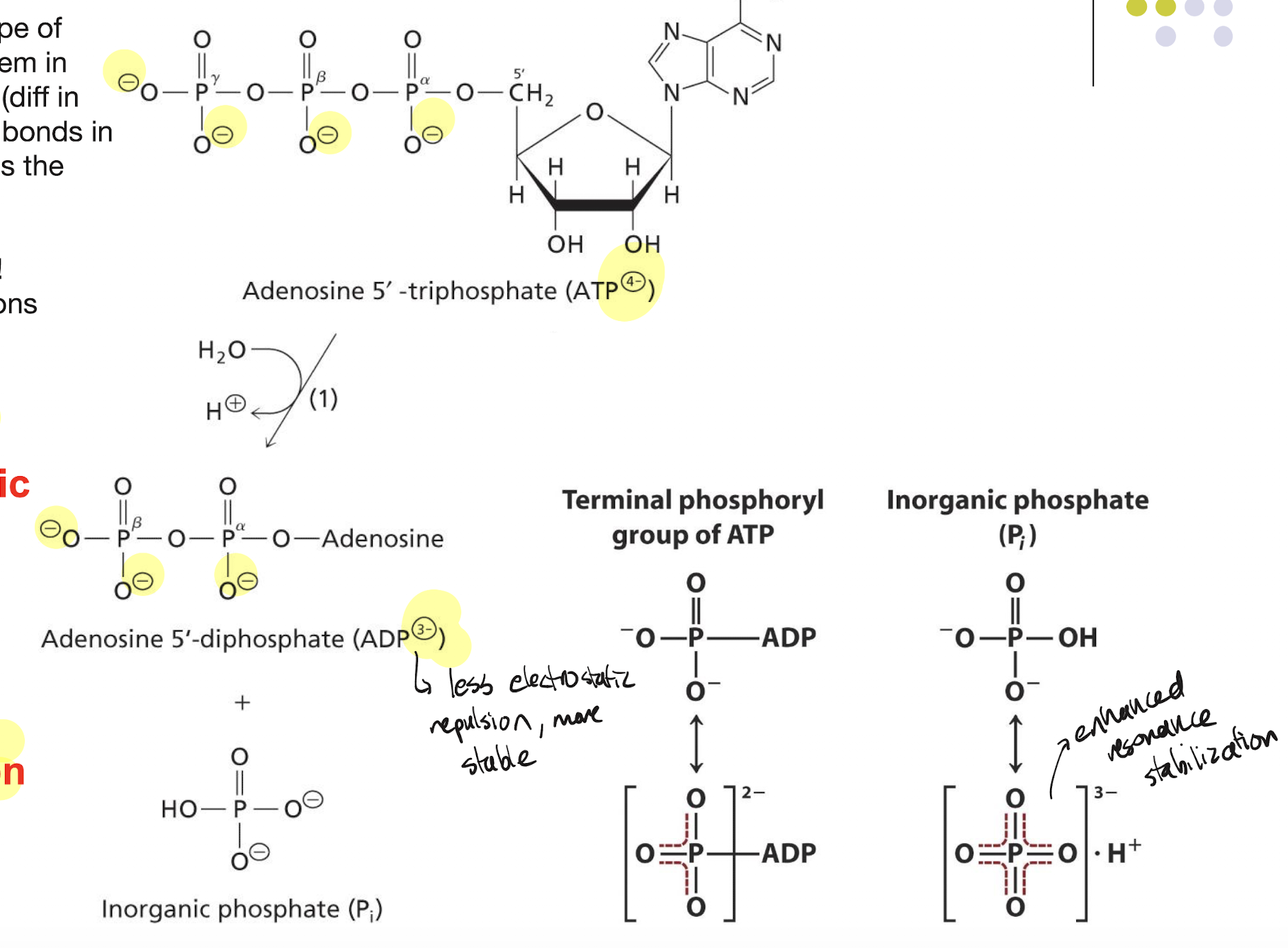
What makes ATP a high energy molecule, comparative to its monophosphate and diphosphate forms? Explain in terms of its hydrolysis.
High electrostatic repulsion due to its added phosphate (-4 charge). Once hydrolyzed to ADP, loses 1 phosphate and has a -3 charge, making it more electrostatically stable and decreasing enthalpy of products. This contributes to a high change in enthalpy
ATP hydrolysis produces an inorganic phosphate, which is stablizes the products due to resonance. This decreases the enthalpy of the products and contributes to a high change in enthalpy
ATP hydrolysis turns one reactant to 3 products (ADP, water, inorganic phosphate), increasing the entropy of the system
Contains 2 phosphoanhydride bonds, which are high energy bonds that release approx -30 KJ each time they are broken
In biological systems, a reaction will proceed only if the free energy of the products is (more/less) than the free energy of the reactants, meaning it is ___. Change in free energy will be (negative/positive).
More, thermodynamically favoured/spontaneous. Negative
Thermodynamics determines which elements of a reaction? What is the measure of thermodynamics that determines this?
Kinetics determines which elements of a reaction? What is the measure of kinetics that determines this?
Whether or not the reaction will proceed: delta G must be negative or else the reaction does not happen
Speed of the reaction: activation energy barrier determines how quick or slow the reaction proceeds
NOTE: delta G does NOT affect kinetics, activation energy does NOT affect spontaneity
Enzymes change reaction (kinetics/thermodynamics) by doing what?
Kinetics: lowers activation energy barrier so that reaction proceeds faster
DO NOT alter the free energy of the reaction!
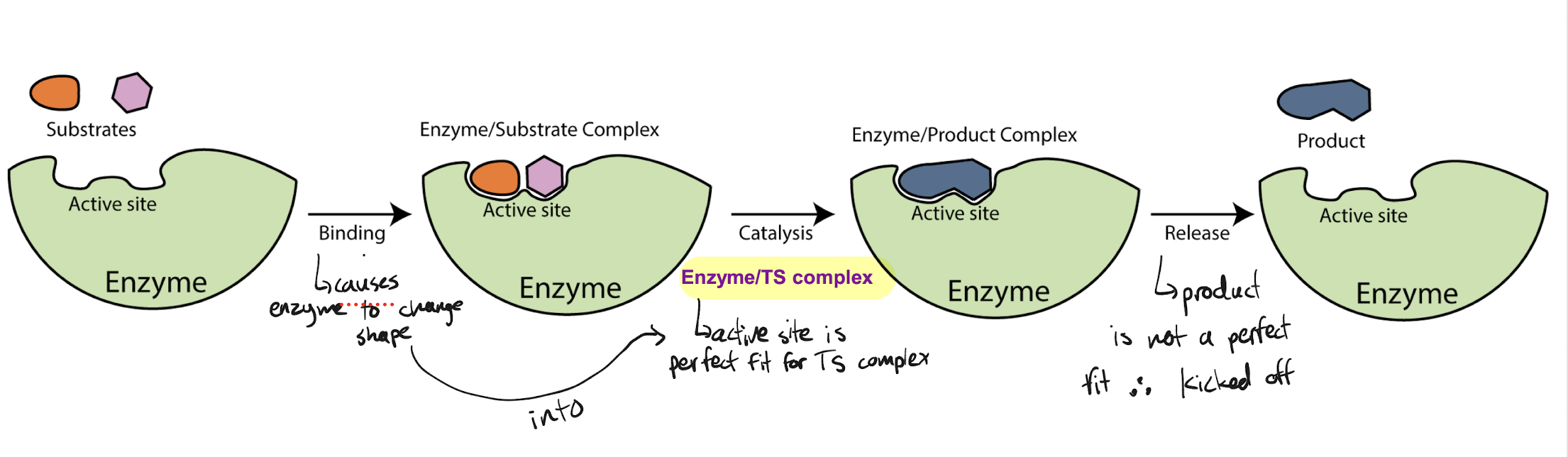
Explain how substrate binding causes a conformation change in an enzyme via the induced fit model.
Substrates bind to the active site, which resembles the TS more closely than the substrate. This causes the enzyme to change shape to be a perfect fit for the transition state, causing the substrate to transform. Once the transition state is released, the product is spontaneously created, which is no longer a perfect fit for the enzyme. The enzyme releases the product.
What are the ways by which catalysts speed up reactions?
Desolvation
Proximity and orientation
Taking part in the reaction mechanism
Stabilizing the transition state
How is desolvation able to speed up a reaction and why?
Removal of water from a substrate prevents interference by solvent molecules. The substrate is then able to form H-bonds easily without competition, eliminating the energy barrier caused by the water solvent molecules. Thus activation energy is lower and the reaction will proceed faster
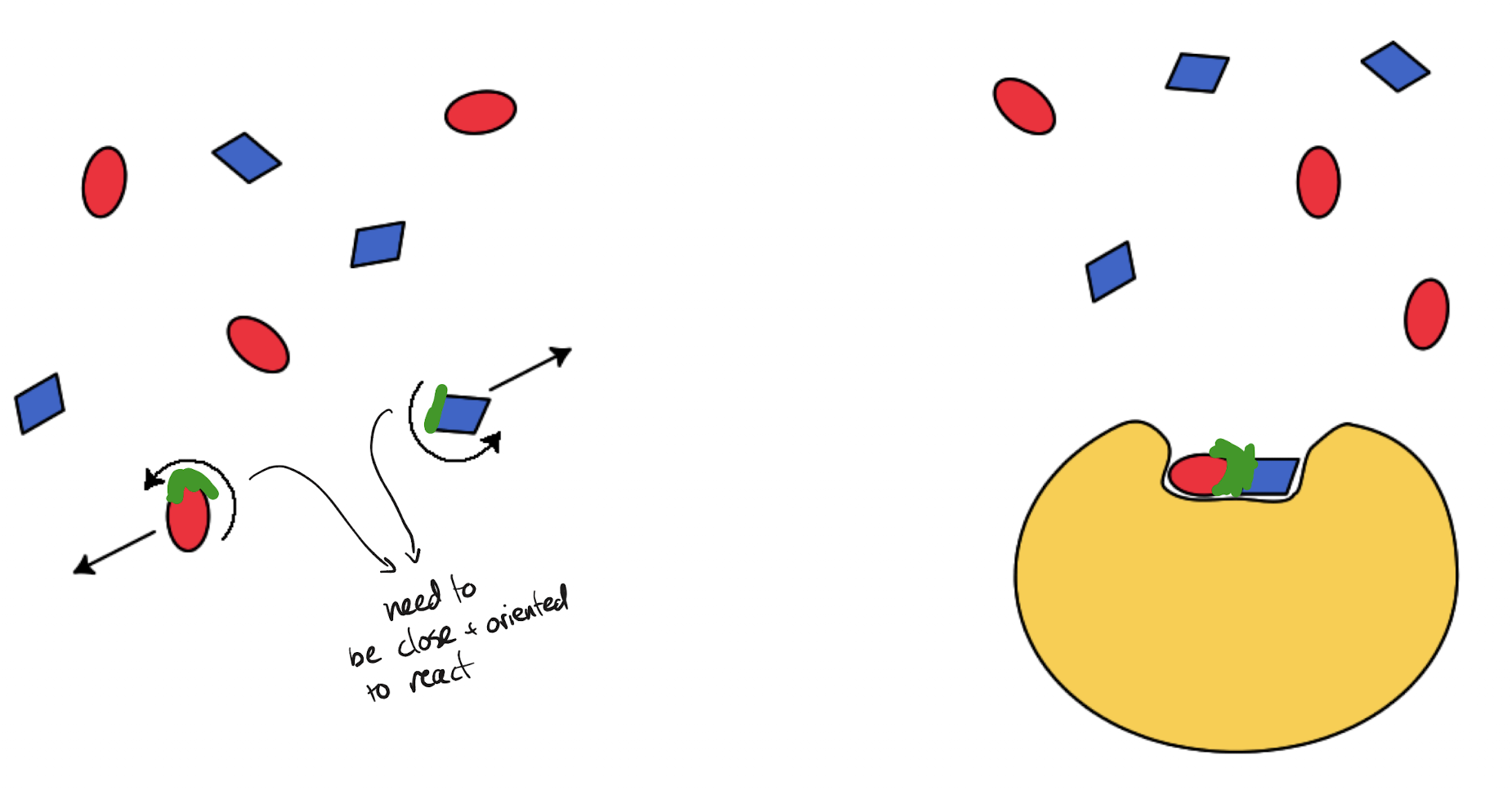
How are proximity and orientation effects able to speed up a reaction and why?
Placing substrate molecules closely enough together encourages them to bind to each other easier and faster. In addition, specific molecules may only have one reactive area (due to functional groups etc.) that needs to collide with other substrate molecules to react, so orienting them correctly speeds up the reaction thousand-fold
What are the ways by which an enzyme can take part in the reaction mechanism of a substrate? How does this speed up a reaction?
Positioning certain amino acid side chains in the active site so that they can react with the substrate (acid-base catalysis/covalent catalysis)
Providing other reactive chemical substances at the active site (cofactors)
Assist in the formation of the transition state, lowering activation energy
How is stabilizing the transition state able to speed up a reaction and why?
The active site binds to the transition state better than to the substrate, forcing a preferential transition state stabilization that will push the substrate to distort to the transition state, lowering free energy. This releases energy, offsetting the energy needed to reach the transition state
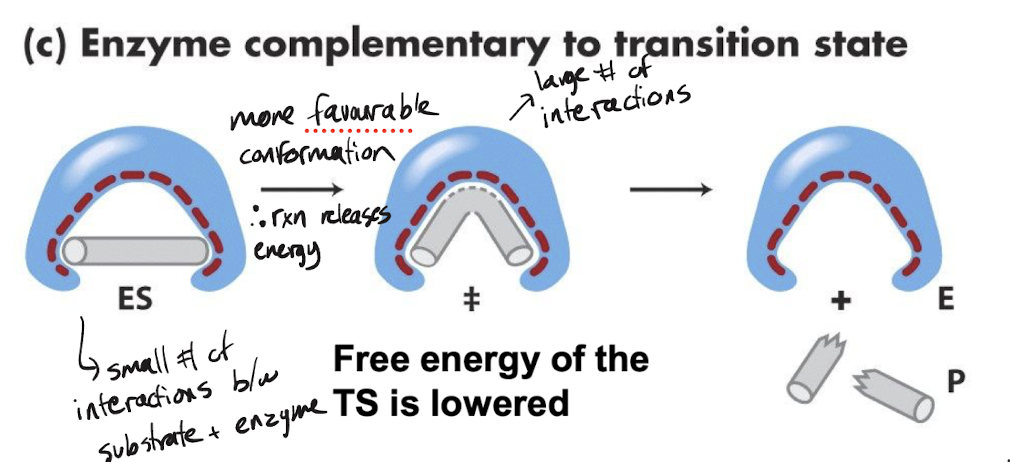
Why does the lock and key model not make sense energetically? Compare to the induced fit model in terms of energy of substrate and transition state.
An enzyme complementary to its substrate would stabilize the substrate, not the transition state (easy fit to substrate, no change in energy to reach transition state. Thus the activation energy doesn’t change and the speed of reaction doesn’t change.
An enzyme complementary to its substrate would cause much less energy to reach the transition state. This lowers the activation energy and speeds up the reaction.
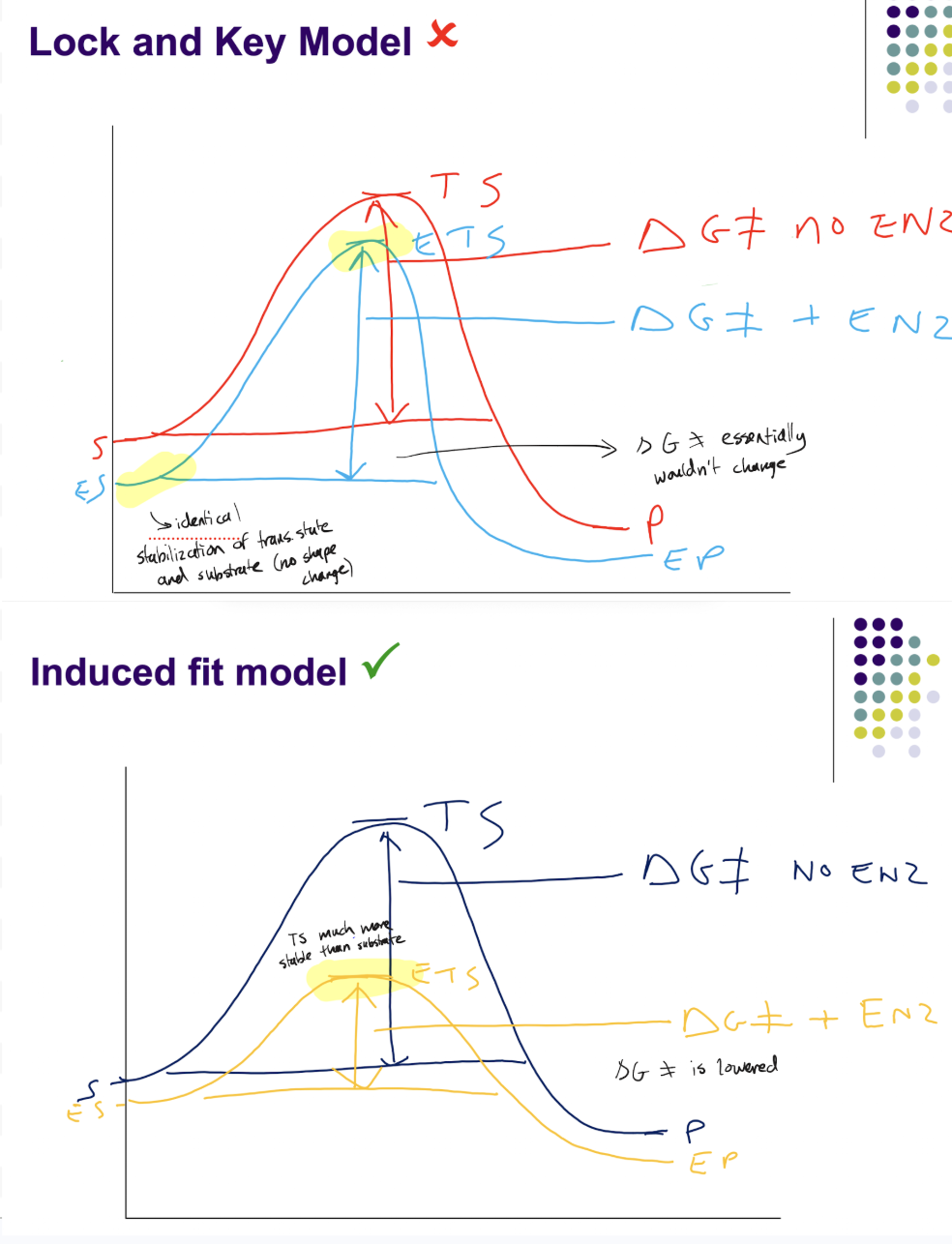
The more tightly an enzyme binds the transition state relative to the substrate, the ____ the catalytic activity of the enzyme.
Greater
Higher Km means what, and what does this mean in terms of enzyme affinity for a substrate?
More substrate needed to get to 50% enzyme activity, lower needed.
Km up, affinity down
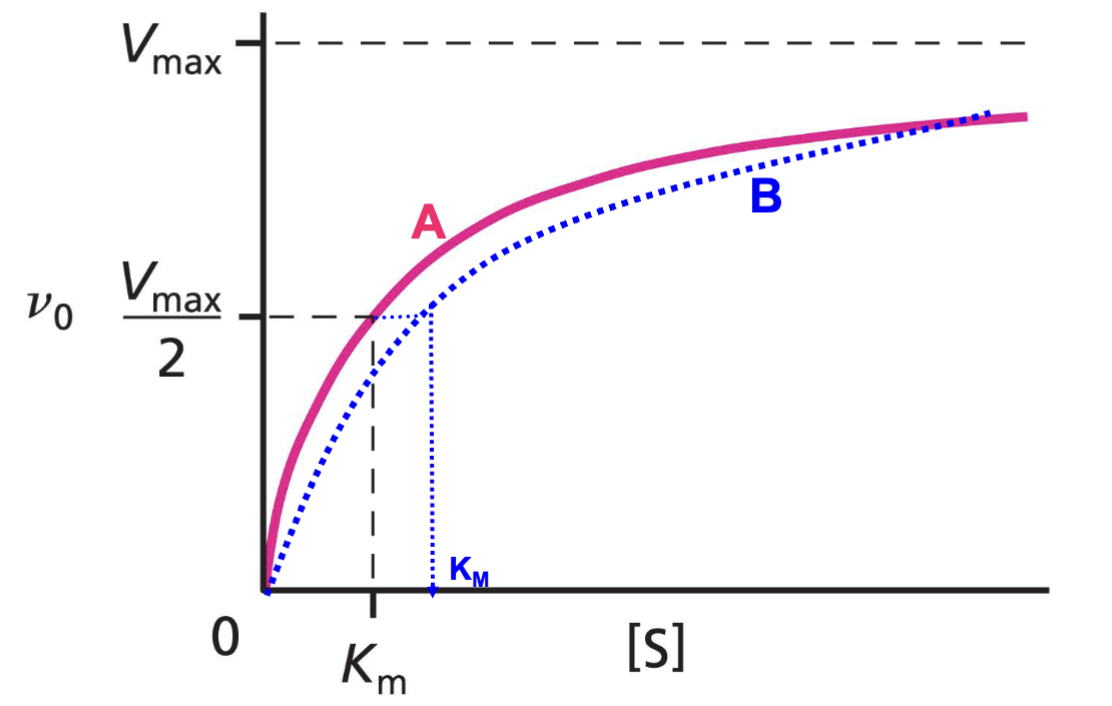
Describe a reaction velocity vs concentration of substrate graph, including shape, midpoint, plateau, and other important features.
The graph is hyperbolic, with a midpoint at Km. Vmax is at the theoretical 100% plateau point of the graph, but the curve does not reach this point because equilibrium reactions are constantly going backwards.
What are some mechanisms within organisms of enzyme activity regulation? Group them based on relative speed.
Quick: competitive inhibition, allostery, reversible covalent modification
Slow: regulation of gene expression, changes in subcellular location (removal of enzyme from substrate), compartmentation (compartmentalizing the enzyme away from its regular location)
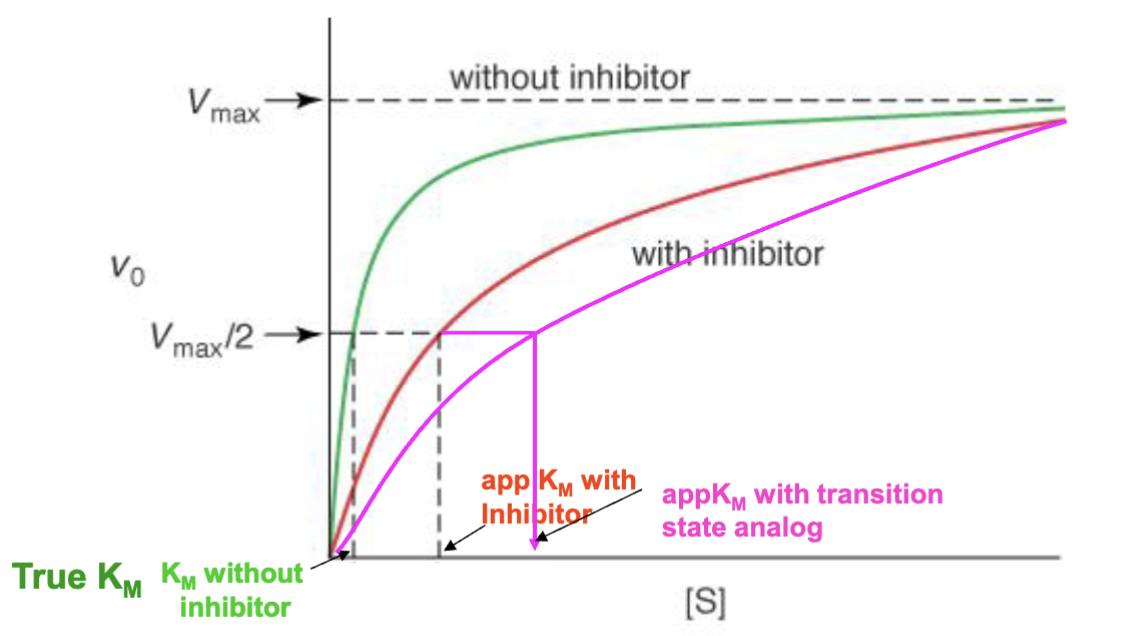
Competitive inhibitors (increase/decrease) apparent Km between enzyme and substrate. How? What would be considered true Km?
Increase (decrease affinity). Inhibitors bind to enzyme to take up spots that substrate could take up, forcing more substrate to be needed to reach full enzyme activity level. True Km is the Km without outside influence (only considering substrate and enzyme), and so since competitive inhibitors are an outside influence, they only decrease apparent Km.
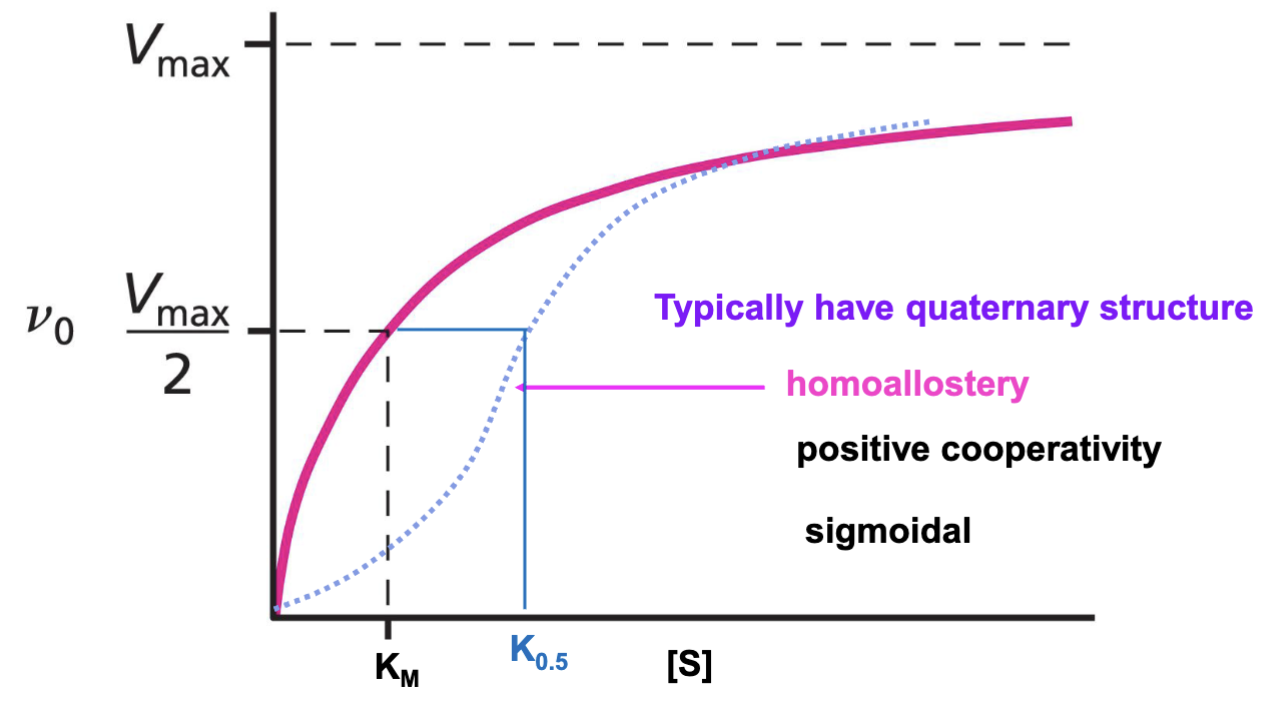
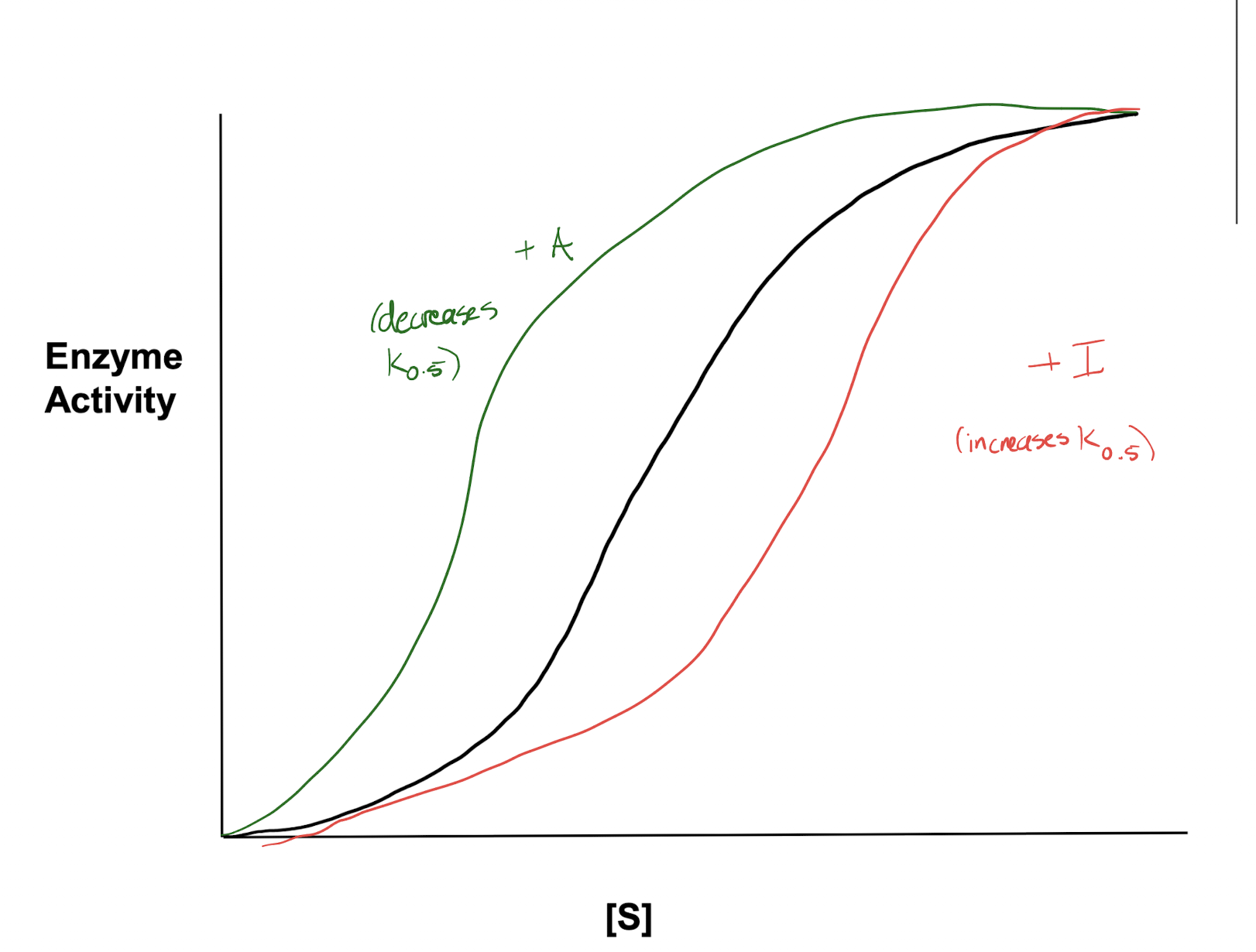
Describe a reaction velocity vs concentration of substrate graph with an allosteric enzyme, including shape, midpoint, plateau, and other important features.
Sigmoidal relationship due to undergoing conformational changes in response to effector binding. Sigmoidal indicates homoallostery, positive cooperativity. Midpoint at Km. Vmax is at the theoretical 100% plateau point of the graph, but the curve does not reach this point because equilibrium reactions are constantly going backwards.
Bottom of the curve will be T state, and as more binds this will change to R state
Describe the 2 conformational states of allosteric enzymes, and what kind of allosteric effectors favour each.
T state (tense, low activity): favoured by allosteric inhibitors, which will bind to the T state to keep the enzyme in T state or bind to the R state to shift the enzyme to T state.
R state (relaxed, high activity): favoured by allosteric activators, which will bind to the R state to keep the enzyme in R state or bind to the T state to shift the enzyme to R state.
Enzymes containing which amino acids can be phosphorylated? Why?
Ser, Thr, Tyr. Need OH group
Describe the forwards and backwards reaction of reversible phosphorylation of enzymes, including reactants, products, and enzymes needed in reaction.
Forward (phosphorylation): phosphate on ATP will be transferred to the hydroxyl group on an enzyme catalyzed by protein kinase. ATP enters, ADP exits.
Backward (dephosphorylation): hydrating the phosphorylated enzyme causes it to lose its inorganic phosphate and return to its unphosphorylated form catalyzed by protein phosphatase. Water enters, phosphate exists
Reaction is reversible!
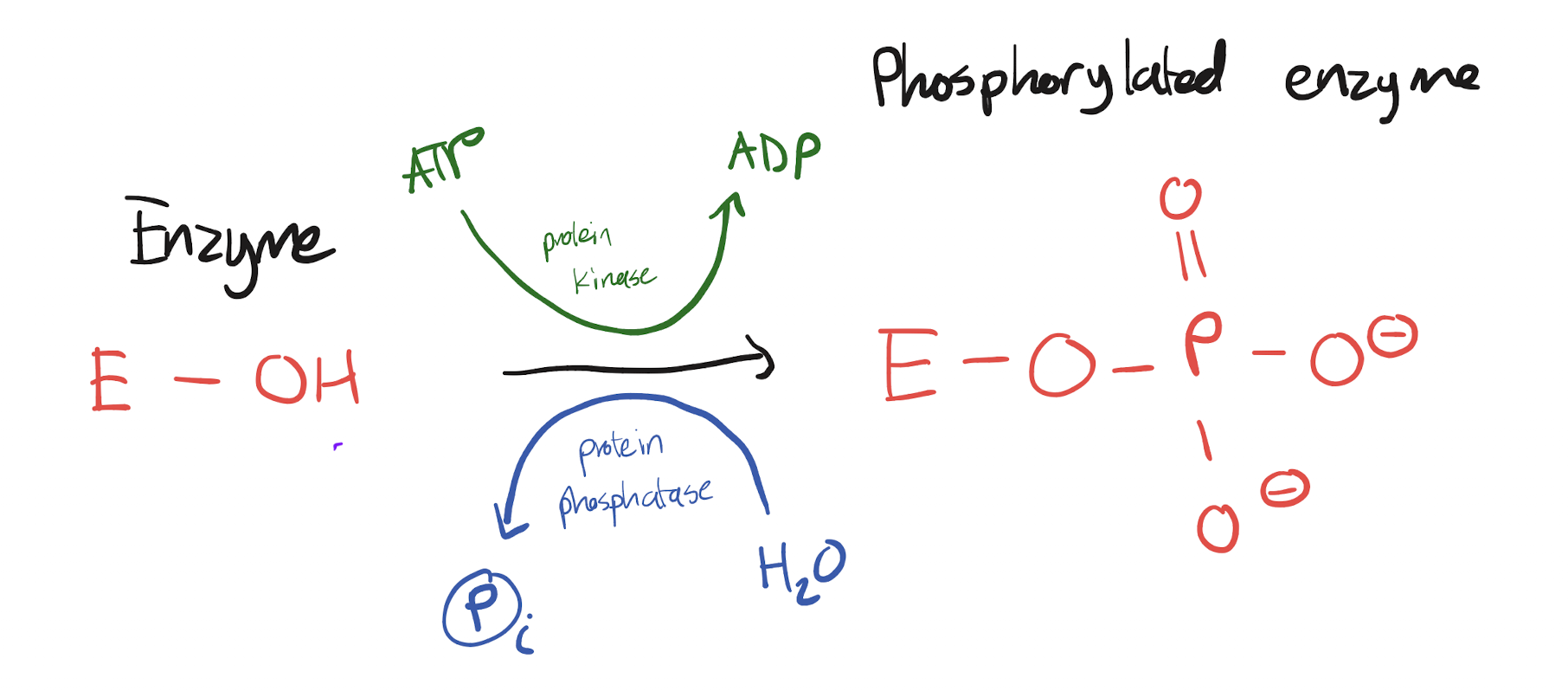
How does the addition of a phosphate group via covalent modification of an enzyme change the enzyme? What does this affect on the enzyme
Increase in size
increase in polarity/hydrophilicity
Addition of 2 negative charges
Capable of making new H-bonds
Overall, changes enzyme activity by modifying its 3D shape. Its active site will change (activate/deactivate) based on phosphorylation