C) Common cardiovascular issues
 Call Kai
 Learn
Learn Practice Test
 Spaced Repetition
 Match
Match Flashcards
 Knowt Play
1/34

There's no tags or description
Looks like no tags are added yet.
Name | Mastery | Learn | Test | Matching | Spaced | Call with Kai |
|---|
No analytics yet
Send a link to your students to track their progress
35 Terms
Dextrocardia
A congenital condition where the heart is located on the right side of the chest.
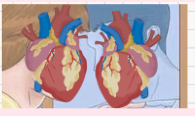
Harmless: When it occurs alone.
Complicated by: situs inversus and defective cilia (Note: This triad describes Kartagener's syndrome/Primary Ciliary Dyskinesia).
Under what circumstance is dextrocardia usually harmless, and what two secondary clinical/cellular anomalies cause it to lead to respiratory disease and infertility?
Ectopia Cordis
A misplaced heart that is located presternally or intra-abnominally.
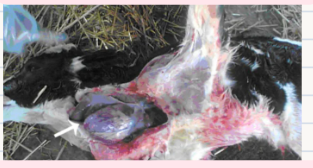
cattle and pigs
In which two domestic animal species is ectopia cordis most commonly diagnosed?
Cardiac Tamponade
Mechanical compression of the heart by a large amount of fluid or blood within the pericardial space that limits the normal range of motion and function of the heart.
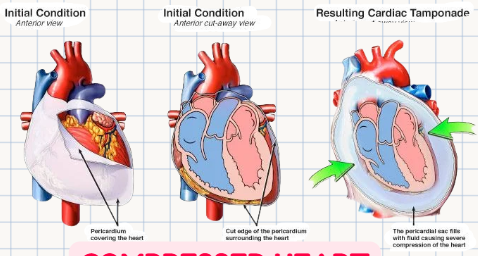
COMPRESSED HEART
What short phrase is highlighted in pink under the cardiac tamponade schematic to summarize its physical effect?
Hemopericardium
Accumulation of whole blood in the pericardial sac ("BLOOD AROUND THE HEART").
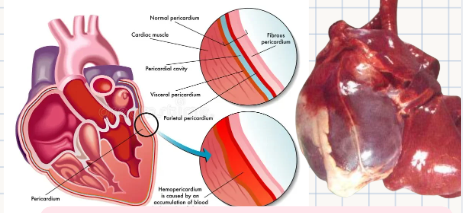
Blunt force trauma or rupture (e.g., cardiac or aortic rupture).
What are the two main mechanical or traumatic etiologies listed for the development of a hemopericardium?
Valvular Disease
Cardiac valves failing to close or open properly.
Myocardial Disease
Heart muscle pumping inefficiently or relaxing inadequately.
Arrhythmia
Heart beating too slowly, too quickly, or irregularly
Hypertension
Increased vascular resistance, either pulmonary or systemic
Cardiac and Extracardiac Shunts
Abnormal communications between chambers on the left and right sides of the heart, or between systemic and pulmonary circulations
Heartworm disease
Parasitism of the cardiovascular system
1. Mitral regurgitation in dogs (MMVD)
2. Hypertrophic cardiomyopathy (HCM) in cats
3. Dilated cardiomyopathy (DCM) in dogs
4. Arrhythmogenic right ventricular cardiomyopathy (ARVC) in Boxers and Bulldogs
5. Heartworm disease
MHDAH
Most significant veterinary cardiac diseases, due to their prevalence, include:
Mitral Regurgitation (degenerative myxomatous mitral valve disease; MMVD)
It is a heart condition marked by thickening and distortion of the mitral valve tissue, which causes abnormal blood flow (regurgitation) and declining heart performance.
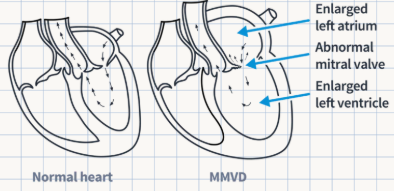
1. mitral valve degeneration (MVD)
2. endocardiosis
3. mitral valve regurgitation
4. mitral valve insufficiency
5. degenerative or chronic mitral valvular disease
6. left atrioventricular (AV) valve degeneration
Mitral Regurgitation
List the 6 alternative clinical names used interchangeably for Degenerative Myxomatous Mitral Valve Disease (MMVD):
Unknown
Mitral Regurgitation
What is the explicit, exact underlying primary cause of the mechanical thickening of the mitral valve in MMVD?
heart enlargement and reduced function.
Mitral Regurgitation
the chronic left-sided valvular thickening and resulting regurgitant blood flow eventually lead to what two global cardiac outcomes?
Hypertrophic Cardiomyopathy (HCM)
A heart condition where the left ventricle's muscles thicken, reducing blood capacity and pumping ability. The cause is not fully understood, but there may be a genetic link.
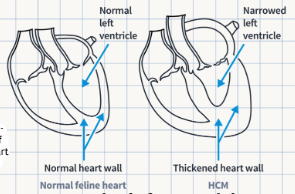
Hypertrophic Cardiomyopathy (HCM)
A heart condition characterized by thickening and distortion of the mitral valve tissue, leading to heart enlargement and reduced function.
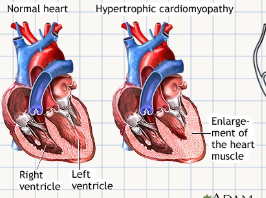
The heart compensates by beating faster, which adds stress and weakens it further.
Hypertrophic Cardiomyopathy (HCM)
How does the heart compensate when it reduces its blood capacity and pumping ability due to HCM?
Dilated Cardiomyopathy (DCM)
A heart condition where defects weaken and thin the heart muscles, directly hindering effective blood pumping.
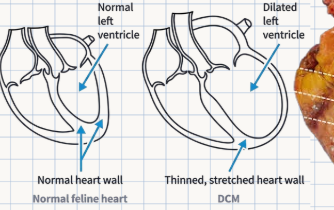
1. Heritable genetic mutations
2. Large breeds (in dogs)
3. Low in Taurine in cats
Dilated Cardiomyopathy (DCM)
List the 3 distinct primary causes or predisposing risk factors for DCM
arrhythmia (irregular heartbeat)
Dilated Cardiomyopathy (DCM)
Beyond reduced forward pumping ability, DCM significantly spikes the patient's clinical risk for what electrical cardiac disturbance?
Advances to congestive heart failure (CHF); causing fluid buildup in the lungs (pulmonary edema) or abdomen (ascites) due to poor heart function.
Dilated Cardiomyopathy (DCM)
As DCM progressively worsens, it advances into what clinical endpoint, and what are the two anatomical zones of fluid buildup?
Arrhythmogenic right ventricular cardiomyopathy (ARVC)
A heart condition that causes abnormal changes in the heart muscle, especially the right ventricle, leading to irregular heart rhythms or arrhythmias.
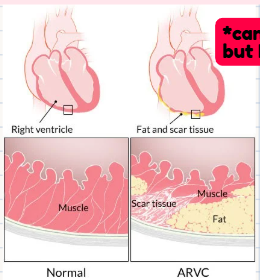
1. boxer cardiomyopathy
2. boxer ARVC
3. familial ventricular arrhythmia
Arrhythmogenic Right Ventricular Cardiomyopathy (ARVC)
List the 3 alternative names used clinically or historically to identify:
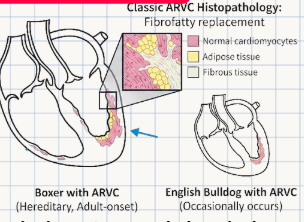
It is an inherited heart disease where fatty or fibrous tissue physically replaces normal heart muscle particularly in the right ventricle
Arrhythmogenic Right Ventricular Cardiomyopathy (ARVC)
Causes of ARVC
MOSTLY on the RIGHT (especially the right ventricle).
Arrhythmogenic Right Ventricular Cardiomyopathy (ARVC)
While ARVC can occasionally occur on the left side, it predominantly targets which specific cardiac region?
Arrhythmogenic right ventricular cardiomyopathy (ARVC)
Abnormal muscle tissue disrupts the heart’s normal electrical signals, causing an irregular heartbeat or arrhythmia.
Arrhythmogenic right ventricular cardiomyopathy (ARVC)
Abnormal muscle tissue disrupts the heart’s normal ________signals, causing an irregular heartbeat or _______.
Arrhythmogenic Right Ventricular Cardiomyopathy (ARVC)
Because the rhythm becomes abnormal, the heart pumps blood less effectively, which can lead to weakness, collapse, or sudden death
Arrhythmogenic Right Ventricular Cardiomyopathy (ARVC)
Because the rhythm becomes abnormal, the heart pumps blood less _______, which can lead to _______, collapse, or sudden ______
Heartworm disease
The pathophysiologic mechanisms involve migration of infectious larval stages and growth to adult worms in the pulmonary arteries
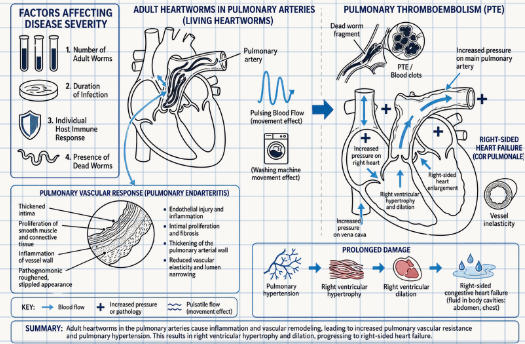
Dirofilaria immitis
Cause of Heartworm disease