Civ Pro II - Preclusion Doctrine
 Call Kai
 Learn
Learn Practice Test
 Spaced Repetition
 Match
Match Flashcards
 Knowt Play
1/16

There's no tags or description
Looks like no tags are added yet.
Name | Mastery | Learn | Test | Matching | Spaced | Call with Kai |
|---|
No analytics yet
Send a link to your students to track their progress
17 Terms
Claim preclusion (“Res judicata”) = Second suit on same ___ __ ___ is precluded
cause of action
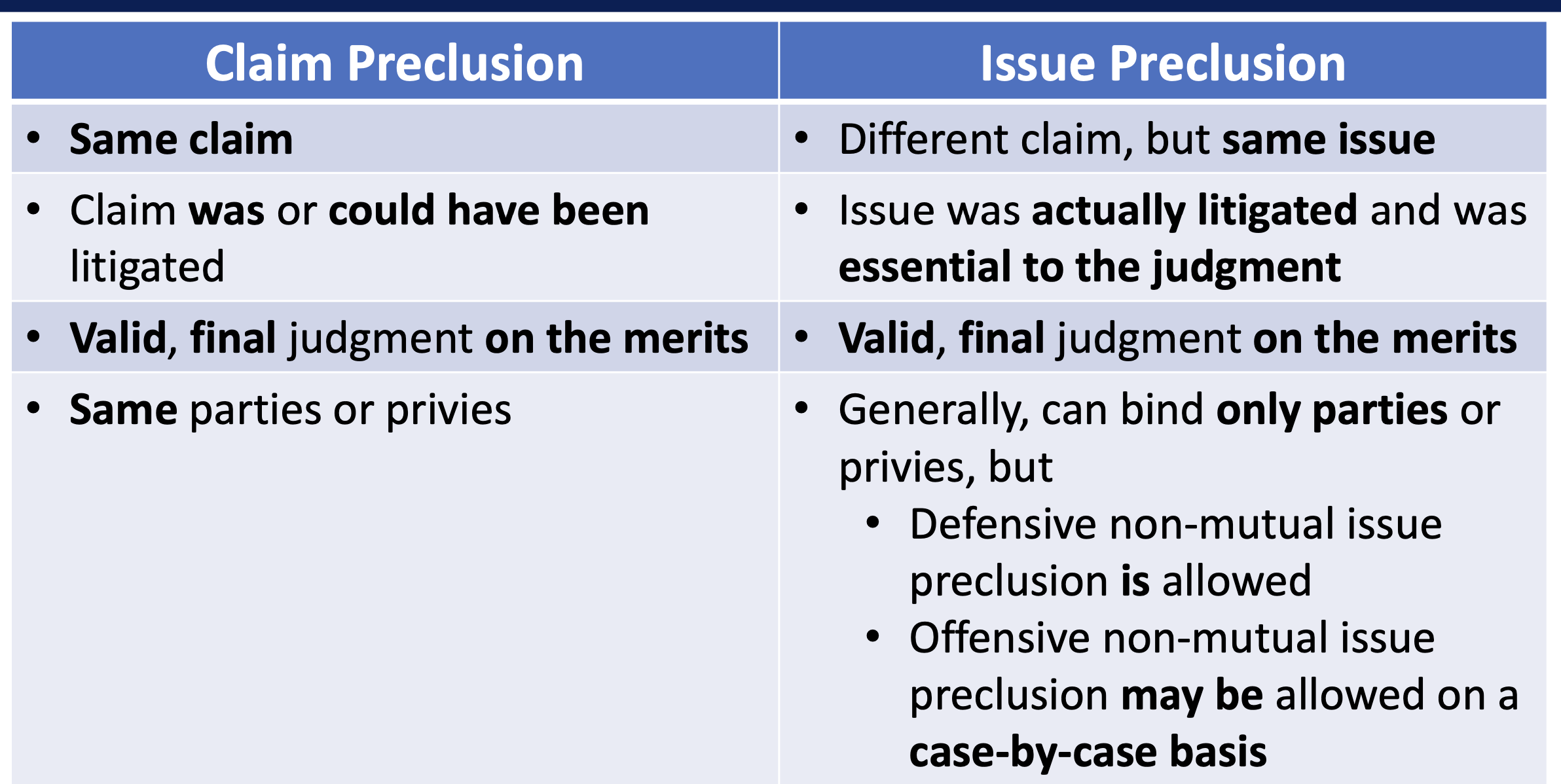
Claim preclusion elements:
• Same ___ (or “cause of action”)
• Same __ or __ in same configuration
• Valid, ___ ___ on the ___ in the first suit
claim, parties, privies, final judgment, merits
Precludes claims that
• Actually were ___ or
• ___ have been ___
litigated, Might, litigated
Claim Preclusion - Different Tests of Scope of Claim:
• Same legal ___ ___ (person and property)
• Same ___ act
• Same ___ or connected series of transactions (RESTATEMENT approach)
• Generally all existing claims under a single contract constitute one claim
primary rights, wrongful, transaction
Who can be bound by a prior judgment?
• ____ to the first suit are bound by it
• Also, persons who are in “___” with parties to the first case are bound
• There are due process limits on who can be bound
Parties
Non-parties who were in some way ___ ___ in the first case
Those in “privity”
parties, privity, adequately represented
Non-parties generally will not be bound by a prior judgment (unless an exception applies)
Parties generally must be in the same procedural posture
EXCEPTIONS:
• Non-party ___ to be bound
• “Pre-existing substantive legal relationship” between the parties
• Party to first case adequately ___ interests of non-party with the same interests
• Party bound in suit #2 ___ the first litigation
• The person to be bound in suit #2 is a proxy or agent of the party in suit #1
• Statutory schemes
agrees, represents, controlled
What is a Valid Judgment?
• First court had ___ and ___ ___ jurisdiction
What is a Final Judgment?
• Must be a judgment ___ of the case for plaintiff or defendant
• It cannot be an interim ruling
• What is the effect of a pending appeal in suit #1?
• In federal courts, a final judgment is final, even if an ___ is pending
personal, subject matter, disposing, appeal
What is a Judgment on the Merits?
“On the Merits” includes
A judgment after a __ ___
A ___ judgment
A judgment as a matter of ___
• In general, any judgment for the claimant is on the merits because it is establishing
liability
full trial, summary, law, liability
Claim Preclusion – Valid, Final Judgment on the Merits
Judgments for the defending party, under Fed. R. Civ. P. 41(b) are on the merits except for lack of ___, improper ___, or failure to join a ___ under Rule 1
Statute-of-___ dismissals do not bar litigation in another court system that applies a different statute of limitations
jurisdiction, venue, party, limitations
Issue preclusion (“collateral estoppel”) involves an __ __ in a second suit on a different __ __ __
identical issue, cause of action
Unlike claim preclusion, issue preclusion bars litigation only of matters __ __ in the prior suit
actually litigated
Issue Preclusion Elements:
Same ___ that was actually ___ in the first case
That decision was ___ to the ___ in the first case
First case was a __, final __ on the __,
Proper ___
Party ___ issue preclusion is proper, and
Party to be ___ is proper
issue, decided, essential, judgment, valid, judgment, merits, parties, asserting, bound
Mutuality requirement:
To use issue preclusion, a party must have been ___ to its use against the party had the fact-finding gone the other way
Two exceptions arose:
Narrow exception: suit against ___, then against employer
Broad exception: suit against ___, then against employee
subject, employee, employer
Offensive vs. Defensive:
Offensive:
• The party seeking to use issue preclusion is using it to ___ liability
Defensive:
• The party seeking to use issue preclusion is using it to ___ liability
establish, defeat
Defensive non-mutual issue preclusion
• When plaintiff had a full opportunity to present their claims against one defendant and ___ in Suit 1; Suit 2 is merely rehashing the ___ issue against a new ___
lost, same, defendant
Offensive non-mutual issue preclusion; two requirements:
Could the party seeking to use offensive non-mutual issue preclusion easily have ____ the first lawsuit?
Is it fair to the party against whom offensive non-mutual issue preclusion would be used?
Did defendant have an incentive to ___ fully in Suit 1?
Is there a risk of ___ ___?
Was defendant precluded from fully defending Suit 1?
joined, litigate, inconsistent judgments