GCSE Chemistry- Y10 EOY
 Call Kai
 Learn
Learn Practice Test
 Spaced Repetition
 Match
Match Flashcards
 Knowt Play
1/445

There's no tags or description
Looks like no tags are added yet.
Name | Mastery | Learn | Test | Matching | Spaced | Call with Kai |
|---|
No analytics yet
Send a link to your students to track their progress
446 Terms
Methyl Orange colour in acids
Red
Methyl Orange colour in Neutral
Orange
Methyl Orange Colour in Alkalis
Yellow
Phenolphthalein colour in Acidic
colourless
Phenolphthalein colour in neutral
colourless
Phenolphthalein colour in Alkalis
Pink
Acid
A substance with pH lower than 7 and produces H+ ions when dissolved in water.
Base
A substance with pH greater than 7
Alkali
A soluble base that releases OH- ions in solution
Indicator
Any substance that changed colour when it is added to acidic or alkaline solutions
Neutral
A solution with a pH of 7
How can pH be measured?
Using an indicator, pH meter or pH probe
What is the ionic equation of neutralisation?
H + OH = H20
Acid + Alkali =
Salt + Water
Acid + Metal =
Salt + Hydrogen
Acid + Metal Oxide =
Salt + Water
Acid + Metal Carbonate =
Salt + Water + Carbon Dioxide
Formula for Hydrochloric Acid
HCl
Formula for Sulfuric Acid
H2SO4
Formula for Nitric Acid
HNO3
Formula for Carbonic Acid
H2CO3
Formula for Phosphoric Acid
H3PO4
Salt derived from hydrochloric acid
Chloride
Salt derived from Sulfuric Acid
Sulfate
Salt derived from Nitric Acid
Nitrates
Salt derived from carbonic acid
carbonate
Salt derived from phosphoric acid
phosphate
Forming soluble salts from an insoluble base
gently warm dilute acid using a bunsen burner
add the insoluble base in excess to the acid until no more reacts
filter out the excess solid that hasn’t reacted
gently evaporate the solution using a water bath or bunsen burner to get pure crystals
Crystallisation
Heating a salt solution to evaporate, water, leaving behind pure salt crystals
What state symbol do acids always have?
Aqueous
Strong Acids
Completely ionised in solution, meaning that all the acid particles dissociate to release H+ ions into solution.
Weak Acids
Do not fully ionise in solution, meaning only a small proportion dissociate to release H+ ions
What does an acid’s STRENGTH tell you?
What proportion of the acid molecules ionise in water
What does an acid’s CONCENTRATION tell you?
How much acid there is in a certain volume of water
What would happen to the pH of an acid if it was mixed with water?
increase
What would happen to the pH of an acidic solution when more acid is added?
decrease
What does aqueous mean?
Dissolved in water
How many electrons do group 1 elements have in their outer shell?
1
What are group 1 metals also known as?
Alkali Metals
Relative Mass of Proton
1
Relative Mass of Neutron
1
Relative mass of election
very small
Relative charge of proton
+1
Relative charge of neutron
0
Relative charge of Electron
-1
How many electrons can the innermost shell of an atom hold?
2
How many electrons can the second and third shells of the electron hold?
8 per shell (16 in total)
On which side of the periodic table are metals found?
Left
On which side of the periodic table are non-metals found?
right
How were elements arranged in the periodic table in the 1800s?
By mass number.
Why did elements used to be ordered by mass number?
scientist had no idea of atomic structure
the term ‘atomic number’ didn’t even exist
What changes did Dmitri Mendeleev make to the periodic table?
He sorted elements into groups based on their properties
He realised that if he put elements in order of atomic mass, elements with similar chemical properties fell into columns
A few elements, however, ended up in the wrong columns
What did Mendeleev do when elements didn’t fit the pattern?
switched the order of the elements so they did
left gaps for undiscovered elements
How were elements arranged once protons and electrons were discovered?
In order of atomic number
State one difference between Mendeleev’s periodic table and the modern periodic table.
Noble gases were not present in Mendeleev’s periodic table, and several other gaps were left for undiscovered elements.
Johann Dobereiner put the elements lithium, sodium and potassium in a Triad because they have similar chemical properties. Use ideas about electron arrangement to explain this.
Lithium, sodium and potassium all have the same number of electrons in their outer shell.
Many chemists suggested different patterns for the elements while using the same data. Suggest why these chemists could not agree.
the same data can be interpreted in different ways
they were reluctant to say their ideas were wrong
Mendeleev placed copper in group 1 of his periodic table. It is now a transition metal. Explain why copper should not be in group 1.
copper doesn’t have similar properties to other group 1 metals
copper is unreactive unlike group 1 metals.
What does atomic number tell us about an element?
The number of protons/electrons in an atom
What does the mass number tell us about an element?
The number of protons and neutrons in an atom.
Why are group 1 metals considered to be highly reactive?
there is only one electron in the outer shell
readily loses this electron to obtain a full outer shell
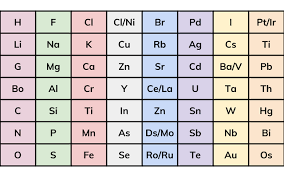
Suggest reasons why Newland’s periodic table was not accepted by most chemists in 1866
some boxes contain two elements
groups contain elements with different properties
Newlands was not a well-known scientist
What type of ions do group 1 metals form?
1+
Properties of group 1 metals
low density (floats on water)
soft (can be cut with a knife)
low MP and BP (< 200)
reactivity increases as you descend the group
Why does reactivity increase as you descend group 1?
Atoms get larger and have more shells
therefore less energy is required to remove the outer electron
What type of substance is a metal hydroxide?
Alkaline
What happens to reactions with water as you descend group 1?
They become more violent and vigorous
Why are group 1 metals referred to as alkali metals?
They form metal hydroxides when they react with water
What group are halogens?
group 7
What type of molecule are all halogens?
diatomic molecules
What colour and state is fluorine?
A (highly reactive) yellow gas
What colour and state is chlorine?
(poisonous) green gas
What colour and state is bromine?
(poisonous) red-brown liquid (which gives off an orange vapour)
What colour and state is iodine?
A grey solid (which gives off a purple vapour)
What increases as you descend group 7?
Melting and Boiling points
What ions do group 7 elements form?
1-
What can more reactive halogens do to less reactive ones?
More reactive halogens can displace less reactive halogens from their compounds
What group are noble gases?
Group 0
Which is the only group 0 element that does not have 8 electrons in its outer shell?
Helium
Reactivity of noble gases
They are highly unreactive as they have a full outer shell.
Properties of noble gases
colourless gases at room temperature
monoatomic (gases are made up of single atoms)
inert
last gases to be discovered
Use of Argon and why
Used in filament lamps
because it is non-flammable and stops the filament from burning away
Use of helium and why
airships and party balloons
low density, non-flammable, unreactive
How can argon and helium protect metals that are being welded?
Their inertness stops the hot metal reacting with oxygen
What increases as you descend group 0?
Boiling point, melting point and density
Why does BP, MP and density increase as you descend group 0?
The number of electrons increases, which leads to greater intermolecular forces that need to be overcome.
Properties of non-metals
brittle, dull, soft
low melting point, good insulator
Properties of metals
hard, shiny, malleable
high melting point, good conductor
Why is gold used in jewellery?
It is shiny and malleable
Why is gold used in electrical components?
It is a good electrical conductor and corrosion resistant
Why is copper used for water pipes?
Because it is malleable and corrosion resistant.
Why is copper used for electrical wiring?
Because it is a good conductor
Similarities between transition metals and group 1 metals
conductors in solid and liquid states
shiny when freshly cut
Differences between transition metals and group 1 metals
transition metals have higher melting points
transition metals have higher densities
transition metals have greater strength
transition metals have greater hardness
What temperature does mercury melt at, and therefore what state is it at room temperature?
- 39C, therefore it is a liquid at room temperature
How are metals above carbon extracted from their ore?
via electrolysis
How are metals below carbon extracted from their ore?
via carbon reduction in a blast furnace
Why is carbon included in the reactivity series?
To show how a metal is extracted from its ore
Why is Hydrogen included in the reactivity series?
To show the reactivity of metals with dilute acid
Equation for oxidation
Metal + Oxygen → Metal Oxide