CS.1 - Amazon Rainforest
 Call Kai
 Learn
Learn Practice Test
 Spaced Repetition
 Match
Match Flashcards
 Knowt Play
1/52

There's no tags or description
Looks like no tags are added yet.
Name | Mastery | Learn | Test | Matching | Spaced | Call with Kai |
|---|
No analytics yet
Send a link to your students to track their progress
53 Terms
What size area does the Amazon rainforest occupy?
Over 60 million km²
What percent of the rainforest is in Brazil, and what other countries?
70% in Brazil, but also extends into parts of neighbouring Peru, Ecuador etc.
Introduce the Amazon:
The Amazon rainforest in South America occupies more than 6 million km², with 70% being in Brazil and the rest in neighbouring countries such as Peru and Ecuador, and is dominated by tall, evergreen hardwood trees.
What is the average annual temp?
25 - 30°C
What is the average annual rainfall?
Over 2000mm per year, with no dry season
What percentage of precipitation is recycled by evapotranspiration?
50-60% of precipitation is recycled by evapotranspiration
What percentage of rainfall is intercepted by forest trees?
around 10% is intercepted by forest trees
What type of rainfall is it?
High-intensity, convectional rainfall
How many GT/year of water is precipitated
13.8GT of water each year precipitated
How many GT per year of water is evaporated?
7.2GT evaporated per year
How many GT of water per year flow in from the Atlantic Ocean
8-10GT flow in per year from the Atlantic Ocean
How many GT of water per year lost to the atmosphere of other regions?
3.5GT lost to the atmosphere of other regions
How many GT water per year are lost as river flow to the Atlantic Ocean
5.5GT water lost as river flow
Why are there high rates of evapotranspiration?
High temperatures
Abundant moisture
Dense vegetation
What is the NPP of the Amazon rainforest?
Averaging 2500 grams/m²/year
What is Net Primary Productivity
The amount of carbon retained in an ecosystem
The difference between the amount of carbon produced through photosynthesis and the amount of energy used for respiration
What is the average biomass of the AZ?
400-700 tonnes/ha
How much carbon stored in the above-ground biomass of a tree?
180 tonnes
How much carbon stored in the below-ground biomass (just biomass) of a tree
64 tonnes
How much carbon stored below-ground in soil and biomass?
226
What is the total annual carbon absorption by photosynthesis of a tree?
30.4 tonnes per year
What is the total annual carbon emission by respiration
24.5 tonnes/year
Draw the tree diagram
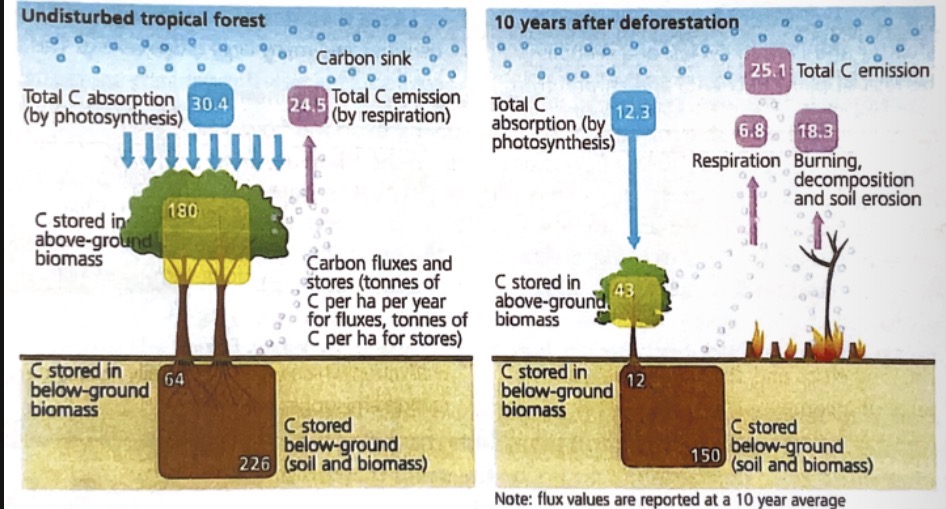
Name the physical factors that affect the flows and stores in the water cycle
Temperature
Rock permeability
Porosity
Relief
What is rock permeability
Rock permeability is their ability to allow fluids to flow into/through it
What is the impact of rock permeability on the water cycle of the AZ?
Much of the amazonian basin is ancient shield such as igneous and metamorphic
Comprising impermeable rocks
Minimal water storage capacity → rapid runoff
What is rock porosity
A measure of the void spaces (e.g. pores) within a rock or sediment that allow the rock to hold fluid
What is the impact of rock porosity on the water cycle in the AZ?
A very small amount of the rocks are porous limestone and sandstone. These can store rainwater and slow runoff
A bit of the rock in the Amazon basin is carboniferous limestone
Allows infiltration, percolation, water can be stored
More throughflow and groundwater flow, which are slower methods of water transfer
What is the impact of relief on the amazon basin?
Much of the Amazon basin is a lowland environment
In this gentle relief, water can infiltrate more easily, allowing horizontal movement through the soil (throughflow) and only slow overland flow
Some areas are so flat and extensive (floodplain areas of the major rivers) that they are classed as wetlands
e.g. the Pantanal - the largest wetland ecosystem in the world
These areas store water for months on end
The AZ extends into the foothills of the Andes mountains to the West, and here the relief is much steeper
Runoff via overland flow is very rapid
What is the impact of temperature on the AZ water cycle?
High temps → frequent and intense convectional rainfall
High rates of evapotranspiration then recycle water
Water constantly being moved between the surface, soil, trees and atmosphere by uptake, evaporation, transpiration and precipitation
Name the 4 physical factors that impact the carbon cycle in the AZ?
Temperature
Vegetation
Organic matter in soil
Mineral composition of rocks
How does temperature impact the carbon cycle in the AZ?
High temps → high rainfall → high biomass totals
Allows the biome to become a vast carbon store
Higher temperatures also leads to faster decomposition
How does vegetation impact the carbon cycle in the AZ?
Acts as both a store and sink
Carbon transferred via processes like photosynthesis, connecting the rainforest carbon store to the atmospheric carbon store
How does organic matter in soil impact the carbon cycle in the AZ?
The rainforest soils are home to some of the most efficient decomposers (bacteria, fungi) in the world
High temps + high humidity → rapid decomposition
Consequently, nutrients are released to the soil very quickly, for immediate uptake by tree root systems
This carbon cycle releases CO2 back into the atmosphere
How does mineral composition of rocks impact the carbon cycle in the AZ?
Generally, the rocks of this ancient shield are igneous and metamorphic
No significant impact on the carbon cycle (few carbonate rocks)
However, the western Amazon is the exception
outcrops of limestone store carbon, contributing to the slow carbon cycle
Introduce the Madeira drainage basin
The Madeira drainage basin is the largest tributary basin of the Amazon river, covering approximately 1.42 million km² across Brazil, Bolivia, and Peru.
The Madeira drainage basin contributes _ of the Amazon’s water volume
Contributes 15% of the Amazon’s water volume
What 3 land use changes impact the carbon and water cycle in the AZ?
Forestry - The art and science of managing forests so as to yield, on a continuous basis, a maximum in quality and quantity of forest products
Farming - The practice of cultivating plants and animals for human use
Urbanisation - Converting land from a rural use (farmland and woodland) to urban use (housing/roads)
What are the impacts of forestry on the water cycle?
More trees → more interception → slow down water cycle through forest area → reduce flood risk
Longer lag times, lower peak flow and total discharge in plantation areas
Evaporation increases: leaves store water → evaporates directly back to atmosphere
Run off and stream discharge reduced
Higher transpiration (where plants absorb water through roots and release it as water vapour through tiny pores called stomata on their leaves)
What are the impacts of forestry on the carbon cycle?
Changing land use to forest increases carbon stores
Forest trees extract CO2 from the atmosphere and sequester it for hundreds of years
But they are only an active carbon sink for the first 100 years
So plantations usually have a rotation of 80-100 years
What are the impacts of farming on the carbon cycle?
Irrigation diverts water from rivers and groundwater supplies to land
So some water used by plants then transpirated instead of going back to sea
Ploughing increases soil moisture loss and can lead to increased run-off and heavy erosion
Use of heavy machinery can compact the soil → increased runoff
Animals eat vegetation and remove it
What are the impacts of farming on the carbon cycle?
Clearance of forest for farming reduces above and below ground carbon stores (biomass)
less photosynthesis
Ploughing reduces soil carbon storage and exposes soil organic matter to oxidation
Harvesting = only small amounts of organic matter returned to the soil
Rice paddies emit ~60 million metric tons of methane per year
Livestock release methane
Increased CO2 from farm machinery emissions
What are the impacts of urbanisation on the water cycle?
Increased surface runoff after deforestation
Approximate 50% decrease in evapotranspiration
Fall in water table as less interception, rain hits the ground faster, less time to infiltrate, surface runoff faster
How much does surface runoff increase after deforestation?
From 1% to 20-30%
Urban areas are responsible for _ of global energy-related CO2 emissions
Over 70% of global energy-related CO2 emissions
What is afforestation?
Planting trees in deforested areas / areas that have never been forested.
This aims to increase carbon sequestration and reduce flood risk
What are the benefits of afforestation?
Trees are excellent carbon stores
Applicable at a variety of scales - any scale you like
Usually has indirect benefits too - e.g. biodiversity and jobs
Woeks in poorer countries
What are the disadvantages of afforestation?
Time consuming
Labour intensive
Time lag
Effectiveness of trees as carbon stores decreases over 100 years
What is the REDD scheme?
In 2009, the Suruí people in the Brazilian Amazon joined the UN’s REDD scheme
The UN pay the Suruí to protect the rainforest and stop logging with carbon credits
in 2013 the cosmetics TNC Natura purchased 120,000 tonnes of carbon credits from the Suruí
Name 3 types of improving agricultural practices / reducing unsustainable practices
Land/crop management
Livestock management
Manure management
What are some methods of land/crop management
Growing crops without ploughing first
Conserves soil’s organic content and reduces risk of erosion
Growing crops interspersed with trees (polyculture)
Tree roots bind the soil, improve moisture content and reduce erosion
Problem: you need space, and then can’t use machinery
Terracing slopes to increase infiltration and reduce runoff
From slope → stairs, so water enters the flat bit of the stairs better
Not using heavy machinery on wet soil as this compacts it further → increases surface runoff
Growing different strains of rice (GMO) that grow in drier conditions
However people that eat rice all day will have a very specific, likely non-GMO, taste preference
What is a method of livestock management?
Improving the quality of animal feed
Increases digestibility
→ Ruminant animals like cows produce less methane
What is a method of manure management
Manure can be stored in anaerobic containers so that methane can be captured as a source of renewable energy instead of being emitted to the atmosphere