L8a the executive brain
 Call Kai
 Learn
Learn Practice Test
 Spaced Repetition
 Match
Match Flashcards
 Knowt Play
1/96

There's no tags or description
Looks like no tags are added yet.
Name | Mastery | Learn | Test | Matching | Spaced | Call with Kai |
|---|
No analytics yet
Send a link to your students to track their progress
97 Terms
What is termed the brain’s ‘conductor’
executive functions
What are executive functions
control processes that enable an individual to optimise performance
What is required to perform executive functions
coordination of basic cognitive processes
What makes executive functions distinct from other cognitive processes
not tied to a specific cognitive domain such as memory or language
Are executive functions supervisory and controlled functions or receptive and uncontrolled functions
supervisory, controlled functions
Name the 4 main categories of executive functions
problem solving, overcoming habitual responses, task-switching and multitasking
What brain region are executive functions most associated with (PFC)
prefrontal cortex
Which 2 PFC subregion are associated with problem solving?
Dorsolateral PFC and ventrolateral PFC
Which PFC subregion is associated with task-switching?
Orbitofrontal/ventromedial PFC
Which 2 PFC subregion are associated with overcoming habitual responses?
Pre-SMA and anterior cingulate cortex (ACC)
Which PFC subregion is associated with multi-tasking?
Polar PFC
What is fluid intelligence (Gf) vs crystallised intelligence (Gc), according to Cattell
the ability to reason and solve novel problems vs knowledge accumulated from culture and education
Where does Gf originate from
Spearman’s general intelligence factor g
What do tests assessing fluid intelligence aim to minimise
cultural and educational influences
Two tests of fluid intelligence
Raven’s Progressive Matrices and Cattell’s Culture Fair Intelligence Test
What kind of test is Raven’s Progressive Matrices
non-verbal reasoning test
What does a non-verbal reasoning test involve
participates identify the missing piece in a pattern or sequence
What knowledge/skill does Raven’s Progressive Matrices rely on to assess fluid intelligence
abstract pattern recognition rather than language/learned knowledge
What does Cattell’s Cultural Fair intelligence Test involve
series completion, classifications, matrices, all using abstract shapes and patterns
What is the Multiple Demand (MD) system (set of which brain regions, 3 tasks, regardless of what?)
a set of frontal and parietal brain regions consistently recruited during complex, novel, and sequential tasks, regardless of cognitive domain
For what 4 kinds of tasks is the MD system recruited for
attention, cognitive control, multi-step problem solving, comparing hard vs easy tasks
What does the MD system explain about cognitive tasks and brain regions
why they active overlapping PFC-parietal regions
What ability does the MD system provide a neural basis for
general problem-solving ability through flexible allocation of processing
What are two types of evidence supporting the MD systems in non-human primates and in humans
electrophysiology and fMRI
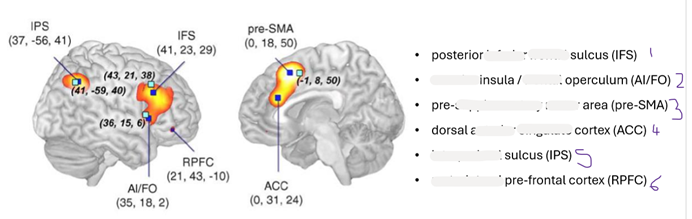
These are the six key brain regions of the MD system – name 1 to 6
posterior inferior frontral sulcus (IFS), anterior insula/frontal operculum (AI/FO), pre-supplementary motor area (pre-SMA), dorsal anterior cingulate cortex (ACC), intraparietal sulcus (IPS), rostrolaterial pre-frontal cortex (RPFC)
Fedorenko et al used fMRI with individual-subject functional localisation instead of group-level analyses – why is this?
to avoid artificial inflating overlap in brain areas due to variability in brain structure
Two aims of Fedorenko et al’s approach was to located the MD in each individual and tap into the MD system – how was each aim achieved
by using one localiser contrast (to locate MD) and test responses to 7 diverse demanding tasks (tap into MD system)
What was a key task design and why was this done
hard vs easy conditions to isolate cognitive demand

Complete the main finding of Fedorenko et al – the first two responses are cortex areas, the second set of responses is the difficulty of the task (think which task MD becomes more active for) and the last response is what this suggests about the MD
frontal, parietal, hard, easy, domain-generality
Why does this individual-level evidence strengthen existence of a real MD system (consider previous issues with group-level analyses)
demonstrates that overlap is true and exists within individuals (not artificial)
Define the principle of problem solving (experimental)
giving a participant an end-point (goal) and a starting point in which they must generate a solution of their own (also known as task-setting)
What is an example problem solving test
tower tests
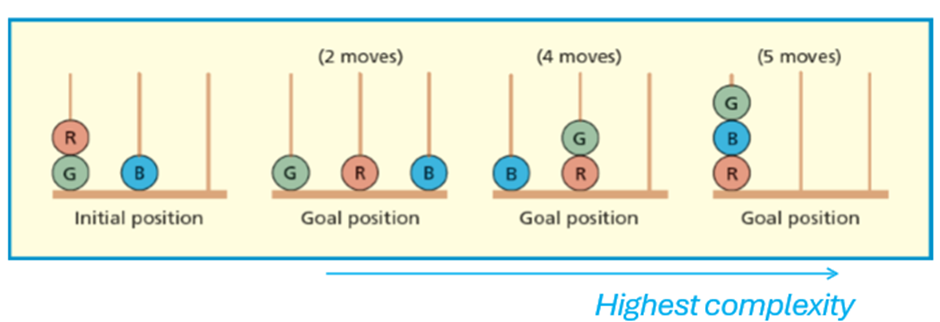
Ruocco et al wanted to study trait deliberation (tendency to think carefully before acting) using an adapted tower test – what was this adaptation and what neuroscience method was used
just answer yes or no, don’t need to do the task. Used fNIRS
What area of the PFC was activate when solving problems
left dorsolateral PFC
How did trait deliberation influence this activation
activation was higher in individuals with high trait deliberation
What two concepts explain/are related to habitual responses
response inhibition and impulsivity
What are two tests of overcoming habitual responses (we’ve looked at these plenty, think back to authoritarianism in personality module)
stroop test and go/no-go test
What are the two behavioural outcomes in the Stroop task that reflect inhibition failure?
Slower reaction times and increased errors.
What did Alexander et al use to relate lesion location to reaction times to stroop task in patients with frontal lesions vs healthy controls
fMRI
Lesions in which three brain areas are associated with slow reaction time and decreased correct responses to Stroop test, suggesting their role in inhibiting habitual responses
ACC, pre-SMA, and dorsolateral areas
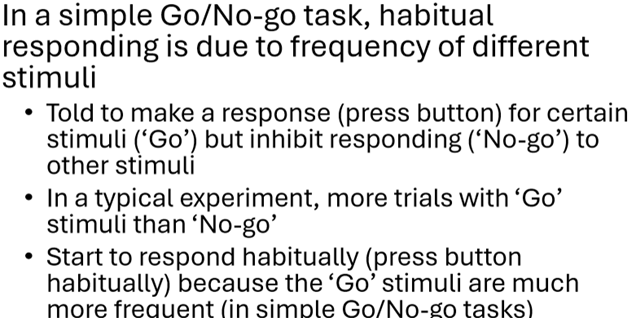
This is the Go/No-Go task, what 2 things does it seek to measure with errors on no-go trials (explored previously)
response inhibition and impulsivity
Picton et al tested response inhibition and impulsivity (false alarms) in healthy controls vs patients with frontal lesions – what 3 lesion locations specifically within the superior medial frontal lobe were associated with more false alarms
ACC, pre-SMA and dorsomedial PFC
Recall the 3 common lesion areas found in the Stroop test and go/no-go test
dorsolateral PFC, pre-SMA and ACC
Recall the 3 common impairments found in the Stroop test and go/no-go test
slower reaction times, more false alarms, and more errors
Of the 3 common lesion areas, which is associated with problem solving (think back to tower tests brain activation)
dorsolateral PFC
Of the 3 common lesion areas, which is associated with response inhibition
pre-SMA
What is the status of the role of ACC
remains debated but possible evidence for its role in error detection
How do humans and non-human primates behave after making an error and what 2 things does this reflect
slower and more accurate, error detection and compensation
How did monkeys with ACC lesions behave after making an error
weren’t slower or more accurate
Gehring et al investigated error-related negativity – what is this?
an event-related potential component in EEG detected when an error is made
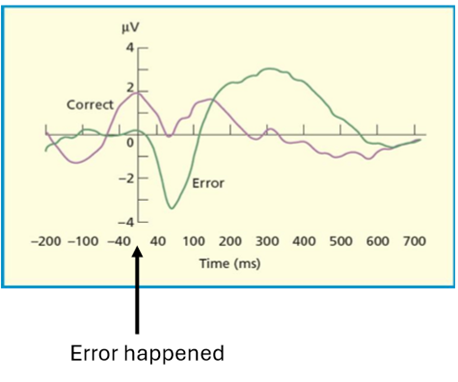
What occurs in the EEG signal when an error happened
large negative deflection
What brain area does this ERP component appear to originate in (supporting earlier debates)
ACC
ACC might then be active during error detection but which brain region is responsible for the change in behaviour (being more accurate) – we know the answer already
PFC
So there is agreement that the ACC is part of an error prevention network but what are the two competing theories for its role (different executive functions)
strategic control vs evaluation
What is the aim of strategic control processes
to reduce response conflict in top-down manner
What is the aim of evaluative processes
to detect response conflict
Wolpe et al using a single-case lesion study, comparing a 74-year old patient with a focal pre-SMA lesion to a 52 health age-matched controls – what task did they perform and what did it require
stop-signal task (part of go/no-go task) requiring participants to stop a potentially already-initiated action when a stop signal appears
Two reaction times were measured for this study – what were these two RT
stop-signal RT and go RT
Wolpe et al also used the Drift Diffusion Modelling, which estimates what 3 parameters
threshold, drift rate and non-decision time
What does threshold measure, and what does high vs low scores signal
how much evidence is needed before acting, high signals caution while low signals impulsive
What does drift rate measure
how quickly evidence accumulates towards a decision boundary
What does non-decision time measure (2 things)
stimulus encoding (time needed to perceive the stimulus) + motor output (time to execute the final motor response)
Did patient should low or high decision threshold in this study
abnormally low
What differences existed between drift rate and non-decision time, if any?
no differences
What can be interpreted from lower threshold (3 subsequent impacts on behaviour/actions)
faster action initiation (requiring less evidence) -> harder to inhibit actions -> causes more error/stopping failures
What conclusion can be drawn about the role of the pre-SMA’s function due to this patient’s behaviour (who has a pre-SMA lesion)
dynamic threshold modulation – mechanism for controlling voluntary action and contributing the MD system
What should the pre-SMA normally do to modulate the decision threshold
increase the decision threshold when stopping might be required
What is task-switching (set-shifting)
discarding a previous scheme and establishing a new one
What is perseveration and how does it relate to task-switching
failure to shift away from a previous response - a behavioural consequence of impaired task-switching
How does the Wisconsin Card Sorting Test (WCST) test task-switching
participants match cards to 1 of 4 cards varying in shape, number, and colour but the sorting rule changes without explicit instruction so participants have to infer the new rule from feedback
What is the “switch cost” in the WCST and what does it reflect
significant slowing of reaction time on switch trails relative to no-switch trials, reflecting the cognitive cost of discarding a previous schema and setting up a new one
Which brain region is the switch cost in the WCST related to – think about what the task requires (maybe problem solving)
left dorsolateral PFC
The Iowa Gambling Task also tests task-switching by giving participants an option of 4 decks of cards with different long-term returns. Decks A+B are initially rewarding but become costly while decks C+D become advantageous – what are participants required to do in this task
switch away from bad decks to good decks
Individuals with a lesion – in which brain area – failed to switch from bad decks to good decks across the task, compared to healthy controls (slightly different to WCST)
ventromedial PFC
What is odd about these individuals with ventromedial PFC lesions – behaviour in other tasks
show intact performance on other tests of executive function like Stroop and WCST
Executive function control processes can be divided into ‘hot’ and ‘cold’ – explain this distinction
‘hot’ refers to stimuli related to reward (food, money) while ‘cold’ refers to cognitive stimuli
Task-switching (WCST) and reversal learning (Iowa test) are related to which control processes
cold and hot, respectively

What double dissociation did Dias et al demonstrate in marmoset monkeys with hot and cold control processes – brain area impaired for which tasks
task-switching, reversal learning
What was Roca et al’s central question about frontal executive deficits
whether they are truly distinct impairments or explained by general fluid intelligence (g)
Were classic executive tests like WCST, Verbal Fluency, and Iowa Gambling Task explained by g or not
were fully explained by g, thus they don’t measure unique executive processes but general intelligence
Go/No-go task was one of many tasks that showed remaining deficits even after adjusting for g – what does this indicate about what they require
require specific executive abilities not reducible to g – an executive function distinct from fluid intelligence
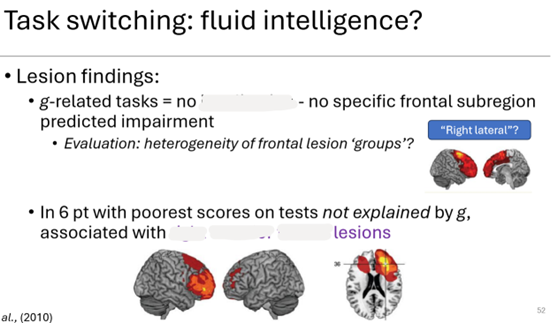
Complete Roca et al’s findings
localisation, right anterior frontal
So fluid intelligence (g) can explain the performance on several classic executive tests – what idea does this challenge and propose instead
that all executive function tests measure distinct functions and instead many reflect general problem-solving ability
How does multi-tasking differ from task-switching
in task-switching, one goal is substituted for another whereas in multi-tasking, several goals are maintained simultaneously
What is prospective memory
the ability to realise an intention after a delay (related to multi-tasking because it requires maintaining future goals in mind while engaged in an ongoing task
Volle et al tested patients with right polar PFC lesions and other lesions (as well as healthy controls) at a prospective memory task – what two deficits did they find for right polar PFC lesions
time-based prospective memory tasks and using prospective memory for tasks
What two tasks were impaired when attempting to use prospective memory
estimating long time durations and/or the self-retrieval of one’s intention to act (both of which are important for multi-tasking)
We saw earlier that some executive tests which were not explained by g, were associated with right anterior frontal lesions – what does this new information contribute to this previous knowledge
that those unexplained tests required multi-tasking
Koechlin and Summerfield proposed a hierarchically ordered executive system – what is this system
poster to anterior gradient for simple to complex tasks
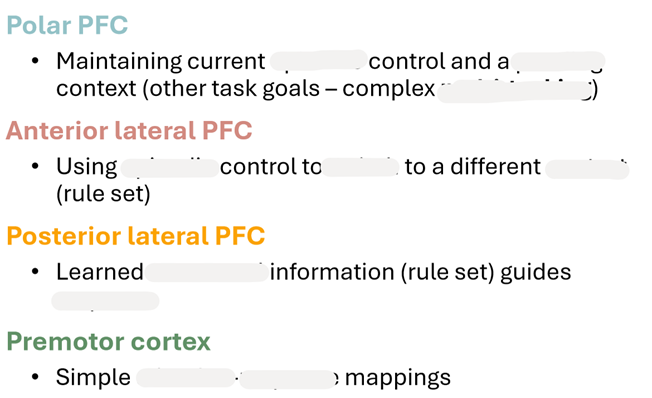
Complete the function of each brain area
episodic, pending, multi-tasking, episodic, switch, context, contextual, response, stimulus-response
What does a modular organisation of executive functions predict
that distinct, non-overlapping brain regions each support specific executive functions
What does a distributed organisation of executive functions predict
that executive functions emerge from flexible, overlapping networks (general intellectual ability)
What does lesion evidence vs neuroimaging evidence suggest about the modular vs distributed brain debate
supports specialisation vs supports flexibility and overlap
How might task complexity confound this debate
simple tasks may engage focal regions while complex tasks engage distributed networks
What is the overall conclusion of this lecture on executive functions
they are domain-general control processes with neural correlates in PFC (and multiple demand system?)
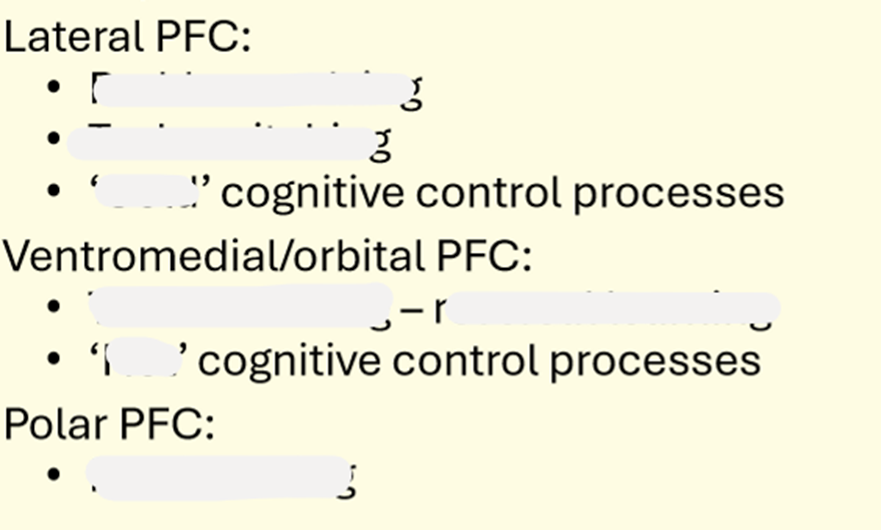
complete the overall conclusions for the different brain areas (executive function and hot/cold)
problem-solving, task-switching, cold, task-switching, reversal learning, hot, multi-tasking
What is the MD system proposed to be the neural basis for
fluid intelligence