Edexcel GCSE Psychology (Memory)
 Call Kai
 Learn
Learn Practice Test
 Spaced Repetition
 Match
Match Flashcards
 Knowt Play
1/39

There's no tags or description
Looks like no tags are added yet.
Name | Mastery | Learn | Test | Matching | Spaced | Call with Kai |
|---|
No analytics yet
Send a link to your students to track their progress
40 Terms
What does input mean?
For human memory, this refers to the sensory information we recieve from our enviroment.
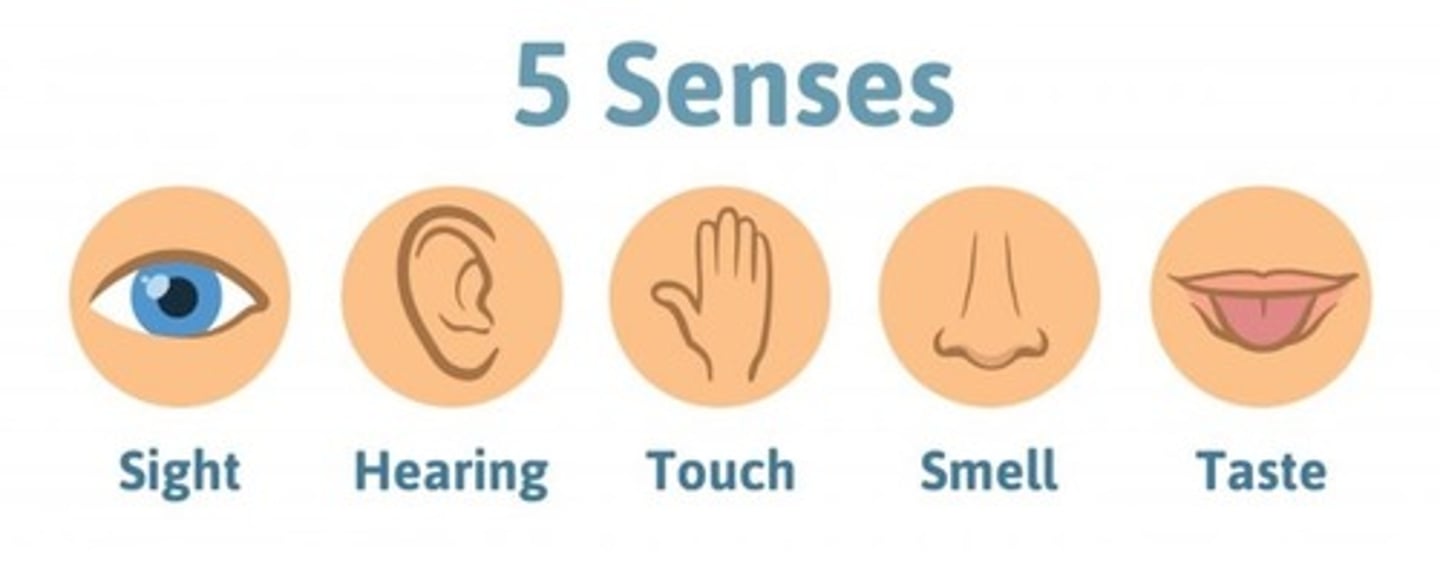
What are the 5 main input senses for humans?
• Sight
• Smell
• Touch
• Hearing
• Taste
What does output mean?
The behavioural response from an input.
An example being, a person remembering a name and then saying it.
What does encoding mean?
Turning sensory information into a form that can be used and stored by the brain.
What are the 3 ways information can be encoded into our memory system?
• Acoustic encoding - holding sound information.
• Visual encoding - holding images.
• Semantic encoding - holding the meaning of information.
What does storage mean?
The retention of information in our memory system.
What is retrieval?
The recall of stored memories.
What is short term memory?
Initial memory that is temporary and limited. It lasts for around 18 seconds and is generally encoded acoustically.
What is long term memory?
Memory that holds limitless amounts of information from a few minutes up to a lifetime, largely encoded semantically, but also visual and acoustic.
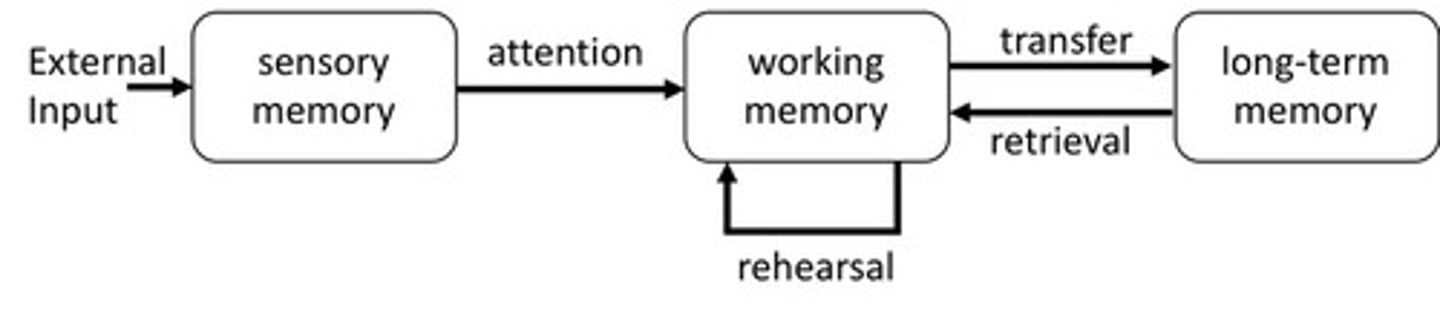
What does the multi-store model of memory show?
The three separate memory stores and how memories are transferred between each store.
How is a short term memory encoded into a long term memory store?
By rehearsal
What is rehearsal?
Repeating information over and over again to make it stick.
What were the aims to Peterson and Peterson’s experiment?
To test the true duration of short-term memory.
How many participants were in Peterson and Peterson's experiment?
24 students
What was the procedure of Peterson and Peterson’s short term memory experiment?
• The participant was asked to repeat out loud a set of letters. These letters were 3 consonants (a trigram)
• Immediately after, the participants were given a 3-digit number, where they then had to count backwards from that number in either 3’s or 4’s.
• When signalled by a red light, each student was asked to recall the trigram.
• Each student repeated this with a different trigram, they did it with the time delays increasing by 3 seconds each time. A total of 8 times.
• A second experiment was then conducted, allowing participants to rehearse the trigram before counting.
What were the findings of Peterson and Peterson’s experiment?
• They founded that the longer the participants had to count backwards, the less able they were to accurately recall the trigram. After 3 seconds 80% could recall the trigram but after 18 seconds only 10% could recall the trigram.
• In the second experiment, they found that the extra time increase the frequency to recall because the participants could rehearse for a bit longer.
What did Peterson and Peterson conclude from their experiment?
They concluded that information held in the short term memory fades rapidly and that only 10% could be recalled after 18 seconds.
What did Sir Fredric Bartlett propose about reconstructive memory?
Our memories are just notes and outlines about what we experience, when we come to recall memories, we elaborate on the mental notes taken by applying our general knowledge (schemas) to explain the memory.
What is active reconstruction?
When a memory is not an exact copy of what we experience. Instead it's an interpretation or reconstruction of notes and schemas together to retrieve the memory.
Why do people tell different different versions of stories?
Active reconstruction happens and because different people have different schemas, they have different versions of events.
What does Omissions mean?
Leaving out unfamiliar, irrelevant or unpleasant details when remembering something. Our schema simplifies information.
What does Transformations mean?
Details being changes to make the memory more familiar and rational.
What does Familiarisation mean?
Changing unfamiliar details to align our own schema.
What does rationalisation mean?
Adding details to a memory to give a reason for something that may not have originally fitted with a schema.
What is the sensory register (or sensory memory)?
Our immediate memory of sensory information. This information is lost very quickly as we do not pay attention to it. For example: background music and noise at a party, we are aware of it but we pay not attention.
What is attention?
Focus on certain sensory information.
What were the aims of Bartlett’s War Of Ghost study?
To test the nature of reconstructive memory using an unfamiliar story. To see the effects of personal schemas on remembering the story.
What is serial reproduction?
Where participants retell a story down a chain, similar to Chinese whispers.
What is repeated reproduction?
Where participants are asked to recall something, again and again and again.
What was the procedure of Bartlett’s war of ghosts study?
• Participants were asked to read the story twice.
• Some participants were then asked to read the story and then retell the story to another participant 15 to 30 minutes later. The second participant then told the story to a third and then so on. This is serial reproduction.
• The other participants where asked to rewrite the story 15 minutes later. They were then asked to recall the story a few minutes later, then a few hours later, then a few days, weeks and months later. This is repeated reproduction.
What were the results (findings) of Bartlett’s war of ghosts study?
• Participants tried to make sense of the 'odd' story by giving it a meaning. This lead to additions or changes to the story so the participants could give reasons for why particular events happened. This is known as rationalisation.
• Participants tended to leave out unfamiliar or unpleasant parts of the story. For example: many changed "canoe" to "boat" and "hunting" to "fishing".
What did Bartlett conclude from her study?
Participants did not recall the story fully or accurately. Instead, they omitted details that did not fit with their schema and some details were altered by the influence of their schema.
What are the strengths of Bartlett’s war of ghosts?
• The study was remembering a story, which can be related to everyday life, this gave the study ecological validity.
• The study was repeated using different stories and participants, the results remained the same. This makes the experiment reliable.
• The study were gathered using qualitative analysis - allowing for the real nature of reconstructive memory to be understood.
What are the weaknesses of Bartlett’s war of ghosts?
• The story was not familiar to everyday life, it was illogical and contained strange words and concepts, so it cannot be linked to a persons everyday life.
• Using qualitative analysis can be seen as a weakness because it's is seen as unscientific, Bartlett could have interpreted the participants recalled stories in light of his own theory and ideas on reconstructive memory.
• Bartlett's allowed the participants to read the story in their own time, meaning they could have taken their own time to remember the story. This means the experiment lacks control.
What is amnesia?
Amnesia is a condition characterised by forgetting or memory loss, particularly common after a brain trauma.
What is anterograde amnesia?
The inability to store any new long-term memories following a brain injury. A patient can form short-term memories for a few minutes; but will not be able to form long term memories.
In short: can not form memories after an injury.
What is retrograde amnesia?
Where a patient who has suffered a brain injury cannot remember information from before the injury. In severe cases, patients can forget who they are and where they come from.
What is reductionism?
Describing something using its basic parts or the simplest explanation. It is looking at parts that make up a behaviour to process and understand how it works.
What is holism?
The opposite of reductionism, trying to understand the whole behaviour rather than its parts. To be holistic is to try and understand the whole person. This approach takes into account that different factors work together to cause a behaviour and therefore dividing factors up and looking at them individually is not useful in understanding the behaviour as a whole.
Turn over for an example of holism:
A cake is made up by a list of ingredients. Each ingredient contributes to the development of the cake. But, you cannot just look at one ingredient and call it a cake, because it requires all the other ingredients together to form a cake.