Behavioral final cram
 Call Kai
 Learn
Learn Practice Test
 Spaced Repetition
 Match
Match Flashcards
 Knowt Play
1/115

There's no tags or description
Looks like no tags are added yet.
Name | Mastery | Learn | Test | Matching | Spaced | Call with Kai |
|---|
No analytics yet
Send a link to your students to track their progress
116 Terms
real incentives (experiment)
payment based on decisions/choices
flat fee (experiment)
$$ for participation
lab vs. field experiment
lab=controlled experiement
field=natural environment
between subject vs. within subject experiment
between subject: every subject/group of subjects has a different treatment
within subject: every subject is exposed to multiple treatments
deception vs no deception (experiment)
deception= don’t reveal the true purpose of the experiment
weak preference
>= ; “is weakly preferred to”
transitive
strict preference
> <
transitive
indifference
~
transitive
Transitivity
if x >= y & y>=z, then x>=z
strict, weak, & indifference preference relations are all transitive
completeness
either x>=y or y>=x. if both=indifferent
completeness+transitivity=weak order (*note: this doesn’t mean weak preference, weak preference becomes a weak order once its assumed that its complete & transitive)
reflexivity
x is >= X; every option x is at least as good as itself
almost always holds
symmetry
~ is symmetric, if x~y, y~x (consistency across equivalent or mirrored situations)
ordinal utility
can replace u by v with v(x) = f(u(x)) for all x, as long as f is an increasing function
prefer higher utility
utility differences have no meaning (can be 0.007 or 67)
cardinal utility
can replace u by v with v(x) = f(u(x)) for all x, as long as f is a linear increasing function
higher utility means preferred
a larger utility difference means a stronger preference
(strong) pareto
1 policy is better if no one is worse off & at least 1 person is better off than before
utilitarianism
1 policy is better than another if it generates greater amt of social welfare (cardinal utility, sum of all utility of all ppl in society)
revealed preferences
people’s preference are revealed through their choices
projection bias
people project their current preferences onto the future
people’s preferences depend too little on what they will be in the future & too much on the present
duration neglect
ranking of past experiences are insensitive to variations in duration, ppl mostly focus on peaks & ends
peak-end rule
ranking of past experiences based on their peaks & end only (ppl forget bad/boring time consuming parts in the middle)
diversification bias
people overestimate the degree to which they will like variety in the future (think they want more variety, but they would rlly choose the same thing over time)
risk vs. uncertainty
risk= known probabilities, unknown outcomes
uncertainty= unknown probabilities & unknown outcomes
expected value
EV(Lottery)=p1*x1+…+pnxn
multiplying probabilities by outcomes
expected utility
EU(Lottery)=p1*u(x1)+…+pnu(xn)
certainty equivalent
same utility level as initial position, without risk, amount you’re indifferent between the lottery with
risk seeking
expected value is lower than CE
prefers risk/lottery to the expected value
convex utility function
risk averse
expected value is > CE
prefers receiving the expected value of a lottery for sure to the lottery itself
concave utility function
risk neutral
indifferent between risk or no risk
EV(L)~L
CE(L)=EV(L)
linear utility
Sure thing Principle
common component x between options, therefore it should not affect the preference between the 2
Asian disease problem
violation of expected utility
=the framing of the situation affects ppl’s choices (shouldn’t occur)
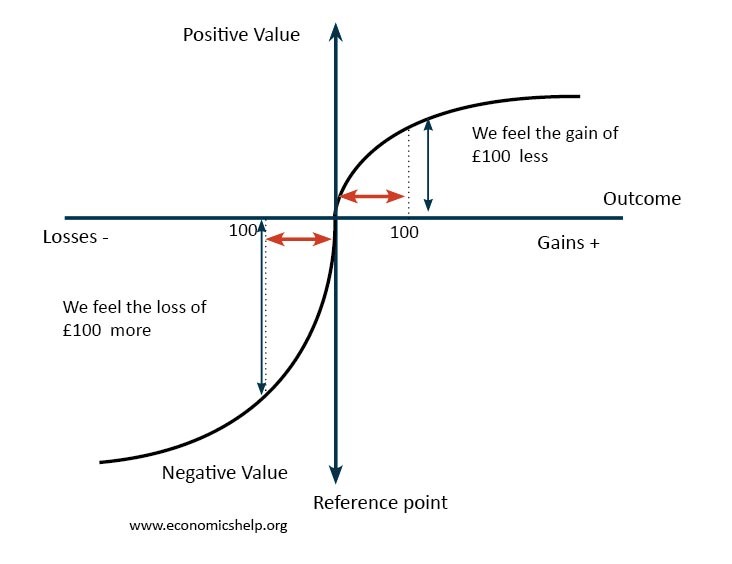
prospect theory
reference points
derive utility (utility seen as gains and losses, which have emotional attachment) from the payoff relative to a reference point (not in cumulative/absolute terms)
diminishing sensitivity & reflection effects
gains concave
losses convex
value function
loss aversion
losses hurt 2x as much as gains, convexity of losses
probability weighing
diminishing marginal sensitivity
a change from 0-10 appears larger than a change from 100-110, both for gains & losses
utility=concave for gains & convex for losses
risk averse for gains, risk seeking for losses (reflection effect)
Reflection Effect
risk attitudes for gains are opposite to those for losses:
risk averse for gains (concave)
risk-seeking for losses (convex)
St. Petersburg paradox
fair coin tossed repeatedly until heads is obtained, if it takes n tosses you earn $2^n. how much are you willing to pay to play?
expected to pay infinite amount because the expected value is infinite, but nobody pays a large amount (eu is a small #)
Violation of expected value
explained by expected utility
*shows that expected utility>expected value to describe ppl’s behavior
Loss Aversion
ppl fear losses more than enjoyment from gains
around the origin/reference point, the utility function is steeper for losses than for gains (losses have a bigger impact)
Alais Paradox
replacing the value of a sure thing shouldn’t change people’s preferences
ex: 89% chance of 60 in choice 1 for both, 89% chance of 0 for both in 2 makes them change preferences
violation of expected utility & sure thing principle
consisted with prospect theory
driven by certainty effect: ppl overweigh outcomes that are certain
maximin
choose option with greatest minimum utility payoff
maximax
choose option with greatest maximum utility payoff
minimax regret
choose option with lowest maximum regret
to calculate: find the difference in utility levels between the options (first note which choice is a win (predicted=outcome & there is no regret, those have a regret of 0; the other choice is the difference)
then compare the regrets & choose the lower one
subjective expected utility model
assign subjective probabilities to different options & then use expected utility
different people have different probabilities (unlike expected utility where everyone has the same probability)
still satisfies the sure thing principle
Ellsberg Paradox
consistent with ambiguity aversion; we dislike not knowing the probabilities
violation of expected utility
should prefer bets where you know the probability for certain (ex: 30/50 balls are blue > 20/50 balls are purple or yellow & u bet on how much are purple (don’t know the exact #)
calculate the expected utility: should have higher EU from known probabilities
decision time, temporal distance, & consumption time
decision time = when you make the decision
temporal distance = distance between deciding & consumption (the longer this is = further in the future the consequences of our decisions)
consumption time = consequences of the decisions occur
outcome stream
specifies what the consequences of our decision will be at every pt in time
transform outcomes into utility levels (turning it into a utility stream)
x= (x0,x1, …, xn)
utility stream =
u=u0,u1,…,un)
discounted utility (DU(x))
value of the utility stream
weighted utilities
further into the future= utility gets a lower weight
equation: DU(x) = u(x0)+d(1)u(x1)+…+d(n)u(xn)
impatience + DU = decreasing D(t); larger t (time)=lower discount function of t, further in the future = less utility
impatience
preference for positive utility sooner rather than later
impatience for unpleasant events (ex:dentist)
you prefer to postpone the event; it will hold a lower weigh in the future bc of discounted utility
*note: duration neglect & diminishing marginal utility are unrelated to delaying negative utility!!!
reasons for impatience
market interest
risk & uncertainty
pure time preference
health behavior
occupational choice
behavior of children & adolescents
contant impatience
adding a common delay to all options will not change preferences
adding a delay of sigma to both = unchanged preferences
(s:x)>(t:y), then (s+sigma:x)>(t+sigma:y) is still prefered
common time delay doesn’t affect preferences
time consistency
keep consumption time fixed, change decision time = preferences remain the same
decreasing impatience
time inconsistent; make plans & don’t stick to them
you’re more willing to wait to choose the better option (ex: get more money) if its far into the future.
if its recent/soon you will be more impatient & choose whatever is closer in time
Exponential Discounting
D(t)= deltat
delta = discount factor
(0<delta<1)
delta = 1/(1+r)
r=discount rate
therefore, larger discount factor = smaller discount rate
constant impatience & time-consistent behavior
Quasi-hyperbolic discounting
constant impatience when all outcomes are received in the future
decreasing impatience if possible to receive an outcome immediately
delta=discount factor, beta = present-bias parameter
decision changes due to time = time inconsistent
rational discounting
perfectly rational economic agent should behave this way
time consistency
exponential discounting can be considered rational
self-commitment
commitment to do a choice in the future
2 challenges to assumption that discounted utility function is independent from outcomes & depends only on time
Magnitude effect=large outcomes are discounted @ slower rate than small ones
Sign effect= losses are discounted @ a lower rate than gains (losses hurt more than gains, value function, reflection effect, convexity of losses, etc)
impatience for gains, but not for losses
contradiction/violation of discounted utility; prefer to get unpleasant things “over with”
dentist today is preferred to dentist in 1 week, despite being unpleasant
going to dentist today reduces unpleasant anticipation
preference for variation
ppl choose variety (ex: 2 different restaurants rather than the same one 2 days in a row)
preference for improving profiles
choice between:
a. 50 (today), 100 (1 month), 150 (2 months)
b. 150 (today), 100 (1 month), 50 (2 months)
ppl choose A
possibly due to loss aversion, prefer to gain over time rather than decrease
loss aversion in B
preference for spread
ppl prefer to spread out/distribute things they enjoy over time (rather than all at once or asap)
game theory 2 types of games
simultaneous-move games
all players decide simultaneously; cannot first observe what others have done
Nash eq
sequential-move games
observe what others have done
sublime perfect eq
why people deviate from nasheq/subgame perf. eq
limited strategic reasoning
either/both you yourself are limited or believe that others are
guessing game
utility depends on own payoff & payoff of others
“social preferences”; WB depends on more than your own utility
dictator game, ultimatum game, trust game
guessing game
state a # between [ , ], you win if you’re closest to 2/3 of the mean of all #s chosen.
playing 0 is a Nash EQ & there is no other Nash Eq
your best response is always to minimize the distance, aka lower the x
other method for obtaining Nash Eq: iterated elimination of dominated strategies
formula: #*P (p=%/prob given in the question)
elimination of all 1st order dominated strategies = eliminate all #s greater than & including #*P
Why don’t ppl play the Nash eq?
1. limited strategic reasoning
2. believe that others have limited strategic reasoning
ultimatum game
Steps:
proposer gets an amount S
proposer offers amount x to responder
responder can accept or reject the offer
accept= responder gets x & prosper gets s-x
reject= both get 0
EQ:
subgame perfect eq: if player’s utility depends only on their own payoff
2 subgame perfect eq
1. proposer proposes 1 cent & responder accepts bc they accept all + offers & reject offers of 0
2. proposer proposes 0 & responder accepts bc they accept anything
ultimatum game in practice
responders’ utilities cannot only depend on their own payoff (also depend on payoffs/intentions of other players too)
2 options for proposers utilities
they derive utility only from their own payoff & expect responders to reject small + offers
they derive utility not only from own payoff (also depends on others)
Dictator Game
Steps:
proposer gets amount s
proposer offers x to responder but responder cannot do anything (has no role, cannot accept or reject)
responder gets x & proposer gets s-x
outcome prediction:
if proposer’s utility depends strictly on own payoff, then he will propose 0 (no risk of rejection)
if the proposer gives anything more than 0, then their utility must depend on more than their own payoff
Trust Game
Steps:
proposer gets amount s
proposer sends x to responder
experimenter increases x to (1+r)x
responder returns y to proposer
result: proposer & responder both send 0
tragedy bc its not pareto optimal: they could both get more than eq if they could commit
public good
steps:
player 1 starts with an endowment
player 1 contributes to the public good some amount X
*if 1 player uses the public good, this doesn’t prevent other players from using it (all players benefit equally)
payoff eq for player I: Pi I = e-xi+msumofxi
Nash eq= no one contributes (assume someone else will anyway)
again results in a tragedy
IRL, ppl do contribute; driven by social preferences, ppl don’t want to be the free rider
Social Preferences
U(x,y) depends on X & Y
*standard preferences = U (x,y) only depends on x
Altruism
u(x,y) increases if y increases
envy
u(x,y) decreases if y decreases
rawlsian
u(x,y) increases if the payoff of the worst off increases
inequality aversion
u(x,y) increases if inequality |y-x| decreases
reciprocity
reward players with good intentions & punish those with bad intentions
outcome fairness
derive utility from final allocation of payoffs, not only from our own payoffs
process fairness
derive utility from how we get to the final allocation of payoffs
opportunity cost
missed value of the BEST NOT CHOSEN ALTERNATIVE
sunk costs/sunk cost fallacy
a) costs that are beyond recovery @ time of a decision & should therefore have no effect on the decision
b) the idea that a person/company is more likely to continue w/ a project if they’ve already invested a lot of time/effort into it (even tho this may not be the best decision) (violation of standard economic theory)
why do ppl believe in the fallacy?
ppl feel a need to justify decisions made in the past
ppl tend to be risk seeking when it comes to losses
decoy effect/expansion condition
the introduction of an inferior product/irrelevant alternative should not change your mind
the decoy is strictly worse than the target in all dimensions but better than the competition in 1 (no one should buy the decoy)
expansion c: if you choose x from {x,y} & if you don’t prefer z over x or y, then you must also choose x from {x,y,z}
but some ppl fall for the fallacy & change their mind
compromise effect
ppl’s tendency to choose an alternative that represents a compromise/middle option in the menu
ex: 1.5 litre coca cola bottle
endowment effect
an individual values something they already own more than in case they don’t yet own it (mugs ex)
*economic model predicts that losses & gains should be valued the same, but ppl value losses larger than gains (losses loom over gains)
gap in WTA & WTP is the endowment effect (they should be the same)
value function
used to describe the endowment effect, shows the larger magnitude (steeper line) of losses
important pt = reference pt
allows you to model if you’re disappointed or surprised by something (ex: firms make use of this by giving you a 30 day free trial)
side of losses is steeper than side of gains
Heuristic
shortcuts for the brain, a rule of thumb, can lead to predictable mistakes
when thinking of a problem, the brain uses shortcuts instead of computing probabilities & utilities
adjustment
subjects mis estimate the math of: 1×2×3×4×5×6 vs 6×5×4×3×2×1 (they think first is lower than the second, they don’t adjust upwards enough)
ppl adjust wrongly, in a predictable manner
Anchoring
an anchor is an initial value or estimate
it can influence the person making the estimation
ex to test this:
give ppl an irrelevant #. ask them if their estimate is > or < the irrelevant number. ask them what their true estimate is
diminishing sensitivity to gains
with a concave utility function for gains, you prefer to segregate gains (aka experience them separately = gives u more utility)
diminishing sensitivity to losses
with a convex utility function for gains, you prefer to integrate losses (combine them to decrease the bad feeling/effect)
mental accounting
ppl categorize/put money in different categories/accounts in their mind
open mental account when a payment is incurred
close the account when the benefits arrive
*timing plays a role in opening & closing of the different accounts (should not happen)
*budgeting is also important bc money is reserved for different budgets & not used intermixably
representativeness
estimating the probability that some outcome was the result of a process by reference to the degree to which the outcome is representative of that process (how similar the outcome is to ppl’s mental representation of that event)
Law of small numbers
ppl exaggerate how much small samples represent the population (could be outliers, etc)
gamblers fallacy
thinking that statistical outcomes are corrected in the short run
ex: thinking that throwing 6-6-6-6-6-6-6 is more unlikely than 5-3-4-5-2-5-1
regression to the mean
failling to see that statistical processes will return to their average in the long run
could be good/bad luck
base rate neglect
failing to take the base rate of an event into account (dont make correlations)
Ex: thinking someone works a specific job bc of personality characteristics, but irl need to consider the % of ppl with that type of job
Probability calculation: independent events
p(a) * p(b)
Probability calculation: bayes Rule
P(B|A) = (p(A|B)*p(B))/((p(A|B)*p(B) + p(A|-B)*P(-B)
Probability calculation: dependent events
p(a|b) * p(b)
availability heuristic
assessing the probability that you think some event will occur based on how easily it comes to your mind (ez=higher prob given)
retrievability of instances
ppl are asked to come up with instances of an event & they place more weight on things that are more salient/they remember more (ex dying of shark over dog, even though dogs are deadlier statistically) MEMORY*
effectiveness of a search set
ppl search for sets in their mind (try to remember/based off memory)
ex: how many words that start with the letter k vs have the letter k as a third letter (ppl think start with but its rlly as 3rd letter) MEMORY
imaginability
ppl predict something based on how they can generate a rule in their mind (have to imagine something)
ex: how many groups of 3 vs groups of 9 (ppl think there’s more of 3 than 9 but its the same)
confirmation bias
ppl look for evidence confirming the bias in their mind already, instead of looking for or considering evidence that disproves it
tendency to interpret evidence as supporting prior beliefs to a greater extent than warranted
conjunction fallacy
overestimating the probability of a conjunction (string of events all of which must happen)
ppl tend to use the probability of one event as an anchor & adjust downward insufficiently
(ex: what’s more probable: Linda works at a bank or Linda works at a bank & is a feminist; bank its statistically more probable, regardless of Linda’s personality or characteristics)
P(AnB)
disjunction fallacy
underestimating the probability of a disjunction (string of events, 1 of which has to happen)
P(A or B)
ppl tend to use the prob of 1 event as an anchor & adjust upward insufficiently
ex: prob of ppl with the same birthday is higher than you expect