Deuterostomes - Echinoderms
 Call Kai
 Learn
Learn Practice Test
 Spaced Repetition
 Match
Match Flashcards
 Knowt Play
1/49

There's no tags or description
Looks like no tags are added yet.
Name | Mastery | Learn | Test | Matching | Spaced | Call with Kai |
|---|
No analytics yet
Send a link to your students to track their progress
50 Terms
mouth, blastospore
In protostomes, the ______ develops from __________.
anus, blastospore
In deuterostomes, the _______ develops from the _______
Open
deuterostomes have a _____ circulatory system
No
deuterostomes have ___ complex sense organs
Marine
Phylum Echinodermata = spiny skinned animals - exclusively ______
radial (grow to become this, they have a bilateral ancestor)
deuterostomes are usually _______ symmetry
Madreporite, mouth
The aboral side of a starfish contains the _______, ______
stomach
A starfish on its aboral side can extrude their ______ through the mouth
Oral (bottom part)
The mouth/tubed feet is located on the _____ side of a starfish
Aboral (top part)
The anus/madreporite is located on the _____ side of a starfish
Echinodermata, gas-exchange
_______ have a unique water system that functions in ___-______
Coelomic canals
This vascular system consists of _______ and tubed feed that serve multiple roles (locomotion, gas exchange, prey capture and excretion.)
ammonia, diffusion, epidermis
In deuterostomes ______ (gas) waste is eliminated primarily by _____ across the _____ and through the tubed feet
Echinodermata
________ move using their water vascular system
Tube feet
___________ extend when fluid is forced into them from the ampullae. They attach to surfaces using adhesive secretions.
Slow
Contractions of the tubed feet then pulls the body forward in a coordinated manner ( ______ )
Calcareous ossicles
Echinodermata have an endoskeleton composed of ________ _______
Support, protection
The endoskeleton provides ______ and ______ and allows continuous growth without molting.
Ossicles
In seastars _____ may be embedded within the dermis and can project outaward as spines
False (spines are NOT tubed feet, spines produce an endoskeleton that provides defense, Tubed feet are on the oral side.
T OR F: Starfish spines are the same thing as tubed feet.
Indeterminate (continouous)
Many echinoderms exhibit _________ growth (unusual among animals)
grow or shrink
Individuals in echinodermata may ______ or _______ depending on resource avalaibility
negligible senescence
Many species in Echinodermata show ________ ________ continuing to grow and reproduce throughout life unless killed by predators or disease
Defense
Spines in Echinoderms function for _______
Toxins
In some sea urchins and sea stars, spines may be associated with _________
Crown of thrones starfish
The spines on ____________ (starfish name) produces toxins for self defense
Dermis
Gas exchange occurs primarily by diffusion throughout the ______
Dermal Papulae (Skin gills)
_________ are fleshy projections of the body wall in Echinodermata that increase the surface area for gas exchange ( as well as ammonia waste)
Dioecious (have distinct male or female individuals)
Echinoderms are mostly _______ (reproduction)
Metamorphosis, radially
The larva in echinodermata settles and undergoes ________ into a ______ symmetrical adult
Phylum Echinodermata
Includes (sea stars, sea urchins, sand dollars, brittle stars, basket stars, sea cucumbers, sea lillies, and feather stars)
Oral Side
Sea Stars: Tubed feet and mouth are located on ______
Externally digest prey
Sea stars can evert their stomach to _______________
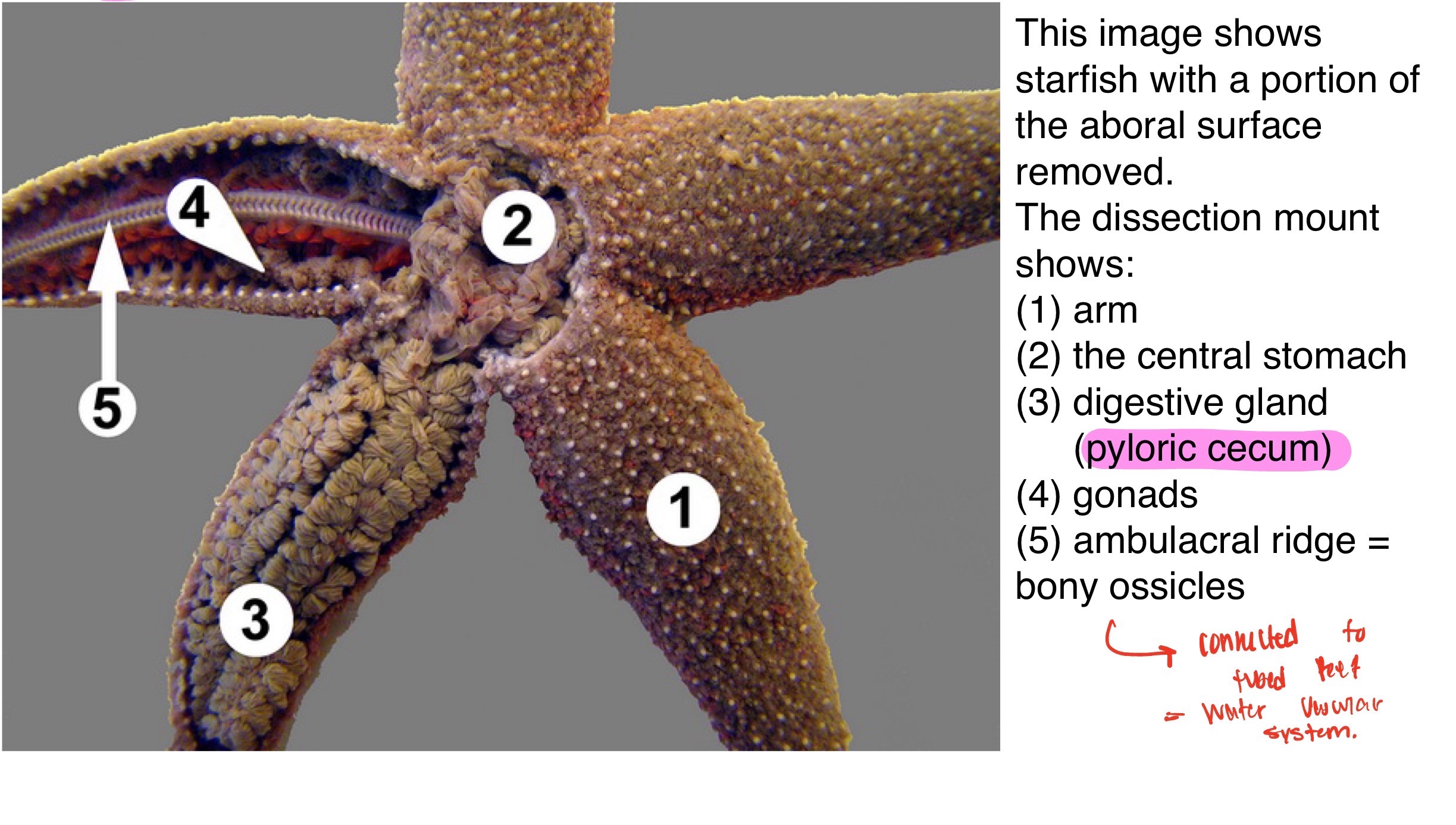
Anatomy of a seastar
The ambulacral ridge = bony ossicles (this is connected to the tubed feet/ water vascular system)
Regenaration
Sea stars can go through _________ to regain lost body parts
Undifferentiated (stem-like) cells
Sea stars and most echinoderms use ________ cells to regenerate body parts
Polyps of hard corals (coral poplyps)
The crown of thorns sea stars can prey on __________. Population outbreaks can decimate coral reef ecosystems
Sea urchins and sand collars, disc
Echinodermata includes ____urchins and _____ collars. They are _____ shaped
fused, test
Calcareous ossicles are _______ to form a rigid external skeleton called a ______.
Sand dollars and sea urchins, algae
In echinodermata, ______ collars and ____ urchins feed on _______ and organic matter
Chewing structure (Aristotle’s lantern)
Echinodermata posses a complex _______ _______ for grazing, composed of five calcareous teeth controlled by muscles.
autotomized (shed)
In brittle stars and basket stars, arms can be _______ for defense and later regenarated.
arm movements
In brittle stars and basket stars, locomotion is accomplished by ________ NOT tubed feed.
oral-aboral body
Sea cucumbers have a ___________ body with no arms: they typically lie on one side.
locomotion, also muscular contractions
Sea cucumbers use tubed feet for _______ and also _______ for body movements
Tubed feet at oral ends
In sea cucumbers, the _____ feet, at _______ are modified into feeding tentancles used for feeding.
Tentacles
In sea cucumbers, tubed feet at oral end = _______
Toxic/Sticky Cuverian Tubules
Sea cucumbers can eject _____/toxic, ______ tubules. As well as portions of the gut and internal organs, through the cloaca to deter predators (video we watched) looks like sperm….