bio exam 3 - chapter 34 (plant form and function)
 Call Kai
 Learn
Learn Practice Test
 Spaced Repetition
 Match
Match Flashcards
 Knowt Play
1/133

There's no tags or description
Looks like no tags are added yet.
Name | Mastery | Learn | Test | Matching | Spaced | Call with Kai |
|---|
No analytics yet
Send a link to your students to track their progress
134 Terms
humanities most important crops are ____
grasses
a membrane enclosed organelle that makes up the majority of plant cells and stores salts, minerals, nutrients, proteins, pigments, helps in plant growth, and is a support structure (regulates turgor/hydrostatic pressure)
central vacuole
intracellular endosymbiotic cyanobacteria that have a double membrane (synthesize and store carbohydrates, lipids, and proteins
plastids
a permanent primary endosymbiosis event in the ancestor of land plants, green algae, via endosymbiosis with a cyanobacteria (likely called gloeomargarita)
LPCA (last plastid containing common ancestor)
how long ago did LPCA live?
~1.6 Ga
eukaryotic cells evolved when prokaryotic cells engulfed bacterium and became dependent on their functions
Endosymbiosis
we design and engineer artificial photosynthetic endosymbiosis between photosynthetic cyanobacteria and budding yeasts
artificial photosynthetic endosymbiosis
Intracellular endosymbiotic cyanobacteria that have a double membrane
Plastids
Undifferentiated plastids
proplastid
green plastids that perform photosynthesis
chloroplasts
colorless plastids that can store lipids, carbohydrates, and proteins
leucoplasts
plastids that synthesize and store pigments (give flowers, fruits, roots, tubers, and fall leaves their colors)
chromoplasts
chloroplasts are composed of ___, _____, and _____
thylakoids, granum, and stroma
site of the light dependent reactions of photsynthesis
thylakoids
stack of thylakoids
granum
fluidic gel like material between grana
stroma
plastids that synthesize and store startch
Amyloplasts
plastids that synthesize and store lipids - found in embryonic leaves and anthers (lipids sent to pollen)
elaioplasts
plastids that synthesize and store proteins - found in seeds, roots, tubers, and fruits
proteinoplasts
orange, red, and yellow pigments that 1) absorb energy from sunlight and transmit the energy to chlorophyll molecules to boost photosynthesis and 2) act as antioxidants
cartenoids
extracellular matrix that encloses each cell in a plant
cell wall
cellulose microfibrils interwoven with a network of pectin polysaccharides (cellulose, cross linking glycans, and pectin are present in roughly equal amounts in a _______)
primary cell wall
linear glucose polymer that is the primary structural component of plant cell walls
cellulose
the network of ____ and _____ (____) provides _______ (stretchability)
cellulose, cross-linking glycans, sugars, tensile strength
what is the main component of dietary fiber
cellulose
class of compounds consisting of monosaccharides linked glycosidically in different configurations
glycans
a single oxygen atom bonded to two separate carbon atoms; usually between sugars
glycosidic bonds
branched polysaccharides that contain many negatively charged galacturonic acid units
pectins
a sugar acid derived from galactose
galacturonic acid
pectin network resists _____
compression
because of their negative charge, pectins are _______
highly hydrated
cell wall layer rich in pectin that cements adjacent cells together
the middle lamella
a rigid cell wall produced by depositing new layers between the primary cell wall and membrane
secondary cell wall
certain cell types (_____ and _____) develop
secondary cell wall
cellulose that has a branched structure
hemicellulose
a hemicellulose with xylose (monosaccharide) monomers
xylan
the sugar alcohol xylitol is made from _____
Xylan
a polymer made by cross linking phenolic precursors
lignin
pores that allow transport of materials between plant cells
Pits
endoplasmic reticulum channels between cells that traverse pits and connect adjacent cells for intercellular trafficking of molecules
plasmodesmata
the entire plant cell excluding the cell wall
protoplast
removing the _____ allows the cell to be used for _______ and ______
cell wall, DNA transformation, genetic engineering
what enzymes are used to generate protoplasts (3)
cellulase, pectinase, xylanase
watery fluid that fills the vacuoles of plant cells
cell sap
humans gather sap in the form of ____,_______, and _____
opium, rubber, garlic flavoring
lengthening of roots and stems
primary growth
area of actively dividing undifferentiated cells in plants
meristems
growing shoot and root tips that result in primary growth
apical meristems
produce the root cap, which consists of lubricated cells that are sloughed off as the meristem is pushed through the soil by cell division
root apical meristems
produces stems, leaves, and reproductive structures
shoot apical meristems
increased rate of cell _____ enlarges the meristem
division
increased rate of ________ in the periphery of the meristem decreases meristem size
differentiation
increase in stem and root thickness (girth) by the production of vascular tissue
secondary growth
cells dividing on the sides of the shoots and roots that results in secondary growth
lateral meristems
a single layer of lateral meristem cells that encircles the root and stems that divide to increase plant width
cambium
a lateral meristem responsible for secondary growth that replaces the outer layer (epidermis) of roots and stems
cork cambium
a lateral meristem is responsible for secondary growth, cells divide and form secondary xylem and phloem - contributes to the vast majority of secondary growth
vascular cambium
grass and grass like flowering plant (_____) stems do not have _______
monocot, lateral meristems
dividing cells in the monocots found in between mature tissues that allow the plant to grow in length
intercalary meristems
outer layer of dead cells in woody plants
cork
secondary xylem
wood
secondary phloem + primary phloem + cork cambium + cork cells
bark
older, nonliving innermost secondary xylem that darkens due to accumulation of resins and gums
heartwood
light-colored, younger secondary xylem containing living vascular tissue
sapwood
______ slows and stops growing during hte dry or cold season
vascular cambium
small openings in bark that allow gas exchange
lenticels
the three tissue systems found in plants are:
dermal, ground, and vascular
outermost layers in plants
dermal tissue
the outer protective layer of the primary plant body (the roots, stems, leaves, flowers, fruits, and seeds)
epidermis
hair like structures that originate from epidermal cells
trichomes
pores in the epidermis that allow for co2 and o2 gas exchange
stomata
cells in the epidermis of a plant that control the opening and closing of stomata
guard cells
a waxy, water repellent substance consisting of highly polymerized esters of fatty acids
cutin
outer layer on leaves and stems consisting of cutin and waxes that prevents water loss
cuticle
all apical meristem derived tissues that are neither dermal (outermost) nor vascular
ground tissue
cells with cell walls that can store water, starch, as well as sugars, and make up the photosynthetic cells in leaves, the centers of stems, roots, and fruits
paranchyma
cells with uneven cell walls that thicken at the corners that provide mechanical and structural support in regions of new growth below the epidermis
collenchyma
cells with thick lignin filled secondary cell walls and usually die when mature - provides the main structural support to the plant
sclerenchyma
cell wall polymer made by cross linking phenolic precursors
lignin
what are the two types of sclerenchyma cells
fibers and sclereids
elongated sclerenchyma cells with lignified secondary cell walls
fibers
short sclerenchyma cells with lignified secondary cell walls
sclereids
vascular tissue that transports water and minerals from the roots upward
xylem
vascular tissue that transports organic materials synthesized by the plant
phloem
long thin cells that taper at the ends and have pits where the secondary cell wall is absent and water can move
tracheids
short and wide water conducting cells that have gaps through both cell walls
vessel elements
Softwoods only contain ____
tracheids
hardwoods contain ____
vessel elements
long thin cells that transport sugars and nutrients through perforated ends called sieve plates
sieve tube elements
cells adjacent to the sieve tube elements that load and unload material for transport into the sieve cells (have large nuclei)
companion cells
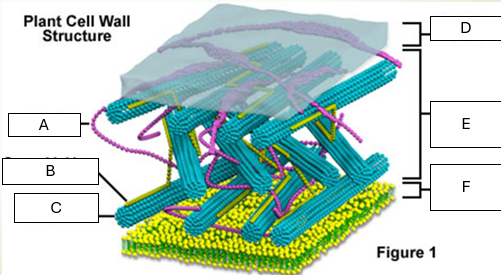
A
pectin
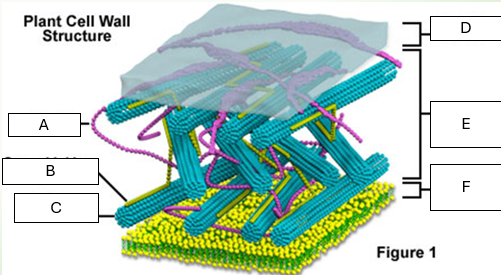
B
cross linking glycan
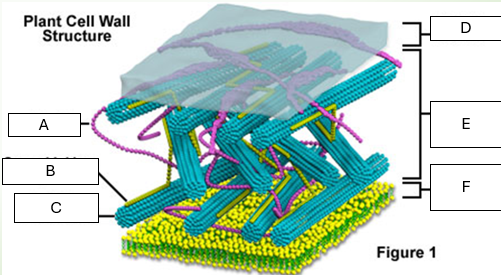
C
cellulose microfibrils
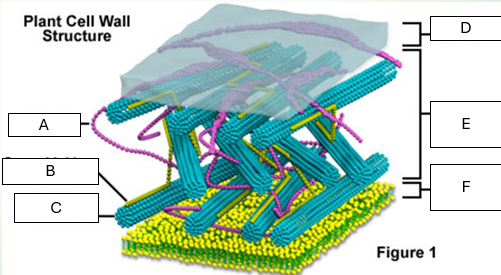
D
middle lamella
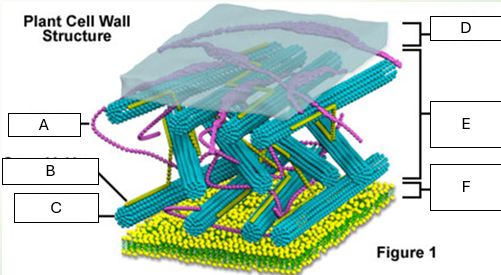
E
primary cell wall
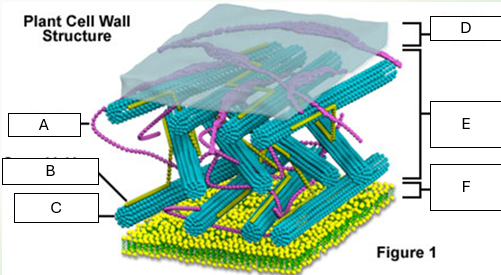
F
plasma membrane
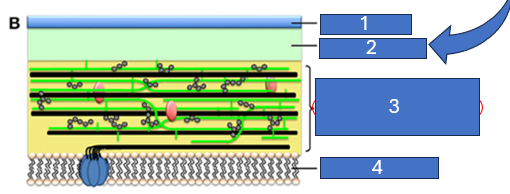
1
middle lamella
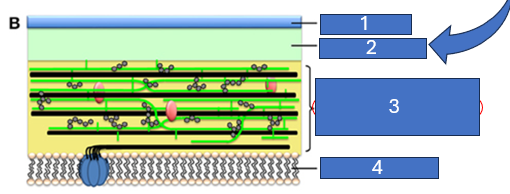
2
primary cell wall
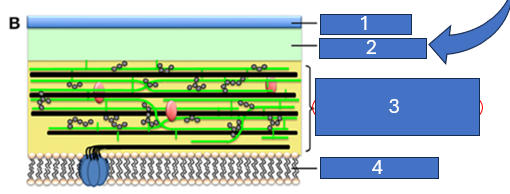
3
secondary cell wall
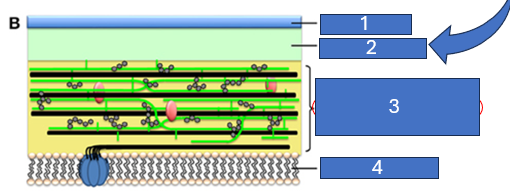
4
plasma membrane