Psych Ch. 19 & 20
 Call Kai
 Learn
Learn Practice Test
 Spaced Repetition
 Match
Match Flashcards
 Knowt Play
1/56

There's no tags or description
Looks like no tags are added yet.
Name | Mastery | Learn | Test | Matching | Spaced | Call with Kai |
|---|
No analytics yet
Send a link to your students to track their progress
57 Terms
Approval by institutional review board, informed consent
Two major research ethics
Approval by institutional review board
○ All behavioral and medical studies with human subjects undergo an independent ethics evaluation
○ All researchers receive ethics training (including students, technicians, etc.)
○ Scientific publications are anonymous—IRB approval checked during peer review
Informed consent
○ Research participants are given full knowledge of the possible consequences of participating in a study
○ Participation is voluntary
○ Full knowledge of risks and benefits
○ Parental must consent and children must assent (agree)
Population pyramid
Graph that depicts age and sex structure of a population over time
Increasing number of young individuals
More older women than men
Growth of individuals 65+, more young people too
Pyramid is getting wider
Changing population demographics
Japan, Italy Greece
US at 44
Countries with largest percentage of individuals 65 and older in 2020
Geriatrics
the medical specialty devoted to aging people
Gerontology
the multidisciplinary study of old age (psychological, cultural, and biological factors)
Young-old
65-75 years
Healthy, financially secure; well-integrated into lives of fam. and comm.
Mid-old
Over 75
More likely to experience physical, mental, or social challenges
Old-old
Over 85 years of age
Mostly dependent on others, requiring supportive serves such as nursing homes or regular hospital stays
Centenarians
Those beyond 100
Despite physical limitations, most centenarians have low rates of diseases and good mental health
Quadruple
Number of centenarians in US is projected to ________ between 2024 and 2054
4%
What percent of US residents over age 65 are in nursing homes?
5%-10%
Brain loses ___________ of its weight between 20 and 90 years old
Slowing of central and auto. nerv. syst. dramatic in late adulthood
Atrophy
Individual differences in the extent to which brain shrinking happens
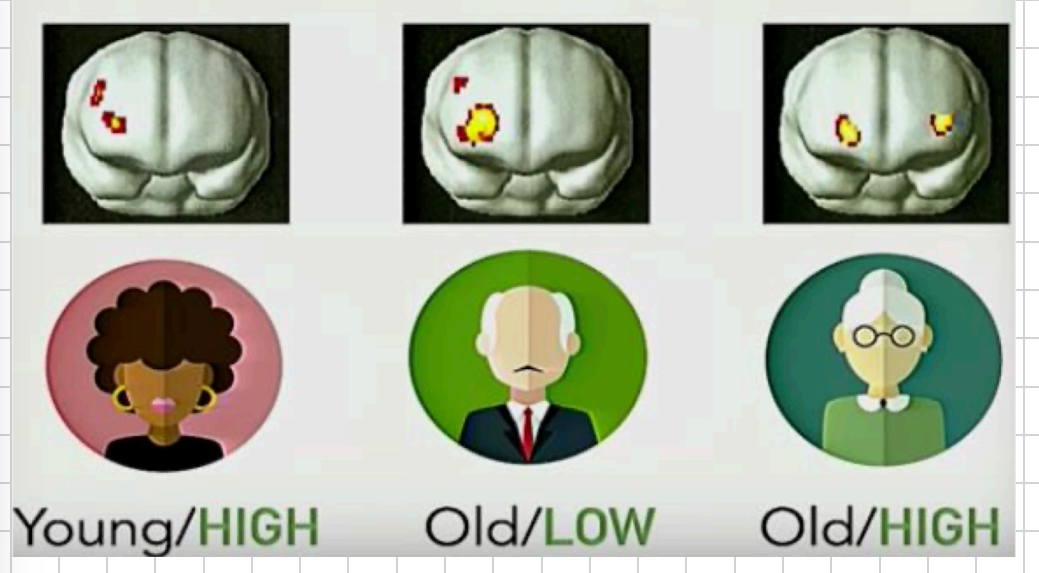
More parts of their shrinking brains
In younger individuals, brain power is more centered around specific locations
Do older adults use more or fewer parts of their brain?
Neural reorganization
Atrophy of hippocampus and prefrontal cortex
Reduced blood flow
Diminished neurotransmitter firing
Deteriorating white matter
Key changes to brain makeup during aging
20-30
Brain aging starts at what age?
Little
______ neuron cell loss in aging brain
NDMA receptors
Lower levels of these receptors - that are used to learn things - in the aging brain
Exercise every day
Running increases molecules in the brain, maintaining volume
One way to stop brain aging
Little changes and shrinkage
Lots of changes or little changes in primary visual cortex?
Think dumbbell graph
Frontal lobe
Mission control center for the brain of executive functions
○ Sets goals
○ Delegates
○ Directs attention
○ Monitors results
Lower perception
Increase medications
Driving accidents frequent
What is caused by declining executive function?
50%
Frontal lobe volume shrinks up to __________ in old age
30%
Hippocampus shrinks by _______%
Explicit memory
Conscious recall
Divided into episodic and semantic
Episodic memory
Type of explicit memory
Memory for specific moments in your life
○ What, where, when–and you in it
○ Includes your memories of what you did last night, your favorite vacation, and conversations you have had
Semantic memory
Type of explicit memory
Facts and general knowledge
Implicit memory
Without conscious recall
Divided into procedural and conditioned responses
Procedural
Motor and cognitive skills learned via practice - walking
Conditioned responses
Associations - knowing someone’s face by their name
Episodic (vivid memories of events), semantic (facts & knowledge collected)
While _____ memory decreases linearly from 20s to 80s, ______ memory tends to increase with age
Dementia
Umbrella term for memory loss, impaired reasoning, language problems, personality changes
The irreversible deterioration of intellectual ability accompanied by emotional disturbance
● Unlike milder forms of mental decline with normal aging, ______may lead to significant impairment in social functioning
MORE COMMON IN WOMEN OVER MEN 85 YEARS OR OLDER
Reversible dementia
Causes
Medication: when elderly people are prescribed several medications, it might lead to side effects with dementia-like symptoms
Depression: most common diagnostic mistake–other mental health problems, social isolation, significant social changes (e.g. death of partner)
Vascular dementia
Degeneration of material in brain by multiple strokes
Alzheimer’s
Disease
Progressive, irreversible brain disorder characterized by deterioration of memory, reasoning, language, and eventually physical functioning
More common in women due to longer life expectancy
Horrible damage to neural communication
Integrity versus despair
This stage is about life review.
If people can mentally resolve their experiences—good and bad—they achieve _____.
If they cannot reconcile their past, they fall into ______.
Ageism
Discrimination against elderly on groups of their age
Institutional, interpersonal, internalized
Institutional ageism
Unjust policies in organizations that discriminate against older people
Interpersonal ageism
Interaction with other individuals discriminate against older people
Internalized ageism
Internal discrimination of old people within themselves
“Because I’m old, I can’t do XYZ”
Increased chance of cardiovascular events/disease
What can ageism lead to?
An expert knowledge system dealing with the conduct and understanding of life
○ Includes factual and practical knowledge (know-how)
○ Intellectual humility - Knowing you don’t know everything
○ Compromise
○ Recognition of uncertainty and change
○ Others' perspectives/broader contexts
Wisdom
Life experience, personal motivations
Two main contributors to wisdom
Selection, optimization, compensation (SOC model)
Three components of successful aging
Dealing with the changing psychological resources due to aging
Selection
Component of SOC model
Focusing attention to more important and manageable goals
Optimization
Component of SOC model
Maintaining performance in certain areas due to continued practice
Compensation
Component of SOC model
Accounting for one’s decline in performance
Arthur Rubinstein - World-renowned pianist who played last concert at young age of 89
Example of successful SOC model
Socioemotional selectivity theory
Theory outlining how people consider what to value depending on how many more years lie ahead
● Older adults become more selective about their social network
● Spend more time with familiar individuals with whom they have had rewarding
Decline, improve
As one grows older, the number of relationships _____, but quality of these relationships _______
Friendships at old age
Provide intimacy and companionship, acceptance, community, consoling when losing a loved one
Familiarity, number
At old age, people prefer _______ over _______ of relationships
Friends must align with personal values
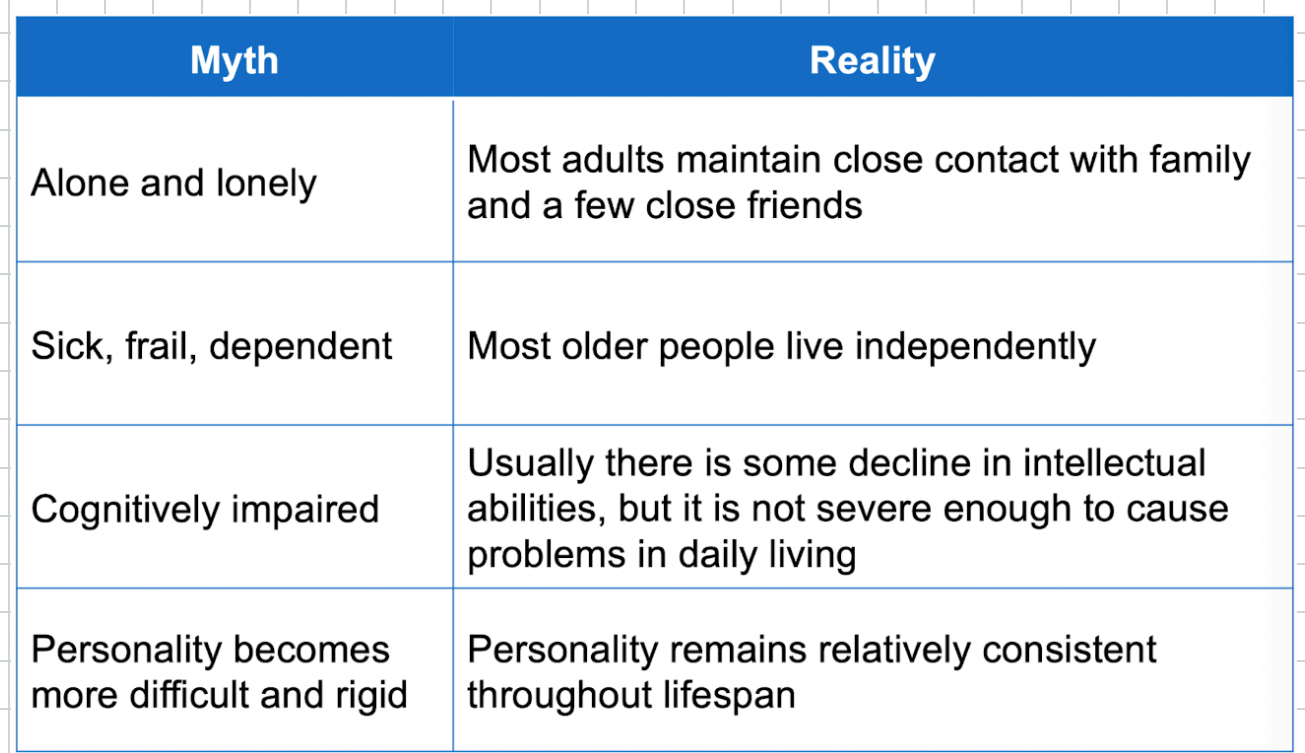
Myths vs. reality of old people
● Professor Laura Carstensen Ted-Talk
○ Emotional aspects of life improve
○ Older people are happier than middle age and young people
○ Fewer older people experience stress compared to younger people
○ Recognizing that we won’t live forever changes our perspectives on life in positive ways
○ Less tolerance for injustice