Thermoregulation chapter 1
0.0(0)
Studied by 3 people Call Kai
 Learn
Learn Practice Test
 Spaced Repetition
 Match
Match Flashcards
 Knowt Play
Card Sorting
1/12

Earn XP
Description and Tags
Last updated 11:01 AM on 12/13/22
Name | Mastery | Learn | Test | Matching | Spaced | Call with Kai |
|---|
No analytics yet
Send a link to your students to track their progress
13 Terms
1
New cards
Why do we have housing?
Manipulation of:
* Reproduction
* Production
* Health/diseases
\
Condition of:
* Climate
* Health/diseases
\
Control of:
* Behaviour
* Feed
* Reproduction
* Longetivity
\
But why?
* Increasing production
* Decreasing costs
With keeping consequences to 3rd parties in mind (animals, humans, environment).
* Reproduction
* Production
* Health/diseases
\
Condition of:
* Climate
* Health/diseases
\
Control of:
* Behaviour
* Feed
* Reproduction
* Longetivity
\
But why?
* Increasing production
* Decreasing costs
With keeping consequences to 3rd parties in mind (animals, humans, environment).
2
New cards
Positive aspects of animal housing
Positive aspects are, among others, the supply of food and water and shelter against extreme climatic conditions.
3
New cards
Negative aspects of animal housing
Negative aspects appear particularly when the needs of animals are not (completely) met. In many cases, animal housing reduces the choices animals can make (e.g. can’t influence climate when in a barn via behaviour).
4
New cards
How to measure the influence of housing?
To measure this objectively, different characteristics can be determined, such as changes in:
* Hormone levels
* Fertility
* Disease resistance
* Behaviour
* Production/growth
* Heat production and heat loss
* Hormone levels
* Fertility
* Disease resistance
* Behaviour
* Production/growth
* Heat production and heat loss
5
New cards
Homeostasis
the animal body’s attempt to maintain a constant and balanced internal environment.
6
New cards
Maintaining homeostasis
1) If the environment of the animal is changing, this is detected by a certain receptor (for example a temperature sensor in the skin or a CO2 sensor in the aorta).
2) The information of the receptor is compared with the set point of the central nervous system (especially the hypothalamus).
3) When those two deviate from each other, animals will react by adjusting their neural and/or endocrine system, whereby for example behaviour or metabolism will be changed.
Sometimes animals are not able to adjust properly. When the same stressor persists for a long period of time or reoccurs often, an animal will adapt to it and the specific stressor will no longer be perceived as such.
2) The information of the receptor is compared with the set point of the central nervous system (especially the hypothalamus).
3) When those two deviate from each other, animals will react by adjusting their neural and/or endocrine system, whereby for example behaviour or metabolism will be changed.
Sometimes animals are not able to adjust properly. When the same stressor persists for a long period of time or reoccurs often, an animal will adapt to it and the specific stressor will no longer be perceived as such.
7
New cards
Acclimation
All reactions of an animal occurring after changing 1 specific environmental factor. For example, a chicken will acclimate to a change in day length.
8
New cards
Acclimatization
All reactions of an animal occurring after more complex changes in climate and/or housing conditions. The responses can be caused by several factors at the same time. For example, a dairy cow with outdoor access will acclimatize to weather changes, such as sun, wind, temperature, and day length.
9
New cards
Habituation
Adaptation to a repeated stimulus that is initially experienced as a stressor.
10
New cards
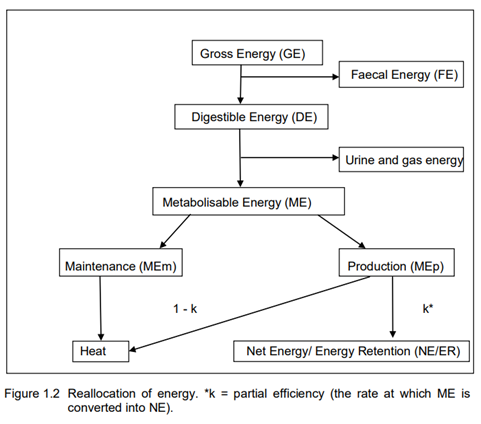
Energy reallocation
GEDEME
11
New cards
Maintenance
* Protein turnover
* Physical activity
* Circulation and respiration
* Thermoregulation
* Immunology
* Stress
* Digestibility
* Physical activity
* Circulation and respiration
* Thermoregulation
* Immunology
* Stress
* Digestibility
12
New cards
Performance
Meat, milk, eggs etc.
13
New cards
Energy reallocation
When a homeothermic animal is exposed to a cold stress for example, the animal will try to maintain its body temperature. It will increase its heat production and energy requirements towards maintenance. An increase in maintenance is required and occur at the expense of energy that is available for performance (e.g. production of milk). → Reallocation can also happen within maintenance!!!