blood spatter
 Call Kai
 Learn
Learn Practice Test
 Spaced Repetition
 Match
Match Flashcards
 Knowt Play
1/54

There's no tags or description
Looks like no tags are added yet.
Name | Mastery | Learn | Test | Matching | Spaced | Call with Kai |
|---|
No analytics yet
Send a link to your students to track their progress
55 Terms
What facts might a trained investigator learn from the analysis of blood spatter at a crime scene?
The Type of weapon ▶ The Number of “blows” with the weapon ▶ Handedness of assailant (right or left-handed) ▶ Position and movements of the victim and assailant during and after the attack ▶ Which wounds were inflicted first ▶ The Type of injuries that the victim would have ▶ How long ago the crime was committed ▶ Whether death was immediate or delayed
texture (Is it rough or smooth):
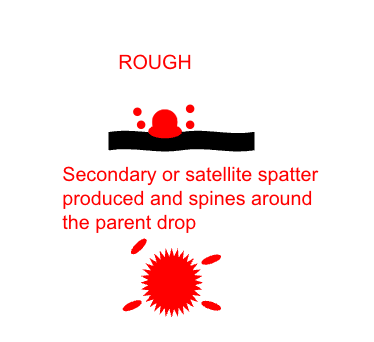
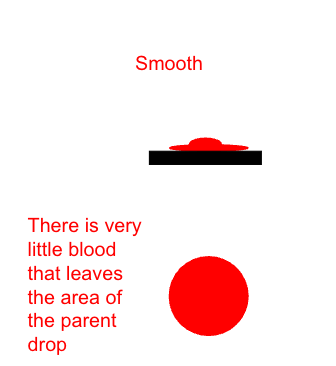
In general when blood hits a rough surface there is more secondary spatter produced/generated – the single drop is not contained to one area.
#2 Is the substrate porous (absorbent) or Non porous (not absorbent).
In general a single blood drop is harder to see – if it has “soaked into a porous substrate” Fabric is generally porous as is paper/cardboard. Substances that are non porous generally allow more of the blood drop to be seen – metal/glass/table tops
the substrate Polar
(electrically charged – it could be + charged or – charged or even both + and - as in the case of the water molecule!)
non polar
neutral – has no charge or no charged part of it – if it is a molecule)
Blood is mostly water Therefore
blood is a polar liquid – like water - hydrophilic
This means that It is “attracted to
water and other electrically charged molecules” OR substrate surfaces when it lands on them!
blood landing on polar surfaces or non polar
Blood landing on a polar surface will be attracted to the surface and so the water molecules in the blood will try to“bond ” to the substrate SO spines will be produced!
Blood landing on a non-polar surface does not “bond “to it- SO NO spines are produced !
blood secondary spatter
Polar surface –
above 1m free fall
Spines – and little secondary spatter
Nonpolar surface – and > 1 m in vertical height
No spines – BUT it will produce more satellite or secondary spatter!
Because the droplet stayed “together” when it hit the surface it actually has a smaller surface area so the droplet may experience “splash out” and secondary spatter is “thrown out”of the drop
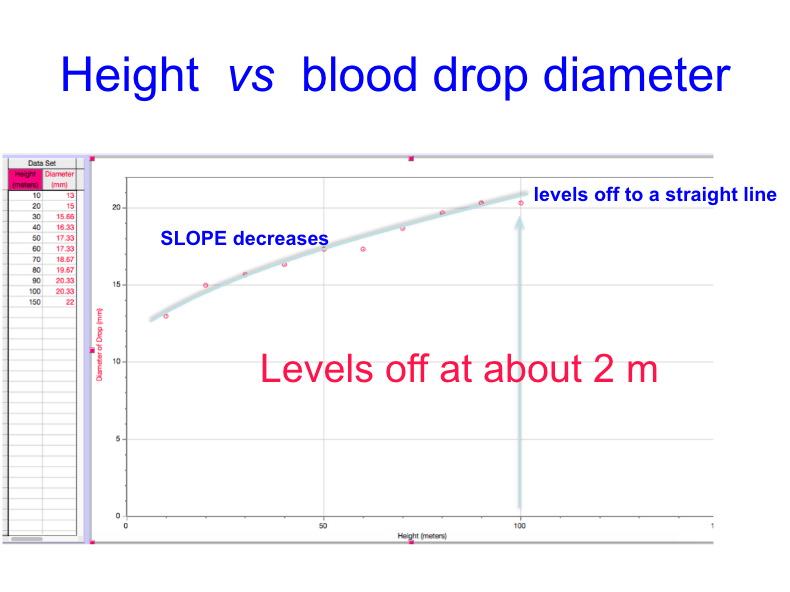
Was there a relationship between height and diameter of a single blood drop??
YES - it is basically a straight line – a positive relationship
BUT KNOW that :
Above about 2 m
in vertical height there is very little change in blood drop diameter – (eventually the line levels off to a horizontal line)
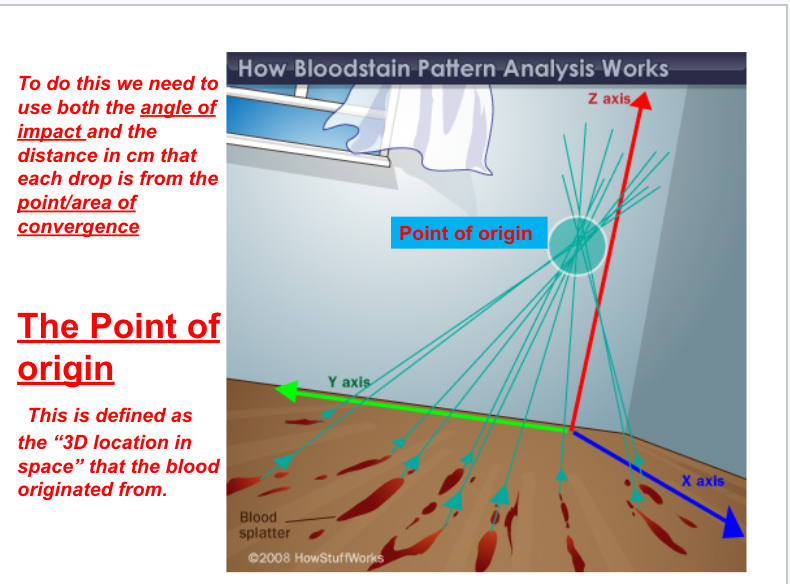
Origin:
the point in space where the blood spatter came from
Target
the surface where the blood ends up
Spatter
bloodstains created when blood travels from origin to target
Spines
the pointed edges of a stain that radiate out from the drop
Parent Drop
the primary (first) droplet - from which satellite spatter originates
Satellite Spatter
Small drops of blood that break of from the parent spatter when the blood droplet hits a surface. very important as it can help determine the direction from which the blood traveled. This is also called secondary spatter.
Angle of Impact
The angle at which a blood droplet strikes a surface.
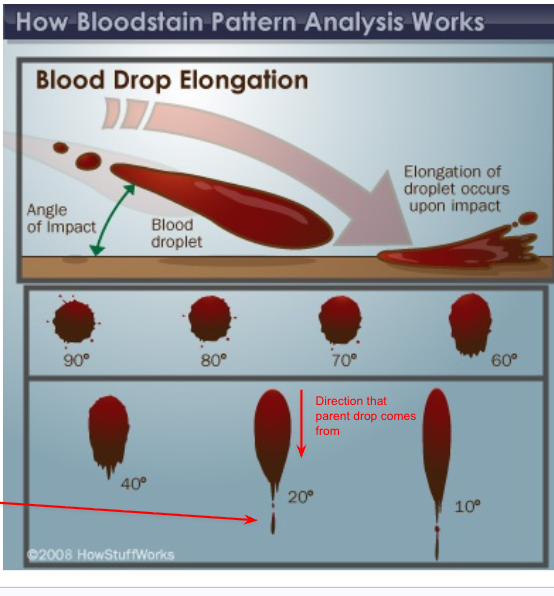
Does Blood drop shape change when the angle of
Impact of a single blood drop changes?
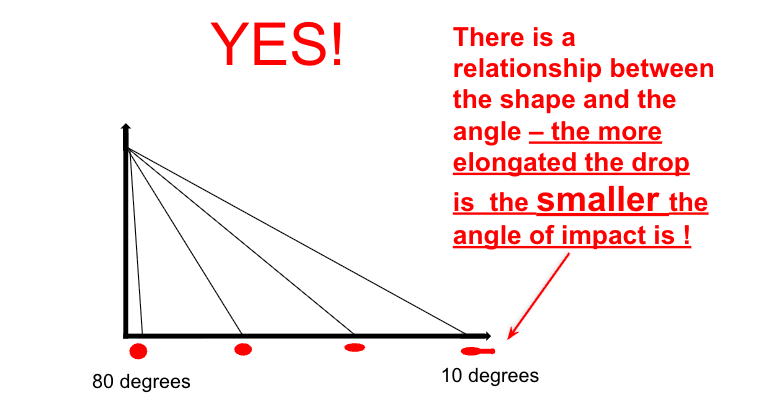
NOTICE THAT when the angle of impact decreases (becomes a smaller number of degrees!)
The parent blood drop become more elongated
AND ALSO that satellite droplets are cast off in front of the parent drop
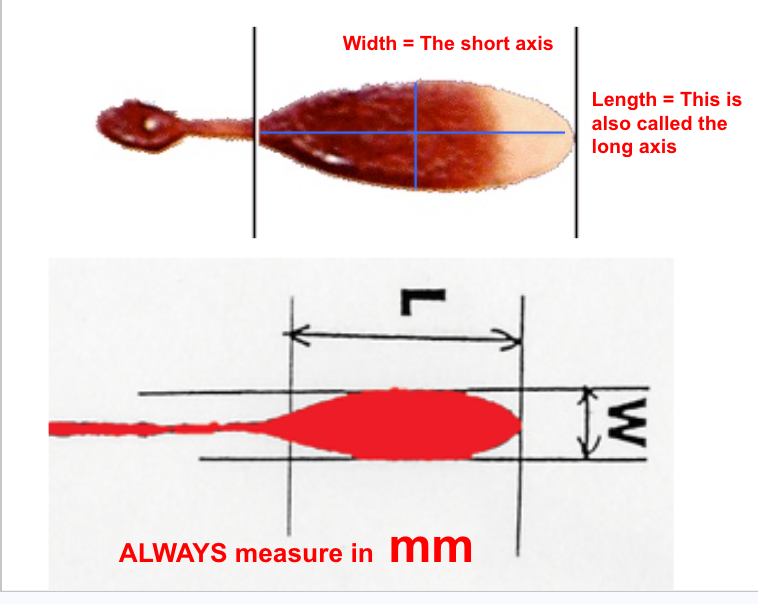
Length must always be greater than width or you will get an undefined answer on the calculator!
mm

point of convergence
simple language –
“How to find the Origin of blood spatter – which way did it come from”
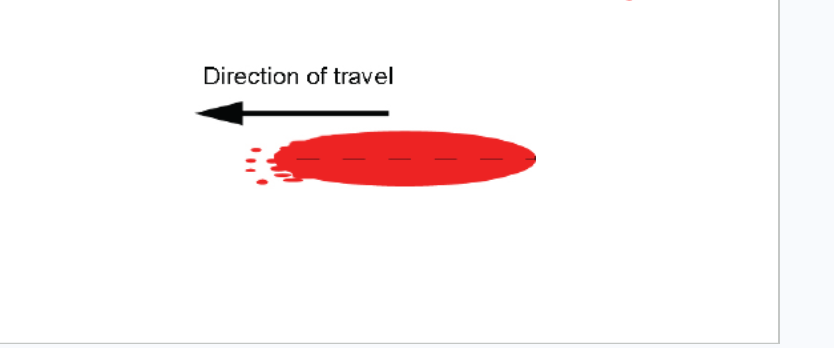
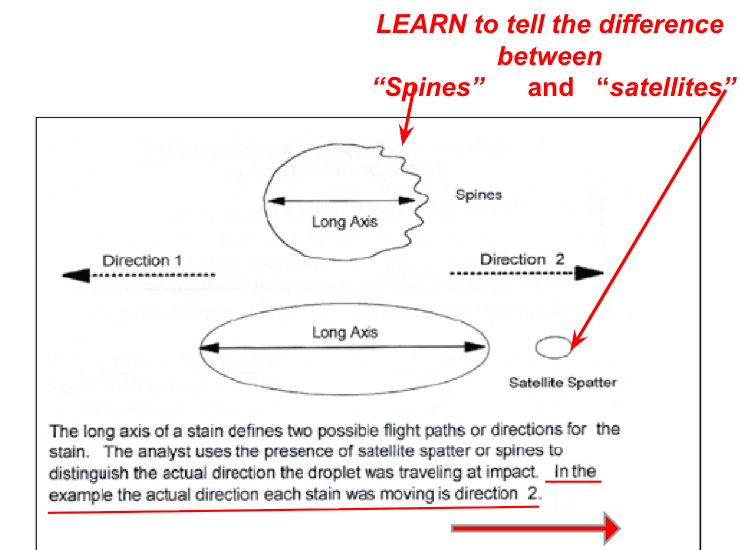
Long Axis
the longest possible diameter of a single blood drop
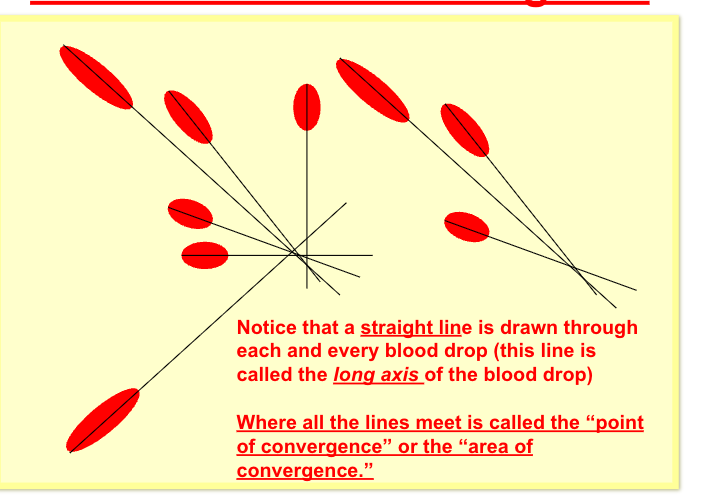
NOTE HOWEVER That when you measure the distance it is taken from the BACK of the drop! (NOT the front of the drop)
The distance measurement is needed so you can calculate the actual height that the blood spatter came from
cm
Wave cast off – learn to identify this !
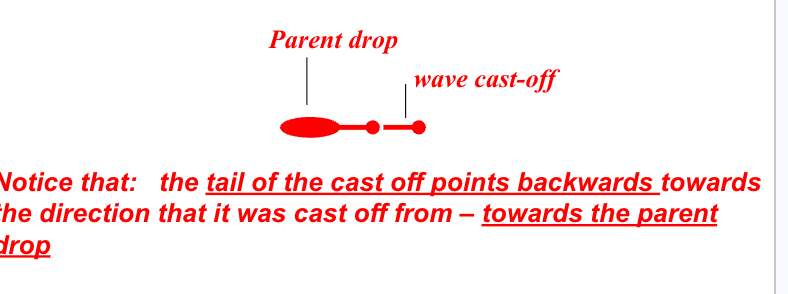
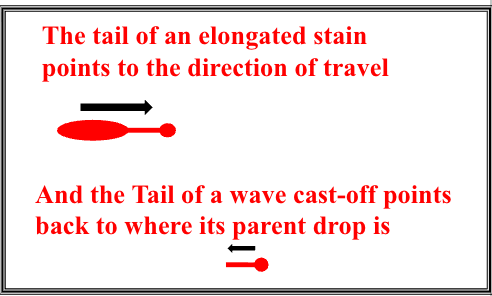
Do NOT use Circular drops for convergence
Why are calipers used
Because The blood is wet – and the calipers will not really need to
touch it – but the ruler would mess it up!
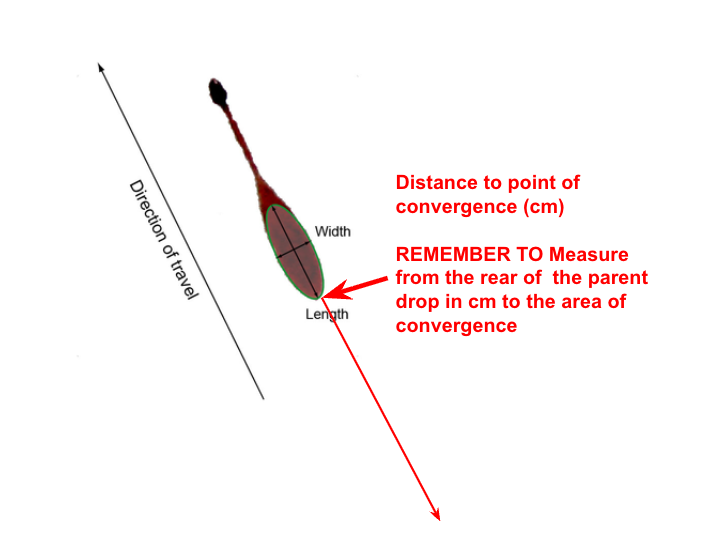

this formula uses cm not like the agle of impact
outlier blood drops
Blood drops can deviated in their normal “flight” by “air currents” produced by sudden body movements of the victim or the weapon, or even subtle breezes.
This will affect their trajectory, angle of impact and their final height result will be quite different from the average of all the other more“normal” blood drops.
DO NOT COUNT THE OUTLIARS
Should blood drop height calculations be scientifically accurate in the courtroom or should they be viewed as more of an estimation and interpretation
Answer = It is an Estimation and interpretation!
cam case
Low Velocity Impact Spatter (LVIS)
blood moving under 2 m/s with stains GREATER THAN 3 mm in diameter
blood dripping off a person or weapon while standing still or walking
Medium Velocity Impact Spatter (MVIS)
blood moving 2 - 10 m/s with stains generally between 1-3 mm in diameter
blood from an arterial spurt, blood that is cast off of a swinging weapon or from someone who is running.
High Velocity Impact Spatter (HVIS)
blood moving at speeds usually > 30 m/s with stains LESS THAN 1 mm diameter
blood projected by high powered machinery, gunshot, or explosion - bomb
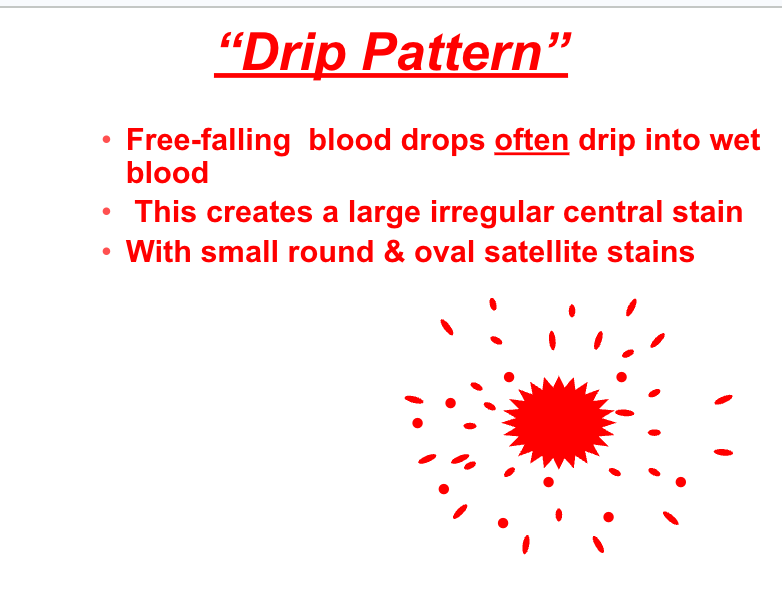
MVIS “Cast-off” from a Weapon
The First blow causes the bleeding
Subsequent blows contaminate weapon with blood
The Pattern & intensity of the stain depends on:
type of weapon
amount of blood adhering to weapon
length of swing arc
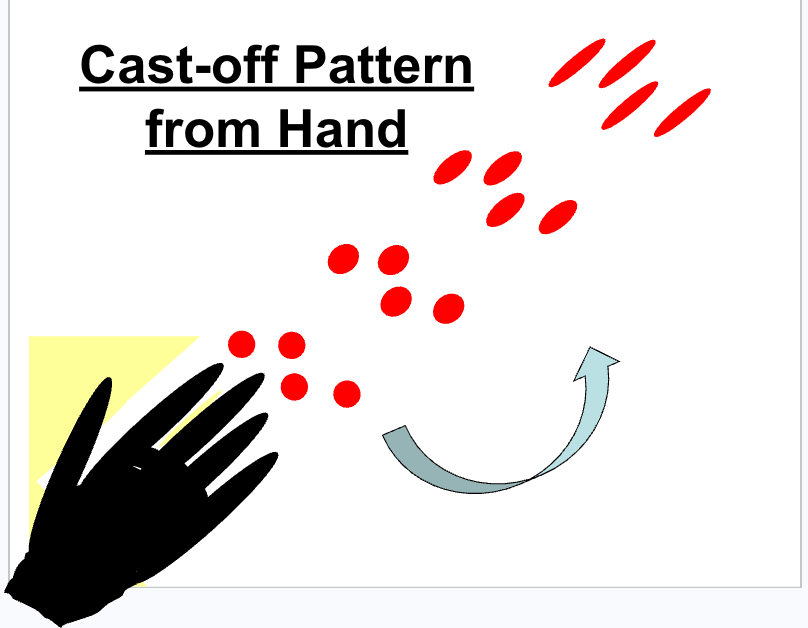
Arterial Spurt Pattern
Blood exits the body under arterial pressure
Large stains with downward flow on a vertical surfaces
A “wave” shape in the flow may be apparent
A High volume of blood produces lots of downward dripping
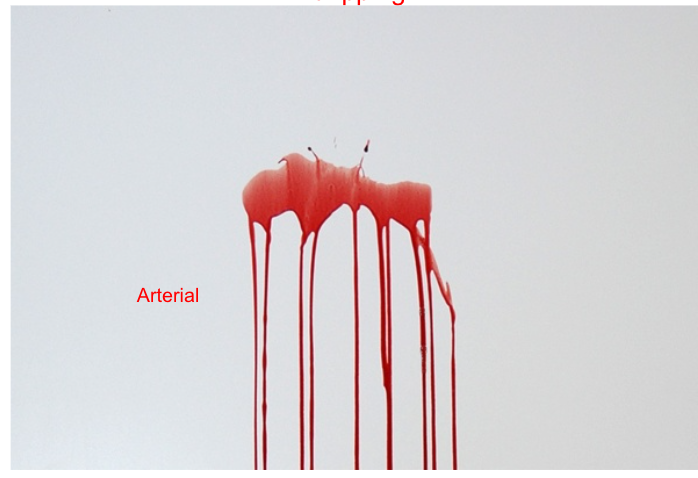
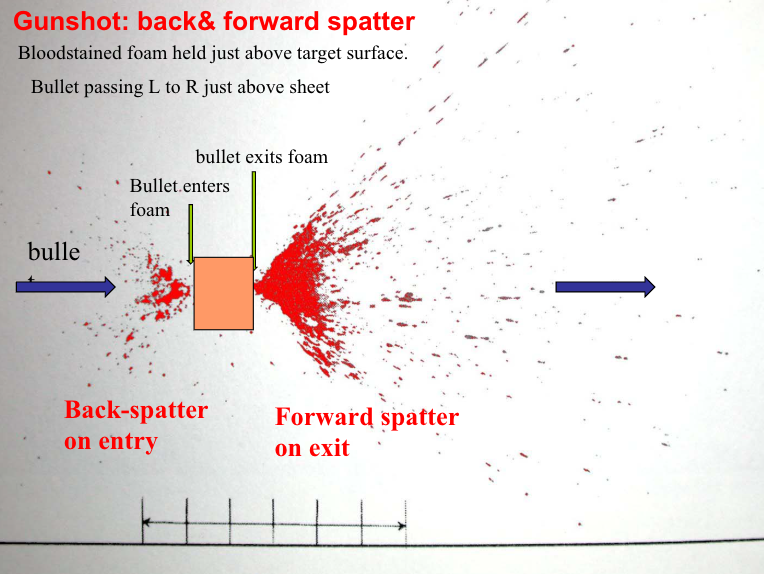
Why is Gunshot Back Spatter so important?
Arises from the entrance wound
Blood travels back towards weapon & shooter
Seen only at close range to entrance wound
Can be Seen on:
inside of a gun barrel
exterior of a gun
hand, arm, chest of shooter
sorry
sorry
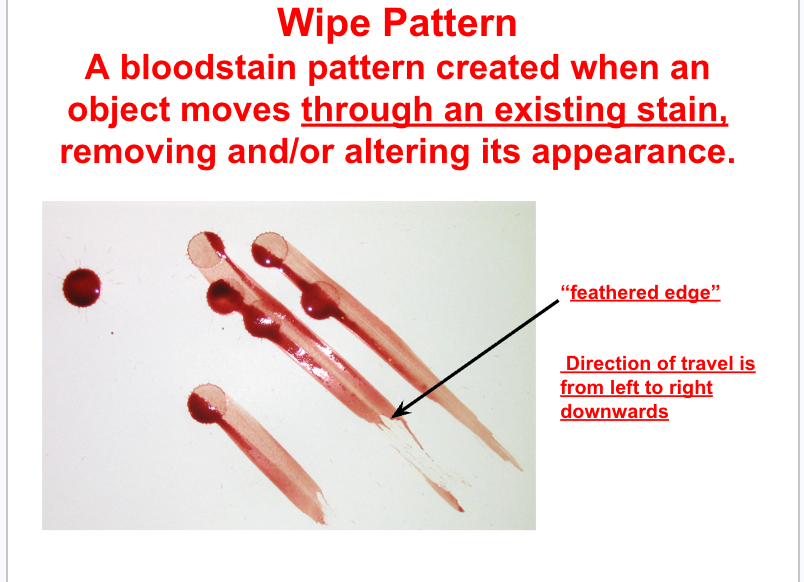
Wipe Pattern
A bloodstain pattern created when an object moves through an existing stain, removing and/or altering its appearance.
Expirated Blood
Blood that is blown out of the nose, mouth, or a wound as a result of air pressure and/or air flow which is the propelling force.
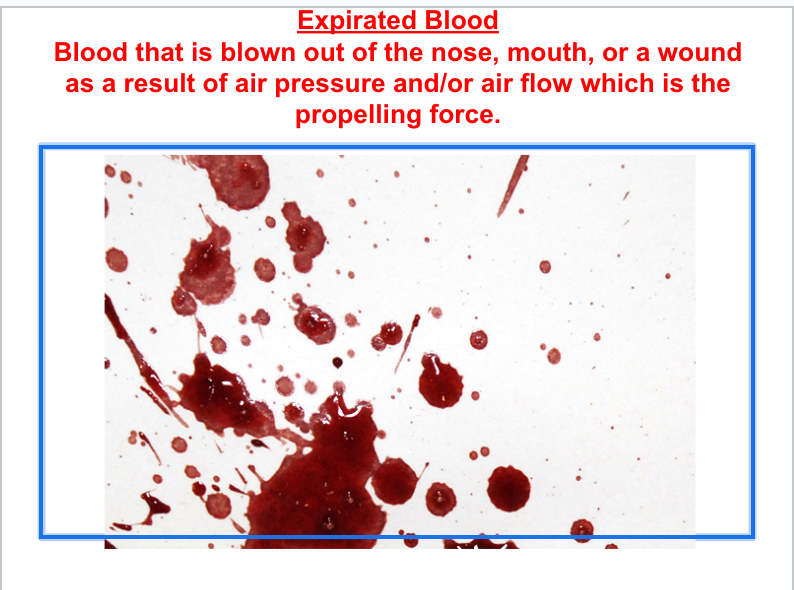
ALSO know that when blood is mixed with saliva, it changes its color.
saliva=lighter. darker - normal color
Bubble Rings
Rings in blood that result when blood containing air bubbles dries and retains the bubble's circular configuration as a dried outline. This is Evidence of expiratory blood
this shows that the victim was still breathing after they started bleeding
David Camm case
The David Camm case occurred in Georgetown, Indiana on September 28, 2000. David Camm, a former state trooper, found his family shot in their garage. The victims were his wife Kim Camm and their children Jill Camm and Brad Camm. He was charged and tried three times because earlier convictions were overturned due to errors and unreliable forensic testimony.
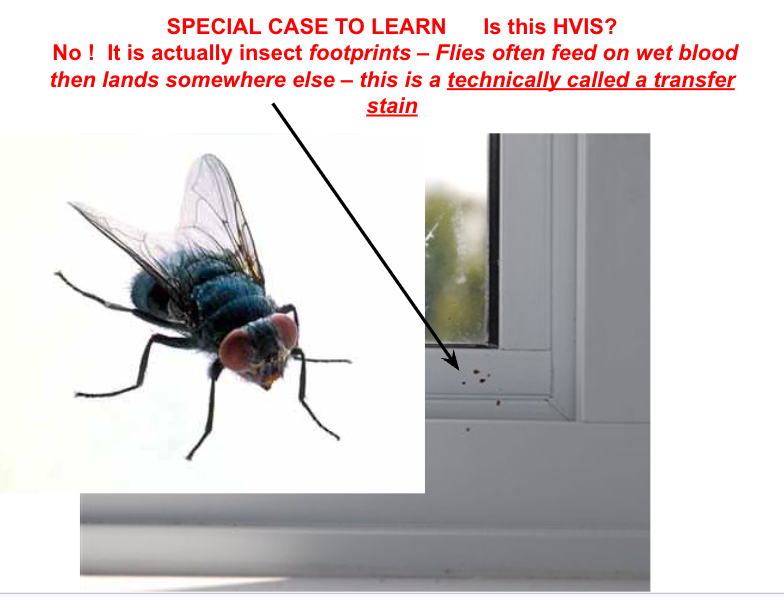
Blood spatter evidence, specifically High Velocity Impact Spatter (HVIS), was central to the case. Prosecutors claimed small stains on Camm’s shirt were HVIS—tiny droplets from gunshots—suggesting he was present during the shooting and therefore the killer.
The defense argued the stains were actually transfer stains, caused when Camm touched his daughter while checking on her. They also challenged the reliability of bloodstain pattern analysis, saying it can be subjective and interpreted differently by experts.
This disagreement over blood evidence became crucial in court. In the third trial, another suspect, Charles Boney, was linked to the crime, and Camm was acquitted. The case shows how blood spatter evidence can be interpreted in different ways and affect trial outcomes.