Biology U1
 Call Kai
 Learn
Learn Practice Test
 Spaced Repetition
 Match
Match Flashcards
 Knowt Play
1/222

There's no tags or description
Looks like no tags are added yet.
Name | Mastery | Learn | Test | Matching | Spaced | Call with Kai |
|---|
No analytics yet
Send a link to your students to track their progress
223 Terms
3 characteristics of DNA
information for creating life in the next generation
form of a code, language
can change through natural selection
Virus are not ____ but has ___ or ___
Virus are not organisms but has DNA or RNA
DNA and RNA stands for
Deoxyribonucleic Acid,
Ribonucleic Acid
Draw and label 3 components of DNA
label the bonds involved with the C numbered
Phosphate [PO4]3-
Pentose deoxyribose sugar
Nitrogenous base
Sugar-phophate backbone with a covalant bond
bases bonded in weak hydrogen bonds
![<ol><li><p>Phosphate [PO<sub>4</sub>]<sup>3-</sup></p></li><li><p>Pentose deoxyribose sugar</p></li><li><p>Nitrogenous base</p></li></ol><p></p><p>Sugar-phophate backbone with a covalant bond</p><p>bases bonded in weak hydrogen bonds</p><p></p>](https://assets.knowt.com/user-attachments/121ec589-cf9d-4830-90de-204cc7e665ed.png)
The complementary base pairs are (FULL NAME)
Adenine - Thymine or Uracil (double bond)
Cytosine - Guanine (tripple bond)
Draw the deoxyribose VS ribose structure
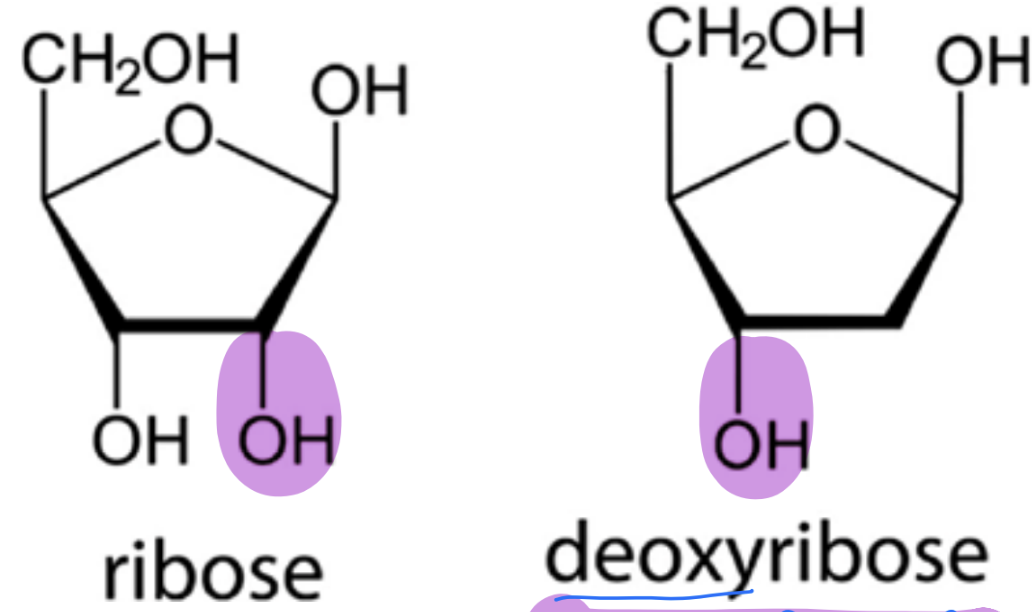
DNA differs in ___ and ___ for all organisms
length, sequence
DNA is efficient becuase it is… (length and base paris)
2 meters long (human) and 3 billion base pairs.
very storage efficient.
Make a table of DNA v.s. RNA with three of their differences
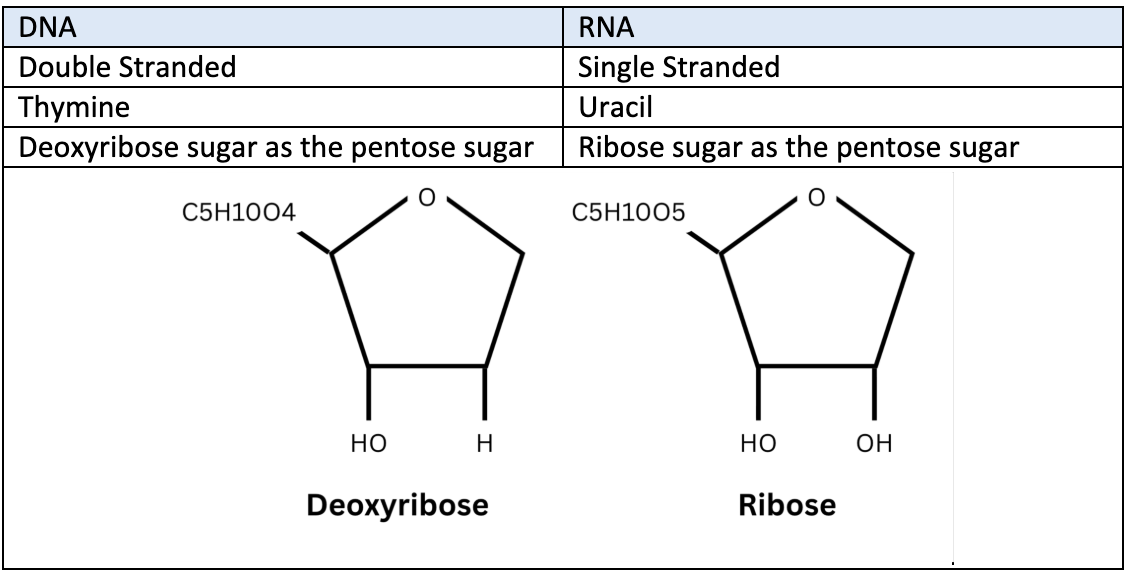
Which are purines and pyrimidines? How do they bond?
Purines: Adenine, guanine
Pyrimidines: Thymine, Uracil, Cytosine
purines and pyrimidines bond in hydrogen bonds (weaker than covalent bonds)
In what two processes are base sequence is critically maintained?
Mitosis
Gene expression
cbp are critcally maintained by accurately manipulating the active site of cbp
L.U.C.A
Last Universal Common Ancestor
genetic ancestor fo all domains of life
discovered by following the genes of trees, plants, fungi
what direction is DNA constructed in?
Attaches 5’ of a DNA nucleotide to the 3’ end of a strand.
Of the 3’ end of the parent strand to the 5’ end.
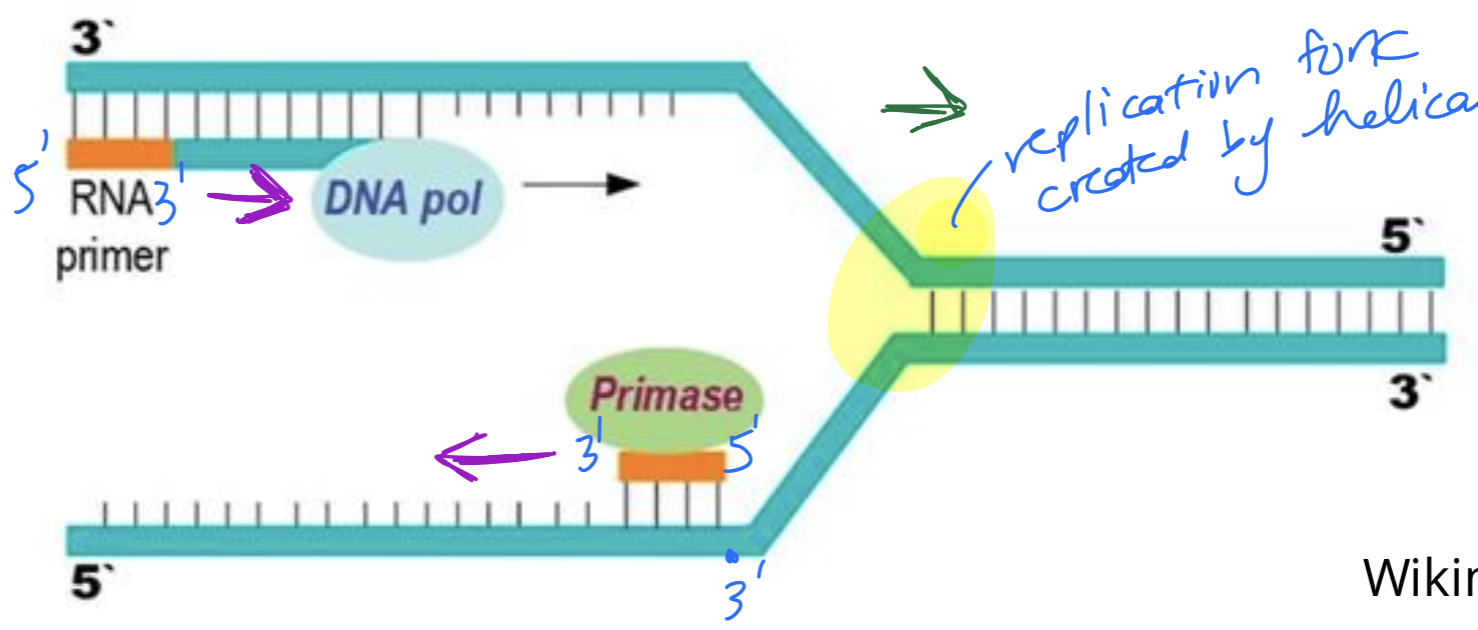
Why are purines and pyrimidines the only combination?
width of 3 rings (2 nm)is just enough for it to be stable
it has to be a constant width across the DNA to be stable
Draw the structure of nucleosomes
octamer of histones in the core
DNA strand coils around the histones
H1 linker histone secures the DNA strand, attched in the linker DNA
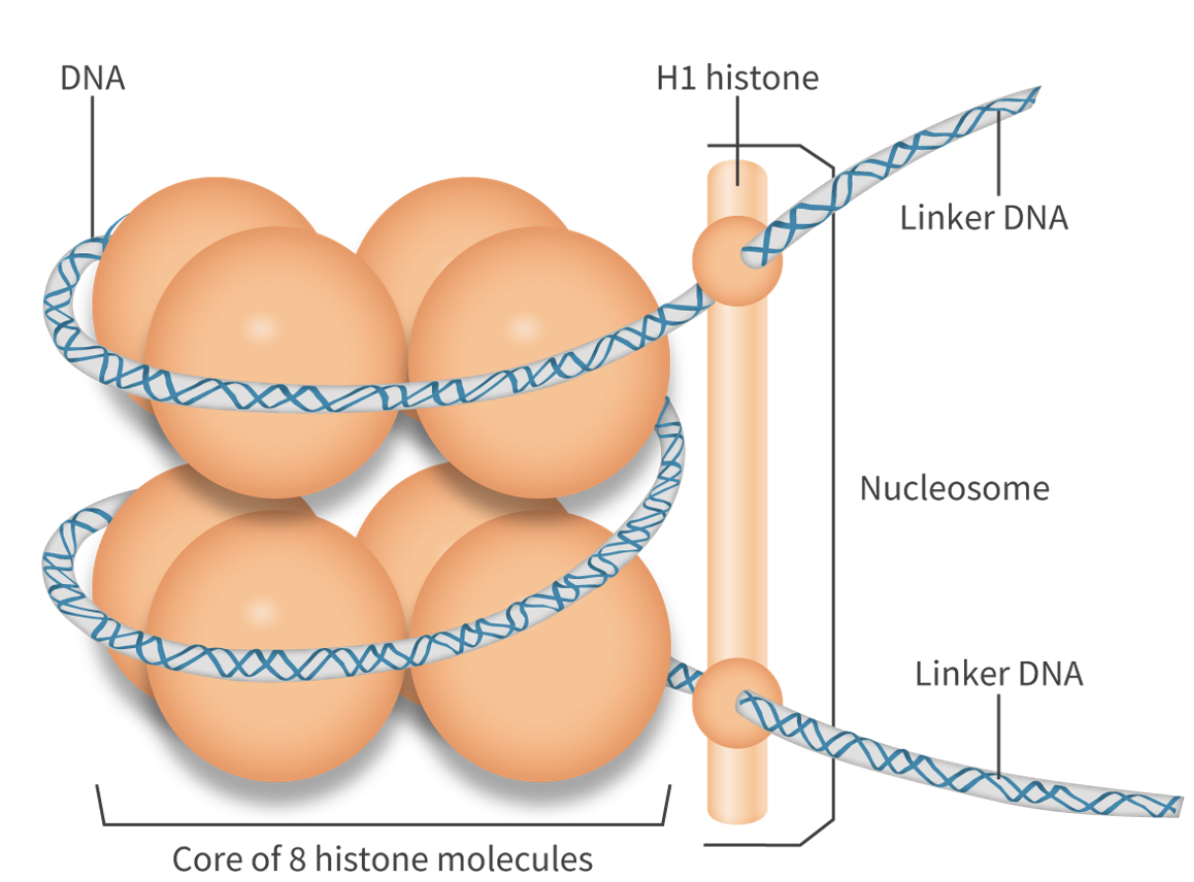
What do Nucleosomes coil into?
Chromatin Fibre and then to a chromosome
What type of cell are nucleosomes found in?
Eukaryotic (animal) cells
Hershey and Chase’s Experiment 1952 (purpose, method and results)
To discover what the heridetary material was
radioactive phosphate labeled on DNA
radioactive sulfur labeled on protein
two samples of bacteriophate with two different labels infects baceria
blend the mixture in a blender
centrifuge the sample so that:
bacteriophate at the top (low density)
bacteria at the bottom (high density)
Sulfur remained on bacteriophage or extracellular
Phosphate found in the bacetria
proved the Avery-Macload-McCarty suspections
Watson and Crick discovery
DNA double helix structure and heridetery in 1953
Radtioisotopes’ definition and use
Atom with an unstable nucleus that emits radiation as it changes to become more stable
Trace location and movement of a labelled molecule
A significant tech. breakthrough
Chargaff’s falsification (method and results)
Examine base pairs of DNA in various species
organise them into tables and percentages
%A=%T
%C=%G
Falsified the tetranucleotide theory that A=T=C=G
4 reasons why DNA is replicated
to repair when there is a need to
to grow an organism
to reproduce a new generation
to regulate functions
Describe how a new strand of DNA is semi-conservative
half is a parental strand
half is a synthesised pair of the parental strand made from free nucleotides
How is genetic integrity maintained?
Active site of cbp is accurately manipulated to allow for genetic continuity and accuracy.
3 steps of polymerase chain reaction at 3 temepartures
after all nessecary things are collected in a test tube, it is put in the thermal cycler
98C: DNA is denatured and base pairs are exposed and broken
55C: lab primers anneal to base pairs as a start before nucleotides
72C: Taq polymerase pairs free nucleotides to the remaining exposed bases and bonds the sugar-phosphate backbone
After 30 cycles, how many copies are made?
After 30 cycles, 2 billion copies are made
The purpose of PCR
to amplify samll amounts of DNA quickly
Why are taq enzymes speical?
they are heat resistant and therefore can sustain its function through all the cycles of PCR without denaturing
they were eenzymes found in hot springs
Gel Electrophoresis 6 steps
PCR to amplify the sample
Restriction DNA cut bonds of fragments of sequences excluding junk DNA. (there are distinct length and sequence of DNA to each person
Samples from different people in a test tube is loaded into wells of a gel slab
Voltage travels through the - and + enode of the gel slab
DNA moves towards the + enode opposite to the wells. Shorter fragments move faster, longer fragments move slower
After a certain amount of time, the fragments of DNA are suspended in the gel and is dyed to make visible.
Two uses of gel elctropheresis
DNA profiling in 2 categories
Forsenic investigations:
Compare for 100% between one sample with several others.
Paternity investigations
Compare for 50% match from a child to a mother or father’s DNA
Role of DNA Helicase
unwind DNA double helix structure
break hydrogen bonds of cdp to expose bases for a new pairing
Role of primase
attaches a primer (short fragment of RNA) to the parental strand that acts as a starting point for polymerase III
There are numerous primers on the lagging strand, but only one on the leading stand
Role of DNA polymerase III
Use the CBP adding of 5’ end of a nucleotide to the 3’ end of a parental nucleotide to build covalent sugar-phosphate backbones
Proofread and corrects DNA errors with a new nucleotide from the 3’ terminal using exonuclease activity
Role of DNA polymerase I
Removes primers and repalces it with DNA Nucleotides
Role of DNA ligase
Bonds Okazaki fragments together with phosphodiester bonds (covalent)
Describe the leading and lagging strand
Leading strand: 3’ end is away from the replication fork, therefore DNA replication can be continuously done as the replication fork expands
Lagging strand: 3’ end is at the replication fork, therefore DNA replication can only be discontinuously done because the polymerase III has to return to the replication fork as soon as it hits the primer.
4 Advantages of compartmentalisation
Carry out specialised functions in a seperate area
Increased efficiency and effectiveness as all metabolites and enzymes needed for a function is already concentrated in an area
Prevent interference of other enzymes
Prevent harming unrealted and healthy organelles
1 possible disadvantage of compartmentalisation
Delays communication signal to the speicalised area
How do Lysosomes and phagocytic vacuoles work together?
in what pH do lysosomes work in?
A vacuole engulfs a foreign particle in the cell (e.g. pathogens)
Lysosome in the vacuole breaks down the foreign particle
lysosome is optimal in a acidic pH of 4.5-5.5, which is not the same as the cell environment
lysosome is also a digestive enzyme, and could cuase harm to healthy parts of the cell if not compartmentalised
How does compartmentalisation allow modification of mRNA before DNA translation?
Because DNA transcription is compartmentalised, mRNA can stll be modified because it is still in the nucleus and not the cytoplasm where translation occurs.
This is not possible for prokaryotic cells
Give four examples of proteins and a one word description of its role
Collagen - structural
Hemeglobin - transports oxygen in RBCS
Insulin - signals blood to be taken into cells in the blood
Trypsin - digestive enzymes for breaking down protein macromolecules
Describe the roles of RNA polymerase
Unwinds DNA double helix
Break cbp hydrogen bonds of bases
Build sugar-phosphate backbones of the mRNA strand using cbp of the mRNA strand and DNA strand
Describe gene expression and factors that could affect it.
Refers to how much genetic information is used to produce functional products like proteins through activity of transcription, translation, etc.
transcription is highl controlled beause it is the first step of gene expression.
Factors: type of cell, external esignals, time, age.
11 of a eukaryotic animal cell (draw and label function)
Plasma Membrane
Cytoplasm
Cytoskeleton
Nucleus
Rough Endoplasmic Reticulum
Smooth Endoplasmic Reticulum
Mitochondria
Golgi Apparatus
Vesicles
80S ribosomes
Lysosomes
13 of a eukaryotic plant cell (draw and label function)
Cell wall
Plasma Membrane
Cytoplasm
Cytoskeleton
Nucleus
Rough Endoplasmic Reticulum
Smooth Endoplasmic Reticulum
Mitochondria
Chloroplasts
Golgi Apparatus
Vesicles
80S ribosomes
Sap Vacuole
5 of a prokaryotic cell (draw and label function)
Cell wall
Plasma membrane
Naked DNA
Cytoplasm
70S ribosomes
Explain steps of DNA replication with a labeled diagram
directionality: 5’ to 3’
Explain steps of DNA transcription with a labeled diagram
What is the effect of DNA transcription on the DNA
None. there is no effect on it and it stays stable.
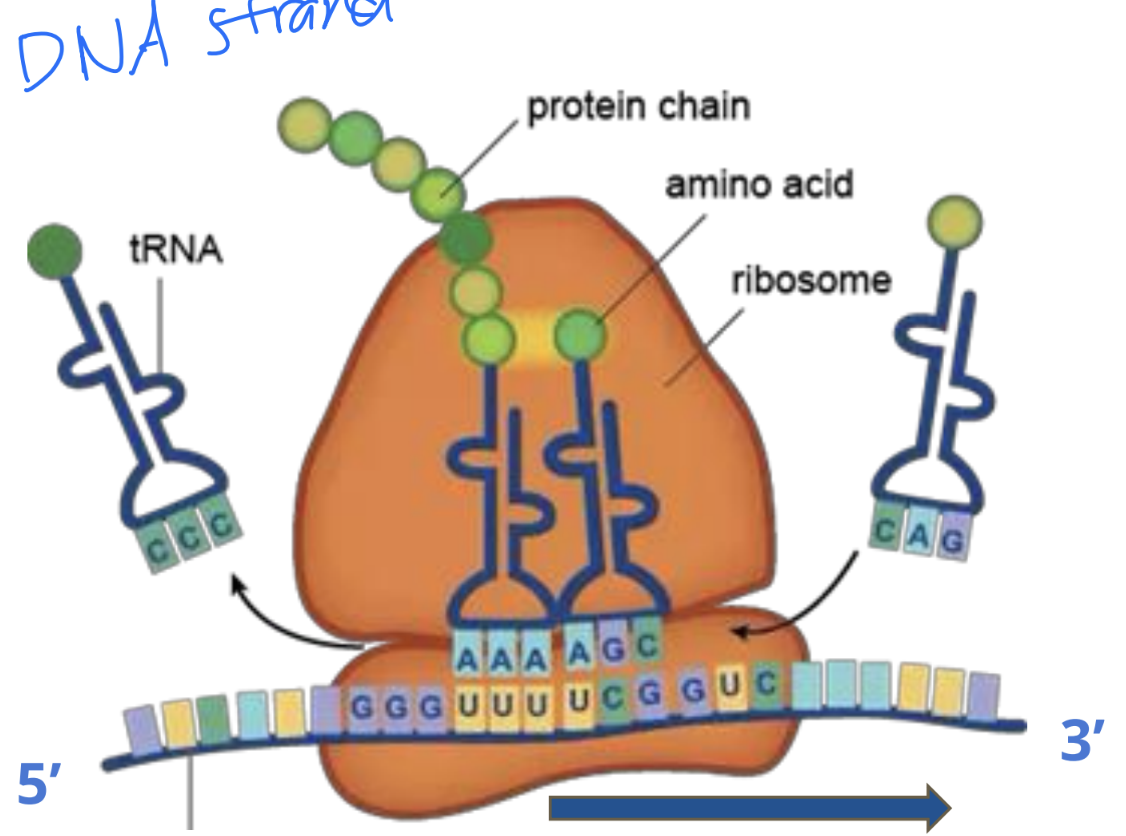
What is DNA translation? (location, required molecules & organelles, product)
takes place in the cytoplasm
requires mRNA, tRNA, ribosomes, amino acids (AA)
produces a polypeptide chain
Draw a labeled diagram of a chain of polypeptide
monomers of amino acids, joined by peptide bonds, forming a chain of polypeptide/ protein
Different combinations of AA bonded makes various structures
3 types of RNA and there function
mRNA (messenger): contains the code for building the protein
tRNA (transfer): brings the amino acid that corresponds to the mRNA codon, to the ribosome
rRNA (ribosomes)
Explain steps of DNA translation using a labeled diagram
Definition for mRNA codon and tRNA anticodon
mRNA codon: 3 nucleotide sequence that corresponds to a tRNA and an AA
tRNA anticodon: 3 nulceotide sequence that base pairs with an mRNA codon
triplets ensure reliability of the process, making no wrong amino acids
Draw a diagram of a ribosome’s strucutre
Small subunit: binds to the mRNA molecule
Large subunit: location of the poplypeptide chain and tRNA entrance and exit. Has space for 3 tRNAs but only really has 2 at a time.
make of ribosomal RNA (rRNA) and other proteins
How many possible codons and amino acids are there?
64 codons
20 amino acids
Many codons can code for the same amino acid —> degenracy
The same codons, code for the same amino acids in every organism on Earth with very few exceptions, evidence for LUCA
What is the functionality of the porous nuclear membrane?
Allows for diffusion fo mRNA and proteins
What are the advantages of a double layered nuclear membrane?
made of lipid bilayers, that are interspersed with proteins
Comparmentalise the nucleus in the cytoplasm (reason for the possibility of post-transcription modification)
Further control of diffusion
What are the advantages of a continuity of the nuclear membrane and rER?
Close proximity —> mRNA can be translated quickly with the ribosomes attached on the rER and outer membrane —> high efficiency of protein synthesis
The changes of the nuclear membrane during mitosis or meiosis
prochase: nuclear membrane breaks down into small vesicles, allowing the chromosomes to be exposed in the cytoplasm
Metaphase, anaphase: vesicles are free floating in the cell
Telophase: vesicles attach on to chromosomes, vesciles fuse with each other to reform the ucelar membrane.
How do free v.s. bound ribosomes differ?
Free ribosomes: in the cytoplasm, produce proteins that are used within the cell
Bound ribosomes: on the rER, produce proteins that is to be secreted out of the cell.
Draw a labeled diagram of the golgi apparatus
Cis face twoards the rER
Cisternae labeled
Trans face towards the plasma membrane
What is the function of a golgi apparatus?
Sort, modify, tag polypeptides for destinations as a final matured protein.
it has the same material (lipid bilayer) as othe rmembranes in the cell, so it can fuse to other organelles in processes such as endocytosis, exocytosis
4 types of vesicles and their functions
Secretory: transport out of the cell
Transport: transport within the cell
Vacuoles: store H2O for osmotic pressure (plant cells only)
Lysosomes and peroxisomes: enzymes that break down materials
Advantages of vesicles (2)
Membrane bound: can concentrate materials, making it easier to keep track of during transport.
Same material as other membranes: can fuse into another and form out of another
Draw a labled diagram of endocytosis and exocytosis
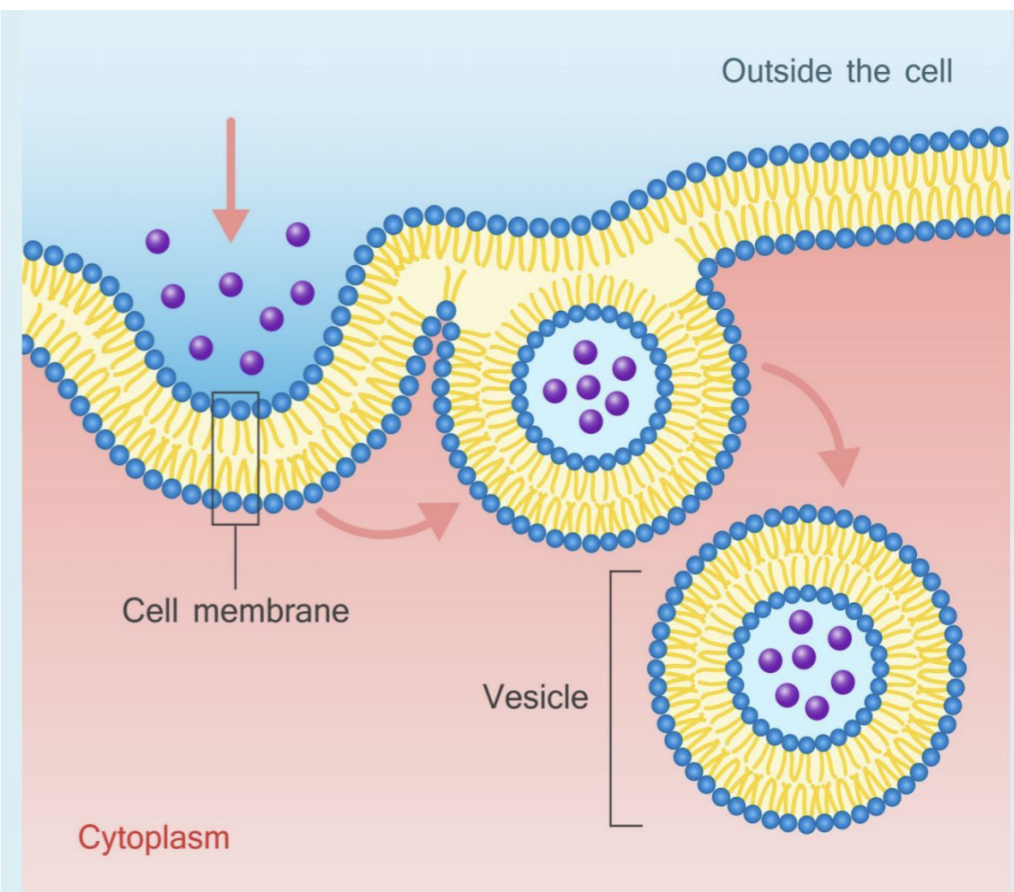
The chronological order of organelles passed through in endocytosis and exocytosis
plasma membrane —> vesicle —> destination
rER —> vesicle —> Golgi apparatus —> vesicle —> plasma membrane
What is Clathrin and how does it help in endocytosis?
A 3 legged protein that has a hexagonal latice
Aids in pulling, shaping and pinching of the plasma membrane
Gives vesicles structure and protection during transportation
Breaks off when the vesicle arrives at the deestination, reused at another vesicle
Describe Normal RBC v.s. Sickle cell
Normal RBC:
A sac of hemoglobin
Disk like shape
Sickle Cell:
A sac of mutated hemoglobin
Shape of a sickle
Cannot carry oxygen well —> blood clots, slow circulation —> sickle cell disease
BUT, reduces malaria infection symptoms
Define gene mutation
Structural changes in genes at the molecular level, meaning the the nucleotide sequence of DNA is changed affecting the structure and function of proteins
3 types of point mutation
Point mutation: a single nucleotide in the DNA is
inserted
deleted
substituded
Base substitution and their effects
aka single-nulceotide polymorphism (SNPS)
Silent —> neutral, same AA
Missense —> beneficial, neutral, harmful, different AA
Nonsense —> harmful and shortens DNA , stop codon
Normal RBC v.s. Sickle RBC base substitution example
Normal RBC: CTC (DNA) —> GAG (mRNA) —> Glu (AA) —> a globular protein structure
Sickle RBC: CAC (DNA) —> GUG (mRNA) —> Val (AA) —> a fibrous protein structure
Frameshift mutations (insertions and deletions)
The triplets sequence changes, so the reading frame shifts, usually resulting in non-functioning proteins
2 Causes of Mutations
Mutagens
Error in DNA replication or repair
Examples of Mutagens
Chemical mutagens
Mustard Gas
Nitrous Acid
Dioxin
Radiation mutagens
X ray
UV
Radioactive isotopes
Randomness of gene mutation
Can occur randomly anywhere on the genome
Some bases are more prone to mutations
Have no deliberate mechanisms for mutations
What are somatic/germ cells and what are the effects of mutation on them?
Somatic Cells:
All cells but germ cells
Cause disease like cnacer
Not passed on to offspring
Germ cells:
Cells that give rise to gamates (egg and sperm)
Lead to mutations in gamates too
Passed on to offspring but has various effects
Overall imapct of mutation in species
Mostly harmful or neutral
Beneficial ones: help survive and evolve in natural selection
Issue of commerical genetic tests
Providing info about potential future health issues and risk is problematic because…
Anxiety
Uninformed decisions
Family impacts
Misleading, misunderstandings
Lack of counseling or comprehensive healthcare
Conserved sequences
Identical or similar DNA sequences across a species or group of species
Highly conserved sequences
Similar DNA sequences over long periods of evolution
3 hypotheses for highly conserved sequences
(Null hypothesis) it happened randomly
the gene’s proteins are fundamental to life that variations and mutations do not survive
There was a low mutation rate (low rate of transcription, translation, replication)
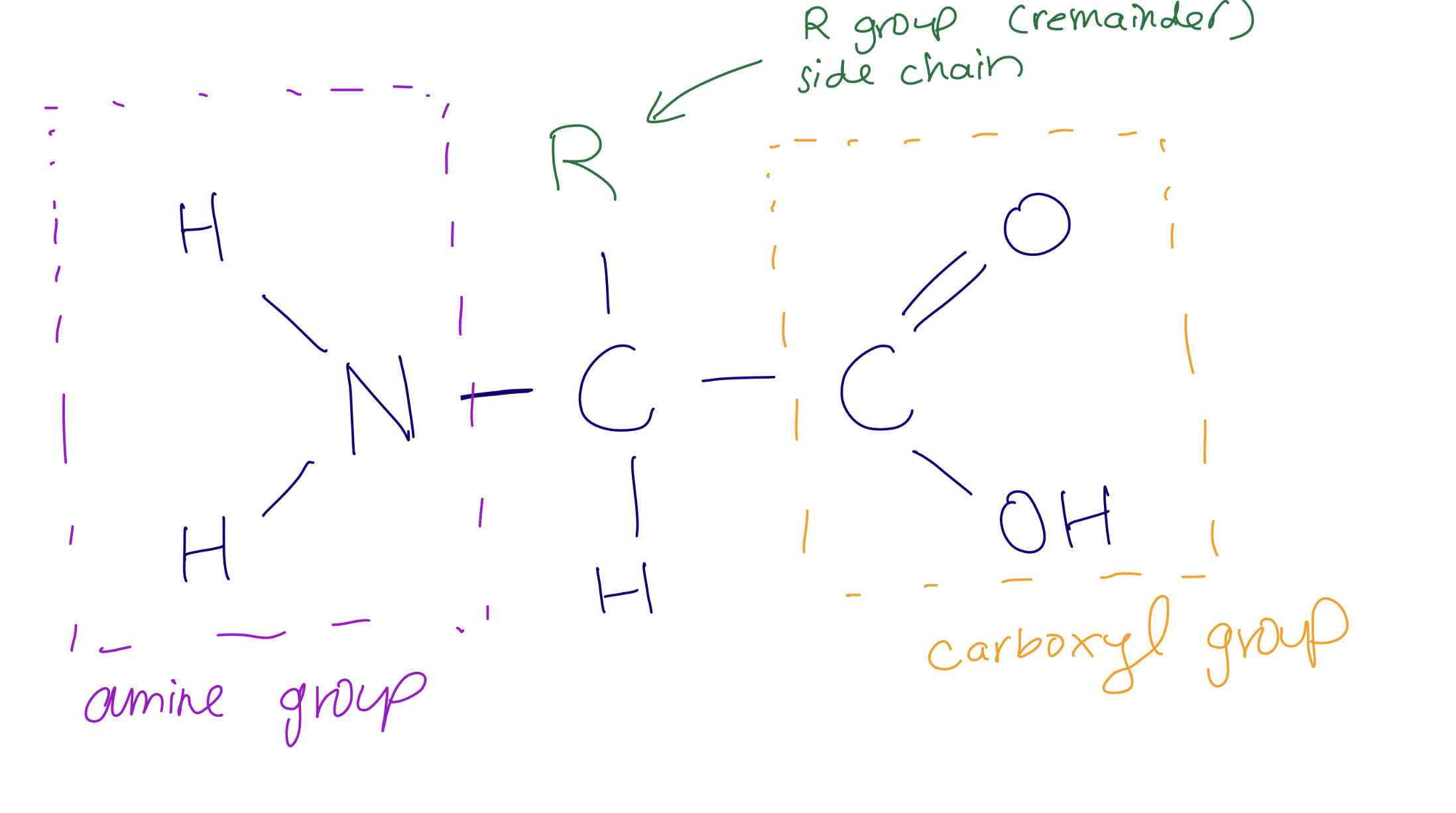
Draw an amino acid and label the groups
draw a dipeptide condensation reaction and label the bond
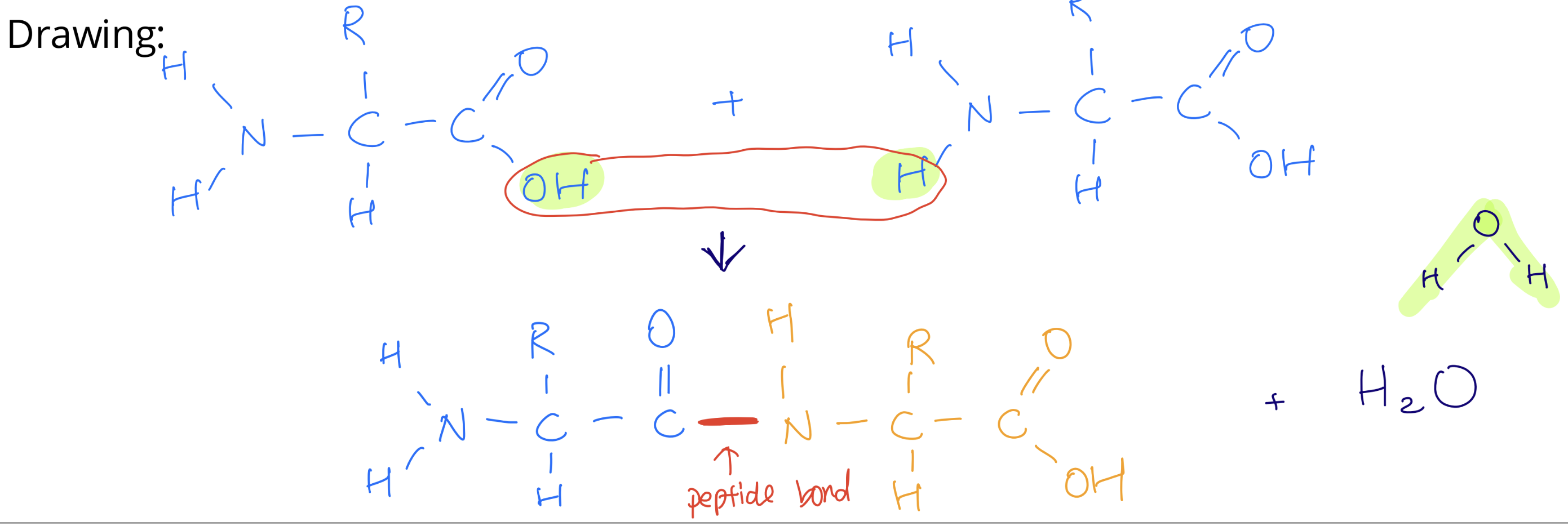
word equation of amino acid condensation
amino acid + amino acid —> dipeptide + water
Definition of condensation
joining of 2 molecules together to form one molecule, with water as a byproduct.
examples: dipeptide and nucleic acid formation
Definition of Non-essetial AA
AA that can be synthesized from other AAs or the human body
Definition of Essential AA
AA that cannot be syntehsized by the human body, and must be obtained through the diet (e.g. egg, meat)
Variety of polypeptide
Although only 20 AAs exist form the genetic code, the combination that it creates makes the polypeptide different in
length of AA
Order/ sequence of AA (not all have to be used)
INIFINITE combinations of AAs —> INFINITE variety of polypeptides
Name 3 examples of polypeptides and their functions
Lysozyme: enzyme
Myoglobin: oxygen storage and transport
Glucagon: hormone that raises blood glucose levels
Effect of pH and temperature on protein structure
Outside of optimal range —> decraesed enzyme activity
Denatured—> loss of structure —> inactive or dysfunctional protein that has altered solubility and charge.
Describe gene knockout
A technique that makes a gene inoperative
Learn what changed in the absence of it
There is a library of knockout mice that are model organisms for research purposes.
Crispr-cas9 procedure outline and examples
Precisely cut DNA at desired sequence
Creates a mutation in the species OR substitute in a new sequence
Natural repair process takes over
Mutate that specific gene as a result
Examples:
Decaf coffee
Take HIV virus out of DNA to clear infections
Modify wheat to remove gluten
the usage of crispr still raises ehtical concerns. a solution could be international regulation systems.
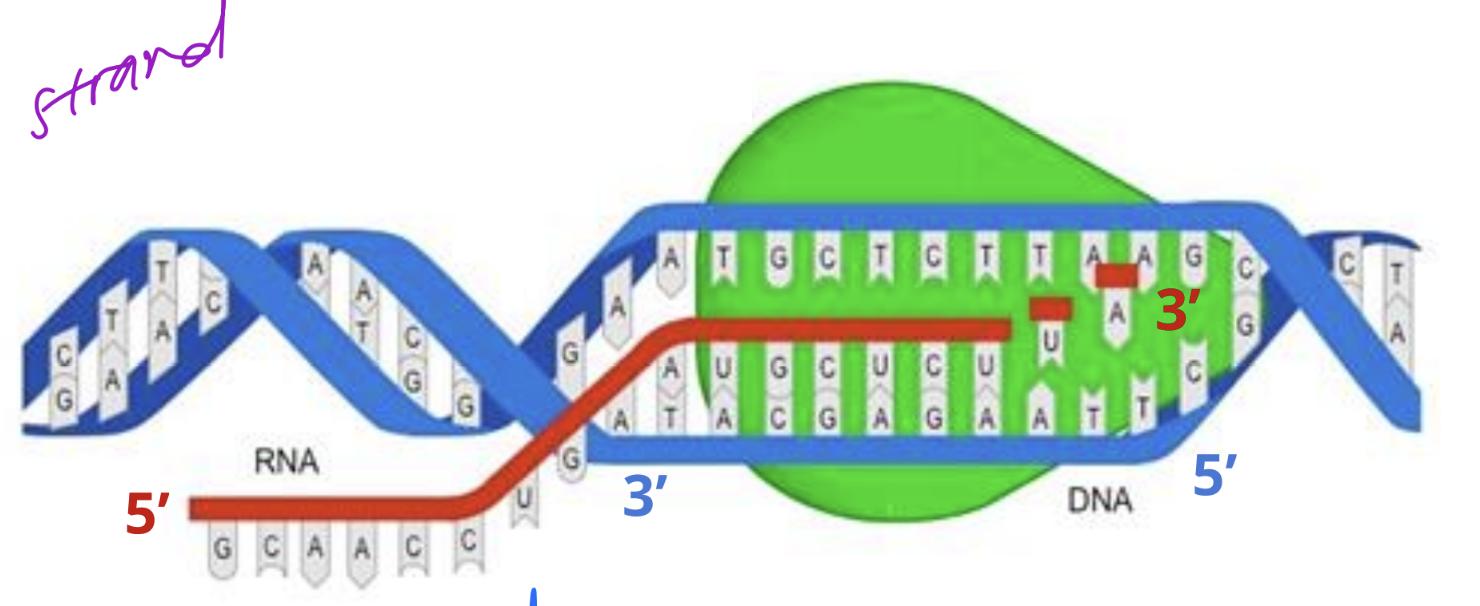
Directionality of DNA transcription
mRNA is synthesised from 5’ to 3’
Directionality of DNA translation
Ribosomes move 5’ to 3’ along the mRNA
Outline of the initiation of transcription
Transcription factors guide RNA polymerase to the promotor region (a non coding region before the gene), where RNA polymerase binds to and begin transcription
Steps of post-transcriptional modification before translation
5’ menthyl cap and 3’ Poly-A tail is added at the beginning and end of the gene, including the leader and trailor. This is to stabalise against the degredation of mRNA
RNA is processed: introns are spliced from the mRNA
Definition of an Intron
non-coding sequence of DNA transcribed into RNA, but is removed in splicing of post transcriptional modifications.
Definition of an extron
coidng sequences of DNA or RNA within transcripted genes.