Class 15: Risk and Uncertainity
 Call Kai
 Learn
Learn Practice Test
 Spaced Repetition
 Match
Match Flashcards
 Knowt Play
1/26

There's no tags or description
Looks like no tags are added yet.
Name | Mastery | Learn | Test | Matching | Spaced | Call with Kai |
|---|
No analytics yet
Send a link to your students to track their progress
27 Terms
What is risk?
Risk arises if the decision-make doesn’t know what will happen,
But can assign probabilities to all possible outcomes
What is uncertainty
The decision-maker doesn’t know the possible outcomes and/or their probabilities
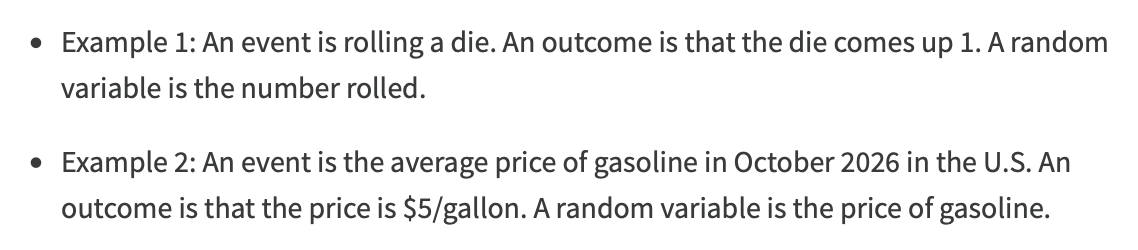
Risk, events, and outcomes
An event is a situation in which a number of possible outcomes can occur
A probability is number between 0 and 1 that indicates the likelihood that a particular outcome will occur
A random variable is a variable that can take on different numerical outcomes with particular probabilities
What is classical probabilities?
Classical probabilities are based on mathematics, when all outcomes are equally
likely. For instance, rolling a fair die.
What is empirical probabilities?
Empirical probabilities are based on past events. Here, the probability is the number of times an outcome occurred divided by the number of possible trials.
What is subjective probabilities?
Subjective probabilities are based on personal assessments. For instance, the likelihood of a recession or of a Kings championship.
What is Expected value
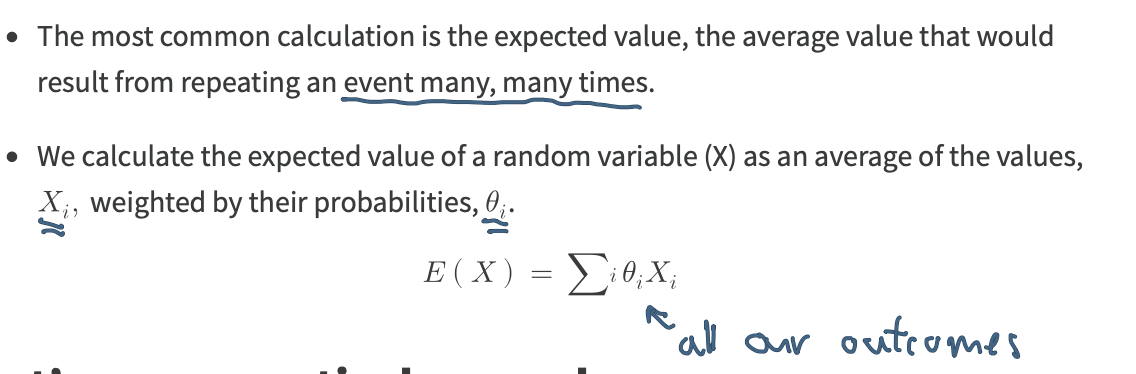
The most common calculation is the expected value, the average value that would result from repeating an event many, many times.
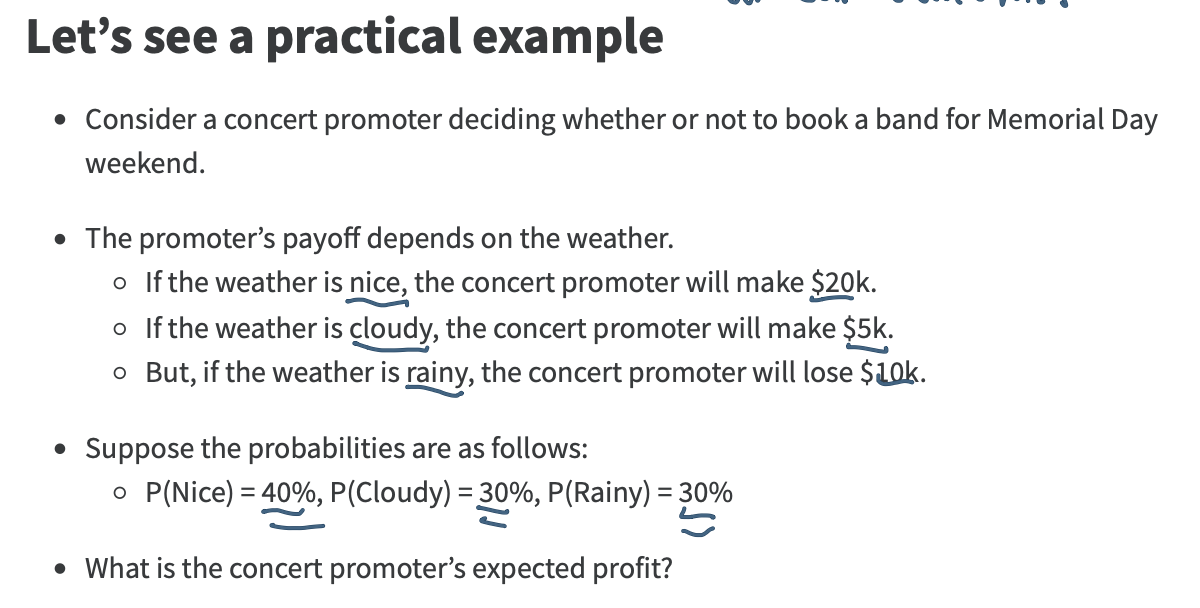
The promoterʼs payoff depends on the weather.
If the weather is nice, the concert promoter will make $20k.
If the weather is cloudy, the concert promoter will make $5k.
But, if the weather is rainy, the concert promoter will lose $10k.
Suppose the probabilities are as follows:
P(Nice) = 40%, P(Cloudy) = 30%, P(Rainy) = 30%
What is the concert promoterʼs expected profit?
Nice weather = .4(20,000)
Cloudy weather = .3(5,000)
Rainy weather = .3(-10,000)
E(X) = 8000 + .3(5,000) - .3(10,000) = $6,500
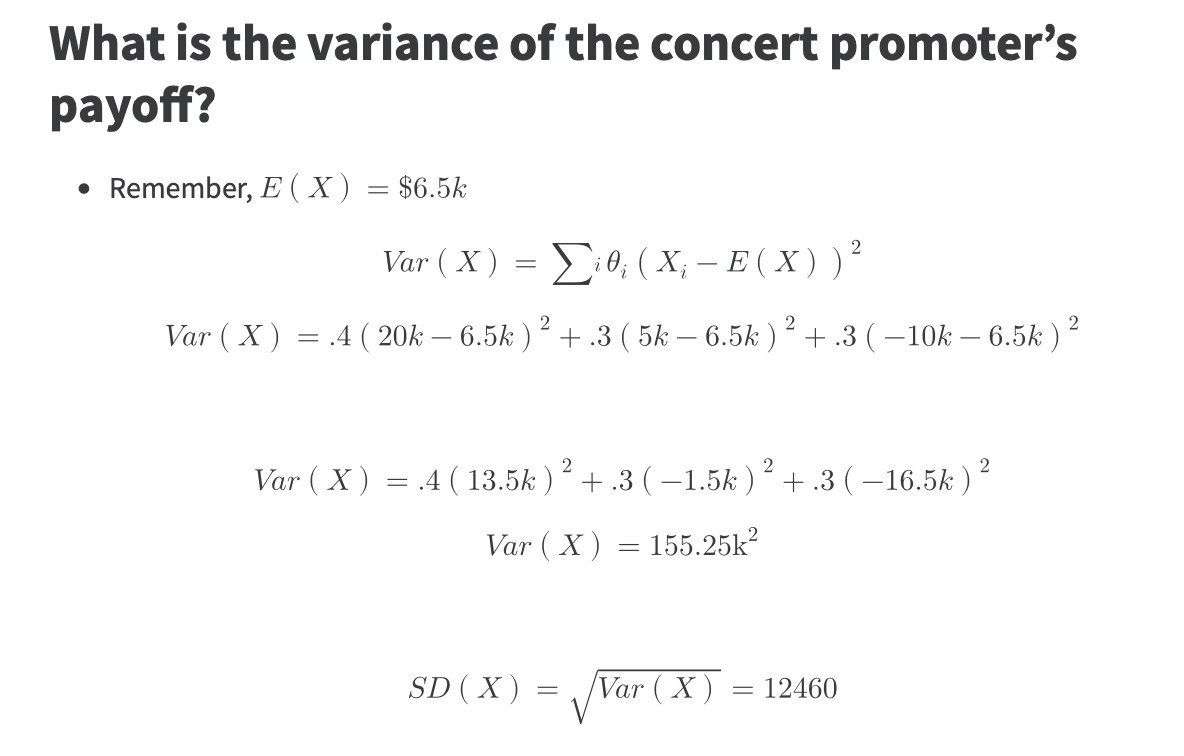
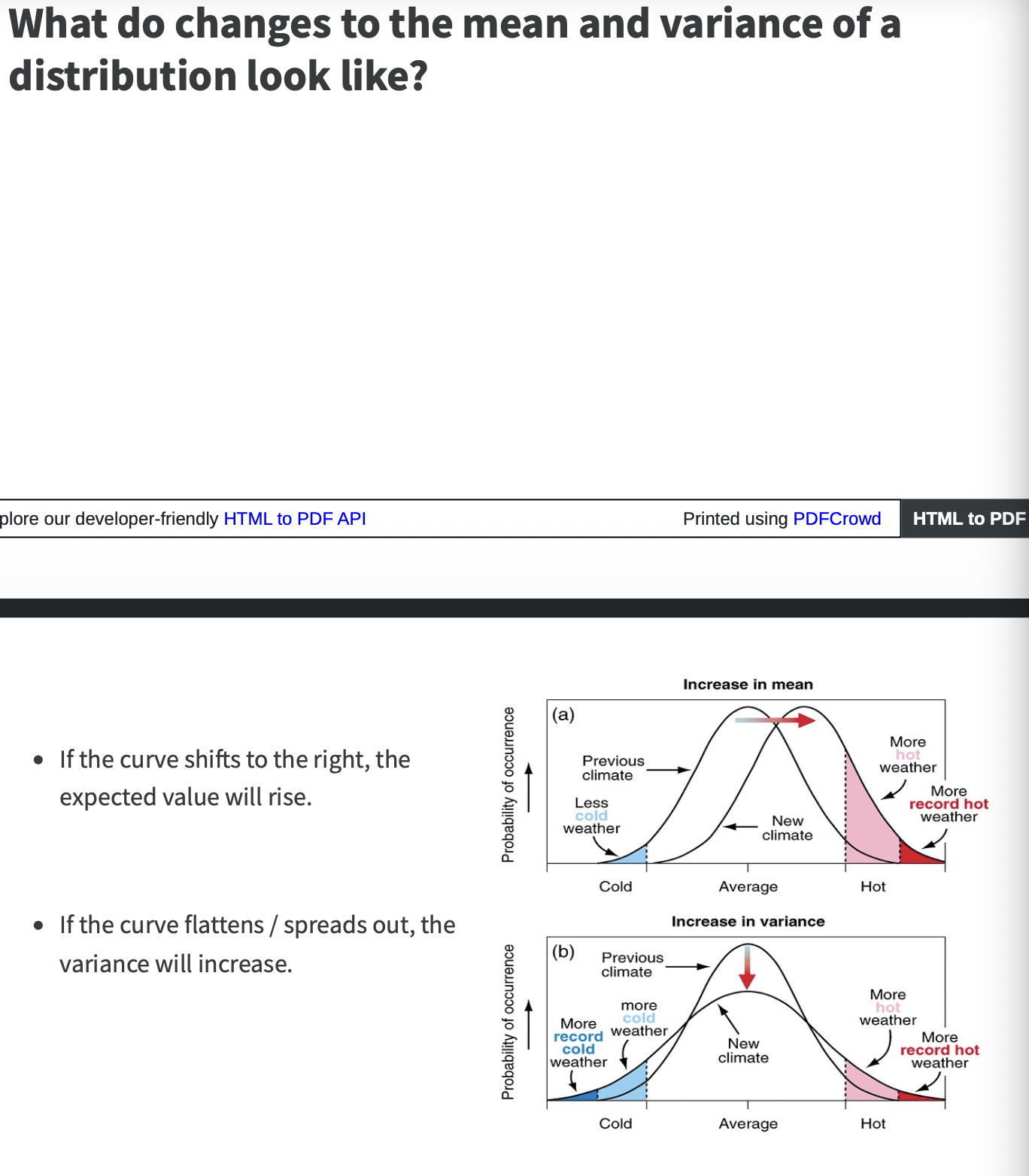
What is variance?
The variance is the measure of variability around the expected valued
The variance is measured as a weighted average of the squared difference between the values that the random variable (X) can take and its expected value.
Note
Noted
Note
Noted
What is the expected value of the lottery ticket?
The lottery ticket has a 50% chance of winning $1,000 and a 50% chance of winning $0.
E(X) = .5(1,000) + .5(0) = 500
The lottery ticket has a higher expected value than the sure $400, yet many people prefer option B. Why do you think that is?
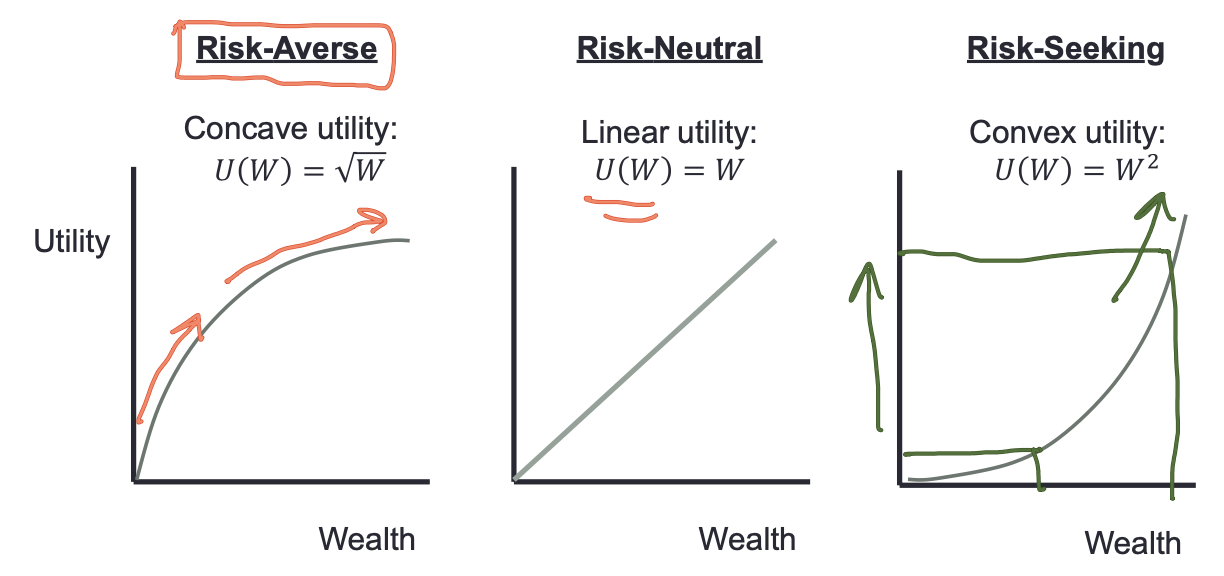
Risk aversion
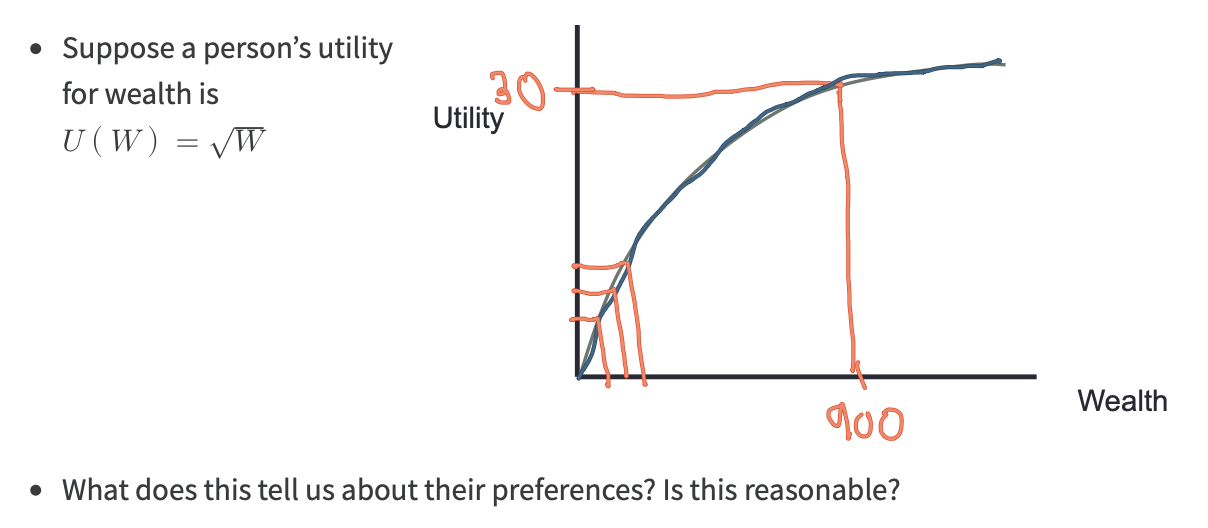
Expected utility theory. We can alter our model of maximization to include, by assuming people maximize expected utility rather than just expected wealth? What does this tell us about their preferences? Is this reasonable
IDK
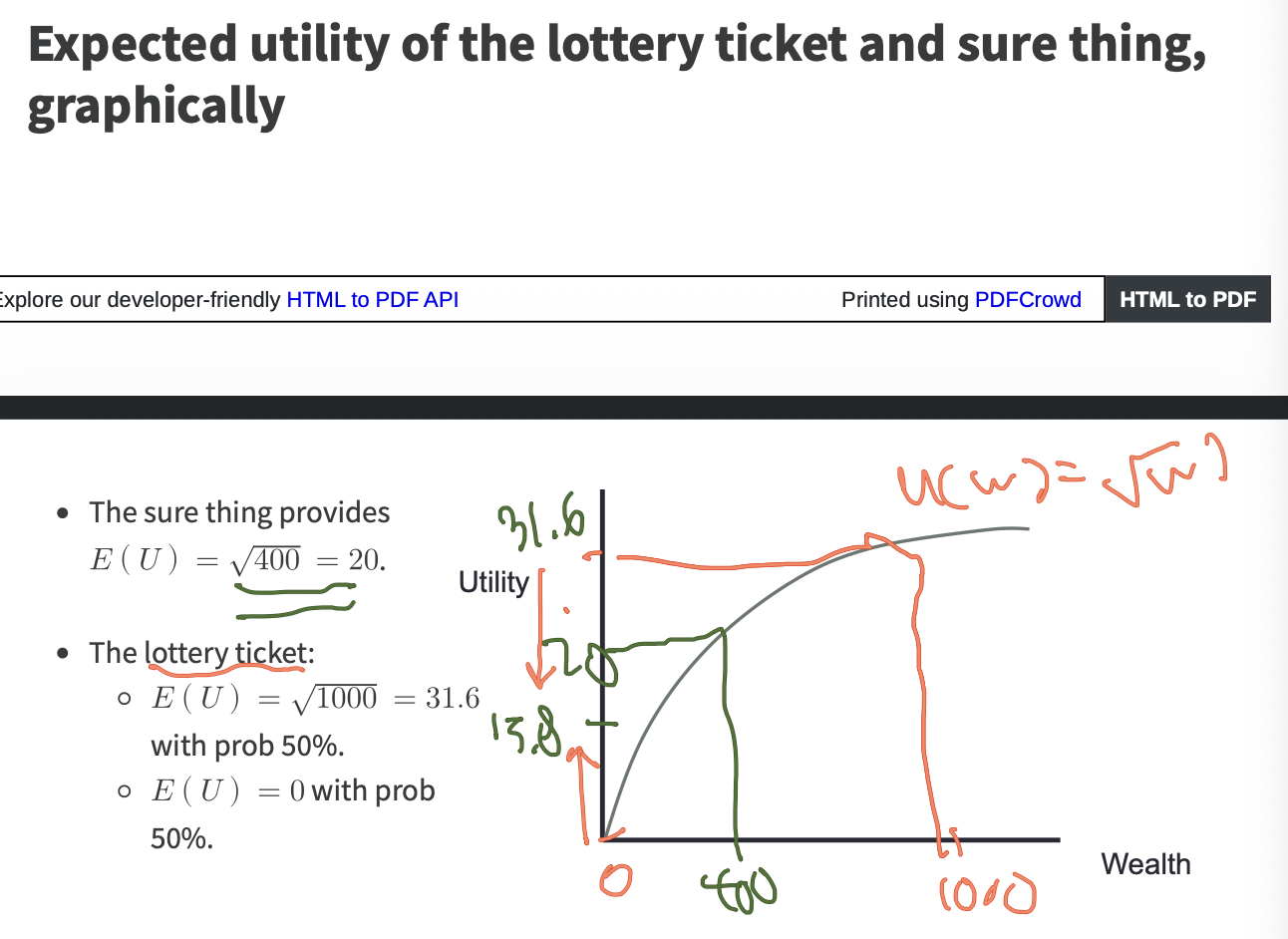
Would the person with U(W) = Sqrt(W) choose the lottery ticket?
The expected utility of the lottery ticket is
E(U) = .5(sqrt(1000) + .5(sqrt(0) = 15.8
The expected utility of the “sure thing” is
E(U) = 1(sqrt(400) = 20
From this the person will prefer “sure thing” over the lottery ticket, because the utility received is higher (20 > 15.8)
Graph expected utility of the lottery ticket and sure thing
Noted
Risk aversion, risk neutrality, and risk seeking
People can be classified by their attitudes toward risk by looking at how they respond
to a fair bet.
A fair bet is a wager with an expected value of zero.
You receive $1 if a flipped coin comes up heads and you pay $1 if a flipped coin
comes up tails.
What is risk aversion?
Someone who is risk averse is unwilling to take a fair bet
What is risk neutral?
Someone who is risk neutral is indifferent about a fair bet
What is risk seeking?
Someone who is risk seeking prefers the fair bet
Concavity of utility and risk aversion
Noted
What is certainty equivalent and the risk premium?
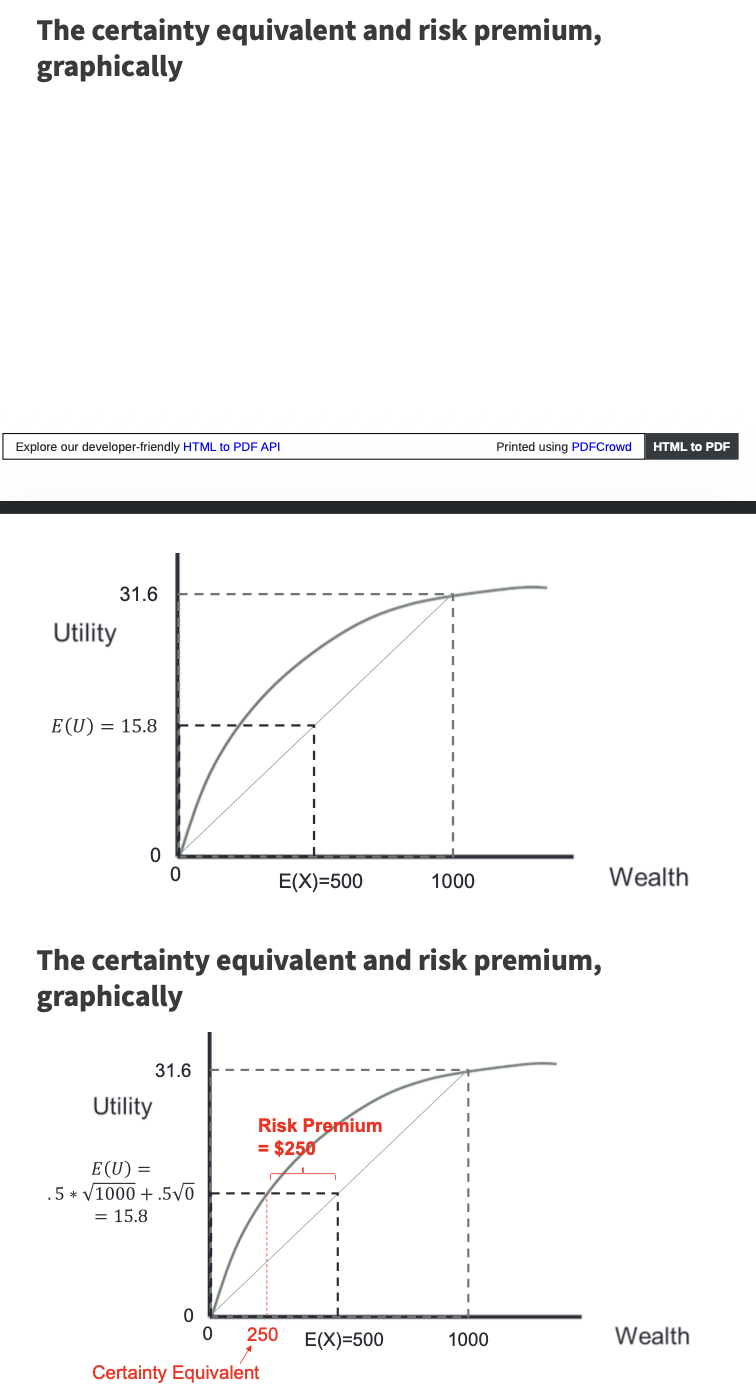
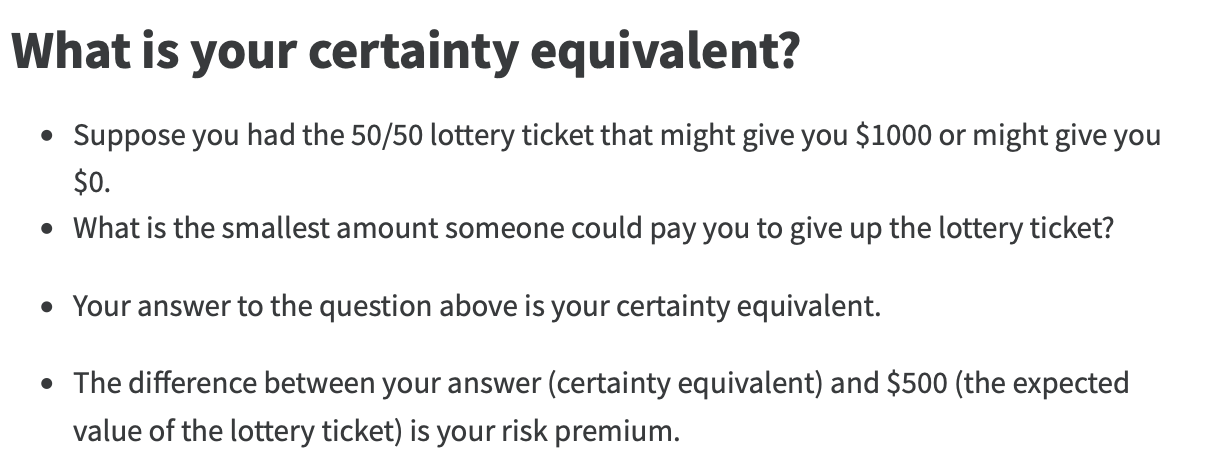
The certainty eqvivalent of the risky prospect is the amount of certain wealth that would yield the same utility as the lottery.
What is risk premium
The risk premium is the difference between the certainty equivalent and the expected
value of the lottery.
The risk premium is how much you are willing to give up in expected value to avoid the risk.
Examples of certainty equivalent and risk premium
Noted
What is the uncertainty equvialent for the individual with U(W) = Sqrt(W)
If U(W) = Sqrt(W), the expected utility of the lottery ticket was
E(U) = 0.5sqrt(1000) + 0.5sqrt(0) = 15.81
CE = W = 250
CE = 250
What is the risk premium for the individual with U(W) = SqrtIW)
E(X) = .5(1000) + .5(0) = 500
CE = 250
Risk premium = E(X) - CE = 500 - 250 = 250
Interpretation: The person is willing to give up $250 of expected value to avoid the risk
of the lottery.
The certainty equivalent and risk premium graphically
Noted