Analysing data
 Call Kai
 Learn
Learn Practice Test
 Spaced Repetition
 Match
Match Flashcards
 Knowt Play
1/46

There's no tags or description
Looks like no tags are added yet.
Name | Mastery | Learn | Test | Matching | Spaced | Call with Kai |
|---|
No analytics yet
Send a link to your students to track their progress
47 Terms
What is a Z score?
A score that is a way of assessing how unusual or uncommon a score is related to the mean
What % of scores will be within 1 standard deviation of the mean?
68%
What % of scores will be within 1.96 standard deviations of the mean?
95%
What % of scores will be within 2.58 standard deviations of the mean?
99%
What is a parameter?
Sample population we are trying to measure
What is standard error?
Standard deviation of the sampling distribution
What is central limit theorem?
If you take sufficiently large random samples from any population with a finite mean and variance, the distribution of the sample means will be approximately normally distributed - regardless of the original population’s distribution.
What is a confidence interval
An estimated range that is likely to include the true population value, with a certain level of confidence
What percentage of samples creates a confidence interval that contains the true population value"?
95%
How do we calculate standard error?

What is confirmatory research?
Hypothesis is determined BEFORE we run any tests
What is exploratory research?
No null hypothesis prior to running test
What are 2 types of conceptual hypothesis?
Non-directional
Directional
What is an operational hypothesis?
The process of translating concepts into measures
What is the null hypothesis? H0
Describes a reality where the effect we are interested in does not exist
What is the alpha level?
Rate of positive findings that we are willing to accept
What is the alpha level most of the time?
5%
What is the p value?
The probability of observing a test statistic, at least as large as the one observed, if the null hypothesis is true
What are the 2 types of T-tests?
Independent
Paired
What is grapheme-colour synaesthesia?
Association between letters/words and particular colours
What is the definition of correlation?
The (standardised) degree to which two variables covary.
How is correlation calculated?
Covariance / product of standard deviations
What is the definition of variance?
How much scores differ from the mean on average
What is covariance?
How much pairs of scores deviate from their (respective) means in the same way, on average
What does it mean if the sign of r mean if it is NEGATIVE?
As one variable INCREASES the other DECREASES
What does it mean if the sign of r mean if it is POSITIVE?
As one variable INCREASES the other INCREASES
What is tertiam quid?
An unmeasured third variable that influences the two other measured quantities
What is chi-squared?
The sum of the squared differences between the observed and expected counts
What is an example of continuous data?
Reaction time
What is an example of categorical data?
Year of uni
What is the equation to calculate confidence intervals?

What is the equation for the linear model?

What is b0?
The intercept
What is b1?
The intercept
What is x1i?
The hypothetical value for the predictor
What is ei?
The error for the individuals actual score
What is R2?
How much of the variance in the outcome is explained by the model
What are the residuals?
How “wrong” the model is - goal as small as possible
What is the F statistic?
Whether the variance explained significantly differs from 0
What is publication bias?
Where statistically significant results are favoured for publication over non-significant findings.
What is p-hacking?
Taking specific analytic steps in order to achieve statistical significance rather than (pre-planned) steps that are more appropriate to answer the research question.
What is HARKing?
Involves collecting data without a clear hypothesis, deciding on a hypothesis based on what's significant and then presenting it as if it was decided on BEFORE running analysis
What is selective reporting?
Collecting a lot of variables and only reporting statistically significant relationships (without making it clear they have collected other data)
What is selective/inaccurate citing
Picking and choosing papers to cite in a way that fit your narrative
What is salami slicing?
Splitting relevant analysis from a single dataset into multiple papers to increase publication count
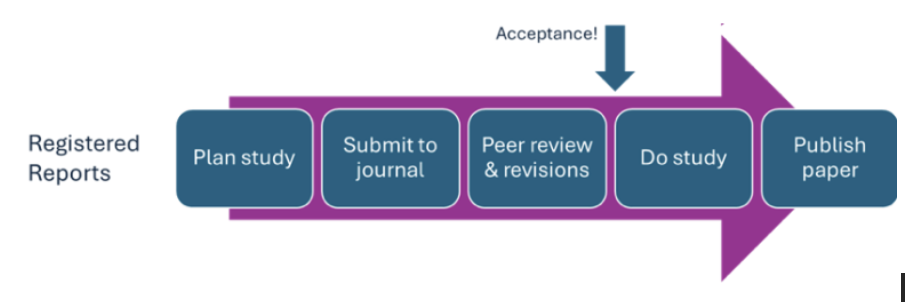
What is the order of traditional publishing?
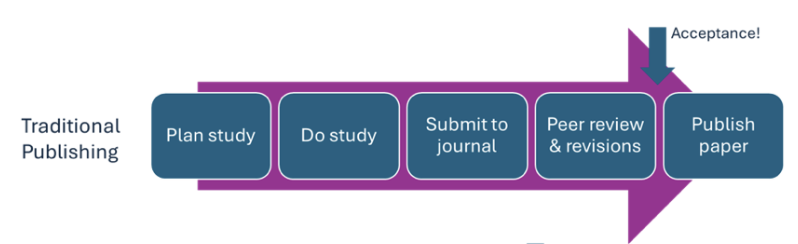
What is the order of registered reports?