Intro to Anaphy, Homeostasis, & Language of Anatomy
5.0(2)
Studied by 11 people Call Kai
 Learn
Learn Practice Test
 Spaced Repetition
 Match
Match Flashcards
 Knowt Play
Card Sorting
1/55

Earn XP
Description and Tags
Kaya natin toh bhie, Prelim lang yan :)
Last updated 4:38 PM on 9/13/23
Name | Mastery | Learn | Test | Matching | Spaced | Call with Kai | Chat |
|---|
No analytics yet
Send a link to your students to track their progress
56 Terms
1
New cards
Microscopic anatomy
study of the smaller structures and fine details that can be seen with the aid of a microscope
2
New cards
Cytology
Study of cell structure
3
New cards
Histology
study of tissues
4
New cards
Gross anatomy
study of the large structures of the human body that can be seen through normal dissection
5
New cards
Surface anatomy
study of the anatomical features that can be studied by sight, without dissecting
6
New cards
Regional anatomy
study of the specific regions of the body
7
New cards
Systemic anatomy
anatomy of the systems of the body
8
New cards
Comparative Anatomy
Study of Comparing Anatomies
9
New cards
Radiographic Anatomy
study of tissues or organs based on the visualization from x-ray films
10
New cards
Pathological Anatomy
Study of Diseases through anatomy
11
New cards
Embryology
study of structures that emerge from the time of the fertilized egg through the eight week in utero
12
New cards
Endocrinology
study of the chemical regulators in the blood and how they control body functions
13
New cards
Neurophysiology
study of functional properties of nerve cells
14
New cards
Immunology
how the body defends itself against disease-causing agents
15
New cards
Cardiovascular Physiology
study of the functions of the heart and blood vessels
16
New cards
Physologist
A scientist wants to study how the body uses foods and fluids during a marathon run. This scientist is most likely an
17
New cards
Chemicals
• smallest level • atoms, chemical bonds, molecules
18
New cards
Cellular
• cells: basic units of life • compartments and organelles • examples are mitochondria, nucleus
19
New cards
Tissues
• group of cells with similar structure and function plus extracellular substances they release • four broad types
20
New cards
Organs
• two or more tissue types acting together to perform function(s) • Examples: stomach, heart, liver, ovary, bladder, kidney
21
New cards
Organ-System
• group of organs contributing to some function • for example, digestive system, reproductive system
22
New cards
Organism
• all organ systems working together • includes associated microorganisms such as intestinal bacteria
23
New cards
Organ System of the body
Integumentary system, Skeletal System, Muscular system, Nervous System, Endocrine System, Cardiovascular System, Lymphatic System, Respiratory System, Digestive System, Urinary System, Female & Male Reproductive System
24
New cards
Organization
• functional interrelationships between parts
25
New cards
Metabolism
• sum of all chemical and physical changes sustaining an organism • ability to acquire and use energy in support of these changes
26
New cards
Responsiveness
• ability to sense and respond to environmental changes • includes both internal and external environments
27
New cards
Growth
• can increase in size • size of cells, groups of cells, extracellular materials
28
New cards
Development
• changes in form and size • changes in cell structure and function from generalized to specialized—differentiation
29
New cards
Reproduction
• formation of new cells or new organisms • generation of new individuals • tissue repair
30
New cards
Homeostasis
• maintenance of constant internal environment despite fluctuations in the external or internal environment • dynamic state of equilibrium • homeo = sameness; stasis = standing still
31
New cards
Variables
• measures of body properties that may change in value
32
New cards
Normal range
normal extent of increase or decrease around a set point
33
New cards
Set point
normal, or average value of a variable Over time, body temperature fluctuates around a set point
34
New cards
FEEDBACK SYSTEMS
cycle of events in which a condition in the body is continually monitored, evaluated, changed, remonitored, and reevaluated
35
New cards
Receptor
• detects changes in variable
36
New cards
Control center
• receives receptor signal • establishes set point • sends signal to effector
37
New cards
Effector
• directly causes change in variable
38
New cards
Negative feedback system
reverses a change in a controlled condition
39
New cards
Positive Feedback System
strengthens or reinforce a change in one of the body’s controlled condition
40
New cards
Negative feedback
is the main mechanism used homeostatic regulation.
41
New cards
Positive feedback
mechanisms occur when the initial stimulus further stimulates the response
42
New cards
Superior
Nearer to the head
43
New cards
Inferior
Away from the head
44
New cards
Anterior
Nearer to the front of the body
45
New cards
Posterior
Nearer to the back of the body
46
New cards
Medial
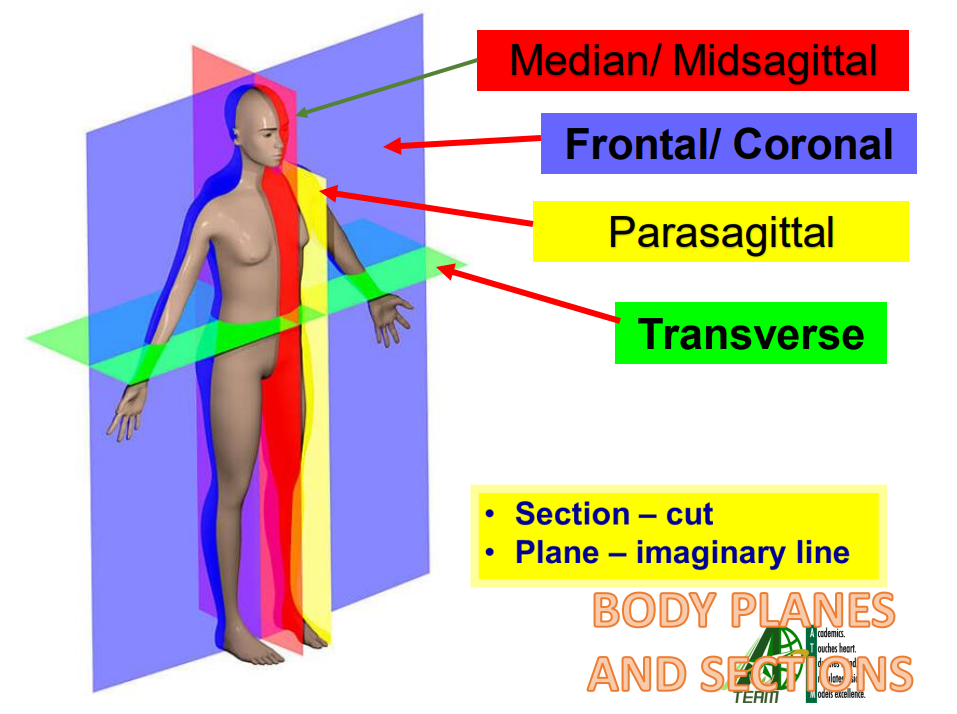
Nearer from the midline, or midsagittal plane
47
New cards
Lateral
Farther from the midline, or midsagittal plane
48
New cards
Intermediate
Between two structures
49
New cards
Ipsilateral
On the same side of the body from the structure
50
New cards
Contralateral
On the opposite side of the body from the structure
51
New cards
Proximal
Nearer from the attachment of a limb to the trunk
52
New cards
Distal
Farther from the attachment of a limb to the trunk
53
New cards
Superficial
Towards the surface of the body
54
New cards
Deep (DEP)
Away from the surface of the body
55
New cards
With answers
Without answers
56
New cards
Just review this lol