Key Terms for Final Exam
 Call Kai
 Learn
Learn Practice Test
 Spaced Repetition
 Match
Match Flashcards
 Knowt Play
1/64

There's no tags or description
Looks like no tags are added yet.
Name | Mastery | Learn | Test | Matching | Spaced | Call with Kai |
|---|
No analytics yet
Send a link to your students to track their progress
65 Terms
What defined the Cold War as a “new era” after World War II?
The Cold War marked a shift from direct (“hot”) war to indirect conflict between the U.S. and the Soviet Union, largely due to the emergence of nuclear weapons and the resulting “nuclear taboo” after Hiroshima and Nagasaki. This period also coincided with widespread decolonization, as former empires declined and independence movements grew, with many nations gaining freedom by the 1980s. At the same time, the U.S. established global influence through military presence and alliances in strategic regions like maritime Asia and Europe, solidifying its role as a superpower with far-reaching geopolitical power.
Origins of the Cold War
Can be traced to rising tensions between the U.S. and the Soviet Union at the end of WWII. At the Yalta Conference (Feb 1945) and Potsdam Conference, disagreements over postwar Europe—especially Germany—began to surface. The U.S. then introduced the Marshall Plan to rebuild Western Europe and contain communism, which the Soviet Union viewed as a threat. In response, the Soviets tightened control over Eastern Europe and blocked access to West Berlin, leading to the Berlin Crisis. These growing divisions ultimately resulted in the formation of NATO, a military alliance aimed at countering Soviet influence.
Yalta Conference (Feb. 1945)
Was a meeting between Allied leaders near the end of World War II to plan the postwar order. A key focus was on how to divide Germany into occupation zones controlled by the U.S., Soviet Union, Britain, and France, shaping spheres of influence in Europe before the war had officially ended.
Potsdam Conference (July 1945)
Allied leaders finalized plans for postwar Germany, agreeing to divide it into four occupation zones controlled by the U.S., Soviet Union, Britain, and France. This division deepened emerging tensions, as the Soviet-controlled East and Western-controlled zones moved toward becoming separate states, laying groundwork for the Cold War.
Marshall Plan (1947)
Was a U.S. program that provided roughly $13 billion in economic aid to rebuild Western Europe after World War II. Its goal was to stabilize economies, reduce poverty, and prevent the spread of communism at a time when many people were turning toward it for more equal distribution (blaming the aristocrats for WWII). The Soviet Union opposed the plan of the US to introduce a common currency for West Berlin, seeing it as an expansion of U.S. influence, and refused participation. This deepened the divide between East and West and contributed to tensions that culminated in events such as the Berlin Crisis.
Berlin Crisis (1948)
The Soviet Union blocked all land routes to West Berlin in response to Western efforts to rebuild and unify West Germany, including the introduction of a new currency. In response, the U.S. and its allies launched the Berlin Airlift, supplying the city by air for nearly a year as they feared military conflict would lead to World War III. The crisis heightened Cold War tensions, solidified the division between East and West Germany, and demonstrated the West’s commitment to containing Soviet expansion. Ultimately led to the formation of NATO (1949) and the Warsaw Pact (1955)
The Potsdam Declaration
Was an Allied ultimatum issued in July 1945 by the U.S., Britain, and China calling for Japan’s unconditional surrender in World War II. It warned that Japan would face “prompt and utter destruction” if it refused to surrender. Japan initially rejected the terms, which helped lead to the U.S. decision to use atomic bombs on Hiroshima and Nagasaki in August 1945.
Warsaw Pact (1955)
Was a military alliance formed in 1955 by the Soviet Union and its Eastern European satellite states in response to NATO. It was designed to strengthen Soviet control over the Eastern bloc and provide a unified military front against the West. The pact deepened the division of Europe into opposing Cold War alliances and reinforced the balance of power between the U.S. and the Soviet Union.
NATO (1949)
A military alliance formed in 1949 by the U.S., Canada, and Western European countries to provide collective defense against the Soviet Union. Its core principle is that an attack on one member is considered an attack on all, aiming to deter Soviet expansion and strengthen cooperation among Western nations during the Cold War.
Cold War in Asia
The Cold War in Asia began with Japan’s defeat after the U.S. atomic bombings, leading to a U.S. occupation that produced Japan’s Peace Constitution and initially focused on democratization. However, as Cold War tensions grew, the U.S. shifted to a “reverse course,” prioritizing anti-communism over full democratization and allowing former wartime leaders back into power, eventually supporting Japan’s Self-Defense Forces. Korea was divided along the 38th parallel, with the North backed by the Soviet Union and the South by the United States. This division led to the Korean War (1950–1953), a civil war that became an international conflict, reinforcing Cold War rivalry in Asia.
Cold War: From alliance to containment
After World War II, the U.S. and the Soviet Union shifted from wartime allies against fascism to ideological rivals. By 1946, Stalin portrayed Western democracies as hostile, while Winston Churchill described an “Iron Curtain” dividing Europe into communist and capitalist spheres. In response, George Kennan’s Long Telegram argued that the U.S. should pursue a policy of “containment,” using political and diplomatic strategies to limit the spread of Soviet influence rather than direct military confrontation.
Iron Curtain
Refers to the political, military, and ideological division of Europe after World War II between the democratic West and the communist East. The term was popularized by Winston Churchill in 1946 to describe how Soviet control had cut off Eastern Europe from the West, symbolizing the growing separation and hostility that defined the early Cold War.
Kennan’s/X’s Telegram
Argued that the Soviet Union was an authoritarian regime that lacked legitimacy and was driven by insecurity and expansionism. He believed the U.S. should “contain” Soviet influence not primarily through military force, but through long-term, patient, and flexible political and economic resistance—showing that capitalism and liberal democracy would ultimately succeed. However, U.S. policymakers partly misinterpreted his ideas, treating containment as a more militarized strategy than Kennan intended.
Buildup of the “red menace” in the US
Fear grew in the U.S. due to a series of major events that heightened anxiety about communism. In 1949, the Soviet Union successfully tested an atomic bomb earlier than expected, shocking American leaders. That same year, the “loss of China” occurred when Communist forces under Mao Zedong defeated the Nationalists, despite U.S. support for the Nationalist government, which then retreated to Taiwan. Domestically, McCarthy-era investigations and anti-communist “purges” targeted suspected sympathizers, increasing paranoia. U.S. policy also became more militarized with NSC-68, which called for a massive military buildup, especially after the outbreak of the Korean War in 1950, reinforcing containment through force.
Cold War: Realism
Realism explains the Cold War as an inevitable conflict between two powerful states competing for security and influence in an anarchic international system. The Soviet Union’s expansion into Eastern Europe was seen as a strategic move to create a buffer zone due to its historical insecurity, economic weakness, and fear of encirclement by Western powers. In response, the United States pursued containment and expanded its own influence through policies like the Marshall Plan, which can also be viewed as a form of economic and strategic expansion. This created a security dilemma, where defensive actions by one side were interpreted as offensive threats by the other, making conflict likely even between states that were primarily seeking security.
Cold War: Constructivism
Explains the Cold War as a conflict driven by competing ideologies and identities: totalitarian communism vs. capitalist democracy. Each side believed its system should expand—spreading communist revolution vs. expanding markets and liberal influence—making conflict more likely. These opposing beliefs shaped how each interpreted the other’s actions, reinforcing mistrust. This ideological clash also played out in interventions in Third World conflicts, such as Vietnam and Afghanistan, where both sides acted based on their perceived roles and values.
Cold War: Liberalism
Explains the Cold War as a result of failed cooperation and lack of shared institutions between the U.S. and the Soviet Union. Unlike relations among democratic states, which tend to be more peaceful, the ideological divide between capitalism and communism prevented trust and economic interdependence. The absence of strong international institutions and open markets between the two blocs increased suspicion and conflict, leading to rivalry instead of cooperation.
Cuban Missile Crisis
Was a 13-day confrontation between the U.S. and the Soviet Union after the U.S. discovered Soviet nuclear missiles in Cuba. President John F. Kennedy imposed a naval blockade to prevent further shipments, bringing the world to the brink of nuclear war. The crisis ended when the Soviet Union agreed to remove the missiles in exchange for a U.S. promise not to invade Cuba and the secret removal of U.S. missiles from Turkey. It was significant because it marked the closest point to nuclear war and led to improved communication and efforts to reduce tensions between the superpowers.
Bay of Pigs Fiasco
It was a U.S.-backed attempt to overthrow Cuban leader Fidel Castro using Cuban exiles. Planned under Eisenhower and carried out by President John F. Kennedy, it was partly driven by a desire to appear strong against communism, as Kennedy had campaigned against stronger enforcement against the Soviets. The invasion failed due to strong local resistance, poor planning, and Kennedy’s decision to withhold full air support at the last moment. The result was a major embarrassment for the U.S. and strengthened Castro’s position, pushing Cuba closer to the Soviet Union.
Events Leading to the Cuban Missiles Crisis
Several escalating Cold War tensions led to this. The failed Bay of Pigs invasion (1961) convinced Cuba and the Soviet Union that the U.S. might attempt another attack, pushing Cuba closer to Soviet protection. At the Vienna Summit (1961), Soviet leader Nikita Khrushchev and President Kennedy met, creating a public image in which Kennedy was seen as inexperienced and weak. This perception was reinforced when the U.S. did not respond militarily to the construction of the Berlin Wall, as they feared retaliation would cause WWIII. Meanwhile, the U.S. had nuclear missiles positioned in Europe (Turkey), increasing Soviet insecurity. In response, the Soviet Union began secretly sending military aid and eventually nuclear missiles to Cuba in 1962 to deter U.S. aggression and shift the balance of power. When the U.S. discovered these missiles, it triggered the 13-day crisis in October 1962, bringing the world to the brink of nuclear war.
Thirteen Days in October 1962
The crisis begins on October 14, 1962, with the discovery of Soviet missile sites in Cuba taken by a U2 intelligence plane. Kennedy assembles ExComm upon the discovery of Soviet missiles in Cuba to plan a course of action. The options: full-out invasion (favored by the Joint Chiefs of Staff), air strikes, and the naval blockade (“quarantine”), which was ultimately chosen.
October 22 = Kennedy makes the discovery public and announces quarantine
October 23 = Khrushchev warns that “pirate actions” by the U.S. would lead to war
October 25 = At 6:00 PM, a letter from Khrushchev states that the Soviet Union would dismantle the weapons if U.S. guarantees Cuba’s survival (also sent a second, drunken letter that was ignored)
October 27 = A U2 reconnaissance plane is shot down.
Resolution: Khrushchev agrees to stop deployment and remove weapons in Cuba in exchange for a no-invasion agreement from the USA
U.S. agrees, and the crisis was averted
Secretly, U.S. removes missiles from Turkey
Vienna Summit (1961)
Soviet leader Nikita Khrushchev and President Kennedy met, creating a public image in which Kennedy was seen as inexperienced and weak. This perception was reinforced when the U.S. did not respond militarily to the construction of the Berlin Wall, as they feared retaliation would cause WWIII.
Cuban Missile Crisis Averted But…
Kennedy’s secret pledge to withdraw missiles from Turkey
Khrushchev is politically weakened (outsmarted by Kennedy)
Moscow and Washington agree to a “hotline.”
Castro wins a security guarantee but feels betrayed by the Soviet Union
Cuba remains on high alert against airspace and coastal violations
The Treaty of Tlatelolco (1967)
The USA has continued to enforce decades of economic sanctions against Cuba (Obama stopped it, Trump resumed it)
The Treaty of Tlatelolco (1967)
Established Latin America and the Caribbean as a nuclear-weapon-free zone, aiming to prevent the spread of nuclear weapons in the region following tensions highlighted by the Cuban Missile Crisis.
Cuban Missile Crisis: Realism
The US and the Soviet Union responded rationally to the strategic situation
The U.S. ExComm team evaluated options (invasion, airstrikes, blockade) and chose the optimal middle course (naval blockade)
Soviet action was based on a calculated need to overcome US strategic (nuclear) superiority
The Rational Actor Model
Objective threat → fixed state response (“all states are like units”) → do anything for survival
Cuban Missile Crisis: Constructivism
Critiques the assertion of an “objective threat” (objective threat → fixed response)
Construction of Cuban enemy
Initially supported the Cuban leader before Cold War → threats are sometimes constructed by identity
Role of language
How they word it (Cuba is now an imprisoned island)
Cuban Missile Crisis: Domestic Politics
Rejects the notion that there’s a fixed rational outcome
Examines patterns of the decision-making process within the state
Objective threat → fixed state response
Bureaucratic Politics Model (Allison’s Models II & III)
Cuban Missile Crisis: Domestic Politics, Bureaucratic Politics Model (Allison’s Models II & III)
No organization or individual has a preponderant power (need more power, which requires funding)
“Where you stand depends on where you sit”
Policies are the product of conflict between organizations
Established “action channels” which help shape outcomes
Slippage occurs between policy and implementation
Even when an executive gives an order, slippage often occurs with implementation (organizations can interpret differently)
Questions about Bureaucratic Politics Model (Allison’s Models II & III)
Does your stance really depend on where you sit?
ex. The Secretary of Defense didn’t want to have a full military involvement in the Cuban Missile Crisis
depended on loyalty to the President
everyday decisions vs. crisis situations
In everyday decisions, it might work, but during crises, it’s the President
No top dog?
The President is first among equals (enough checks and balances that no individuals or organizations can have full power)
Vague and difficult to apply
Selective use of evidence (usually one-off situations)
The End of the Cold War
After the Cuban Missile Crisis
“Ich bin ein Berliner” (Kennedy’s visit to the Brandenburg Gate in June 1963)
“I am a Berliner“ → very American, in the German language you don’t use “am” or “the” (not proper grammar)
translation → Berliner = jelly donut
The American War in Vietnam
The American War in Vietnam
US influence in Europe wanes as it commits more resources to Vietnam
Vietnam would have fallen to communism by 1945
1969 = 500,000 military personnel in Vietnam
The failure of the Tet Offensive (1968) and ineffective bombing campaigns created heightened public opposition to the war
President Nixon took over → didn’t end war but withdrew troops
Goes to Guam and declares that Asian wars will be fought by Asian troops (stated he was withdrawing troops) → war still continued → treaty/end took place later in 1969
2 million civilian deaths → called the 3rd bloodiest war in 20th century (after WWI and WWII)
US citizens realized it wasn’t a anti-communist war but a Vietnam independence war → thought US shouldn’t intervene
Tet Offensive (1968)
Took place on the first day of the year of the Monkey
Massive coordinated attacks by North Vietnamese and Viet Cong forces across South Vietnam
Important because it grabbed everyone’s attack and within 3 days US was able to recapture land
Turning point in public perception: showed public that war was not coming to an end and that the communist party in Vietnam was not weak or deterred
“Routinization” of the Cold War
Cold War tensions become predictable and normalized
Major powers avoid direct confrontation and accepts spheres of influence
ex. In 1968, the Soviet Union crushed reforms in Czechoslovakia (Prague Spring)
The West stands aloof as the Prague Spring is crushed in 1968
Wanted to avoid WWIII
Prague Spring
In the spring of 1968, Alexander Dubček was a more moderate-leaning official who introduced reforms → loosening restrictions on media, freedom of speech, and travel, in hopes that communism would thrive (listened to the voices of people who were discontent with restrictions)
People started to gather more → official did nothing → Soviet Union intervened and crushed the movement (with Warsaw Pact)
USSR troops stayed in Prague until the end of the Cold War
huge stop/block on reformist voices
Strategic Arms Limitation Talks (SALT)
Series of negotiations between the U.S. and USSR during the Cold War that aimed to limit the number of nuclear weapons, especially ballistic missiles
Focused on controlling arms buildup, not eliminating nuclear weapons
Strategic Arms Reduction Treaty (START)
U.S.-Soviet / U.S.-Russian agreements aimed at reducing nuclear weapons, not just limiting them
First one was signed in 1991 between the U.S. and USSR
Required major reductions in strategic nuclear arsenals
Included verification measures to ensure compliance
The Beginning of the End of the Cold War
Soviet invasion of Afghanistan (1979-89)
The end was aided by wives, daughters, and sisters of Soviet veterans asking why they were in Afghanistan
The US and Osama Bin Laden were allies (the Taliban called themselves “Freedom Fighters” to fight against the Soviet Union)
Formation of solidarity and the anti-Soviet movement in Poland (1980-89)
Anti-communist party wins election
so successful and had the population’s support that the Soviet Union had to invite them to the round table
Reagan and the SDI (“Star Wars” criticism)
Gorbachev introduces perestroika (reforms) and glasnost (openness/freedoms) to reduce corruption in 1985
Gorbachev admits the economy is bad (command economy) and introduces major reforms
4 years later = Soviet Union collapses
Solidarity (Poland) movement (1980s)
The mass anti-communist movement forced negotiations and won political power
Incredibly successful and supported by the population
Command economy
government is in charge of the economy (prices aren’t driven by the market, but by the government (no invisible hand)
Soviet–Afghan War (1979–1989):
A costly and unpopular war; public dissent grew (families of soldiers questioned the war)
U.S. supported anti-Soviet fighters, including groups linked to figures like Osama bin Laden, framing them as “freedom fighters.”
Mikhail Gorbachev’s reforms (1985):
In 1985, Gorbachev introduced perestroika (economic restructuring) to reform the failing command economy and glasnost (openness) to expand freedoms of speech and transparency, and while these reforms aimed to strengthen the Soviet Union and reduce corruption, they ultimately weakened government control and contributed to its collapse in 1991.
Ultimately encouraged reform movements across Eastern Europe and contributed to the eventual collapse of the Soviet Union in 1991
Collapse of Communist Regimes in Eastern Europe
In 1989, communist regimes rapidly fell across Eastern Europe as reform movements gained momentum and the Soviet Union, under Mikhail Gorbachev, chose not to intervene, as it would delegitimize his actions of perestroika and glasnost. Thus, free elections in countries like Poland and Hungary, a peaceful transition in the Velvet Revolution in Czechoslovakia, and the violent overthrow of Nicolae Ceaușescu in Romania, culminated in the Fall of the Berlin Wall on November 9, which triggered mass migration and ultimately led to German reunification and the toppling of the communist regime in East Germany.
The Collapse of the Soviet Union
In 1990-1991, the upheaval in Eastern Europe spread to the different nationalists within the USSR
economic reforms aren’t happening fast enough, and citizens now know that it’s a problem for everyone, not just them → start to come together and protest
Ultimately, the perestroika economic reforms were unsuccessful, and glasnost allowed the public to voice their dissatisfaction and revolt against the central government
Gorbachev survives a KGB-led coup in August 1991 but is forced to step down in December when the Soviet Union disintegrates into the Confederation of Independent States
End of Cold War: Realism and the Problem of Systemic Change
Unexpected breakdown of bipolar stability (said it was stable for two superpowers to rule → shows it wasn’t)
Newfound attention to domestic political factors (structural realism → classical realism or dynamic power transition theory)
pay more attention to classical realism, NOT structural, since the field was changing
Was a struggle for power until it wasn’t
Realism is ineffective at explaining change
It being a dominant theory somewhat changes (had to change because it couldn’t explain the Cold War)
Cold War: Modified Realism
Domestic economic failures in the Soviet Union and American arms buildup contributed to a change in the relative balance of power between the two superpowers, which upset the stability of the international system
But why did perceptions change so dramatically? → they cannot capture the timing/acceleration of change in the late 1980s
Another variant argues that it is the perceived (rather than actual) balance of power that matters the most. While the Soviet Union had gradually been on the decline since the 1970s, its leaders only began to feel the impact in the mid-1980s
They still do not tell us how the Soviet Union collapsed the way it did (voluntarily and peacefully)
End of the Cold War: Liberalism
The end of the Cold War was driven by increased cooperation and interdependence. For example, Détente and the Helsinki Accords (1975) provided a context not only for leaders but also for policy elites and nongovernmental organizations, which opened up domestic institutions and created transnational coalitions. Also, the Information Revolution and technological innovations created new positive economic incentives for change in Soviet policies to adopt more cooperative and reform-oriented policies.
Détente
Was a period of reduced tensions between the United States and the Soviet Union marked by increased diplomacy, arms control efforts, and cooperation to avoid direct conflict.
The Helsinki Accords (1975)
Was an agreement that promoted cooperation in security, economic relations, and human rights, while also encouraging interaction between governments, policy elites, and NGOs, helping spread international norms and challenge authoritarian control.
Brought together both NATO and Warsaw Pact nations
End of the Cold War: Constructivism
Diffusion of international norms and Gorbachev’s “New Thinking.”
formulation of new ideas in foreign policy
newfound identification with a “common European home.”
shocking because it challenged the Iron Curtain
Gorbachev is persuaded by Western officials to accept a reunified Germany in NATO
Huge deal
Actor practices leading to a change in structure
repeated and shared practices consolidated new social identities, which can result in structural change
Helsinki Accord on human rights → Charter 77, which led international organizations and the media to spread their practice of nonviolent protest
Gorbachev’s revocation of the Brezhnev Doctrine reconstituted the norms and practices of under-periphery relations
End of the Cold War: Domestic Politics
Mikhail Gorbachev weakened internal opposition by maneuvering over conservative “hawks,” while socialist governments in Eastern Europe faced intensifying legitimacy crises due to economic failure and public dissatisfaction, and increasing exposure to Western culture further undermined confidence in communist systems and encouraged demands for political change.
What does the UN do?
The United Nations is an international organization that promotes peace, security, and human rights, and was created at the end of the Cold War. Although it oversees many agencies and programs, it requires significant funding from member states, with major contributors like the United States gaining strong influence in the Security Council, where the P5—United States, China, Russia, United Kingdom, and France—hold permanent seats and veto power over major decisions.
Main types of international institutions
International institutions can be classified by scope (international or regional), function (peace and security, economic and social development, or international law and human rights), and authority type, which includes intergovernmental organizations (IGOs) made up of states and nongovernmental organizations (NGOs) made up of private actors that operate across borders.
Rise of Transnational Actors
Compared to about 200 nation-states and about 250 IGOs, it’s estimated that there are as many as 30,000 ____ NGOs, excluding MNCs (multinational corp) which are another 78,000 entities
_____ NGOs constitute civil society, an arena of activity for groups and individuals that is relatively independent of and, to some extent, protected from government interference
Transnational advocacy networks (TANs) and global civil society
Are networks of activists, who are motivated by principled ideas or values and seek to build new links among actors in civil societies, states, and international organizations
consist of individuals and NGOs acting in pursuit of a normative objective, including human rights, the environment, economic and social justice, democracy, women’s rights, etc
How do TANs influence world politics?
Informative sharing
Persuasion and socialization of norms (the norms lifestyle)
the agenda-setting by political entrepreneurs
typing point and “norms cascade” (landmine ban happened because celebrities like Princess Diana protected and brought attention)
internalization
Putting pressure on states (for policy change) — directly or indirectly
the boomerang model
Boomerang model
Explains how local activists bypass their own government by appealing to international allies and NGOs, which then pressure external governments or international organizations to intervene, creating a _____ effect that brings pressure back onto the original state to change its policies.
International Political Economy (IPE)
Is a combination of International Relations (IR) and Political Economy (PE, which is the juxtaposition of states and markets)
Markets = efficiency (markets care most about efficiency/supply and demand)
States = distribution of power and values
Governments care more about things other than efficiency (protect their citizens and domestic area, sometimes at the expense of efficiency (ex. Tariffs, which put the domestic economy over the overall market)
___ brings in the condition of anarchy and multiple sovereign states with their own “values.”
The perspective that most closely predicts this is constructivism
U.S.-China trade relations
In 1978, China opened up, but made its economic zones contained → the economy flourished. This allowed U.S. consumers to benefit immensely (lower costs due to the workforce in China being cheaper). However, over time, tensions emerged due to the U.S. manufacturing job losses, national security concerns, subsidization and state-owned enterprises, currency manipulation, and labor and human rights violations.
This trade relation still worked until China’s rise to power, and it diverged from World Trade Organization rules, and the U.S. responded with policy measures while the WTO faces challenges enforcing rules
Global Economic System: Liberalism
Mutual gains through specialization based on comparative advantage (most economies cannot do every sector well, so they specialize in one area, e.g., Taiwan and its semiconductors, Japan and car manufacturing, Canada and lumber, the U.S. and pharmaceuticals/financial/banking/satellites/weapons)
Interdependence dampens incentives for conflict (opportunity costs)
Economic exchanges mediated by rules and institutions
Global Economic System: Realism/Statism/Mercantilism
Economic ties among states almost always involve power relations (even within mutual gains, some gain more than others → some states can set up a system where they can always gain more)
Composition: What I trade (governments have the power to control what they trade)
Protectionism: How much I trade (governments can put limits on how much they can trade with a certain state, with tariffs)
Discrimination: With whom I trade (governments can decide who they trade with, e.g., during the Cold War, there was a blockade by Russia on the Western world)
Consequence of anarchy: Economic goals are important as long as they do not undermine security objectives
Survival is still job number one
Ex. Current trade with the U.S.-China went well until China began to threaten the U.S. more broadly → now a more tense situation
Exceptions to free trade
National security restrictions on military and dual-use technology (ex. drones)
Protection of infant industries (government attempts to keep foreign nations out of the infant industry/put protection barriers in place because if they don’t, the infant industry would be priced out/undercut)
The problem is that it’s hard to know when the industry has grown enough
Strategic Trade Theory
Hegemonic Stability Theory
Strategic Trade Theory
A theory that became popular in the 1990s. During this time, Japan was rising economically → the three car companies lobbied to protect American domestic industries from Japan
Theory arose during this era, and stated that before this, trade was complementary, as the richer countries would buy/manufacture in the poorer countries, and poorer countries would import from the richer countries goods → trade switched to be between the rich countries, which created a more competitive market
Theory says some governments will artificially prop up some industries, and that is not good for global trading
Hegemonic Stability Theory
Not so much the WTO or the global laws, but instead the most powerful country in the world, which acts as a leader (states that the trading system works best under a unipolar system)
Having a state that acts as a global police creates one set of rules/singular standard (and when the rules aren’t followed, they can enforce them)
Ex. The British Empire (during this period, there was piracy, with the recent two hotspots being the Somali Coast and the Malacca Strait)
The British Empire fought off pirates → providing a public good, which was worth it not only because they traded a lot, but also to maintain the system (if the system went corrupt, then there would be disorder/a new set of rules)
The hegemon provides collective goods (indivisibility and nonrivalrous consumption) that maintain the stability of the global economic system (e.g., like clean air, you cannot stop other people from enjoying the benefits of clean air)
E.g., security, markets, common currency, and loans
The hegemon bribes “free riders” driven by parochial interests by offering security assistance or foreign aid
Hegemonic Stability Theory: U.S. Leadership in the Bretton Woods System (1945-1989)
Fixed exchange rates and the dollar/gold standard
Institutionalization of multilateral trade and capital controls (GATT/WTO, IMF (International Monetary Fund), World Bank)
Most favored nation (MFN) principle
GATT introduced this (still has this to this day) → all the tariffs that the U.S. and China are doing are technically illegal → said that when you enter this treaty (now organization under WTO), you have to give the same favorable treatment to every country for tariffs
IMF = When states are experiencing a run on their currency, they turn to the IMF and borrow short-term funds (interest rates are incredibly high → if they were low, governments would consistently draw loans and would default upon them/would cause riskier behavior (moral hazard))
Golden age of capitalism (through these institutions, there was a rapid rise in trade)
Global Economic System: Marxism
Domestic class conflict
Winners and losers within societies
International conflict
“Law of uneven growth” among capitalist states (for whatever reason, countries grow at different rates)
Exploitation of poorer countries by the rich (dependency theory)
The prices of raw materials are vastly lower than the prices of service goods/high technology → many countries are only rich in raw materials
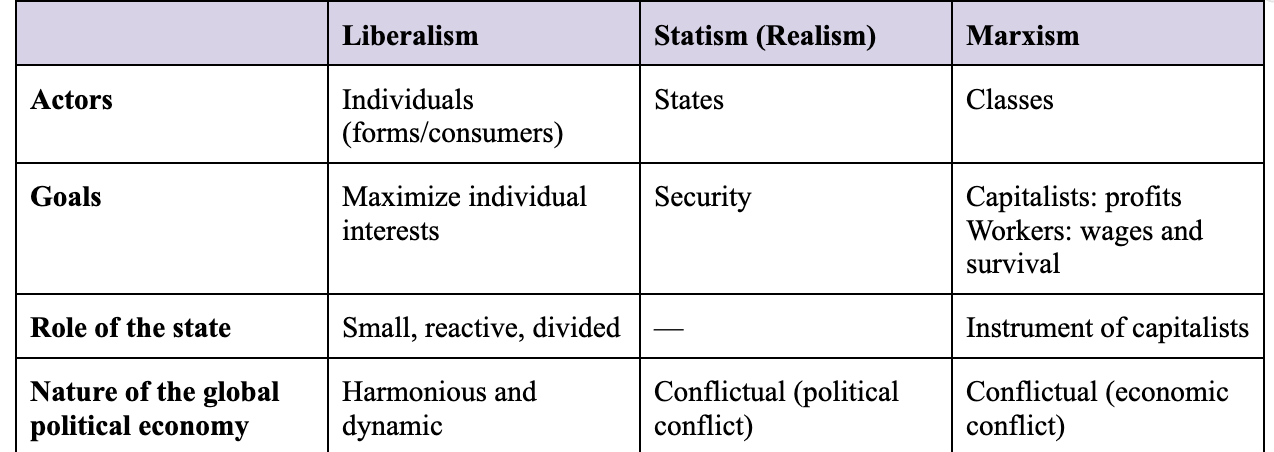
Summary: Contending Views of the International Political Economy