Module 8: Functional Subdivisions of the cerebellum and dysfunctions
 Call Kai
 Learn
Learn Practice Test
 Spaced Repetition
 Match
Match Flashcards
 Knowt Play
1/17

There's no tags or description
Looks like no tags are added yet.
Name | Mastery | Learn | Test | Matching | Spaced | Call with Kai |
|---|
No analytics yet
Send a link to your students to track their progress
18 Terms
what is the most common symptom of cerebellar lesions?
ataxia, which is defined as impaired coordination of muscle recruitment (not due to weakness, ROM limitations, or abnormal tone changes)
what are some other presentations of cerebellar lesions?
decomposition of movement, intention tremors, hypotonia, dysmetria, and dysarthria
what are the three main functional subdivisions of the cerebellum?
spinocerebellum, vestibulocerebellum, cerebrocerebellum
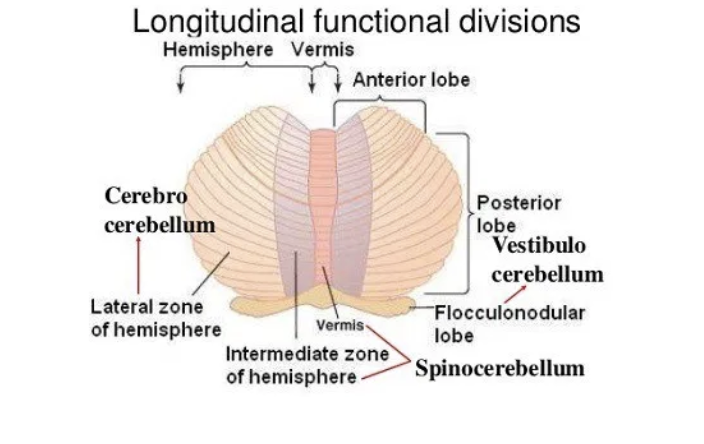
what structures make up the spinocerebellum?
the vermis and the intermediate zone
what are the inputs and outputs of the spinocerebellum?
inputs from spinal cord and about what our body is doing via the spinocerebellar tract, and output to the medial motor pathways (vestibulospinal, recticulospinal, anterior CST)
what is the function of the spinocerebellum?
enables the nervous system to make postural adjustments/fine tune ongoing movements for future motor commands, predominantly involving muscles of trunk/posture and gait
what is the clinical presentation of lesions to the spinocerebellum?
ataxic movements- gait ataxia, intention tremor, dysarthria, dysdiadochokinesia, dymetria, and decompositon of movement
what is dysdiadochokinesia?
the inability to perform rapid, alternating movements
what is decomposition of movement?
the loss of coordination across joints, movements are no longer smooth and joints move separately
what is dysmetria?
the inability to accurately move towards an intended direction
what structure makes up the vestibulocerebellum?
flocculododular lobe- is the functional name for it
what are the inputs and outputs of the vestibulocerebellum?
the major inputs are from the vestibular system and the superior colliculus, the major outputs are to the vestibular nuclei to influence postural control and eye movements (control of the vestibulo-ocular reflex)
what is the function of the vestibulocerebellum?
regulation of balance and equilibrium, integration of visual and vestibular inputs to coordinate motor activity for posture and head and eye movements
how does damage to the vestibulocerebellum present?
see balance deficits and unsteadiness, truncal ataxia, abnormal eye movements (nystagmus- overshooting of the eye), and decrease eye-head coordination
what structures make up the cerebrocerebellum?
the lateral hemispheres of the cerebellum
what are the inputs and outputs of the cerebrocerebellum?
inputs from the cortex that travel through the pontine nuclei, and outputs to the premotor areas and primary motor cortex, and also the red nucleus
what is the function of the cerebrocerebellum?
planning movements and motor learning, coordinates precise, distal voluntary movements, and important for visually guided movements
what is the clinical presentation of damage to the cerebrocerebellum?
see appendicular ataxia (especially in the hands/fingers), dysarthria, and delay of movement initiation