Economics Unit 3 AOS 3
 Call Kai
 Learn
Learn Practice Test
 Spaced Repetition
 Match
Match Flashcards
 Knowt Play
1/68

There's no tags or description
Looks like no tags are added yet.
Name | Mastery | Learn | Test | Matching | Spaced | Call with Kai |
|---|
No analytics yet
Send a link to your students to track their progress
69 Terms
Exports
Imports
Exports: goods and services made in Australia and purchased by foreign residents
A nation sells its products overseas
Imports: goods and services purchased by Australian residents that are made outside Australia
A nation buys products from overseas
Trade-to-GDP ratio + how to calculate it
Trade-to-GDP ratio: indicator of the relative importance of international trade in the economy of a country/its openness to trade → expressed as a percentage
It is calculated by dividing aggregate value of imports and exports over a period by GDP for the same period

Aus biggest imports
Machinery, nuclear, boilers
Motor vehicles (other than railways, tramway)
Minerals fuels, oils, distillation products – refined petroleum products
Electrical/electronics
Aus biggest importers:
China
US
Japan
SK
Aus biggest exports
Ores slag & ash
Minerals, fuels, oils – iron ore, coal, natural gas
Pearls, precious stones
Wool
Agricultural goods (e.g. beef, wheat)
Aus biggest exporters
China
Japan
US
SK
Benefits of trade for consumers and firms
For consumers
Lower prices → more competitive market as there are more sellers
Greater choice → as more available products which Aus may not be able to produce + more sellers
Firms
Greater access to resources at lower cost → again due to more sellers + some countries just have the ability to provide a greater amount of a type of resource, making it cheaper to buy from there
Comparative advantage
Trade allows countries to focus their production on goods and services where they have a comparative advantage relative to other countries - that is, where their opportunity cost is lowest.
Economies of scale
Economies of scale are cost advantages that firms or countries can obtain by producing a greater amount of the same product and so are able to spread their fixed costs across greater volume → bring down the average cost per unit → comes from focusing on areas of comparative advantage as a nation's market gets bigger
Why trade increases efficiency
More competition – firms to work more efficiently to compete with other firms
Greater access to more resources + cheaper resources/parts
Focus on areas in which we have a comparative advantage
Get economies of scale due to access to more buyers
A) The balance of payments + what is it split into
B) Credits
C) Debits
The balance of payments is a record of financial transactions between Australia and the rest of the world
Split into current account (CA) and capital and financial account (CAFA)
Credit | Money received by Australian residents from other countries --> money entering |
Debit | Money paid by Australian residents to other countries --> money leaving |
Current account
CA balance
CAS
CAD
Do we tend to have a CAS or CAD?
CA: an account in the balance of payments which includes all the debits and credits of a current nature that do not result in or cancel future obligations → includes payment for goods & services and interest
Current Account Balance | the sum of all credits (positive) and debits (negative) on the Current Account for a particular period. It can be positive or negative. |
Current Account Surplus (CAS) | the amount by which the credits on the Current Account exceed the debits for a particular period. |
Current Account Deficit (CAD) | the amount by which the debits on the Current Account exceed the credits for a particular period |
We tend to always have a CAD (except between 2019 and 2022)
What does CA consist of and explain each one:
Balance on Merchandise Trade (BoMT) / Balance on goods/Net goods | sum of all credits (positive) and debits (negative) due to the sale of goods to or from Australia. It is a sub-account of the current account |
Net services | sum of all credits (positive) and debits (negative) due to the sale of services to or from Australia. It is a sub-account of the current account |
Balance on goods and services/Trade balance | BOGS or the trade balance is the sum of Net Goods and Net Services. |
Net primary income | sum of all credits (positive) and debits (negative) due to payment of income on assets (such as shares, property and loans) to and from Australia
|
Net secondary income | sum of all credits (positive) and debits (negative) due to gratuitous payments (such as gifts, pensions and foreign aid) to and from Australia. It is a sub-account on the current account |
Capital & financial account
What does it consist of - are the components equally important in this study design?
CAFA: an account in the balance of payments which includes all the debits and credits of a capital nature that result in future obligations or cancel future obligations → It includes loans, purchases of shares and direct investments in land or businesses
Consists of the capital and financial account - however in this study design, capital account is not important (net inflow of assets by migrants/emigrants + net credits & debits for transfers of intellectual property) → FA is more focused on
What does the financial account consist of? Describe each
Net portfolio investments | sum of all credits (positive) and debits (negative) due to purchases of a part interest in a company (less than 10%) by Australian residents overseas or by foreign residents in Australia mostly commonly through buying shares It is a sub-account on the Financial Account. |
Net direct investments | sum of all credits (positive) and debits (negative) due to purchase of an interest in a company (more than 10%) or by directly creating or investing in a business by Australian residents overseas or by foreign residents in Australia. It is a sub-account on the Financial Account. |
Net other investments | sum of all credits (positive) and debits (negative) due to investment by Australian residents overseas or by foreign residents in Australia which doesn't fall into other categories in the Financial Account. It includes loans between Australian and foreign residents. It is a sub-account on the Financial Account. |
Financial Derivatives which is the value of the net position on complex financial instruments like interest rate swaps and options
Net Reserve Assets which is the value of the net position of payments to and from the Reserve Bank and the Australian Government
What is the relationship between CA & CAFA (hint: think about quantity) Why is this the case?
CA + CAFA = 0
When we spend more than we earn (CAD) → we must get the money from somewhere to pay for imports we cannot afford so we must have a CAFA surplus - bring in extra cash to pay for imports (e.g. get a loan or sell some assets - increases credits)
If we have CAS → we have to do something with the excess → we must CAFA deficit → invest more overseas than foreigners invested here
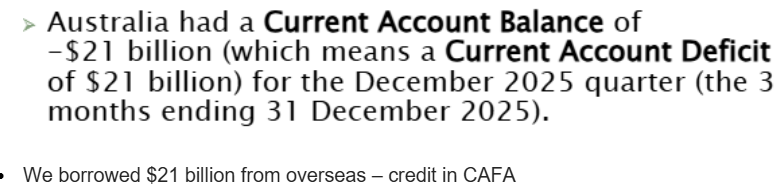
What was Aus CA balance for the Dec 2025 quarter?
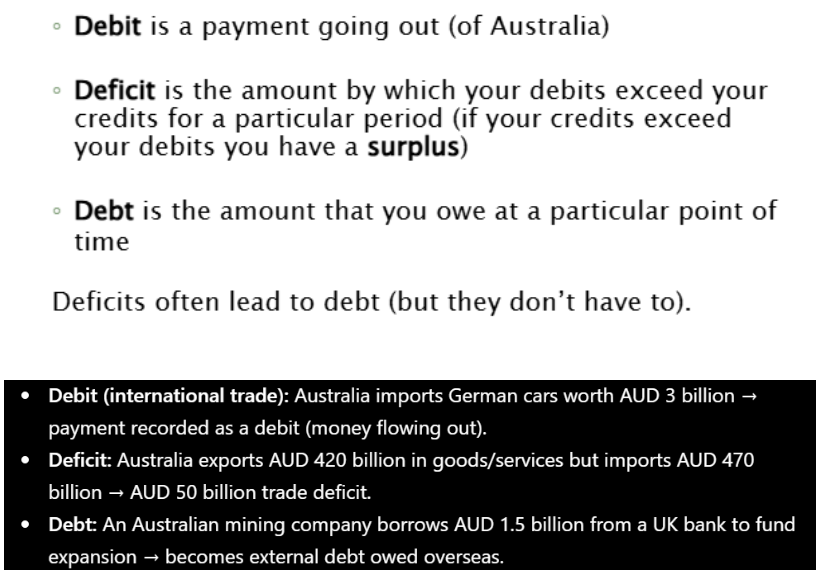
What’s the difference between debit, deficit and debt?
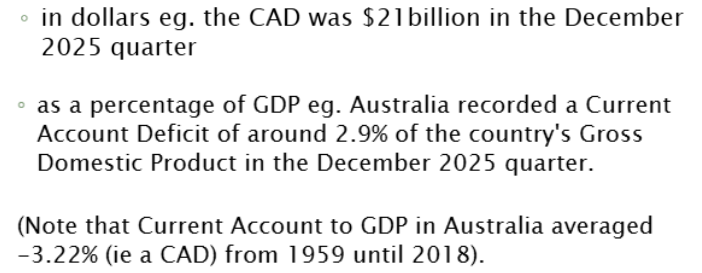
How can the CAD/CAS be measured in?
Using these unit of measurement describe Aus CA balance in the Dec 2025 quarter
CAD/CAS can be measured in:
Dollars
Percentage of GDP
Structural influences on the CA
What do they include (don’t need to explain each)
The structural influences on the Current Account these are the long term structural issues that impact on the Current Account and they include the savings and investment imbalance, weak international competitiveness, resource discovery and overseas growth in the past 40 years and the self-reinforcing nature of current account surpluses and deficits.
Savings and investment imbalance
Australia has a savings and investment imbalance because Australia has a relatively low savings ratio (the ratio of household saving to disposable income) but is a young country with unexploited resources so has many opportunities for investment. --> To invest at the level that we wish we need to obtained funds from overseas
Weak international competitiveness
Australia has a relatively low level of international competitiveness compared to similar countries --> as we are relatively low on labor market efficiency + high minimum wages + strong leave and superannuation rights → This makes our exports more expensive & hence less competitive + makes imports more attractive than Aus products --> thereby reducing the surplus (or increasing the deficit) on the trade balance
Resource discovery and overseas growth
In the past 40 years Australia has benefited from continued discovery of mineral and energy resources and strong overseas growth in trading partners, especially China, which has boosted the value of our commodity exports and significantly improved our balance of trade.
(Not as important as the others)
Self-reinforcing CAD/CAS
Every year that we have a Current Account Deficit (CAD) increases the CAD in subsequent years since when we borrow money from or sell assets to foreigners to cover the CAD, the interest or profits on those liabilities → makes the net primary income component of CAD bigger in subsequent years.
Similarly, every year that we have a Current Account Surplus (CAS) increases the CAS in subsequent years since when we invest money or buy assets overseas with the surplus the interest or profits on those investments educe net primary income deficit/ increase net primary income surplus → adds to the CAS in subsequent years.
Cyclical component of the current account deficit
Link to when there is strong growth
Link to when there is weak growth
The cyclical component of the Current Account is that part of the Current Account that depends on the business cycle.
When Australia is experiencing strong growth, consumer confidence is usually high causing the savings ratio to drop and investment to increase which adds to the savings and investment imbalance + also when growth is strong, imports are usually higher due to reaching productive capacity where Aus production cannot meet demand so people turn to imports --> Both these factors worsen the Current Account (reduce a CAS or increase a CAD).
When Australia is experiencing weak economic growth, consumer confidence tends to fall, causing households to increase their savings and businesses to reduce investment spending. This helps reduce the savings-investment imbalance. Additionally, weaker growth leads to lower demand for goods and services, resulting in fewer imports as households and businesses spend less --> these help improve the Current Account balance by increasing a Current Account Surplus (CAS) or reducing a Current Account Deficit (CAD)
In 2019, we switched from a CAD to a CAS. Explain why this occured
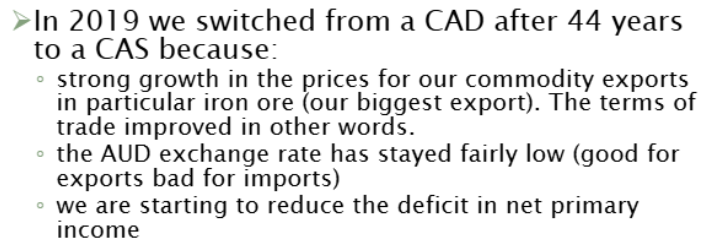
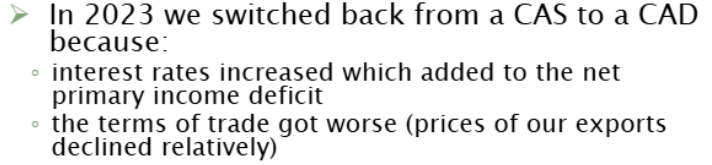
In 2023 we switched back from a CAS to a CAD. Explain why:
Returning to CAS depends on:
TOT → where we want higher export prices → increases credits
AUD exchange rate → lower rate → make exports more competitive + increases credits
Net foreign debt
What was Aus NFD at Dec 2025?
Net foreign debt: the amount by which total borrowing by Australians from foreign lenders exceeds total loans by Australians to foreign borrowers
[Currently positive meaning we owe more overseas than they owe to us]
Includes all loans (government, firms, individuals)
![<p><span style="background-color: inherit; line-height: 19.55px; color: windowtext;"><strong>Net foreign debt:</strong></span><span style="background-color: inherit; line-height: 19.55px;"> the amount by which total borrowing by Australians from foreign lenders exceeds total loans by Australians to foreign borrowers</span><span style="line-height: 19.55px;"> </span></p><ul><li><p class="Paragraph SCXO177853000 BCX0" style="text-align: left;"><span style="background-color: inherit; line-height: 19.55px;">[Currently positive meaning we owe more overseas than they owe to us]</span><span style="background-color: inherit; line-height: 19.55px; color: windowtext;"> </span><span style="line-height: 19.55px; color: windowtext;"> </span></p></li><li><p class="Paragraph SCXO177853000 BCX0" style="text-align: left;"><span style="background-color: inherit; line-height: 19.55px; color: windowtext;">Includes all loans (government, firms, individuals)</span><span style="line-height: 19.55px; color: windowtext;"> </span></p></li></ul><p></p>](https://assets.knowt.com/user-attachments/8703d382-4148-4707-8d5e-1232a708dc97.png)
Net foreign equity
What was Aus NFE at Dec 2025?
Net foreign equity is the amount by which Australian assets (such as property and shares) held by foreigners exceeds foreign assets held by Australians [Currently negative mean we have more equity overseas than they have here]
![<p><span style="background-color: inherit; line-height: 19.55px;"><strong>Net foreign equity</strong> is the amount by which Australian assets (such as property and shares) held by foreigners exceeds foreign assets held by Australians [Currently <strong>negative mean we have more equity overseas than they have here</strong>]</span><span style="background-color: inherit; line-height: 19.55px; color: windowtext;"> </span></p><p></p>](https://assets.knowt.com/user-attachments/62f5ef5e-adae-43b9-9251-8df79edaccc4.png)
NFE is much ___ than NFD
Net international investment position/net foreign liabilities + how to calculate it
NFE is much smaller than NFD
Net international investment position/net foreign liabilities - amount by which Australian's obligations to foreign residents exceeds foreign residents' obligations to Australians (NFE + NFD)
Why should I worry about NFD
In what cases would NFD not be a problem?
NFD is more worrying than NFE as you can't default (fail to fulfil) on NFE
Too big NFD could result in Aus having credit rating downgraded → seen as riskier borrower → reduces investment + foreigners lending to us → reduces Aus level of investment
Bigger NFD means more national income devoted towards interest payments overseas
A lot of NFD is borrowing by private companies and just because they default doesn't mean Australia defaults
But NFD won’t be a problem if our GDP is growing enough so we can afford the level of NFD/debt
The terms of trade + how to calculate
The terms of trade is an index that measures the ratio of an index of Australia's export prices to an index of Australia's import prices

What are the factors that affect TOT (Hint: prices)
Export prices → when an increase in export prices will increase TOT
Import prices → an increase in import prices will decrease TOT
These could be affected by:
Commodity prices (e.g. coal, iron ore, gas, wheat)
Production costs in trading partners
How will a higher TOT affect LS
How will a higher TOT (caused by increases in export prices) affect the achievement of the goal of SSEG and FE?
How will a higher TOT (caused by decrease in import prices) affect AS
Higher TOT will increase LS (generally - most of the time)
If export prices rise → exports would be sold at higher prices → increased profits, wages, consumption, investment, AD and real GDP → make it easier to achieve SSEG + FE
If import prices drop → reduce production costs → increase AS
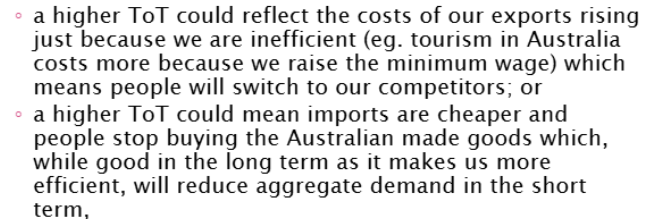
Ways in which higher TOT would be bad (sometimes)
How does TOT affect inflation
High TOT (caused by decreases in import prices) will tend to reduce inflationary pressures → reduces production costs → thus lowers risk of cost inflation + falls in import prices directly reduce CPI
High TOT (caused by increase in export prices) will increase inflationary pressures as it increases X and thus AD → demand inflation
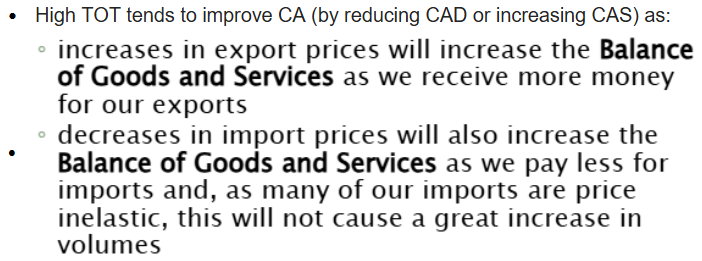
How does TOT affect CA
How is the value of AUD usually measured?
USD or
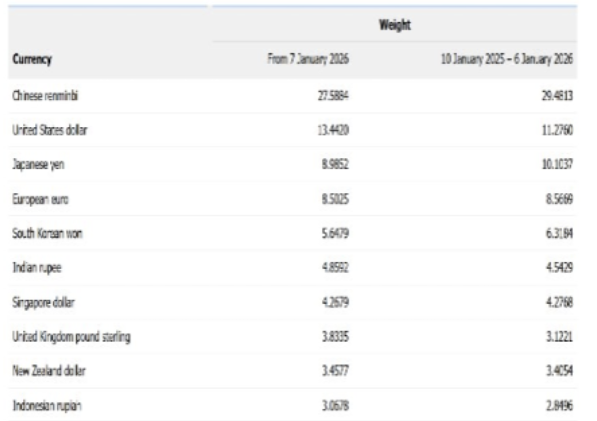
A trade weighted index - shows the value of the Australian dollar when compared to a basket of currencies of our major trading partners - there's a total of 20 currencies
In the trade weighted index, which currencies are weighted the most?
Is it possible for a nation to control its exchange rate?
It is possible for a nation to control its exchange rate (to some extent) due to being able to control supply of its own currency - but was given up in 1983 → when we floated the AUD (meaning that its exchange rate was determined by the market instead of government intervention
In the AUD market, who is the buyers and sellers?
Buyers → overseas people who need AUD for dealings with Australians
Sellers → Australians who need foreign currencies for dealings with foreigners
Demand for AUD depends on:
Supply for AUD depends on:
Demand for AUD depends on:
Sales of exports → more exports will mean foreigners need more AUD to buy them
Income we earn from overseas (e.g. US company earns USD which needs to convert to AUD to give to Aus shareholders
Amount of funds loaned by foreigners to Aus → as it needs to be converted to AUD
(Anything that required foreign to aus currency)
Supply for AUD depends on:
Purchase of imports by Aus → we need more foreign currency to buy them → which makes us sell AUD
Income foreigners earn from Aus (e.g. interest on loans) as it would initially be in AUD → need to sell to convert to own currency
Amount of funds invested by Aus overseas → as we need to sell AUD to buy foreign investment
For these just think:
Imports & exports
Funds - investment, loans
Income earnt which must be given
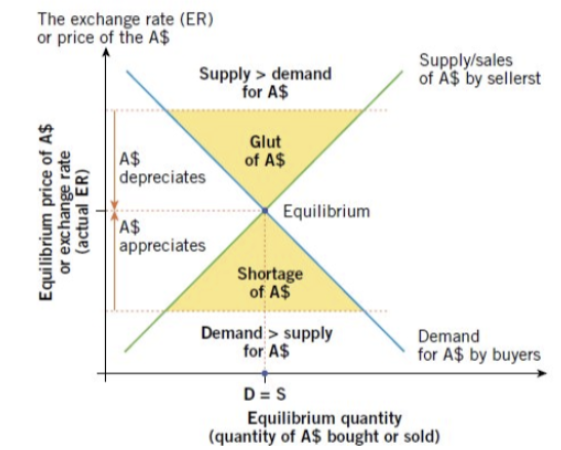
AUD depreciates when:
Demand decreases (shifts left)
Supply increases (shifts right)
AUD appreciates when:
Supply decreases (shifts left)
Demand increases (shifts right)
Draw supply-demand graph for the AUD market
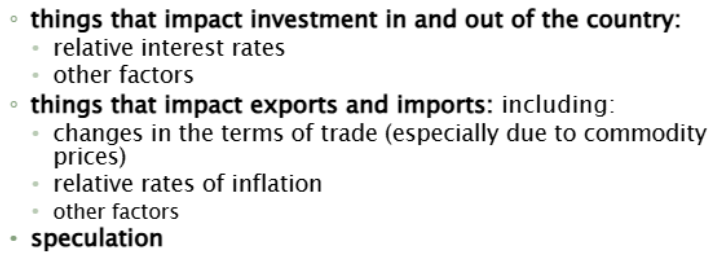
Factors that affect AUD include:
Capital outflows & inflows
Capital inflows | Capital inflows are funds entering Australia as debt or equity investments by foreigners in Australian businesses or assets. |
Capital outflows | Capital outflows are funds leaving Australia as debt or equity investments by Australians in foreign businesses or assets. |
How do interest rates affect the value of the AUD
Higher relative interest rates → attracts investment to Aus due to higher returns → and so creates demand for AUD as you need to convert foreign currency to AUD to lend money → hence this increase capital inflows and causes AUD to appreciate
While lower relative interest rates cause capital outflows
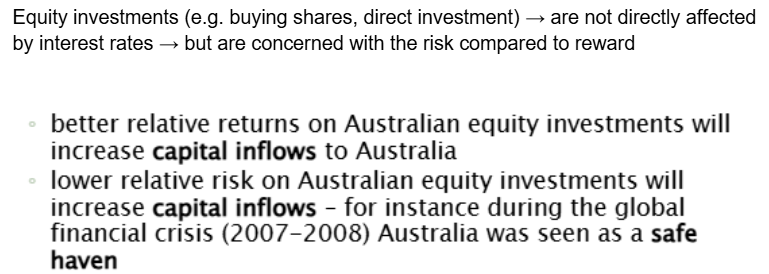
How does equity investment affect the value of AUD
How does TOT affect the value of AUD
If TOT increases (due to export prices increasing) → increase in demand for AUD as foreigners have to pay more AUD to buy imports → leads to appreciation of AUD
If TOT increases (due to import prices decreasing) → there would be, ceteris paribus, a decrease in supply of AUD as they need less AUD to buy imports → appreciation of the AUD
So overall of TOT increase, then AUD appreciate
So overall of TOT decrease, then AUD depreciate
How does relative rates of inflation affect the value of AUD
Higher inflation → less competitive exports due to higher prices → reduces demand for AUD
Higher inflation → increases imports → leads to more supply of AUD
→ Overall causing AD to depreciate
How does credit ratings affect the value of AUD
A credit rating is an assessment of a borrower's creditworthiness—their financial reliability and likelihood of repaying a debt. It is calculated by credit reporting agencies (like Equifax, Experian, or Illion in Australia, Standards & Poors and Moody’s)
Aus has the highest possible credit rating AAA/Aaa
→ which if fell will mean that Aus is a riskier place to invest (as we are more likely to default on debt) → reduces overseas investment in Aus → less demand to AUD → causing AUD to depreciate
How does speculation affect the value of AUD
Speculators buy or sell currencies based on their expectations of future exchange rate movements
--> If speculators believe the AUD is going to appreciate, they will buy AUD now so that they can sell it later at a higher price and make a profit -->This increases demand for the AUD, causing its value to rise
What are some other factors that affect the value of AUD
Overseas rates of growth
Rising levels of consumption → increase imports due to reaching productive capacity which Aus may not be able to supply → depreciate AUD
Other factors (e.g. climate, preferences)
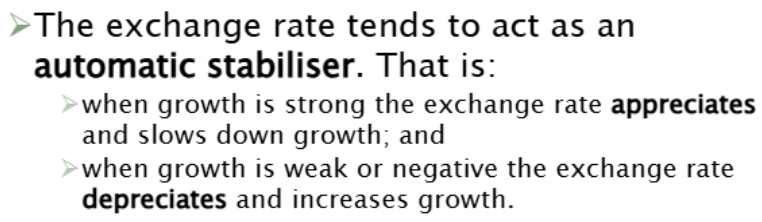
The exchange rate tends to act as an automatic stabiliser. This means? (Don’t need to outline why, just say what occurs)
Which has a more important effect: AD or AS?
AD - demand side effects are stronger
When growth is strong – AUD appreciates this is because:
RBA sets higher interest rates to reduce inflation → higher relative interest rates → leading to more investment in Aus → which would increase demand for AUD and hence cause AUD to appreciate
This would then cause there to be less exports as more expensive → less exports → lowers AD and hence growth → this will increase unemployment and thus lower living standards
(However on the supply side, appreciation in AUD will help growth as it reduces production costs and increase AS) - but demand factors outweigh supply effects
When growth is weak – AUD depreciates this is because:
Weak growth → the RBA may lower interest rates to stimulate the economy → Australian interest rates become less attractive relative to overseas rates → foreign investors move funds elsewhere → demand for AUD falls → AUD depreciates
A lower AUD makes Australian exports cheaper and more internationally competitive → exports increase → Aggregate Demand (AD) increases → economic growth strengthens —> encourages firms to expand production and hire more workers, reducing unemployment and improving living standards
Impact of exchange rates on inflation
Appreciation of AUD reduces inflationary pressures
→ it reduces exports → lowers demand and hence risk of demand inflation
→ It reduces costs of production → increases AS → lowers risk of cost inflation
Impact of exchange rates on CAD
Appreciating AUD → increases imports + reduces exports → reduce surplus/increase the deficit on the trade balance due to increased debits--> increases a CAD/reduces CAS
Depreciating AUD → imports become more expensive and exports become cheaper for overseas buyers → imports fall and exports rise → the trade balance improves due to increased credits → increases a Current Account Surplus (CAS) or reduces a Current Account Deficit (CAD).
international competitiveness + what factors influence it
A country's international competitiveness measures how well it can compete in international markets (price, service or quality of products)
It is influenced by factors including labour productivity, capital productivity and access to resources
Is Aus internationally competitive? What is its rank in 2025?
Aus is not very internationally competitive
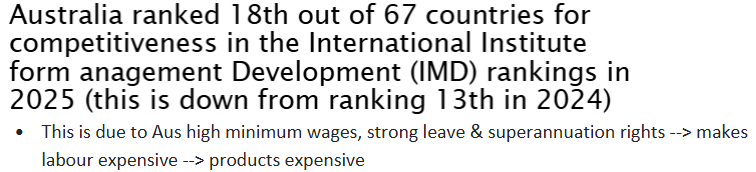
Productivity
How does it affect international competitiveness?
Productivity: measures how much output can be produced from a given number of inputs
Generally increases in productivity improve international competitiveness as production costs fall --> Aus competes better on price/quality
However in monopolistic or oligopolistic markets, including markets protected by tariffs --> increases in productivity may be retained as profits rather than used to increase competitiveness
One factor that affects productivity is economies of scale
What factors affect production costs?
Production costs are influenced by productivity, labour costs, capital costs, raw material costs immigration/participation rate
The exchange rate also acts as an automatic stabiliser for international competitiveness. Explain why
If we become less competitive due to expensive exports --> this reduces demand for AUD and more demand for imports which increases supply of AUD --> this causes AUD to depreciate which increases Aus competitiveness
If we become more competitive, the opposite occurs and the AUD appreciates --> reduces our competitiveness
Relative rate of inflation affects international competitiveness:
High relative inflation rate will increase prices of exports and hence would cause Aus exports to become less competitive
How does international competitiveness affect:
Goal of LIPS
Goal of SSEG
Goal of FE
LS
--> helps achieve the goal of LIPS as it reduces cost inflation (also can reduce demand inflation to a certain extent by increasing AS)
--> It also helps to achieve the goal of SSEG
--> Helps to achieve FE (although opening international markets can cause short-term structural unemployment)
--> Helps increase LS