Microbiology Final (Eric Shows Jones College)
 Call Kai
 Learn
Learn Practice Test
 Spaced Repetition
 Match
Match Flashcards
 Knowt Play
1/290

There's no tags or description
Looks like no tags are added yet.
Name | Mastery | Learn | Test | Matching | Spaced | Call with Kai |
|---|
No analytics yet
Send a link to your students to track their progress
291 Terms
Microbiology is the study of
microbes related to their molecular and cellular anatomy, physiology, genetics, and their ecology
ecology
the study of how organisms interact with their environment
mikros (Greek)
Small
bios (Greek)
life
logos (Greek)
discourse, study, reason
microbes include
bacteria & archaea
viruses
fungi
protozoa
Helminths
algae
how does microbiology intersect with other disciplines?
Virology (virus)
Bacteriology (bacteria)
Mycology (fungus)
Parasitology (parasites)
Immunology (Immune system)
Serology (blood serum)
because of the connection to infectious disease, microbiology is unavoidably linked to ________________.
epidemiology (the study of incidence, distribution, causes, and control of diseases.)
___________contains specific antibodies against a particular microbe.
antiserum
functions of a microbe
decomposition
nitrogen fixation
photosynthesis
symbioses
ubiquitous
present or existing everywhere
Shigella
a microbe that causes bacillary dysentery (infection of the intestines resulting in severe diarrhea with the presence of blood and mucus in the feces) with only being exposed to very few cells
Microbiome
the microorganisms in a particular environment
pathogenic microbe
microbe that has the capacity to produce disease
true pathogens
exists in order to reproduce and infect
opportunistic pathogens
causes disease if the situation is perfect
Virulence
how easily the pathogen can infect and cause a disease in a host
avirulant
Incapable of causing disease
Virulance factors
invasiveness (the ability of a microbe to establish itself in/on a host)
toxigenicity (the ability for the microbe to produce a toxin in order to weaken/damage a host
Taxonomy
the system of assigning formal scientific names and classifications to organisms
phylogeny
The study of evolutionary relationships among organisms
Taxonomy classification system

three domains of life
Bacteria, Archaea, Eukarya
Metabolically diverse, found in most any habitat; prokaryotic; typically unicellular. (domain of life)
Bacteria
extremeophiles; prokaryotic; typically unicellular (domain of life)
Archaea
-philes
favor, attracted to, like
Eukaryotic; contain a membrane-bound nucleus; can be multicellular or unicellular (domain of life)
Eukarya
binomial nomenclature
A system for giving each organism a two-word scientific name that consists of the genus name followed by the species name
True or False:
prokaryotic cells don't have a plasma membrane
False; both prokaryotic and eukaryotic cells have a plasma membrane called the phospholipid bilayer
what is the cell wall of a prokaryotic cell made from?
peptidoglycan (bacteria);polysaccharides and/or proteins (archea)
some prokaryotic cells have an external layer to the cell wall. what is the name of this layer?
glycocalyx
structures of motility in prokaryotic cells
flagella
prokaryotic cells genetic material location
nucleoid region
eukaryotic cells genetic material location
nucleus, mitochondria, and chloroplasts
meter (m)
measures distance
liter (L)
measures volume
gram (g)
measures mass
kilo-
k
10³
centi-
c
10^-2
milli-
m
10^-3
micro-
10^-6
nano-
10^-9
prokaryotic and eukaryotic cells are measured in...
micrometers
viruses are measured in...
nanometers
structures of movement in eukaryotic cells
flagella, cilia, pseudopodia
parts of a prokaryotic flagellum
Filament: the tail; made of a protein called flagellin
Hook: anchor which is embedded into basal body
Basal Body: rings that are anchored through the cell wall, periplasmic space, and cell membrane
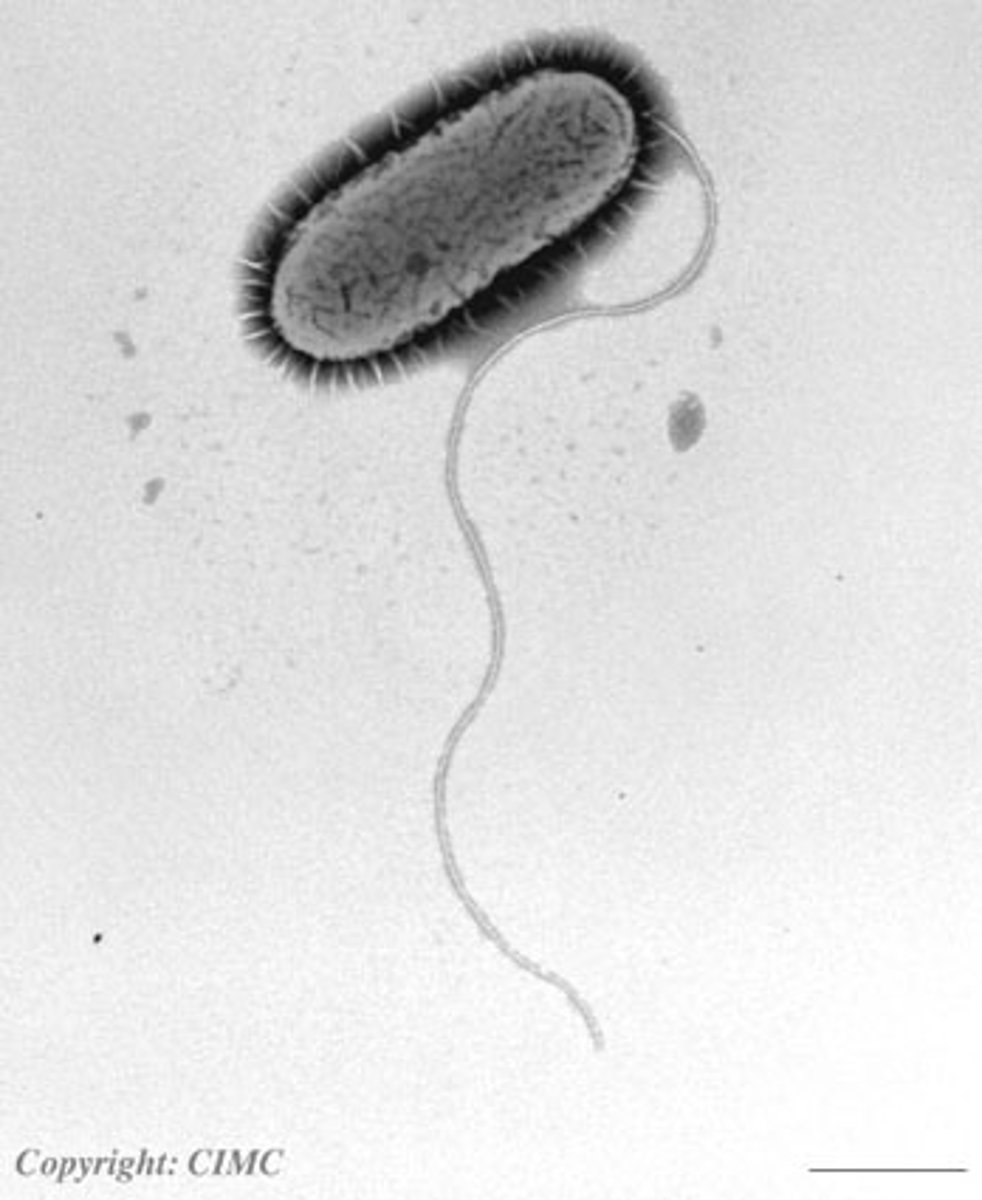
what movement do bacterial flagellum make for motility?
rotating movement due to ions
what movement do eukaryotic flagella make for motility?
whip like motion powered by ATP proteins.
prokaryotic flagellum: filament
helical structure composed of a protein called flagellin. This forms the protruding tail of the flagellum.
prokaryotic flagellum: hook (sheath)
curved tubular structure anchored to the cell by the basal body
prokaryotic flagellum: basal body
stack of rings fixed to hold the flagellum together. It is attached firmly through the cell wall, periplasmic space, and the cell membrane
Polar flagellation
having flagella coming from one or both ends of the cell of the prokaryotic cell
monotrichous flagella
single flagellum attached at one end of the cell
lophotrichous flagella
more than one flagella at one end of the cell
amphitrichous flagella
flagella at both poles of the cell
peritrichous flagella
flagella that cover the surface of a cell
endoflagella
flagella that spiral tightly around a cell instead of protruding
taxis
movement in response to an environmental stimulus
+ taxis
movement toward the stimulus
- taxis
movement away from stimulus
chemotaxis
Cell movement that occurs in response to chemical stimulus (food source)
movement in response to sunlight
phototaxis
movement in response to Oxygen gradients
aerotaxis
magnetotaxis
movement toward or away from the Earth's magnetic field
what are the two types of pili called
fimbriae
sex pili
What are fimbriae?
hairlike appendages that allow for attachment
What are sex pili?
only found in G- bacteria; involved in connecting cells during bacterial conjugation (a type of horizontal gene transfer)
what are hamus
grappling hook like structures that are used to aid in cell-to-surface attachment.
what is the purpose for the bacterial glycocalyx
protection; helps to adhere to surfaces (increases virulance); can also help form biofilms
What is a biofilm?
protective aggregates of microbes that form on surfaces such as teeth, gums, implanted medical devices, industrial piping, and terrestrial and aquatic habitats
what are the two types of glycocalyxes and their structure?
slime layer; loose
Capsule; organized
glycocalyces: slime layer
a loose layer that protects the bacterium from dehydration and nutrient loss
composed of polysaccharides, protein, and/or glycoproteins
gives the cell wall a sticky consistency
glycocalyces: capsules
a thicker, more organized layer
composed of polysaccharides, proteins, and/or glycoproteins
the layer is chemically bonded to the cell
cell wall
cell membrane
periplasmic space
what are the parts of the bacterial cell envelope
periplasmic space
internal space between the plasma membrane and the cell wall
what is the purpose of the cell wall
to protect and support the cell; also helps prevent osmotically-induced lysis.
peptidoglycan
A type of polymer in bacterial cell walls consisting of glycan (polysaccharide) that are cross linked by peptides (amino acid chains)
what are the steps to the gram stain
crystal violet
rinse
iodine
rinse
alcohol
rinse
safranin
rinse
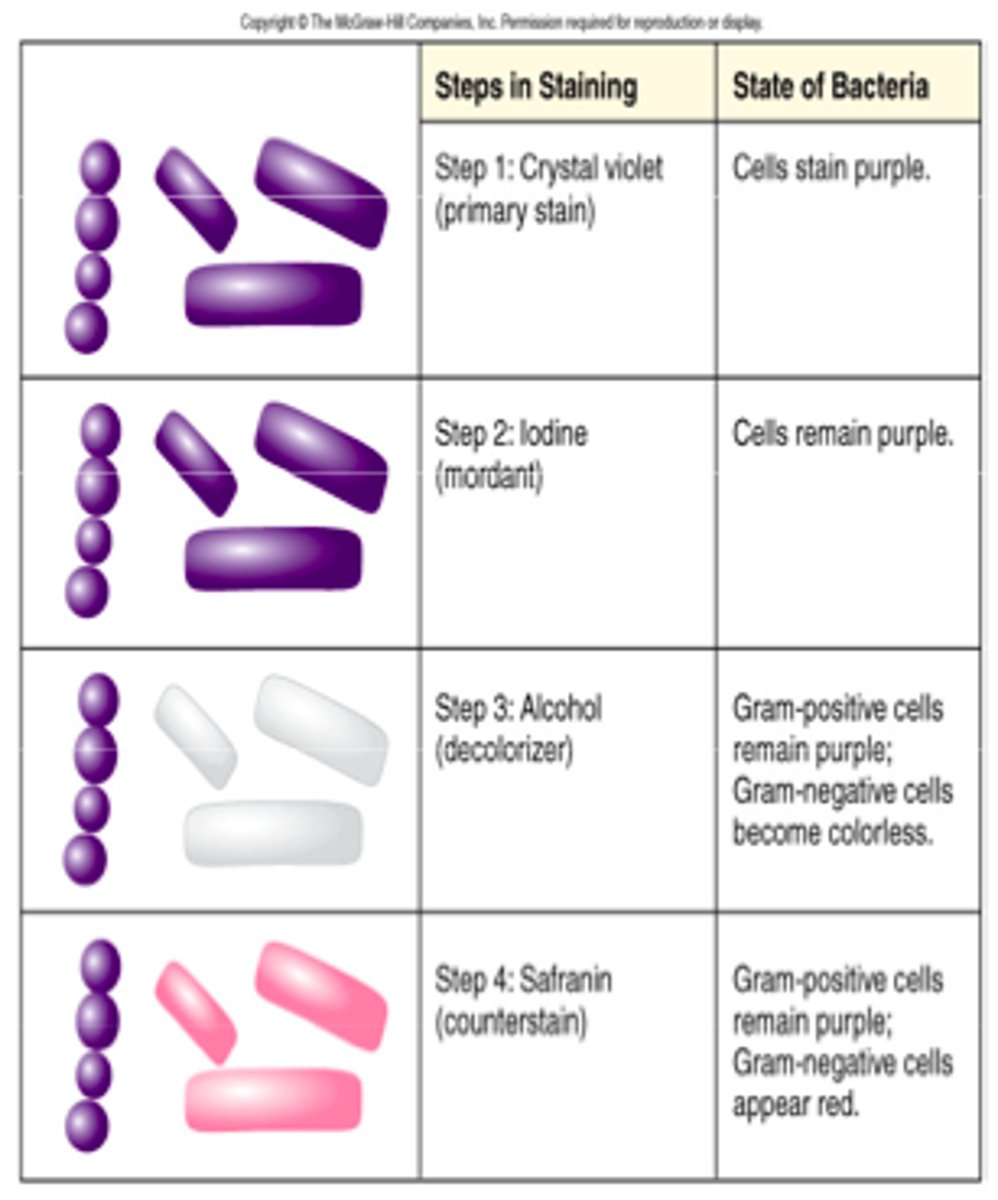
in microscopy, how can you determine if the cell is gram positive or gram negative
Purple cell = gram positive
Pink cell = gram negative
what are characteristics of a gram positive cell
the thick peptidoglycan layer of the cell wall
teichoic acid
lipoteichoic acid
what type of electrical charge does the gram positive cell wall have
negative charge
what are the obvious characteristics of a gram negative cell wall?
a thin peptidoglycan layer plus an extra outer membrane
how is the extra outer membrane of a gram negative cell wall anchored
braun's lipoproteins
what are the exceptions to a gram staining result and why are they exceptions
Mycobacterium and Nocardia spp.; they have mycolic acid
Myoplasma spp.; naturally lack a cell wall
L forms; parts of the cell wall have holes
1. bacteria can lose their cell wall forming genes
2. bacteria is exposed to penicillin
3. bacteria are exposed to an antimicrobial enzyme
why would a cell lose it's cell wall
what are the two types of L forms and where are they found
Protoplast; G+ bacteria
Spheroplast; G- bacteria
Protoplast
an osmotically fragile round body that results from G+ bacteria losing their cell walls
the outermost covering will now be the plasma membrane
Spheroplast
an osmotically fragile round body that results from G- bacteria losing their thin peptidoglycan layer but retaining the outer membrane of their cell wall
True or False; all cells have a cell membrane
True
what are the functions of a prokaryotic cell membrane
1. controls what enters and leaves the cell
2. allows for secretion
3. contains enzymes for making structual macromolecules
4. contains infoldings studded with enzymes
5. contains receptors for taxis
cytoplasm
A jellylike fluid inside the cell in which the organelles are suspended
cytosol
Fluid portion of cytoplasm
What is the nucleoid region?
Region in prokaryotic cells where DNA is located (in cytoplasm)
What are plasmids?
Plasmids are small loops of extra DNA that aren't part of the chromosome. Plasmids contain genes for things like drug resistance and can be passed between bacteria.
What are ribosomes?
site of protein production
inclusions
aggregations of organic and inorganic material in the cell
may or may not be membrane enclosed
type of inclusions: metachromatic granules (volutin)
aggregates of poly- and metaphosphates that act as a phosphate reservoir for metabolic reactions
Corynebacterium spp. often contain these granules.
type of inclusions: magnetosomes
granules composed of magnetite that are used by some bacterial species to orient themselves relative to the Earth's magnetic field
type of inclusions: Glycogen and PHB inclusions
carbon storage
type of inclusions: gas vesicles
controlled to provide buoyancy