11.5 Multivariable Chain Rule
 Call Kai
 Learn
Learn Practice Test
 Spaced Repetition
 Match
Match Flashcards
 Knowt Play
1/4

There's no tags or description
Looks like no tags are added yet.
Name | Mastery | Learn | Test | Matching | Spaced | Call with Kai |
|---|
No analytics yet
Send a link to your students to track their progress
5 Terms
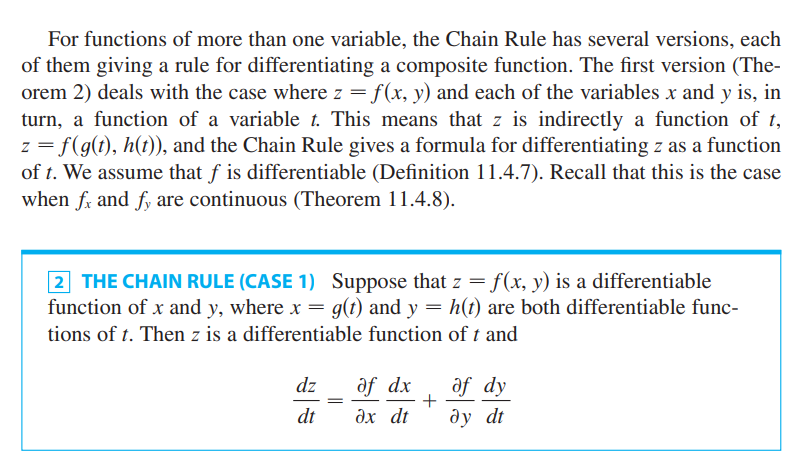
The Chain Rule (Case 1)
A function of multiple variables may itself have its variables defined in terms of another variable; in this example, we must utilize the chain rule because the original function has another function within it (the definition of a composite function → chain rule).
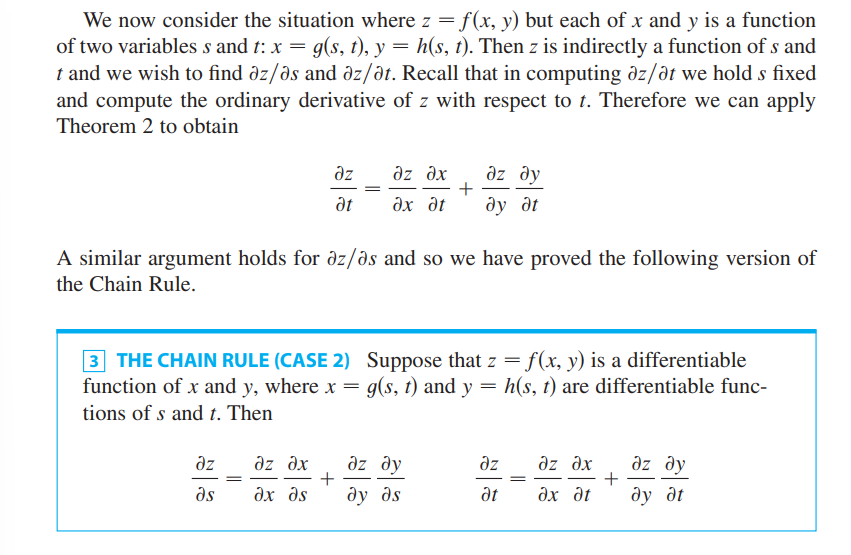
Chain Rule (Case 2)
Case 2 occurs when the original function, z = f(x,y), has x and y defined in terms of multiple variables itself; that is to say, x = g(s,t) and y = h(s,t). In this instance, keep differentiating until the desired variable in the denominator is met:
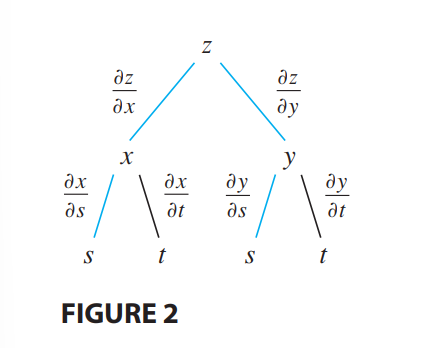
The Family Tree Method for the Chain Rule
In general, the more complex the function is, the more branches that will be required. Start with the n variables with which the original function is defined. From there, create a branch for each of the n variables. From there, create two m branches for each of the variables that each of the original n variables have.
SO in the picture attached, z is defined as z = f(x,y). So our first two branches are x and y. From there, x and y are both defined in terms of s and t; therefore, we have x = g(s,t) and y = h(s,t). From there, we take the partial derivatives of x and y with respect to the individual s and t variables.
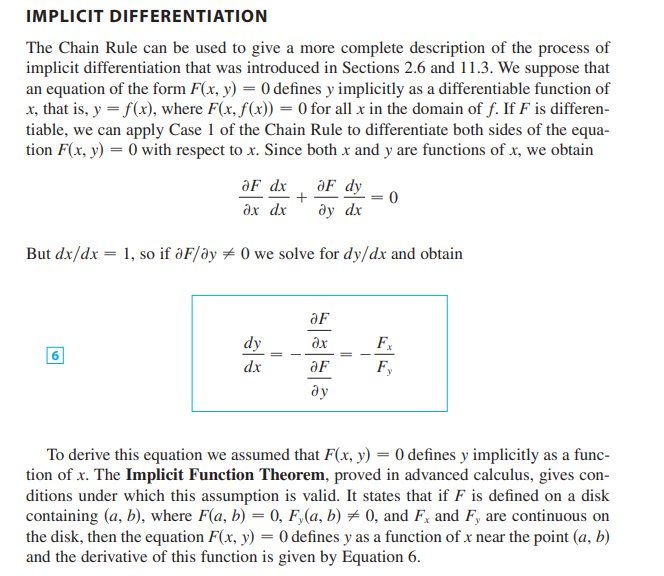
Implicit Differentiation Using Partial Derivatives
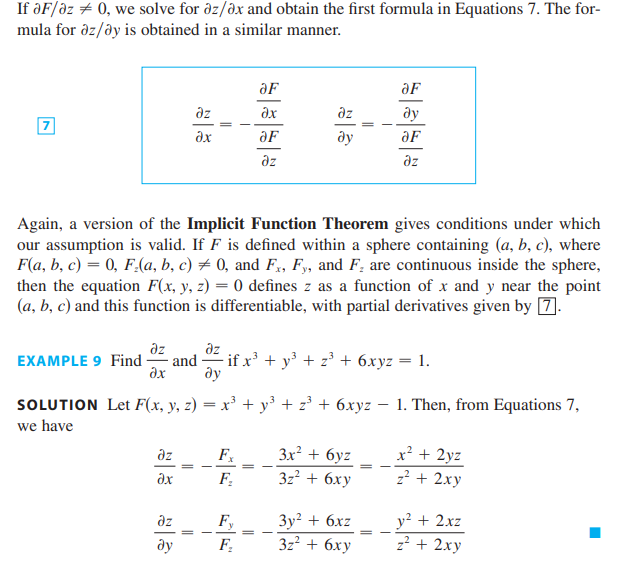
The value dy/dx can be determined based on the partial derivatives of the expression (should that expression be defined implicitly). Formula:
An important point to note is that the expression must be written in terms of F(x,y) = 0; therefore, it is necessary to subtract all terms such that one side of the equation is 0.
The Implicit Function Theorem (Part 2)