Kine305: Ch.2 Biomechanics
 Call Kai
 Learn
Learn Practice Test
 Spaced Repetition
 Match
Match Flashcards
 Knowt Play
1/42

There's no tags or description
Looks like no tags are added yet.
Name | Mastery | Learn | Test | Matching | Spaced | Call with Kai | Chat |
|---|
No analytics yet
Send a link to your students to track their progress
43 Terms
Friction Force
Force between 2 surfaces that increases resistance to motion of one surface on another (Skating, snowboarding is low action friction in order to glide)
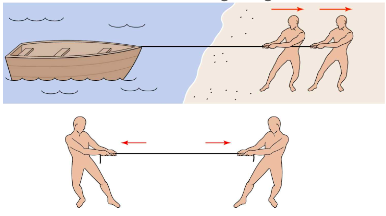
Linear Force
2 forces acting on the same line
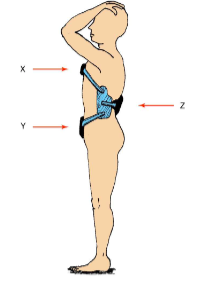
Parallel Force
Occur in the same plane and in the same or opposite direction (x and y working in same direction, z working in opposite)
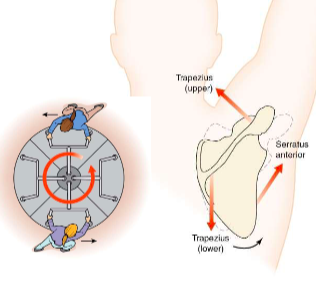
Force Couple
Two or more forces act in different lines of pull or directions (produces CW or CCW rotation)
Concurrent Force
Two or more forces acting on an object, push or pull in different directions
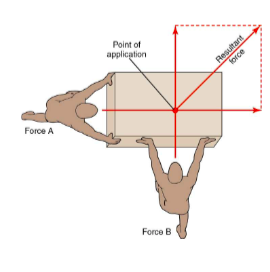
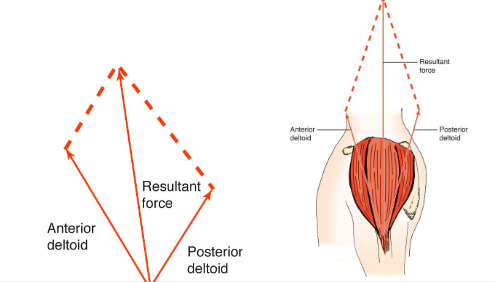
Resultant Force Vector
Sum of magnitudes and directions of each individual force vector, results from all applications of all forces acting on the object
Traction
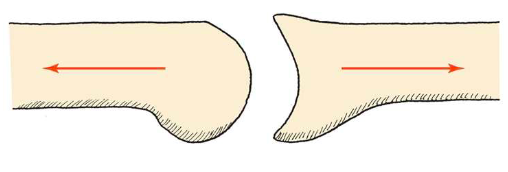
Distraction or tension (ex. at your elbow, there can be a little traction if carrying a heavy suitcase)
Compression
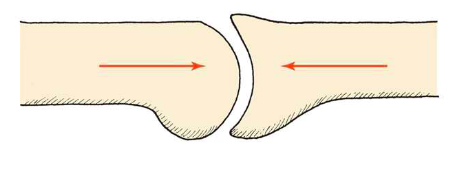
Forces that compact, squeeze, or press inwards on tissue, typically acting along the longitudinal axis of bones and joints. (ex. dislocated shoulders- planks create compression force within their joint to help with better muscle activation and stabilization via compression)
Shear
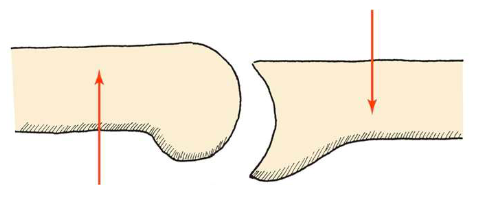
Parallel forces but in opposite directions so if I’m trying to improve glide of joint… I can do a shear (ex. take humerus head and glide it anterior (like jose said) to help with external rotation
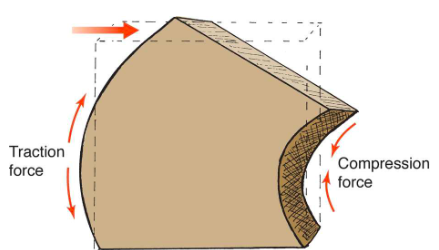
Bending
Combination of compression on one side and traction on the other, like when we side bend through the vertebra
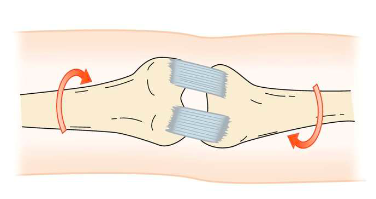
Rotary/Torsion
Twisting(torsion) around the long axis, 2 opposing forces create a twist within the object, one force turns one direction and the other the opposite (twisting and rotating(rotary) are not the same *twisting is opposite direction, rotating is same direction) (ex. tibial torsion - the femur twists outward while the lower leg twists inward)
Torque
Torque = F x D
Tendency of a force to produce rotation about an axis. How muscles create rotation around a joint (angular motion)
a twisting force that tends to cause rotation.
Moment Arm
Perpendicular distance between the line of application of force and axis
Longer Moment Arm
= Greater Torque
Force Arm
Where the muscle attaches
Practical applications of torque
Increasing exercise difficulty, choice of exercise can be influenced by understanding how torque affects muscle engagement and joint movement, lifting weights at different angles can change the moment arm and thus the torque experienced by the muscles
Newton’s 1st Law
Law of inertia states that an object either stays at rest or remains in motion in a constant state, unless acted upon by an external force (ex. person standing won’t start walking until muscles generate force agains the ground, muscles have to overcome and apply force or decelerate)
Newton’s 2nd Law
Law of acceleration defines the relationship between force, mass, and acceleration (f=ma) ex. kicking a soccer ball vs a med ball, difference in amount of force required to kick
Newton’s 3rd law
Law of action - reaction states that for every action there is an equal and opposite reaction ex. gravity, jumping we get off the ground but GRF with gravity down into the ground to create that motion, prof Osmar hitting the wall
Equilibrium
Is when the sum of all forces acting on an object is equal to zero, dependent on COM, COG, and BOS
What makes a stable vs. less stable equilibrium?
Smaller BOS, standing off balance, elderly, etc..
Postural equilibrium
Other muscles will start working because your axis (axis of rotation) created a larger moment arm, so created more torque and now working really hard to hold yourself, mechanical advantage goes down
Longer the moment arm
= greater the torque
Rectilinear motion
Same distance, same direction, at same time (straight line path, no rotation) ex. sled across ice
Curvilinear motion
Motion that follows a curved path ex. ski, flight of a thrown ball
Angular motion
Motion that occurs around a fixed point (axis) ex. knee extension during kicking happens around an axis and creating angular types of motion
What do most movements in our body have?
Most have linear and angular motion at the same time
Levers
Rigid bar that rotates around a fixed point (three classes of levers)
bone
lever
joint
axis
muscle
force
When does movement happen?
When the muscle torque overcomes the resistance torque (inverse relationship)
Bw/ gravity / weight
type of force but is over resistance
First class lever
Axis between force and resistance (F - A - R or R - A - F) ex. like a see saw, creating a balance FA=RA
Second class lever
Resistance between axis and the force (A - R - F or F - R - A) resistance is closer to axis which is creating a much longer force arm, ex. wheelbarrow has long force arm FA > RA
Longer force arm
Greater mechanical advantage
Key features of second class lever
Less effort to move a larger load but class 2 levers are more rare in the human body, ex. brachioradialis at elbow joint, ankle plantarflexors, ex. jar openers w/ longer levers (better mechanical advantage)
Third class lever
Force between axis and resistance (A - F - R or R - F - A), mechanical advantage: RA > FA so less mechanical advantage. they do create more speed/distance of movement but you have to create more force to do it. So RA is always longer which requires greater force to move the load but does lead to more motion ex. bicep
Can the class of the lever ever change?
Yes, just put a weight in your hand. change 2nd class to 3rd, increased load increases RA so less mechanical advantage bc RA gets larger. Now, exercise will be harder with weight in hand.
3rd to 2nd class
Change to eccentrically, weight of lowered forearm becomes applied, biceps brachiii now RA
Fixed Pulleys
Single pulley attached to a fixed point, creates a first class lever
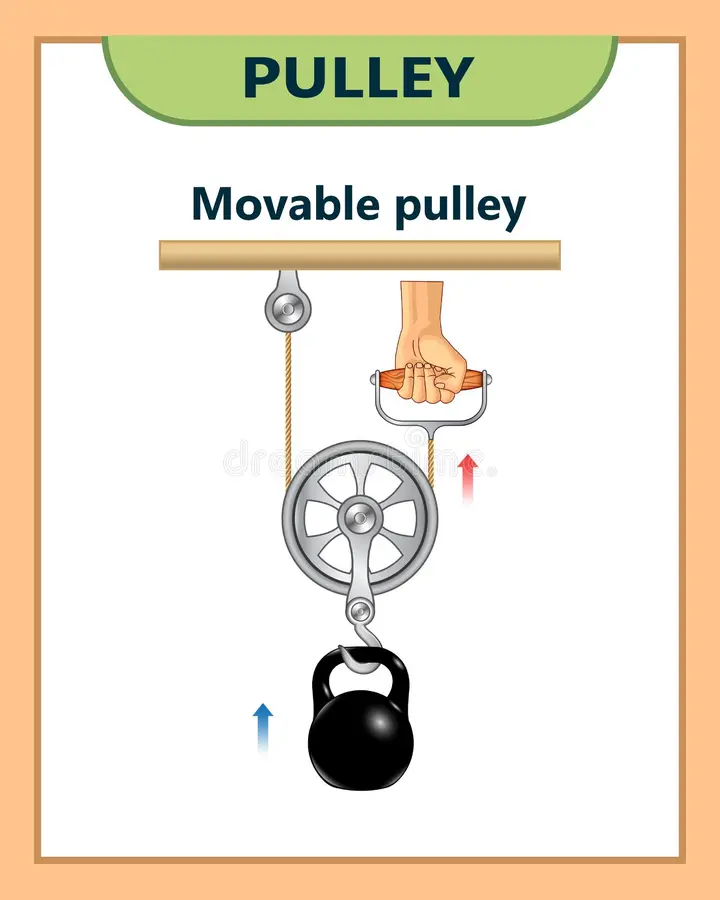
Moveable Pulley
Combines a fixed pulley to change direction of force application, a moving pulley to change magnitude of force applied to lift a load (like a third class A - R - F)
Inclines plane
a longer ramp requires less force, a shorter ramp requires more force