Engineering Geology
 Call Kai
 Learn
Learn Practice Test
 Spaced Repetition
 Match
Match Flashcards
 Knowt Play
1/186

There's no tags or description
Looks like no tags are added yet.
Name | Mastery | Learn | Test | Matching | Spaced | Call with Kai |
|---|
No analytics yet
Send a link to your students to track their progress
187 Terms
How do you determine the bulk density, moisture content, void ratio, and degree of saturation of a soil block, and what are the most common calculation pitfalls?
These parameters are found using standard phase relationships:
Bulk Density (ρ): Total mass divided by total volume (m/V).
Moisture Content (w): Mass of water divided by mass of solids (mw/ms).
Void Ratio (e): Volume of voids divided by volume of solids (Vv/Vs).
Degree of Saturation (Sr): Volume of water divided by volume of voids (Vw/Vv). Alternatively, it can be found using the formula wGs = Sre.
When a surcharge load is rapidly applied to a saturated clay layer, how are the total stress, pore-water pressure, and effective stress affected immediately after application?
In a "rapid" application on clay, the soil behaves in an undrained manner. The total stress increases immediately by the full magnitude of the surcharge. Because water cannot drain quickly from the clay, the excess pore-water pressure absorbs the entirety of this added load. Consequently, the effective stress remains unchanged immediately following the loading.
How does the shear stress versus shear strain response behave for a stiff, overconsolidated clay, and what are the key strength stages?
When sheared, a stiff, overconsolidated clay exhibits a response where the shear stress rises to a maximum peak strength. As strain continues (and the soil dilates), the shear strength drops, passing through a critical state, and eventually flattening out at a lower residual strength after considerable shear strain.
What is the correct procedure for deriving effective stress shear strength parameters (c’ and ϕ) from triaxial test data?
Calculate the major and minor principal stresses (σ1' and σ3') at failure.
Plot these as Mohr circles on graph paper using equal scales for the axes.
Draw a single failure envelope line that is tangential to all the circles.
The y-intercept of this line is the effective cohesion (c'), and the slope angle is the effective friction angle (ϕ')
What formula is used to determine the coefficient of permeability from a constant head permeameter test?
You must use Darcy's Law, q = A x k x i, and solve for the coefficient of permeability (k). The components include the discharge volume over time (q), the cross-sectional area (A), and the hydraulic gradient (i).
What are the fundamental rules for drawing a valid flow net for groundwater seepage?
A flow net must be drawn to scale on graph paper. It consists of flow lines and equipotential lines that intersect at 90 degrees, forming a "square" net.
How is the pre-consolidation pressure (σc’) determined from an odometer test?
It is determined using Casagrande's procedure. You plot the void ratio (e) on the y-axis against the log of the applied pressure (effective stress) on the x-axis. You then locate the point of maximum curvature on the graph to graphically derive the preconsolidation pressure.
When analyzing settlement across multiple clay layers, how is the time factor and degree of consolidation (Uz) handled?
The rate of consolidation (Uz) varies for each specific layer based on its individual properties (like cv and drainage paths). However, the timeframe (t) is identical across all layers.
What are the key factors controlling the compaction behaviour of a cohesive soil for engineered fill?
The key controlling factors are the soil's moisture content, the resulting dry density, and the specific compactive effort applied to the soil
What specific parameters are measured during in-situ Standard Penetration Tests (SPT), Cone Penetration Tests (CPT), and Vane Shear Tests (VST)?
SPT: Measures "blow counts" aka the N-value
CPT: Measures "cone tip resistance" which is the force acting directly on the cones tip/cone’s base area, "sleeve friction" the frictional resistance acting along the cylindrical sleeve surface directly behind the cone tip, and "pore-water pressure" which is the fluid pressure generated within the soil matrix during penetration .
VST: Measures the "torque" requried to induce structural shear failure whihc is mathematically translated into the soil’s undrained shear strength
How do benches manage rockfall risks in quarries, and what is a critical design consideration?
Benches help manage rockfall by reducing the overall slope angle and decreasing the fall height. They act as collectors to trap rocks, effectively limiting the coefficient of restitution, especially when covered with loose materials or vegetation
What are the six classification parameters used in the Rock Mass Rating (RMR) system?
the RMR uses the following six parameters:
Uniaxial compressive strength of rock material.
Rock Quality Designation (RQD).
Spacing of discontinuities.
Condition of discontinuities.
Groundwater conditions.
Orientation of discontinuities.
What is the Rock Quality Designation (RQD) and how is it calculated?
RQD is a quantitative estimate of rock mass quality derived from drill core logs. It is defined as the percentage of intact core pieces longer than 10 cm in the total length of the core.
Why are rock mass classification systems critical in engineering projects?
Identify the most significant parameters influencing the behavior of a rock mass.
Divide a rock mass formulation into classes of varying quality.
Relate the experience of rock conditions at one site to others.
Derive quantitative data and guidelines for engineering design.
Provide a common basis for communication between engineers and geologists.
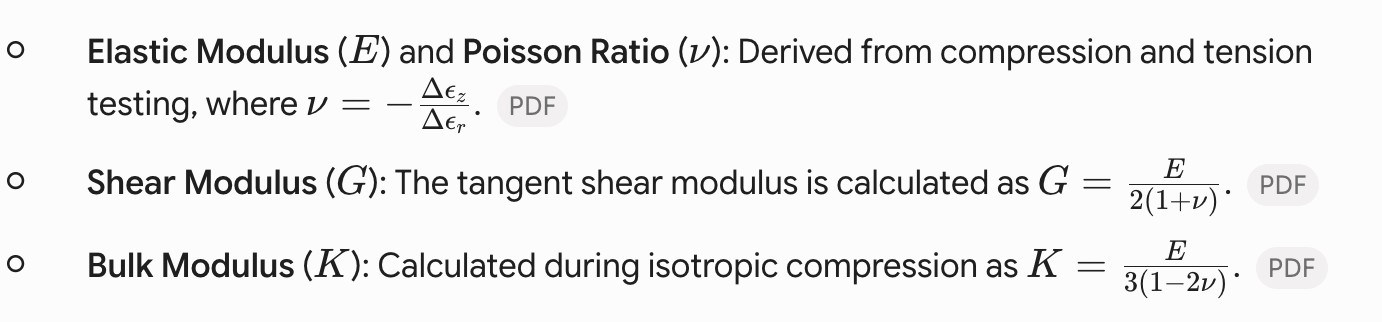
What factors are used to define a rock's stiffness?
Stiffness relates increments of stress to increments of strain. The primary parameters include:
What are the three broad groups of rocks and how are they formed?
Igneous: Formed by the cooling of molten material at or beneath the Earth's surface. Examples include intrusive rocks like Gabbro and Granite, and extrusive rocks like Basalt.
Metamorphic: Formed when subjected to more pressure or heat; the process of metamorphism does not melt the rocks. Examples include foliated rocks like Slate and non-foliated rocks like Marble.
Sedimentary: Formed at or near the surface of the Earth, either in water or on land, and they frequently have bedding planes. Examples include clastic rocks like Sandstone and chemical rocks like Limestone.
What are the primary types of geological structures and how are they defined?
Geological structures are large-scale physical arrangements or configurations of rock masses in the Earth's crust created by tectonic forces (compression, tension, or shearing). The primary types include:
Faults: Fractures created when rocks are subjected to pressure.
Folds: Formed when rocks bend under pressure; they include Synclines (youngest beds are preserved in the center core) and Anticlines (oldest beds are preserved in the core).
Unconformities: A major gap in the geological sequence where there are big differences in the beds below and above the break in sedimentation (e.g., angular unconformities, nonconformities, and disconformities).
What is a discontinuity in engineering geology
A discontinuity is a collective and specific technical term for any surface or break in a rock mass where the continuity of the rock material is interrupted at an engineering scale. Common types include joints, faults, bedding planes, and foliation/schistosity (the parallel orientation of platy minerals)
What factors influence rock density, and what are typical density ranges?
Rock density is influenced by its constituent minerals, porosity, and the degree of compaction or cementation. Typical densities range from about 1.5 g/cm³ for porous sedimentary rocks like shale to over 3.0 g/cm³ for dense igneous or metamorphic rocks like Gabbro or Eclogite. Common rocks like Granite fall around 2.6 to 2.8 g/cm³.
How is the slake durability of a rock evaluated?
Slake is the breakdown or disintegration of rock when exposed to wetting and drying without applied mechanical load. This typically affects rocks like Shale, Mudstone, and Siltstone. The slake durability test measures a rock's resistance over two wetting-drying cycles. The index is calculated using the formula Idn = Mn/M0 x 100% where M0 is the initial dry mass and Mn is the retained dry mass after n cycles. A result > 95% indicates essentially non-slaking rock, while < 30% indicates rapid disintegration.
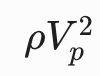
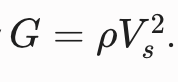
How can dynamic measurements be used to evaluate rock stiffness in-situ?
Dynamic tests utilize shear waves and body waves generated at ground level or at depth. The moduli can be calculated using wave velocities: Elastic modulus (E ) =
Shear modulus (G ) =
What is the Point Load Strength Index and how does it relate to Uniaxial Compressive Strength?
The Point Load Strength Index (Is) is calculated as P/De2, where De is the equivalent core diameter. This index must be corrected to a reference dimension of 50 mm, represented as Is50. For a standard NX (54 mm) core, it is commonly related to the Uniaxial Compressive Strength (σc) via the empirical relationship σc = 24 Is.
What is the Brazilian test?
The Brazilian test is a splitting tensile strength test. It typically uses a rock sample with a diameter of 54 mm and a thickness of 27 mm. The tensile strength (T) is calculated using the equation T = 2P/πLD
Differentiate between the types of failures experienced in hard rock tunnels versus weak rock tunnels.
Hard Rock: In materials like granite or quartzite, failures are typically stress-controlled. These include spalling/slabbing (the breaking off of thin slabs of rock) and rock bursts (a violent, rapid release of stored energy).
Weak Rock: In materials like shale, mudstone, or weak schist, failure is ductile and time-dependent. This is commonly referred to as squeezing.
What are triaxial tests?
Lab test for shear strength and failure
A rock specimen (height to diameter ratio of 2) is subjected to varying levels of confining pressure (σ3) and axial stress (σ1)) to understand brittle vs. ductile behaviour and strength envelopes.
What is Unconfined Compression Tests (UCT) testing?
Lab test for compressive strength
A standard cylinder sample (50 mm diameter, height-to-diameter ratio of 2:1) is loaded in a press until failure to find the ultimate limit stress.
What is point load tests
lab test for point load strength (Is)
Applies concentrated load to a rock sample to calculate Is = P/De2. This is corrected to a 50mm reference dimension (Is50) and is frequently used to estimate Uniaxial Compressive Strength ( σc=24Is for an NX core).
What is a slake test?
lab test for durability ( resistance to weathering)
Measures a rock's resistance to disintegration under repeated (typically two) wetting-drying cycles without applied load. Yields the Slake Durability Index (Id2).
What is a pressure test?
lab test for hydraulic conductivity
Used to determine permeability in a controlled laboratory setting using Darcy's Law.
What is a rock tunnel
A rock tunnel is an underground passage excavated through rock. Rock tunnels are used when it is more practical, safer, or more efficient to pass through the ground rather than build on the surface.
What are rock tunnels used for?
Transportation e.g. railway tunnels, road tunnels, and subway tunnels.
Water conveyance e.g sewer tunnels, water supply tunnels, hydropower tunnels, and drainage tunnels.
Energy-related purposes e.g. nuclear waste disposal tunnels and underground oil or gas caverns.
Mining extraction: Tunnels are used to access and remove minerals or resources.
Underground space utilisation e.g. underground data centres, archives, storage areas, or protected facilities.
Military and scientific purposes e.g. military tunnel networks and deep underground laboratories.
What happens to the stresses when a circular tunnel is excavated?
Before excavation, the rock is under natural ground stress. When a tunnel is excavated, the rock that used to carry stress is removed. The remaining rock around the opening must redistribute the stress.
This causes stress concentration around the tunnel boundary. Some parts of the tunnel may experience high compressive stress, while others may experience tensile stress or low confinement.
What is the Kirsch solution used for?
The Kirsch solution is used to estimate the stresses around a circular tunnel opening in an elastic rock mass.
It helps engineers understand where the tunnel boundary may experience the highest stress and where failure may occur.
The key stresses are:
Radial stress, σr
Stress acting perpendicular to the tunnel wall.
Tangential or hoop stress, σθ
Stress acting around the tunnel boundary. This is very important because high hoop stress can cause compression failure, and negative hoop stress can indicate tension.
Shear stress, τθr
Stress acting along the tunnel boundary.
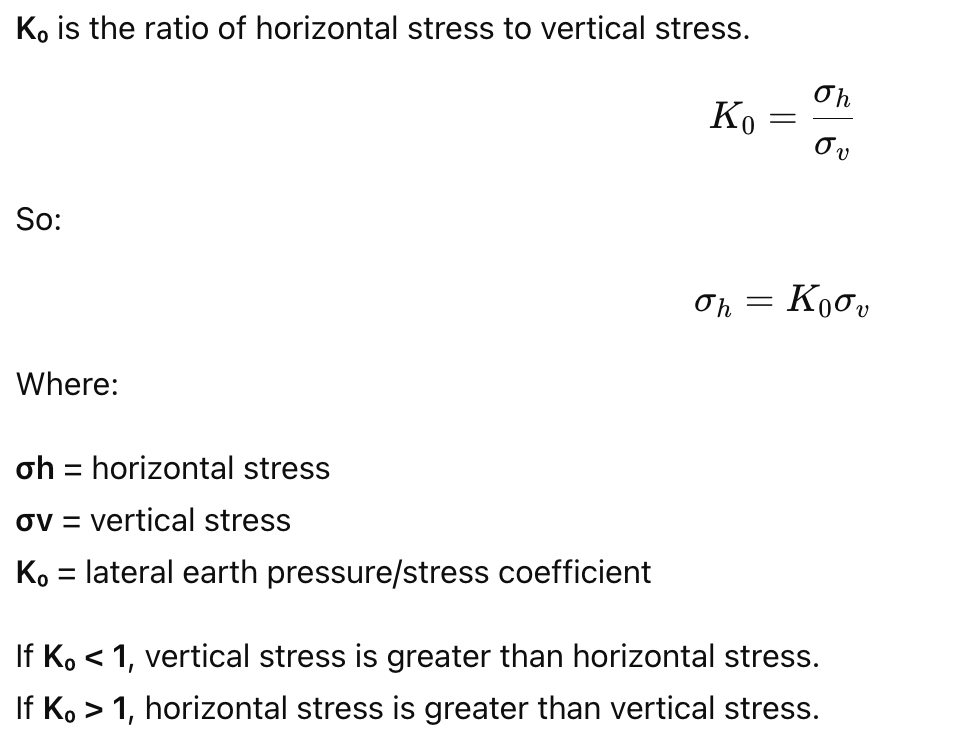
What are the equations for K0
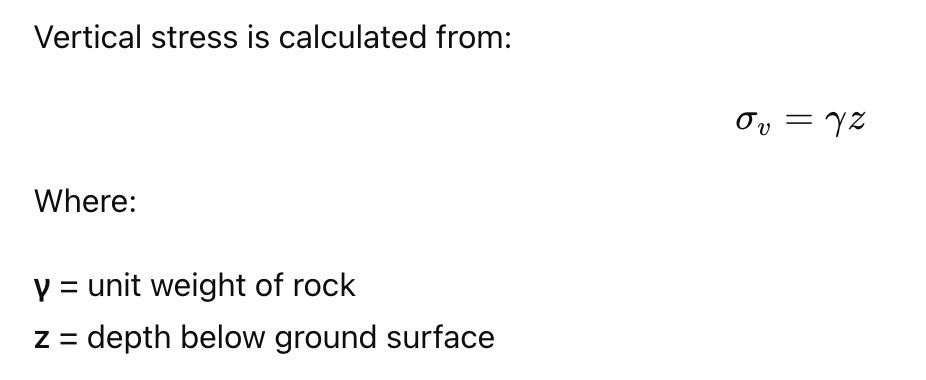
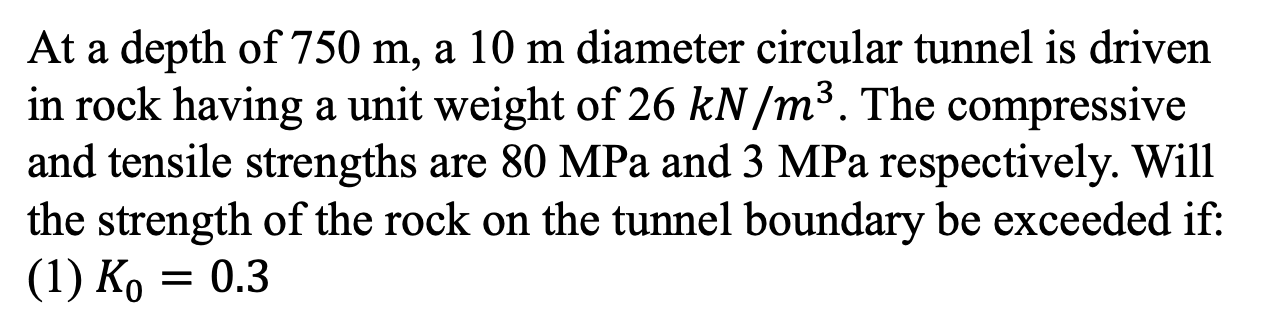
What is the vertical stress σv at depth?
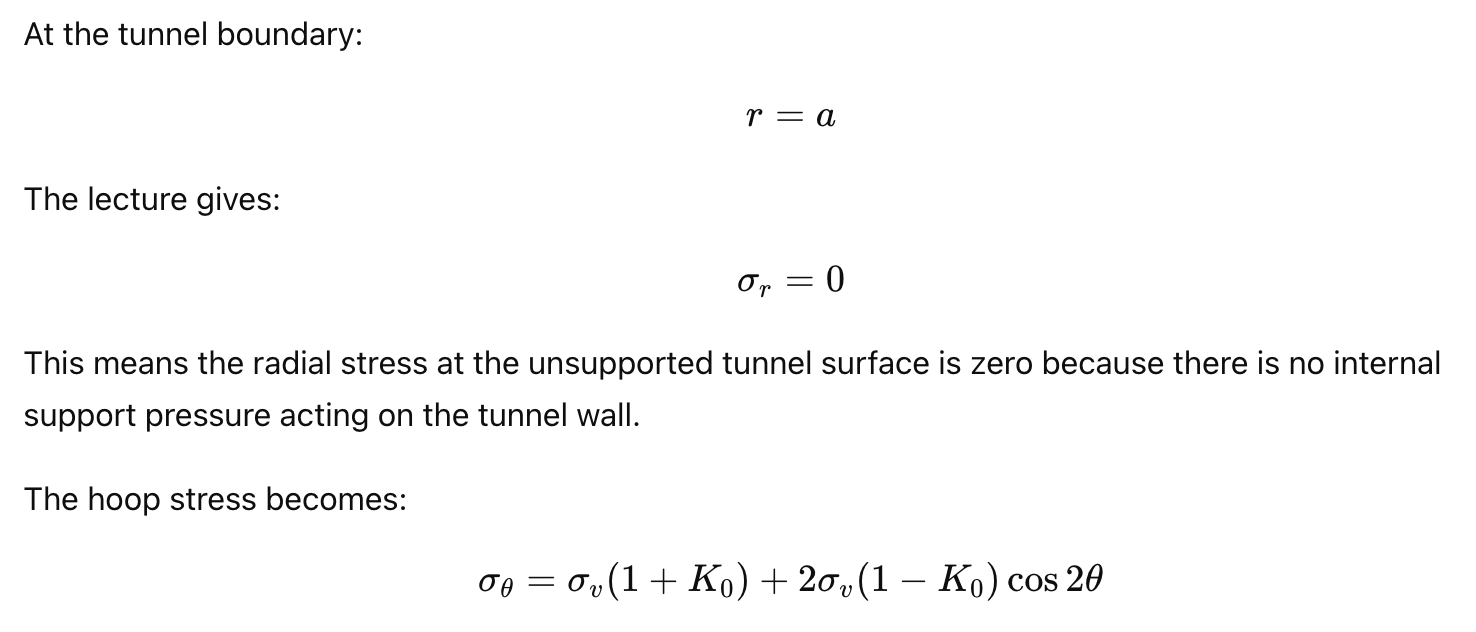
What is the stress at the tunnel boundary?
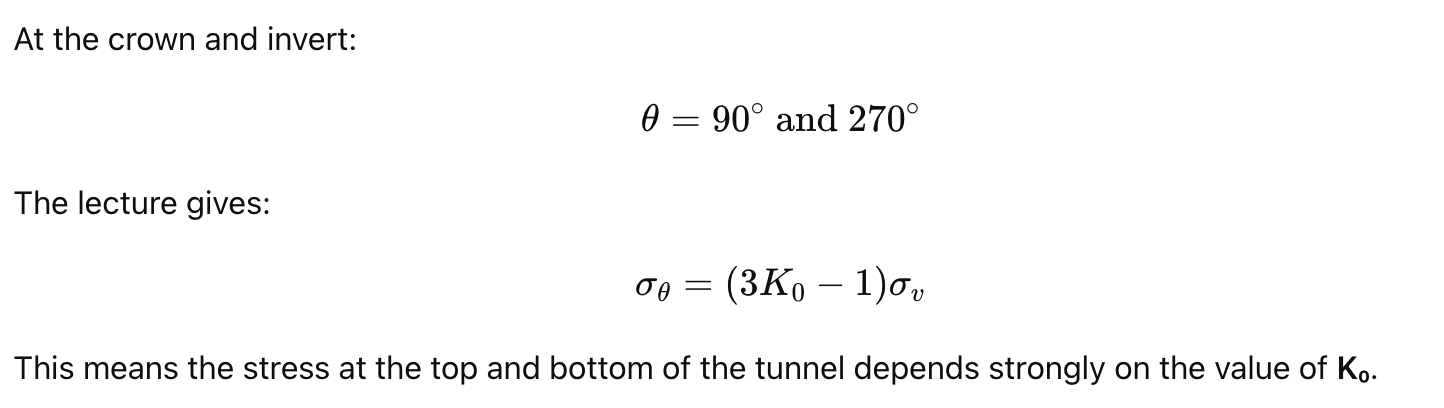
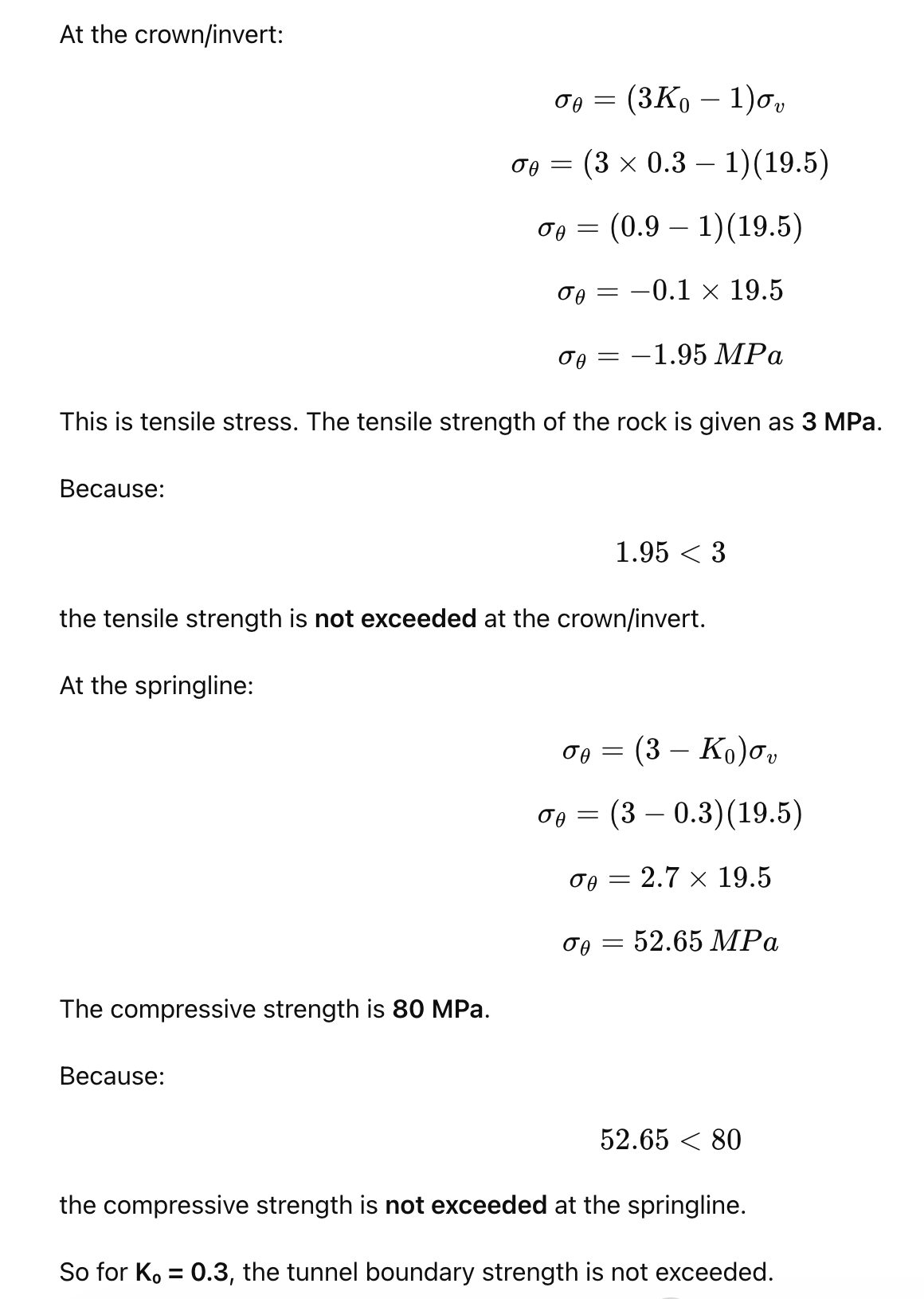
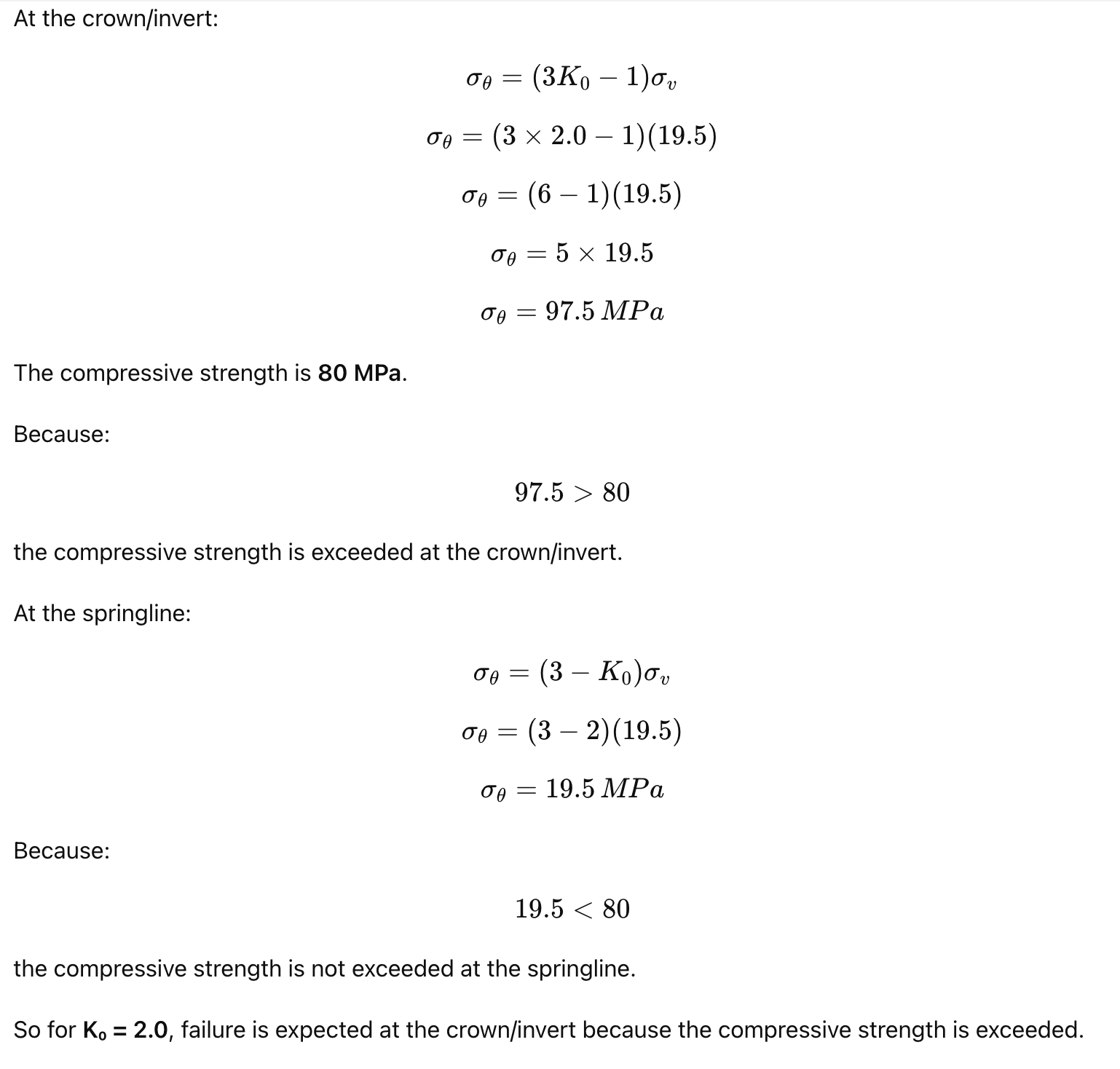
What is the hoop stress at the crown and invert?
The crown is the top of the tunnel.
The invert is the bottom of the tunnel.
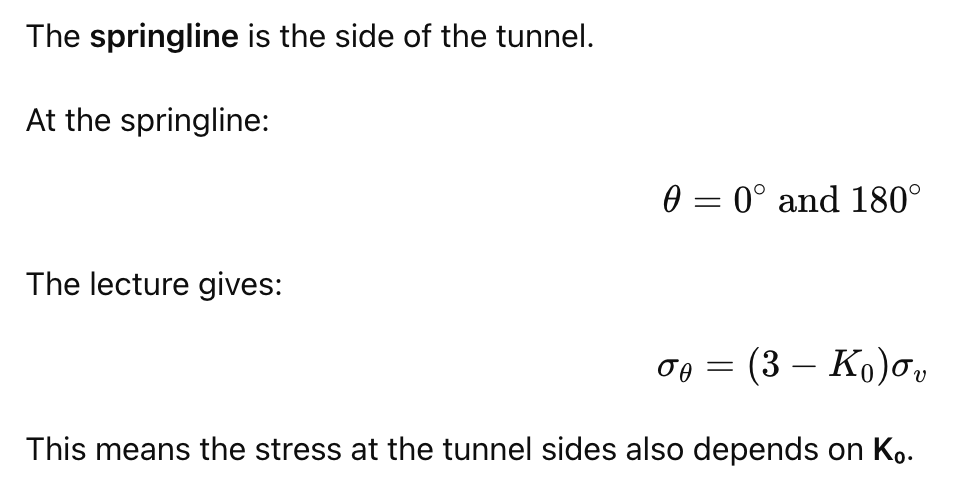
What is the hoop stress at the springline?



Why is tunnel behaviour complex?
Tunnel behaviour is complex because many factors affect stability, including:
Tunnel shape: Circular, elliptical, horseshoe, arch, and rectangular tunnels behave differently.
Support-rock interaction: The support and rock mass work together. The support does not act independently.
Water: Groundwater can reduce stability, increase pressure, cause erosion, or trigger swelling.
Layers and stratification: Rock layers can create weak planes.
Discontinuities: Joints, bedding planes, and faults can create blocks or wedges that may fall or slide.
Time effects: Some rocks deform slowly over time, especially weak rocks.
Construction method: Drill and blast, TBM, and roadheaders disturb the rock differently.
Rock properties: Strength, stiffness, discontinuity spacing, and durability all matter.
What are the main types of rock tunnel failure?
1. Structurally controlled failure
2. Stress controlled failure
3. Ductile or time-dependent failure
What is structurally controlled failure?
Structurally controlled failure happens when tunnel instability is controlled by geological discontinuities such as:
Joints
Bedding planes
Faults
Fractures
It is common in jointed or blocky rock, usually at shallow to medium depths.
The main driving force is usually gravity acting on rock blocks or wedges.
What are examples of structurally controlled failure?
Roof fall- A wedge or block falls from the tunnel roof.
Sidewall wedge failure - A block slides or falls from the tunnel sidewall.
Planar sliding - A rock block slides along a single discontinuity plane.
Toppling - A rock block rotates and falls due to unfavourable discontinuity orientation.
Why is structurally controlled failure common at shallow depth?
At shallow depth, rock confinement is usually low. This means there is less surrounding pressure holding rock blocks together.
If the rock mass is jointed or blocky, gravity can cause wedges to fall from the roof or sidewalls.
So shallow tunnels often fail due to block movement rather than high stress crushing the rock.
What is stress controlled failure?
Stress controlled failure happens when the stress around the tunnel becomes high enough to damage or break the rock.
It is common in:
Hard rock
Examples include granite and quartzite.
Medium to deep tunnels
Rock masses with fewer discontinuities
Instead of blocks falling along joints, the intact rock itself may fail due to stress concentration.
What is spalling or slabbing?
Spalling or slabbing is when thin pieces or slabs of rock break away from the tunnel wall.
It usually happens in hard rock under high stress. aka a type of stress controlled failure
The rock near the tunnel boundary is overloaded, causing layers or flakes to detach.
What is a rock burst?
A rock burst is a sudden and violent failure of rock caused by a rapid release of stored strain energy.
stress controlled failure
It occurs when:
Stress is very high
Rock is hard and brittle
Stored energy is released suddenly
Rock burst can cause pieces of rock to be ejected into the tunnel, making it very dangerous.
What is ductile or time-dependent failure and give 2 examples?
Ductile or time-dependent failure happens when the rock does not fail suddenly, but slowly deforms over time.
two examples are:
Squeezing
Swelling
What is squeezing ground?
Ductile/ time dependent dailure
Squeezing occurs when the rock mass undergoes large, slow, plastic deformation.
The tunnel gradually closes as the rock moves inward.
In simple words, the tunnel diameter slowly becomes smaller.
4 common in weak rocks :
Shale
Mudstone
Phyllite
Weak schist
Why is squeezing dangerous?
Squeezing is dangerous because the tunnel support can be damaged.
If the support is too rigid, it may be crushed by the squeezing rock.
If the support is too flexible, the tunnel may close too much and become unusable.
Therefore, squeezing ground requires carefully designed flexible support
What is swelling ground?
Swelling happens when minerals in the rock expand after contact with water.
Ductile/time dependent failure
This creates pressure on the tunnel lining.
Swelling can cause:
Invert heave
The tunnel floor rises upward.
Cracking of tunnel lining
Long-term deformation
Swelling is common in clay-bearing rocks
What is invert heave?
Invert heave is when the floor of the tunnel moves upward.
It can happen when swelling minerals expand due to water, or when weak ground pushes into the tunnel opening.
Invert heave is serious because it can damage the tunnel floor, track bed, road surface, drainage, or lining.
What is rock mass classification?
Rock mass classification is a way of describing the quality and behaviour of a rock mass.
Two methods used are:
Geological Strength Index, GSI
Rock Tunnelling Quality Index, Q
What is GSI?
GSI means Geological Strength Index.
It is used to estimate rock mass quality based on:
Rock structure
Blockiness
Surface condition of discontinuities
A high GSI means better quality rock.
A low GSI means poorer quality rock.
What is the Q-system?
The Q-system is the Rock Tunnelling Quality Index.
It is used to classify the rock mass and help decide what type of tunnel support is required.
The Q-system can be linked to support recommendations such as:
Unsupported excavation
Spot bolting
Systematic bolting
Shotcrete
Fibre-reinforced shotcrete
Bolts plus shotcrete
What are the three main rock tunnelling methods
1. Drill and blast
2. Tunnel Boring Machine, TBM
3. Roadheader
What is drill and blast tunnelling?
Drill and blast is a traditional rock excavation method.
The rock is drilled, explosives are placed in the holes, the rock is blasted, and the broken rock is removed. Support is then installed, and the process is repeated.
What is the drill and blast cycle?
Survey → Drilling → Loading → Blasting → Ventilating → Dislodged rock removal → Scaling → Bolting
In simple terms:
Survey
Set out the tunnel face and drilling pattern.
Drilling
Drill holes into the rock.
Loading
Place explosives into the holes.
Blasting
Detonate the explosives to break the rock.
Ventilating
Remove fumes and dust.
Dislodged rock removal
Remove broken rock from the tunnel.
Scaling
Remove loose pieces from the roof and walls.
Bolting/support
Install rock bolts or other support.
When is drill and blast suitable?
Drill and blast is suitable when:
The tunnel shape is complex
The geology is variable
The rock is very hard
The tunnel shape is non-circular
Support needs to be adapted frequently
It is a flexible method because the excavation shape and support can be changed as conditions change.
When is drill and blast less suitable?
Drill and blast is less suitable when:
There is high groundwater inflow without control
The tunnel is in a vibration-sensitive urban area
Noise and dust are major problems
Fast continuous advance is required
Blasting can cause vibration, noise, dust, and an excavation damaged zone.
What are the 5 limitations of drill and blast?
Cyclic process: It is slower than TBM because the work happens in repeated stages.
Requires skilled blasting design
Noise and vibration
Dust and fumes
Overbreak and damaged rock zone
What is a Tunnel Boring Machine, TBM?
A TBM is a machine that excavates rock or soil continuously using a rotating cutterhead.
It can also provide ground support while excavation is taking place.
TBMs are especially useful for long tunnels with reasonably uniform geology.
When is a TBM suitable?
A TBM is suitable for:
Long tunnels
Straight alignments or gentle curves
Reasonably uniform geology
Urban tunnels
Projects requiring high advance rate
Projects needing smooth tunnel profile and good lining quality
When is a TBM less suitable?
A TBM is less suitable for:
Sharp curves
Highly variable geology
Fault zones
Squeezing ground
Swelling ground
Highly abrasive rock causing cutter wear
The machine can become jammed in squeezing or swelling ground.
What are the 6 advantages of TBM tunnelling?
Very high advance rate
Smooth tunnel profile
Better working conditions
Good for urban areas
Excellent lining quality
More predictable deformation
What are the 6 disadvantages of TBM tunnelling?
Very high capital cost
Fixed tunnel diameter
Difficulties in fault zones
Cutter wear in abrasive rock
Risk of jamming in squeezing or swelling ground
Less flexibility compared with drill and blast
What 6 design features affect TBM performance?
TBM performance depends on:
Disc cutter design
Cutterhead rotation speed, RPM
Cutter spacing
Machine geometry
Thrust level
Rock strength and abrasivity
What is a roadheader?
A roadheader is a mechanical excavation machine that cuts rock using a rotating cutting head fitted with picks.
The cutting head is mounted on a boom, which can move freely to cut different tunnel shapes.
When is a roadheader suitable?
A roadheader is suitable for:
Weak to medium strength rock
Low to moderate abrasivity
Non-circular tunnel shapes
Variable and complex alignments
It is more flexible than a TBM for shape and alignment.
When is a roadheader less suitable?
A roadheader is less suitable for:
Very hard rock
Highly abrasive rock
Squeezing ground
Jointed rock with block fall risk
Ground needing strong face confinement
What are the advantages of roadheaders compared with drill and blast?
Compared with drill and blast, roadheaders have:
No blasting vibration
Less overbreak
More continuous excavation
Less disturbance to surrounding rock
What are the advantages of roadheaders compared with TBMs?
Compared with TBMs, roadheaders offer:
Lower capital cost
More flexibility in variable geology
Ability to excavate non-circular shapes
Better adaptability to complex alignment
What are the disadvantages of roadheaders?
Disadvantages include:
Lower advance rate than TBM
High pick consumption in hard or abrasive rock
Poor performance in squeezing ground
Block fall risk in jointed rock
Limited face confinement
Why does a rock tunnel need support?
Tunnel support is used to stabilise the excavation and prevent failure.
Support helps to:
Hold loose blocks in place
Reduce deformation
Protect the tunnel surface
Control water and weathering effects
Improve safety during construction
Provide long-term stability
What are the main types of tunnel support in the lecture?
The lecture covers:
Reinforcement
Shotcrete/spray concrete
Structural steel support
Precast segments
What are 3 types of rock reinforcement and their purpose?
Rock reinforcement includes:
Dowels
Rock bolts
Anchors
These are installed into the surrounding rock to improve stability.
What do rock bolts do?
Rock bolts:
Bind rock blocks together
Restrict movement along discontinuities
Strengthen the rock mass
Prevent wedges from falling
Help the rock mass act as a self-supporting structure
They are especially useful in jointed or blocky rock.
What is shotcrete?
Shotcrete, also called spray concrete, is concrete or mortar sprayed at high velocity onto the tunnel surface.
It compacts and hardens without needing formwork.
What is shotcrete used for?
Shotcrete is used to:
Stabilise loose rock blocks
Provide immediate support after excavation
Protect rock from weathering
Protect rock from water
Work together with rock bolts and mesh
What are 4 limitations of shotcrete?
It is not effective alone for large wedges
It can crack if poorly cured
It has limited tensile capacity
It usually needs to be combined with reinforcement
What are the types of shotcrete mentioned?
Plain shotcrete
Used mainly to seal the surface and prevent weathering.
Fibre-reinforced shotcrete
Contains steel or synthetic fibres. This improves ductility, so the concrete can bend slightly without cracking.
Mesh-reinforced shotcrete
Wire mesh is pinned to the rock and then covered with shotcrete. This is useful for very poor-quality rock.
What is structural steel support?
Structural steel support uses steel frames or ribs to support weak ground.
It is used when the rock is too weak for bolts alone, especially in:
Squeezing ground
Fault zones
Very poor-quality rock
What are lattice girders?
Lattice girders are lightweight triangular or rectangular steel frames.
They are usually encased in shotcrete to form a reinforced composite arch.
They provide support while still working with the surrounding rock and shotcrete.
What are steel sets?
Steel sets are heavy H-beam or I-beam steel ribs.
They are used in extreme ground conditions where high-capacity immediate support is needed.
They are stronger and heavier than lattice girders.
What are precast segments?
Precast segments are factory-made concrete lining pieces installed inside the tunnel.
They are commonly used with TBMs.
They provide a finished permanent lining immediately after excavation.
Where are precast segment linings commonly used?
Precast segment linings are common in:
Long tunnels
Subways
Underwater tunnels
TBM-driven tunnels
They are fast and provide high-quality permanent support.
What is NATM?
NATM stands for New Austrian Tunnelling Method.
It is not a specific excavation method like TBM or drill and blast. Instead, it is a design and construction philosophy.
NATM uses the inherent strength of the rock mass and controls deformation through flexible, observational support.
What is the main idea of NATM?
The main idea is that the rock mass itself should be used as the main load-bearing structure.
The support system should not completely replace the rock. Instead, it should help the rock support itself.
What types of support are commonly used in NATM?
NATM commonly uses:
Shotcrete
Rock bolts
Mesh
Lattice girders
Fibre-reinforced concrete
These are applied based on observed ground conditions.
Why is NATM called an observational method?
NATM is observational because the design is updated during construction based on monitoring.
Engineers measure deformation and loads.
If the tunnel is moving too much or support loads are too high, the support design is changed.
How many principles are there of NATM
7
What is NATM Principle 1?
The rock mass is the main load-bearing structure.
Support should activate the strength of the rock rather than replace it.
This means:
Avoid unnecessary blasting if possible
Conserve rock mass strength
Make support interact with the rock
Install support at the right time
Why is timing of support installation important?
Timing is important because if support is installed too late, the rock may loosen or deform too much.
If support is installed too early or is too rigid, the rock may not mobilise its own strength properly.
The aim is to allow controlled deformation but prevent failure.
What is NATM Principle 2?
Shotcrete protection.
Shotcrete is used to:
Prevent rock loosening
Reduce deformation
Stop weathering
Prevent deterioration of exposed rock
What is NATM Principle 3?
Monitoring and measurement.
Instrumentation is installed to monitor:
Tunnel deformation
Support loads
Ground movement
Readings are taken regularly, and the design is updated based on the data.
Why is monitoring important in NATM?
Monitoring is important because ground conditions can change during excavation.
If deformation increases, engineers may need to:
Increase shotcrete thickness
Add more bolts
Install closer support spacing
Close the invert earlier
Change the excavation sequence
What is NATM Principle 4?
Flexible support.
NATM uses active, flexible supports rather than passive rigid supports.
Flexible support allows stresses to redistribute around the tunnel.
Extra support is added if monitoring shows it is needed.
What is NATM Principle 5?
Close the invert.
The invert is the bottom part of the tunnel.
Closing the invert allows the tunnel lining/support to act as a complete load-bearing ring.
This helps distribute stress around the whole tunnel.
What is NATM Principle 6?
Flexible contracts.
The construction contract must allow design changes during construction.
This is necessary because NATM depends on adapting support based on monitoring and actual ground conditions.