Ch. 21 & 22 Development of Multicellular Organisms
 Call Kai
 Learn
Learn Practice Test
 Spaced Repetition
 Match
Match Flashcards
 Knowt Play
1/13

There's no tags or description
Looks like no tags are added yet.
Name | Mastery | Learn | Test | Matching | Spaced | Call with Kai |
|---|
No analytics yet
Send a link to your students to track their progress
14 Terms
what is the difference between germ cells and gametes?
germ cells → give rise to gametes (mitosis)
gametes → sperm & eggs (meiosis: diploid → haploid)
Human Embryo from fertilization to implantation
Ovary releases estrogen and progesterone
ovulation is busting of ovary
prepares endometrium for implantation → influx blood vessels and glands secrete sugars
Oocyte (egg) enters the fallopian tube (oviduct)
Fertilization happens at distal end of oviduct → Day 0
2-cell stage → Day 2
4-cell stage → Day 3-4
8-cell compacted: morula → Day 4
trophoectoderm (only rise to placenta) → Day 5
Zona pellucida → Day 6-7
Implantation of the blastocyst → Day 8-9
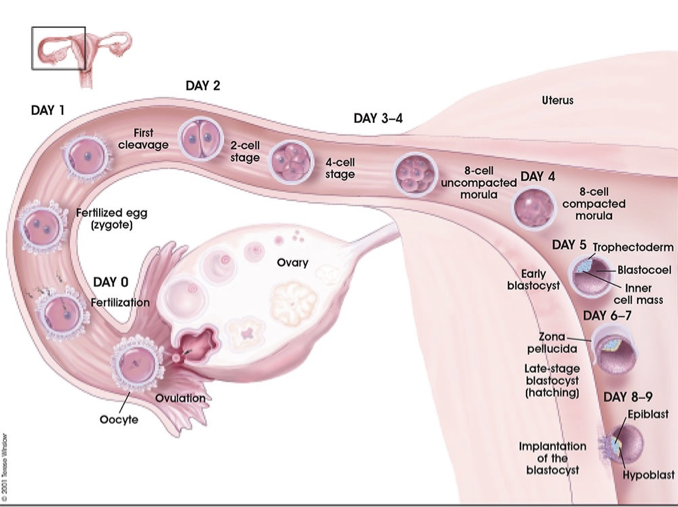
Details of Day 5 of human embryo
trophectoderm
blastocoel
inner cell mass → pluripotent
early blastocyst
blastula → 1st embryo that can implant
Clinical applications for the human embryo
Ectopic pregnancy
birth control pill = low, constant estrogen & progesterone
abortin pill: mifepristone (RU486)
progesterone R antagonist that blocks receptors and induce menstration
Early Mammalian embryonic development
fertilized egg → 2 cells (1.5 days) → morula 8 cells (2.5 days) → 16 cells (3 days) → blastula: section of blastocyst (4 days)
blastula:
inner cell mass → every tissue/germ layer
blastocoel
trophectoderm → becomes placenta
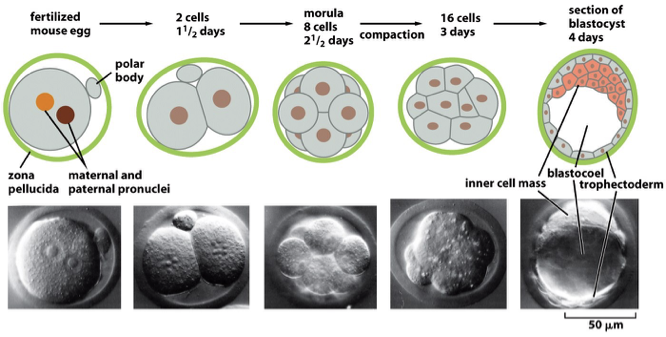
Totipotent vs. pluripotent cells
totipotent cells can become complete organism
early embryonic cells
8-16 cell stage embryo
cells fates restricted after 16-32 cell stage
pluripotent cells are the inner cell mass
what is a chimeric embryo?
organism with distinct cells with unique DNA
where are embryonic stem cells derived from?
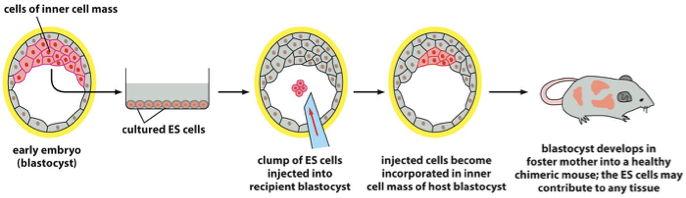
inner cell mass
immortal when grown in correct environment
cells of ICM are genetically altered → injection of ES cells into recipient blastocyst → cells become incorporated in inner cell mass of host blastocyst → blastocyst develops in foster mother into a healthy chimeric mouse; ES cells may contribute to any tissue
Cell Replacement therapy using Human ES cells
embryos left over after IVF/ART can be used as a replacement in humans
early embryo destroyed → human ES cell lines are cultured in dish → signaling molecule injected to create replacement
examples include skeletal/cardiac myocytes
pancreatic islet cells
What are the problems of using human ES cells in cell replacement therapy? Alternatives?
Problems:
embryo destruction
tumor formation
immune rejection
Alternatives:
Adult stem cells (epithelial)
SCNT-derived hES cells (cloning)
iPS cells
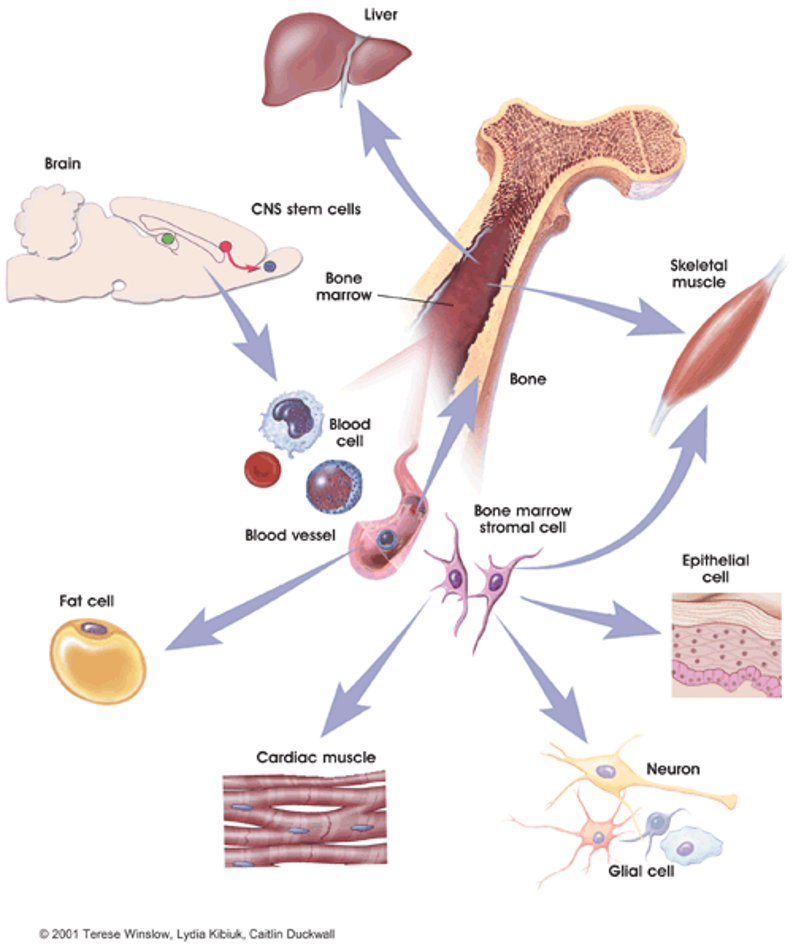
Pros and Cons of Adult Stem Cells in Bone Marrow Hematopoietic Stem Cells
Pros:
exist in many tissues
multipotent
no immune rejection after transplantation
no ethical controversy
Cons
difficult to isolate
degree of pluripotency is controversial
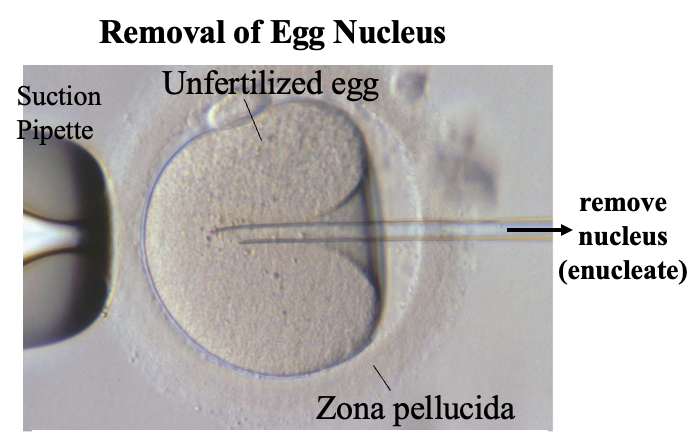
What is SCNT hES cloning?
Somatic Cell Nuclear Transfer
inject somatic cell nucleus into enucleated egg
implant embryo into uterus for live-birthed organism
1997: Dolly 1st mammal cloned from adult somatic cell
Cell replacement using iPS cells
iPS: induced pluripotent stem cells
master gene regulator proteins: cMYC, OCT4, KLF4, SOX2 (transcription factors)
patient → skin biopsy → patient specific iPS cells → gene targeting to repair disease causing mutation or in vitro differentiation
gene targeting: in vitro differentiation → healthy cells → transplantation of genetically matched healthy cells
in vitro differentiation: affected cell type → disease-specific drugs → treatment with drugs