Cognitive Neuroscience of Vision and Attention: Key Concepts and Disorders
 Call Kai
 Learn
Learn Practice Test
 Spaced Repetition
 Match
Match Flashcards
 Knowt Play
1/27

There's no tags or description
Looks like no tags are added yet.
Name | Mastery | Learn | Test | Matching | Spaced | Call with Kai |
|---|
No analytics yet
Send a link to your students to track their progress
28 Terms
What are the learning objectives for the Cognitive Neuroscience of Vision?
1) Understand the neuroscience of vision and basic visual processes starting with the eye. 2) Explore higher cognitive areas of the brain that interpret light hitting the retina. 3) Apply this knowledge to illusions.
What are the Gestalt Principles?
The Gestalt Principles include symmetry, similarity, closure, proximity, common fate (motion), good continuity, and multistable perception.
What is constructive perception?
Constructive perception is the process by which the brain interprets sensory information to construct a perception of the environment.
What is reification in perception?
Reification is the process of perceiving a more complete or detailed object than what is actually present in the sensory input.
What is emergence in perception?
Emergence refers to the way complex patterns arise from relatively simple rules in perception.
What is object invariance?
Object invariance is the ability to recognize objects as the same despite variations in perspective, lighting, or other conditions.
What is perceptual rivalry?
Perceptual rivalry occurs when two conflicting perceptions are presented to the brain, leading to alternating perceptions.
What is binocular rivalry?
Binocular rivalry is a phenomenon where each eye is presented with a different image, leading to a competition between the two images for perception.
What is the role of the LGN in vision?
The lateral geniculate nucleus (LGN) relays visual information from the retina to the primary visual cortex (V1).
What is V1's response to perceived size?
V1 responds to perceived size, which can be influenced by contextual factors such as the moon illusion.
What is color constancy?
Color constancy is the ability to perceive colors of objects consistently under varying lighting conditions.
What is cortical achromatopsia?
Cortical achromatopsia is a visual disorder associated with damage to area V4, resulting in the inability to perceive color.
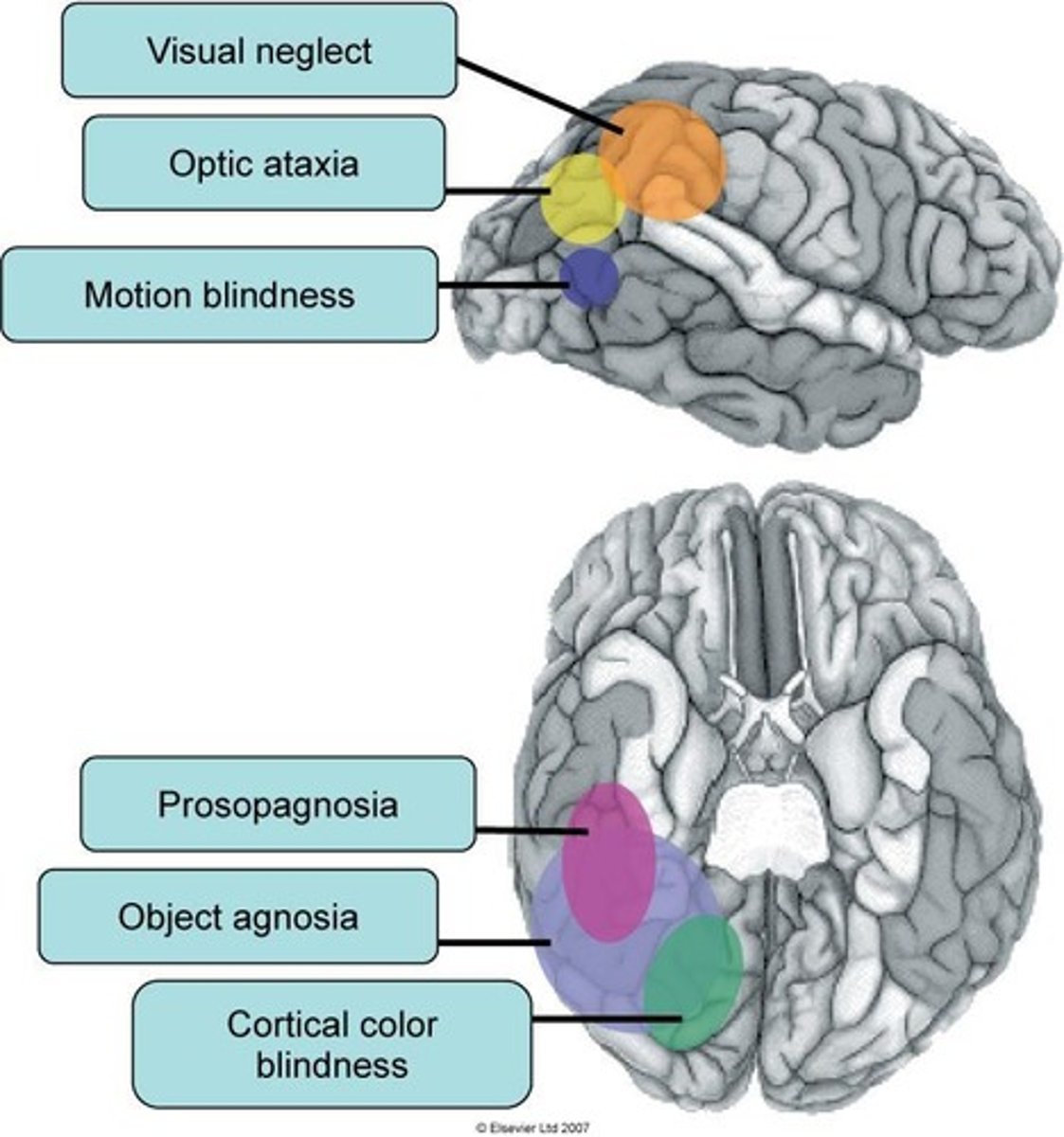
What is visual agnosia?
Visual agnosia is a disorder associated with damage to the LOC, resulting in the inability to recognize objects.
What is prosopagnosia?
Prosopagnosia is a disorder associated with damage to the FFA, resulting in the inability to recognize faces.
What is motion blindness?
Motion blindness is a disorder associated with damage to MT/V5, resulting in the inability to perceive motion.
What is optic ataxia?
Optic ataxia is a disorder associated with damage to the parietal cortex, leading to difficulty in visually guided actions.
What is visual hemineglect?
Visual hemineglect is a disorder associated with damage to the posterior parietal cortex, resulting in the inability to attend to one side of the visual field.
What is perceptual/cortical blindness?
Perceptual/cortical blindness, associated with damage to V1, results in the inability to perceive visual stimuli despite having intact eyes.
What is the difference between visual associative agnosia and apperceptive agnosia?
Visual associative agnosia is the inability to recognize objects despite intact perception, while apperceptive agnosia is the inability to perceive objects correctly.
What is the difference between color blindness and cortical achromatopsia?
Color blindness is a genetic condition affecting the ability to perceive colors, while cortical achromatopsia is a brain disorder affecting color perception due to cortical damage.
What is a receptive field in relation to neurons?
A receptive field is the specific area of the visual field where a stimulus will trigger the firing of a neuron.
What causes the blind spot in our eyes?
The blind spot is caused by the absence of photoreceptors where the optic nerve exits the eye, but the brain fills in this gap, preventing awareness of it.
What are the What and Where pathways in vision?
The What pathway (ventral stream) is involved in object recognition, while the Where pathway (dorsal stream) is involved in spatial awareness and movement.
What is the difference between perceptual rivalry and binocular rivalry?
Perceptual rivalry occurs with conflicting perceptions from the same visual input, while binocular rivalry occurs when different images are presented to each eye.
What are the different forms of attention?
Different forms of attention include alertness and arousal, sustained attention, selective attention, and attentional resources.
What is sustained attention?
Sustained attention is the ability to maintain focus on a task or stimulus over an extended period.
What is selective attention?
Selective attention is the process of focusing on specific stimuli while ignoring others, involving both early sensory and later conceptual gating.
What is attentional resources?
Attentional resources refer to the brain's capacity to process information, which can be maximized by using different types of attention simultaneously.