MSK - Sprains and strains
 Call Kai
 Learn
Learn Practice Test
 Spaced Repetition
 Match
Match Flashcards
 Knowt Play
1/75

There's no tags or description
Looks like no tags are added yet.
Name | Mastery | Learn | Test | Matching | Spaced | Call with Kai |
|---|
No analytics yet
Send a link to your students to track their progress
76 Terms
What is the structure in the body that gives support for soft tissues, protects internal organs from injury, assists in movement, carries out mineral homeostasis, blood cell production and triglyceride storage?
Bones
What is the structure in the body that works in pairs via contraction and relaxation that moves the bones of the skeleton?
Muscles
What is the structure in the body describing any join between 2 or more bones in the body?
Joints
How many types of joint are there?
3
What is the type of joint which lacks synovial cavity, held together by dense connective tissue e.g., joints between bones of skull and teeth held in place by the jaw?
Fibrous joints
What is the type of joint which lacks a synovial cavity, but the bones are connected by a layer of cartilage allowing little or no movement e.g., intervertebral joints of the spine?
Cartilaginous joint
What is the type of joint which has a synovial cavity between articulating bones full of synovial fluid and allows free movement of the joint e.g., knees, hips, elbows, MCP joints of finger?
Synovial joints
What is the structure which is comprised of dense collagen fibres attached to the periosteum of articulating bones and allows for movement, whilst its tensile strength holds the joint in place and prevents dislocation?
Ligaments
What is the structure that attaches muscle to bones allowing for skeleton movement?
Tendons
What is the structure which is a small fluid filled sac-like capsule consisting of connective tissue lined with a synovial membrane, strategically located to reduce friction at certain joints e.g.., shoulder, knee and are located between skin and bone, tendons and bones, muscles and bones or ligaments and bone?
Bursa - bursae
What is the structure which is a sleeve-like area that encapsulates a synovial joint, comprised of an outer fibrous membrane including ligaments and an inner synovial membrane?
Joint capsule
What is the fluid secreted by the synovial membrane, which is of a viscous clear or pale yellow liquid containing constituents e.g., hyaluronic acid and interstitial fluid and aids in joint movement and cushioning?
Synovial fluid
What is a diagram to show joint structure?
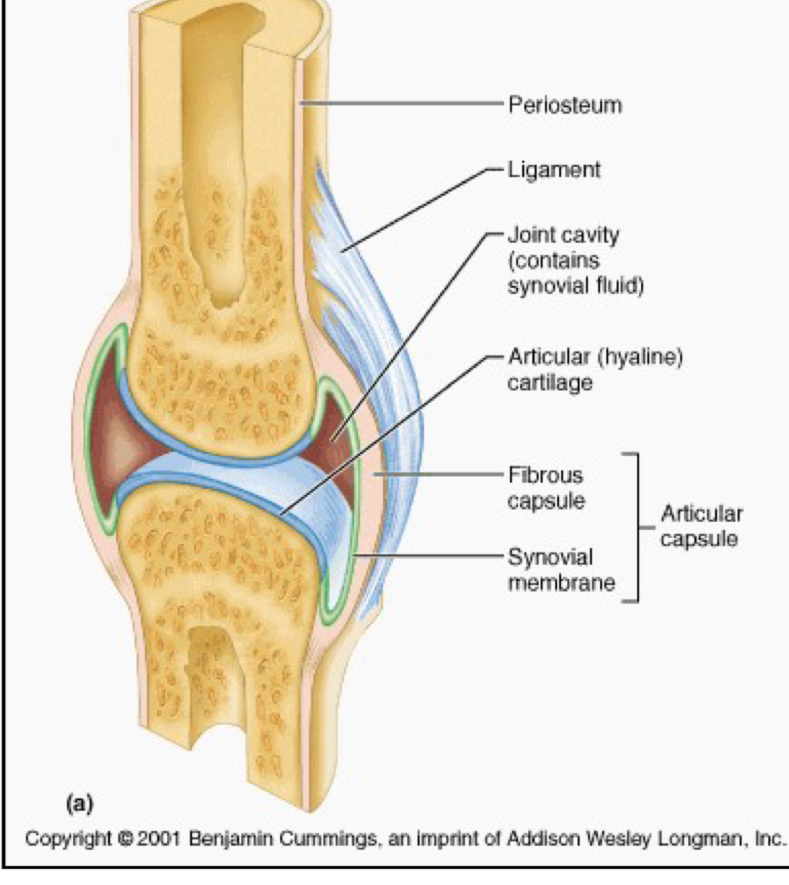
When is peak bone mass, muscle tone, tensile strength and stamina usually achieved?
Ages 20-30
What can young patients MSK issues be due to?
Trauma, overuse, genetic factors, iatrogenic causes
What is the extent of an injury caused by trauma dependent on?
Force of impact, direction of impact and inherent strength of individuals MSK system
When do fractures occur?
Bone subjected to a force greater than its inherent strength
What should happen for patients presenting to a community pharmacy with fractures?
Refer to appropriate location
What individuals may have overuse injuries?
Athletes or manual workers
What some examples of overuse MSK injuries?
Tennis elbow, shin splints, stress fractures
What can overuse injuries be classified as?
Acute or chronic - both usually with gradual onset
What are some genetic factors causing MSK issues?
Juvenile idiopathic arthritis, Perthe’s disease
What is the term used to describe an unknown cause of body causing joint inflammation in young people?
Juvenile idiopathic arthritis
What is the term used to describe the blood supply to the femoral head being temporarily lost, causing bone death, weakening or collapse and the bone will reform over several years?
Perthe’s disease
What does iatrogenic mean?
Medical treatment
What class of medicines reduce bone mineral density and increase the risk of fracture?
Corticosteroids
What can occur if a bandage, support or plaster is applied too tightly to the injury?
Numbness, paraesthesia, tissue strangulation or compartment syndrome
What is the type of soft tissue injury where a muscle has been stretched beyond its elastic limit, further divided into genuine, tear or complete muscle rupture?
Strain
What is the type of soft tissue injury where a ligament or joint capsule is stretched beyond its elastic limit and causes joint instability or laxity, commonly divided into 3 grades?
Sprain
What are the 3 grades of sprains?
Grade 1 - minor tissue damage with no joint laxity
Grade 2 - some joint laxity however connective tissue is intact
Grade 3 - rupture, surgical repair is case dependant
What is the type of soft tissue injury caused by a traumatic injury to muscle caused by a direct blow, causing localised damage and bleeding?
Contusion/bruise
What should a history of an MSK injury include?
Location of injury, how it occurred, force and direction of impact, whether patient has had similar injury in the past, experiencing other symptoms e.g., headache, nausea, vomiting, what the patient has done so far
What may a sound from an injured area such as a popping sound indicate especially for sprains?
Grade 3 sprain
When should MSK injuries be referred?
Obvious deformities, patient cannot bear weight, reports numbness or paraesthesia, when there is severe pain and disproportionate swelling, no improvement after a few days, doubt about injury severity
What are some immediate complications from soft tissue injuries?
Pain, inflammation and restriction of movement, followed by bruising
What is the condition occurring when a muscle injury is associated with damage to its blood supply or soft tissue is severely damaged?
Compartment syndrome
What are some muscle groups contain in?
Rigid fascia/compartment
How does compartment syndrome occur?
If muscle swells or blood leaks into compartment of some muscles, internal pressure can rise and cut off blood supply to the muscle, leading to muscle death and replacement by fibrous tissue that contracts leaving a withered clawed limb
What is the name of the withered clawed limb produced from compartment syndrome?
Volkmann’s ischaemic contracture
What are the symptoms of compartment syndrome?
Extreme pain, paraesthesia and swelling in affected muscle
What treatment is given for mild/chronic cases of compartment syndrome caused by exercise?
RICE
What is the treatment for if RICE fails in mild/chronic compartment syndrome or in severe/acute cases?
Fasciotomy
What does a fasciotomy entail?
Splitting the fascia to allow the muscle room to expand and wound is sewn up over a few days
What is the condition where following a direct blow to the periosteum and muscle, bone plaques can be deposited into the muscle and can occur as a result of joint replacement surgery, causing a very painful condition where the patient can feel the density in the issues alongside movement limitation?
Myositis ossificans
What can be used to diagnose myositis ossificans?
X-ray, MRI, ultrasound
What does treatment of myositis ossificans include?
Rest and pain relief until bone plaques stabilises and inflammation is minimised - once bone is stable or surgically removed, physiotherapy can commence to restore ROM
How long do soft tissue injuries take to heal?
Heal at different rates depending on location and type of injury - muscles heal faster due to increased vasculature, tendons and ligaments have poor blood supply so healing is delayed and may never occur naturally
How long may the repair process for tendons and ligaments take?
Weeks or months as new blood vessels need to be incorporated and scar tissue made of collagen
What does the poor blood supply of tendons and ligaments also affect?
Useful of pharmacological therapies
What is the primary management of muscle and ligament injuries?
Non-pharmacological management
What can synovial effusions cause?
Marked inflammation and haemarthrosis e.g., bleeding into joint capsule
What are some acronyms to treat soft tissue injuries?
PRICE, RICE, MICE, POLICE, PEACE and LOVE
What does PRICE stand for?
Protection, rest, ice, compression, elevation
What does RICE stand for?
Rest, ice, compression, elevation
What does MICE stand for?
Movement, ice, compression, elevation
What does POLICE stand for?
Protection, optimum loading, ice, compression, elevation
What does PEACE and LOVE stand for?
Protection, elevation, avoid anti-inflammatories, compression, education, load, optimisation, vascularisation, exercise
What acronym for strains and sprains is the most updated?
PEACE and LOVE
What is the most suitable analgesic for most soft tissue injuries if pain is an issue?
Paracetamol
When does the PEACE in PEACE and LOVE apply?
first 3 days of injury
Why is NSAID use in soft tissue injury controversial?
Reduces inflammation which is an integral part of the healing process and preventing/reducing this in first 48 hours can lead to increased healing times
What patients should NOT be sold NSAIDs?
Asthmatic patients, history of GI or duodenal ulcer, history of renal failure, hypertension
What type of NSAIDs have fewer side effects and may be more suitable for soft tissue injuries?
Topical NSAIDs
What type of topical preparation for soft tissue injuries work by counter-stimulation, by producing a warming effect via vasodilation in the area where they are applied and takes the patients mind off pain?
Rubefacients
Where should rubefacients NOT be applied?
Broken skin
What condition does NICE not recommend rubefacients for?
Osteoarthritis
What injections can be used for MSK conditions?
Corticosteroid injections, muscle relaxants
Why are corticosteroid injections used?
Relieve pain and increase mobility in inflammatory joint conditions
How do corticosteroid injections work?
Suppress tissue’s inflammatory response to injury, catabolic effect that break down tissue
Where are corticosteroid injections useful?
Areas where muscles, tendons and ligaments attach to dense connective tissue covering bone at articular surfaces
What are the negatives to corticosteroid joint injections?
Increase risk of septic arthritis and mask signs of infection
What has been reported following corticosteroids injections due to their catabolic properties?
Tendon rupture
How is the injection carried out for corticosteroid injections?
Strict aseptic technique and never on a previously infected joint
What conditions may predispose muscles going into spasm/involuntary contractions?
Falls, whiplash injuries
What can be used as muscle relaxants to treat muscle spasms?
Low dose diazepam - direct relaxant, methocarbamol - short term relief of symptoms
How does capsaicin cream work?
Depletes neurotransmitter substance-P, results in reducing pain signal transmission from injured area