C2.2 Neural Signaling
 Call Kai
 Learn
Learn Practice Test
 Spaced Repetition
 Match
Match Flashcards
 Knowt Play
1/27

There's no tags or description
Looks like no tags are added yet.
Name | Mastery | Learn | Test | Matching | Spaced | Call with Kai |
|---|
No analytics yet
Send a link to your students to track their progress
28 Terms
what are the peripheral nerves
motor and sensory neurons not in the CNS
what are dendrites
Dendrites are short branched extension that receive electrical signals from other neurons or receptors.
what is an axon
Axon is typically very long extension that transmit electrical signals to other neurons or effectors at synapses. (example of a long axon is the extension from the tips of the toes or the fingers to the spinal cord)
An axon joins the cell body at the axon hillock where signals that travel down the axon are generated. Near its other end, an axon usually divides into many branches
function of glia/glial cells
nourish neurons
insulate the axons of neurons
regulate the extracellular fluid surrounding neurons.
glia sometimes function in replenishing certain groups of neurons and in transmitting information.
what is resting potential
the potential difference from inside to outside the cell (across a nerve cell) when it is not stimulated (-70mV).
what is membrane potential
Every cell has a voltage (difference in electrical charge) across its plasma membrane called a membrane potential
This membrane potential exists because of differences in the ionic composition of the intracellular and extracellular fluids
Messages are transmitted as changes in membrane potential
which cells have membrane potential and which cells have an action potential
By convention, the charge on the outside surface of the plasma membrane is given a value of zero.
In an animal cell, the charge on the inside surface of the plasma membrane is in the range of –50 mV and –100 mV and the membrane is said to be polarised
Although all cells have a membrane potential, only excitable cells, e.g. neurones and muscle cells, have the ability to produce an action potential ~ non-excitable cells cannot produce an action potential
When a neurone is in its resting state (i.e. not transmitting information or an action potential) the membrane potential is typically at –70 mV.
This is called the resting potential of the neurone
how is resting potential formed
1.Na+ concentration is higher outside and K+ concentration is higher inside
2.The sodium-potassium pump pumps three Na+ out for every two K+ in by active transport (using ATP)
3.The inside of axon also holds negative ions (e.g. Cl- ions), negatively charged proteins and organic anions
4.Thus, inside of neuron is negative in comparison to outside
5.electrochemical concentration across the membrane is the resting potential is at –70 mV
what forms the myelin sheath and what is the purpose of the myelin sheath
in the central nervous system, myelin sheaths are made by glia (oligodendrocytes)
in the peripheral nervous system, schwann cells form the myelin sheath by growing around the axon. Each time they grow around the axon, a double layer of phospholipid bilayer is deposited. There may be 20 or more layers when the Schwann cell stops growing.
enables saltatory conduction
how does saltatory conduction work
myelin sheath → insulator, prevents charge leakage
voltage gated sodium channels are restricted to gaps in the myelin sheath in the nodes of ranvier. the axon membrane can only contact extracellular fluid at these nodes.
thus, action potentials are not generated at the regions between the nodes outside the cell
action potentials are propagated by an inward current that travels within the axon to the next node where voltage gated sodium channels enable reninitiation. less energy in the form of ATP is expended as the sodium potassium pump is only working at the nodes
this makes the action potential appear to jump from node to node, and increases the speed of conduction
where are neurotransmitters produced and stored
Neurotransmitters are all relatively small molecules that diffuse quickly. They are produced in the Golgi apparatus in the synaptic knob and are held in tiny vesicles before release.
describe synaptic transmission and include an example of an actual neurotransmitter
1.Nerve impulse reaches the end of the presynaptic neuron.
2.Depolarization causes voltage gated calcium channels in membrane to open and calcium diffuses into the presynaptic neuron.
3.This causes vesicles containing neurotransmitter move to and fuse with presynaptic membrane.
4.The neurotransmitter is released by exocytosis into synaptic space.
5.The neurotransmitter diffuses across the synapse and attaches to receptors on postsynaptic neuron.
6.The receptors cause ligand gated sodium ion channels to open and sodium ions diffuses into the postsynaptic neuron.
7.The postsynaptic neuron membrane is depolarized and causes a new action potential.
8.The neurotransmitter on postsynaptic membrane is broken down by enzymes and is reabsorbed into the presynaptic neuron. This stops the effect on the postsynaptic membrane.
neurotransmitter - acetylcholine
acetylcholinesterase removes acetylcholine by breaking it down
Acetylcholine is broken down into its two component parts by the synaptic enzyme acetylcholinesterase(AChE)
AChE is either released into the synapse from the presynaptic neuron or embedded on the membrane of the post-synaptic cell
The liberated choline is returned to the presynaptic neuron where it is coupled with another acetate to reform acetylcholine
example of a neurotransmitter and where it is released
One example of a neurotransmitter used by both the central nervous system and peripheral nervous system is acetylcholine
It is commonly released at these areas:
neuromuscular junctions and binds to receptors on muscle fibres to trigger muscle contraction
within the autonomic nervous system to promote parasympathetic responses (‘rest and digest’)
phases in membrane polarisation
Depolarisation phase
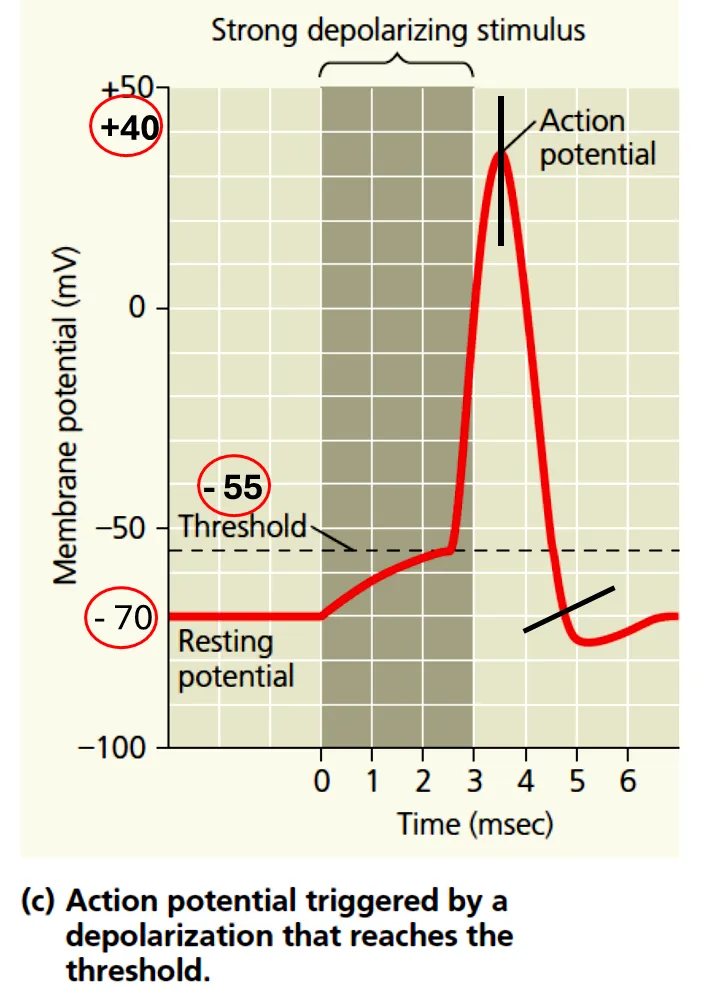
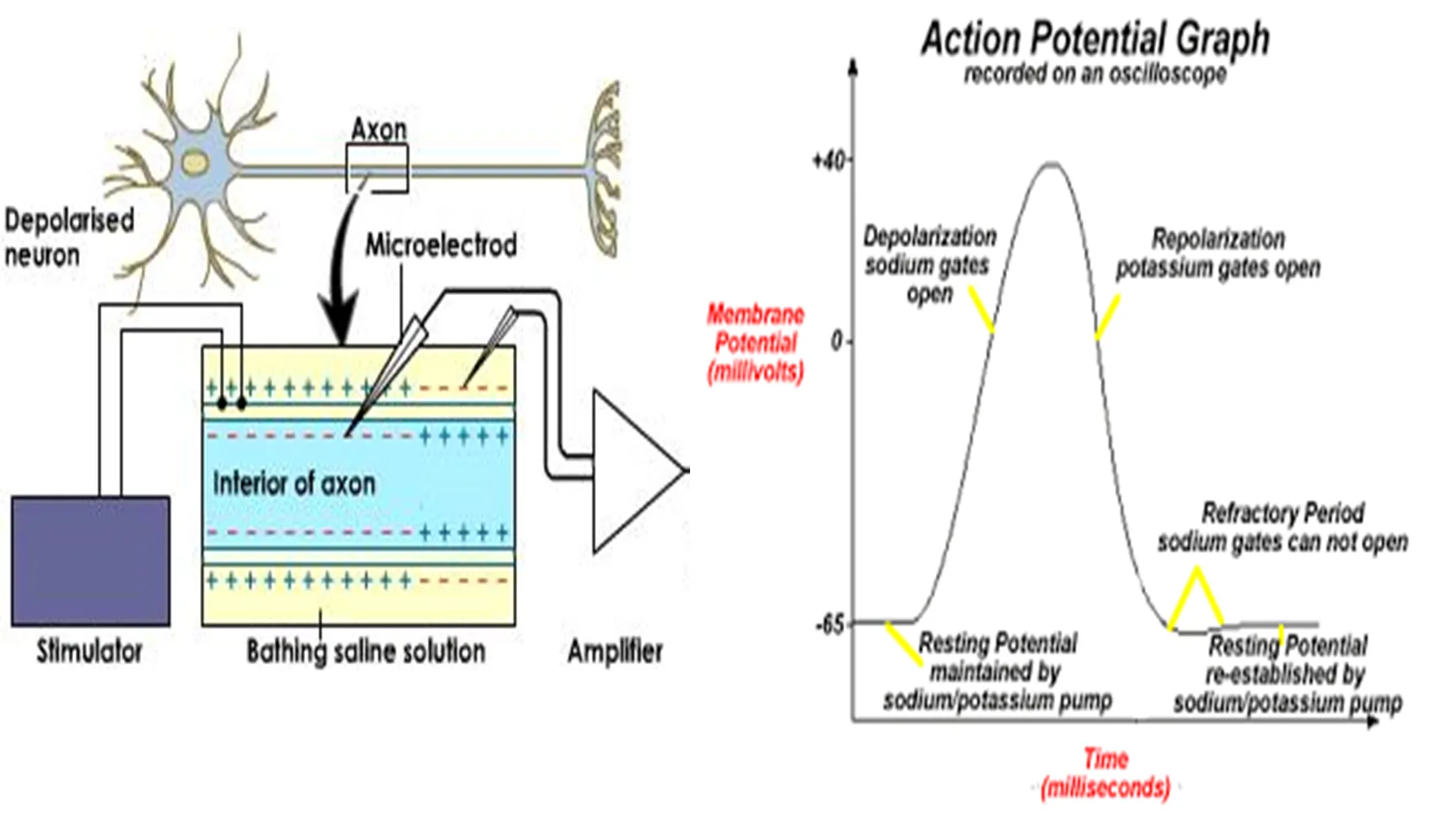
membrane potential increases from –70 mV to +40 mV (due to Na+ moving IN)
Repolarisation phase
membrane potential returns to its resting level of –70 mV from +40 mV (due to K+ moving OUT)
Refractory period (Hyperpolarization)
membrane potential is transiently more negative than the resting potential. The membrane is said to be hyperpolarised (due to more K+ moving OUT)
what are graded potentials
changes in polarization where the magnitude of the change varies with the strength of the stimulus
usually involves ligand gated ion channels rather than voltage gated ion channels
usually occurs at the dendrites, as ligand gated ion channels would require neurotransmitters to activate
used to integrate information from multiple locations in the body - the sum of the graded potentials from presynaptic neurons can be sufficient to pass the threshold potential in the postsynaptic membrane, triggering an action potential
what are action potentials
Voltage-gated Na+ and K+ channels respond to a change in membrane potential
When a stimulus depolarizes the membrane, voltage-gated Na+ channels open, allowing Na+ to diffuse into the cell
The movement of Na+ into the cell increases the depolarization and causes even more Na+ channels to open (positive feedback)
A strong stimulus results in a massive change in membrane voltage called an action potential
When gated K+ channels open, K+ diffuses out, making the inside of the cell more negative
This is hyperpolarization as the membrane potential becomes more negative (e.g. from -70mV to -80mV)
Threshold potential refers to the potential a neurone must reach for an AP to be initiated
Threshold potential in a neurone is about 20 mV more positive than the resting potential, ie –50 mV
At & above the threshold potential, the voltage-gated Na+ channels will be triggered to open
if the stimulus is below threshold potential will an action potential be generated
no
Action potential - propagation of electrical impulses along a neuron (including the role of myelin)
Resting potential is –70mV ( relatively negative inside in comparison to the outside).
At resting potential, there are more sodium ions outside axon and more potassium ions inside axon.
A nerve impulse is an action potential that stimulates a wave of depolarization along the axon.
If neuron is stimulated above threshold potential ( –50mV is reached), sodium ion voltage gated channels open and sodium ions diffuse in, causing depolarization (inside of neuron becomes more positively charged than outside of neurone) to +40mV.
Local currents cause action potential to continue as Na+ ions diffuse from depolarized region to next region of axon, causing the next region to depolarize.
Depolarization is followed by repolarization of the neuron.
Voltage gated potassium ion channels open and potassium ions diffuse out, causing repolarization.
Then Na+/K+ pumps re-establish the resting potential by pumping 3Na+ out and 2K+ in.
Myelin around the neuron insulates the axon and helps to speed the transmission.
Myelin permits saltatory conduction by allowing action potential to jump from node to node
importance of resting potential in generating action potential
When one area of an axon has opened a channel to allow sodium ions to diffuse in and potassium ions to diffuse out, that area cannot send another action potential until the sodium and potassium ions have been restored to conditions of resting potential
The sodium channels remain inactivated during the falling phase and the early part of the undershoot.
Thus, if a second depolarising stimulus occurs during this period, it will be unable to trigger an action potential.
This interval is called the refractory period.
This refractory period sets a limit to on the maximum frequency at which action potentials can be generated.
This also ensures that all signals in an axon travel in one direction, from the cell body to the axon terminals.
draw an oscilloscope trace of an impulse
use two examples to show how exogenous chemicals affect synaptic transmission
Neonicotinoid insecticides are a relatively new class of insecticide that are chemically similar to nicotine.
This type of insecticide works by binding to the postsynaptic receptors that normally accept the neurotransmitter acetylcholine.
When acetylcholine binds to the receptor protein, the result is the opening of sodium channels and the propagation of the action potential along the postsynaptic neuron.
When neonicotinoid molecules bind to the same receptor proteins, the action potential is not propagated.
In addition, the neonicotinoid molecules are not released by the receptor and are not broken down in the synaptic cleft.
The receptor becomes permanently blocked.
This leads to paralysis of the affected insect, and eventually death.
Cocaine affects the action of a neurotransmitter called dopamine, which is associated with feelings of reward, pleasure, motivation and being productive.
Cocaine prevents the removal of dopamine from the synapse and stimulates dopamine-releasing neurons to release dopamine that is usually held in reserve.
Normally, dopamine is removed from the synaptic cleft by a specialized protein called the dopamine transporter.
When cocaine is present, it attaches to the dopamine transporter and blocks the removal process.
This causes a build-up of dopamine in the synaptic cleft, flooding the brain with an elevated response.
This is why cocaine is highly addictive.
Repeated use of cocaine often results in the brain adapting to an unnatural reward pathway and becoming less sensitive to natural reinforcers.
This increases the likelihood of the user seeking the drug instead of relationships, food or other natural rewards.
Also, as cocaine use continues, a tolerance may develop so that higher doses and more frequent use are sought, to produce the same level of pleasure and relief from the withdrawal that may be experienced.
The use of cocaine as well as many other addictive drugs can also seriously damage essential organs of the body.
excitatory vs inhibitory neurotransmitters with examples
Excitatory neurotransmitters generate an action potential by increasing the permeability of the postsynaptic membrane to positive ions.
Acetylcholine is an example of a neurotransmitter that is excitatory.
Inhibitory neurotransmitters cause hyperpolarization of the neuron, which inhibits action potentials.
GABA (gamma-aminobutyric acid) is an example of an inhibitory neurotransmitter
how does an inhibitory neurotransmitter work
Hyperpolarization refers to the inside of the neuron becoming more negative than normal, making it even more difficult for an action potential to be generated.
An inhibitory neurotransmitter binds to a specific receptor.
This causes negatively charged chloride ions (Cl-) to move across the postsynaptic membrane into the postsynaptic neuron, or it can cause positively charged potassium ions (K+) to move out of the postsynaptic neuron.
This movement of chloride ions into the neuron or potassium ions out of the neuron causes hyperpolarization.
can a postsynaptic neuron receive multiple stimuli and how does it carry it forward
A postsynaptic neuron can receive many excitatory and inhibitory stimuli at the same time.
If the sum of the signals is inhibitory, then the impulse is not carried forward.
If the sum of the signals is excitatory, then the impulse is carried forward.
The summation of impulses in this way enables processing in the CNS.
An action potential is only initiated if the threshold potential is reached, because only at this threshold potential, the voltage-gated sodium channels start to open, causing depolarization.
However, at a synapse, the amount of neurotransmitter may not be enough to reach the threshold potential in the postsynaptic membrane. In this case, the post synaptic membrane does not then depolarize.
A typical postsynaptic neuron in the brain or spinal cord has synapses not just with one neuron but with many presynaptic neurons.
It may be necessary for several of these to release neurotransmitter at the same time for the threshold potential to be reached and a nerve impulse to be initiated in the post synaptic neuron
This type of mechanism can be used to process information from different sources in the body to help in decision-making
what do nociceptors do and how, illustrate with use of specific example
detect pain (actual/potential tissue damage)
These receptors have channels for positively charged ions that open in response to stimuli such as temperature, acid or certain chemicals.
If the threshold stimulus is reached, an action potential will be generated and conducted to the CNS for interpretation.
Hot chilli peppers, such as the jalapeno, contain a chemical called capsaicin.
Capsaicin can bind to a nociceptor and trigger the opening of an ion channel that allows an influx of calcium ions into the neuron.
Capsaicin can cause a nociceptor to reach its threshold potential and send an action potential to the brain that interprets the impulse as pain or heat.