Lec 30: CONTEMPORARY ISSUES IN LABORATORY ANIMAL MEDICINE
 Call Kai
 Learn
Learn Practice Test
 Spaced Repetition
 Match
Match Flashcards
 Knowt Play
1/58

There's no tags or description
Looks like no tags are added yet.
Name | Mastery | Learn | Test | Matching | Spaced | Call with Kai |
|---|
No analytics yet
Send a link to your students to track their progress
59 Terms
Who are Lab animal veterinarians governed by?
The American College of Laboratory Animal Medicine
What are Lab animal veterinarians overall responsible for?
The health and welfare of laboratory animals used in biomedical research
What are the sub responsibilities of lab animal vets?
Ensure regulatory compliance
Perform research procedures
Collaborate with scientists and researchers
What is animal research?
Use of animals in scientific research to advance medicine
What are all made possible with the use of animals?
Vaccines, antibiotics, insulin, organ transplants, etc
True or False? Animal research is required before human trials can begin?
True
Except in cosmetics testing and when using known ingredients
First major Law in Animal research?
Cruelty to Animal’s Act, UK 1876
Required licensing for research
Introduced regular facility inspections
What was the earliest reference of Animal research?
Aristotle
Dissection of different species
When was the Animal Welfare Act created?
1966
What is the Animal Welfare Act?
Federal law that regulates the treatment of animals in research, teaching, exhibition, and transport?
Who is the Animal Welfare Act enforced by?
USDA
Regular inspections of animal facilities
What species does the Animal Welfare Act not cover?
Does not cover cold-blooded animals, birds, rats, mice, or food/farm animals.
Who defined the 3Rs?
Russell & Burch in 1959
What guides the 3Rs?
The practice and regulation of animal research
What are the 3Rs?
Reduction
Replacement
Refinement
Reduction - 3R
Using the smallest amount of animals possible to conduct research
Use statistical models to determine
Replacement - 3R
Using nonanimal methods (cell cultures, organ on a chip, AI, computer models) or “lower” consciousness animals (mice in place of NHPs)
Refinement - 3R
Minimizing any pain or distress that animals may experience
Pain medication, humane, endpoints
What is the essential document that provides the framework for the care and use of animals in research?
The
Examples of things mandated under the Guide for the Care and Use of Laboratory Animals:
Cage sizes, transport requirements, IACUS requirements, etc.
What species does the Guide for the Care and Use of Laboratory Animals not cover?
Agricultural animals, wildlife, and certain aquatic animals
What organizations must follow The Guide?
All NIH funded and AAALAC accredited institutions
What is the AAALAC?
Association for Assessment and Accreditation of Laboratory Animal Care (AAALAC) - voluntary accreditation that ensures research is meeting high ethical standards
What is IACUC?
Institutional Animal Care and Use Committee
What does IACUC oversee?
Any institution’s animal research program
ALL animal research programs must have an IACUC
Who does IACUC report to?
OLAW
Responsibilities of IACUC
Approve and monitors all research protocols (needed to begin research)
Conducts semi annual inspections of all facilities
IACUC Committee requirements
Minimum of 5 members
Must include veterinarians, scientists, a nonscientist and a community member
What species are common animal models?
Mice and rats (make up 95% of research animals)
Zebrafish
Rabbits
Nonhuman primates, dogs, pigs, cats, ferrets, other animals (make up less than 1%)
What is the most common mouse strain used?
C57BL / 6 is the most widely used in research due to its genetic uniformity and specific traits.
Mice are maintained in what type of systems?
Rack systems
IVC system for mice?
Individually ventilated cages
allows for individual environments
Multiple study animals can be housed on the same rack without affecting research outcomes
Research mice are checked how often by personnel?
daily
What is provided in mouse housing?
Nesting material - allow for burrowing & digging
Food & water provided ad lib unless otherwise indicated
Huts & enrichment items
Cage change ever 7-14 days
When changing a mouse cage what must be done to help them adjust?
Must move nesting material to new cage as mice are very scent dependent
What form of housing is most ideal for mice?
Group housing
Can be dependent on research protocol
Male mice often aggressive
What is the # of mice per cage dependent on?
Cage size & age/sex of mice
Nutrition of mice
Study dependent
Pelleted, nutritionally complete
Diet goals
What is the second most used mammal in research?
Rats
What are the most common rat strains used in research?
Sprague-Dawley, Wistar, Long-Evans
Rat housing conditions
Same rack as mice
Larger cages
enrichment/ husbandry
What type of housing is most ideal for rats?
Group housing
Male rats fight less than male mice
Most common nonhuman primates used in research?
Rhesus macaques, cynomolgus macaques, marmosets, African green monkeys
Nonhuman Primates are used in less than __ of all research conducted?
1%
The regulatory requirements around nonhuman primates are
VERY strict
Considerations around nonhuman primate hosuing?
Social housing, large cage sizes, adequate environmental enrichment
Single housing for nonhuman primates requires
justification and IACUC approval
Indoor housing examples (nonhuman primates)
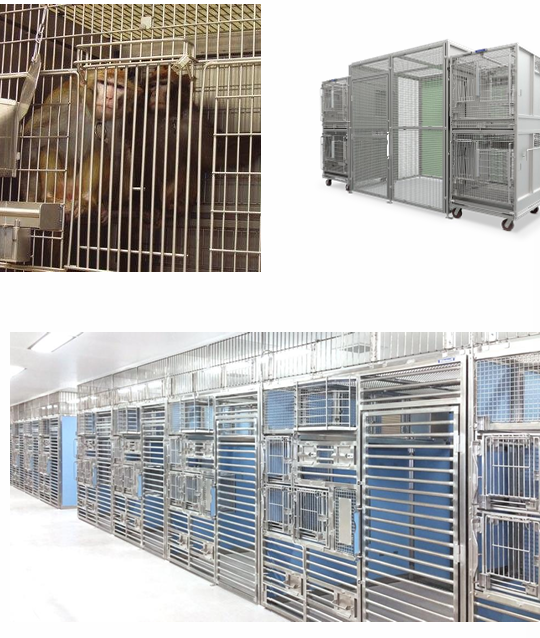
Use of squeeze cages ensures ___ for both monkey and research.
safety
How can monkeys be trained to help decrease use of chemical and physical restraints?
They can be trained to present arm or leg for procedures
Happy, healthy animals =
good science!
Behavioral management units ensure that animals are provided with
adequate environmental enrichment, train animals for procedures, help with group housing
Rhesus Macaque Hierarchy consists of
Matrilineal - females inherit their mother’s rank & stay w/ their natal group
Males leave their natal group upon maturity - enter new troop at bottom of rank
Rhesus Macaque dominance is enforced through
aggression
Lower ranking monkeys have less access to food, mates, space
Use of chimpanzees in research ended in 2015 due to
Extension of endangered species label covering animals in captivity too
Where are most research Chimpanzees today?
In sanctuaries or in retirement at their facility
Current issues in Lab animal medicine
Animal’s rights groups
Increased public scrutiny
Multiple recent bills to block use of dog and nonhuman primates
What is the future of animal research?
Possible alternative methods from animal use is becoming more popular
Alternatives to animal research include
Cell cultures
Organ-on-a-chip technology
AI modeling
Computer models