particle size analysis
 Call Kai
 Learn
Learn Practice Test
 Spaced Repetition
 Match
Match Flashcards
 Knowt Play
1/61

There's no tags or description
Looks like no tags are added yet.
Name | Mastery | Learn | Test | Matching | Spaced | Call with Kai |
|---|
No analytics yet
Send a link to your students to track their progress
62 Terms
What does particle size affect
Physiochemical and pharmacological properties e.g dissolution rate ( higher the dissolution rate, faster the onset of action)
Processing properties of powders e.g flowability, mixing ( good flow and mixing properties manufacture process easier, less energy + costs)
Formulation performance e.g stability of dispersed systems
How does particle size affect dissolution rate and how does this affect what type of tablet you have
Increased particle size decreases the dissolution rate
If you want a slow release tablet you may increase the particle size
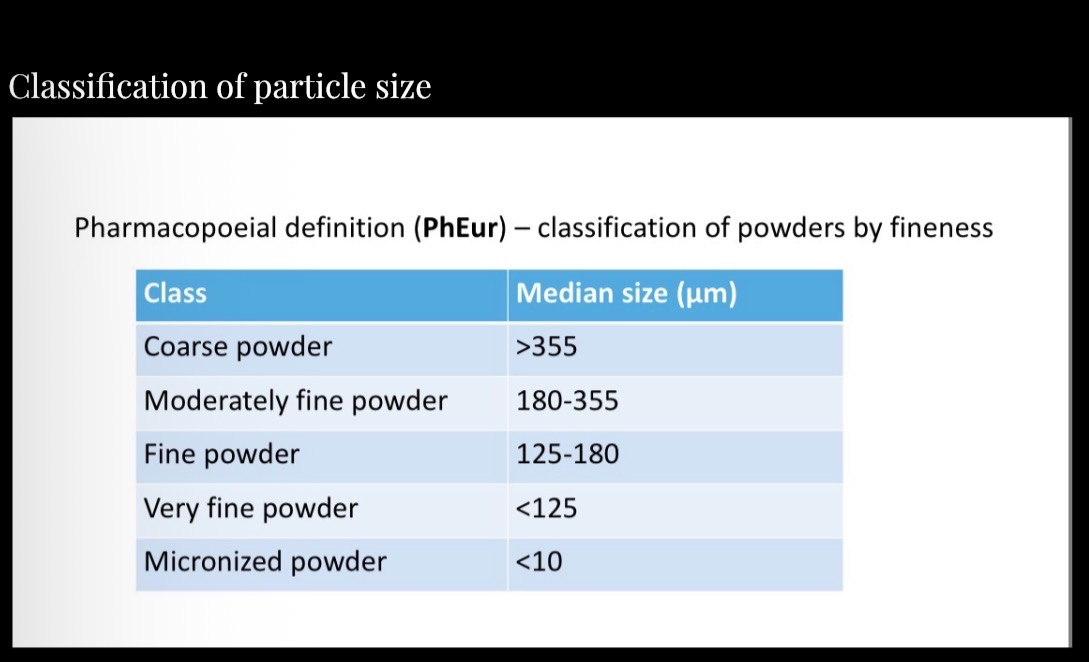
What is the median size of a coarse powder and a microionised powder
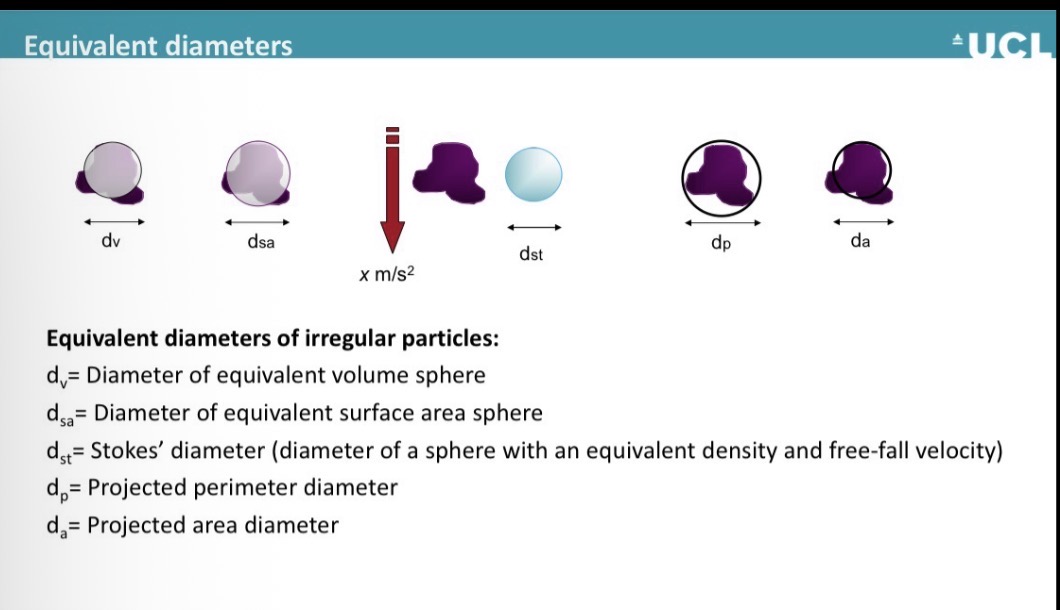
Give examples of the different equivalent diameters
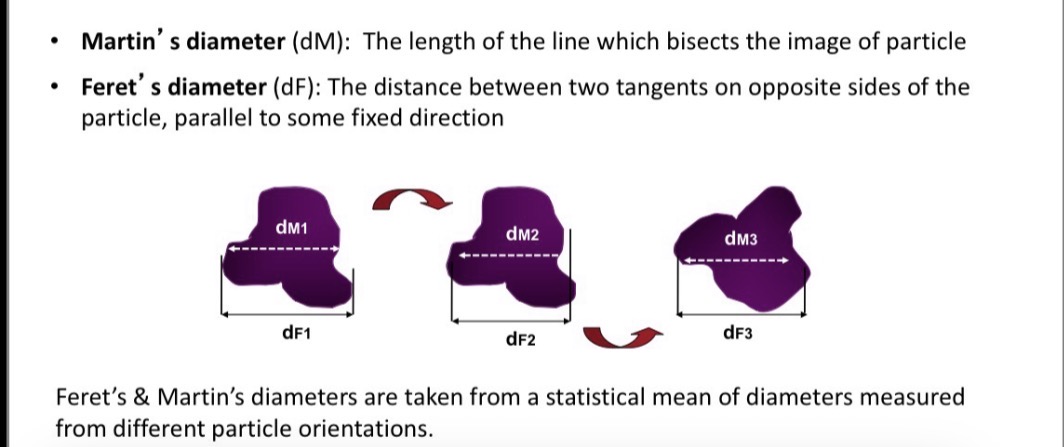
How is Martins diameter and Ferets diameter measured
Martins diameter : cut the shape in the middle and measure it, the length of the line which bisects the image of the particle
Ferrets diameter : measure the two furthest points of the particles, distance between two tangents on opposite sides
What is the issue when taking martins diameter and Ferets diameter
How do you fix this issue
you get different values if the shape is oriented in different ways
you must measure the values for all the different orientations ( orientate it 18 degrees each time and measure it 10 times) and then take an average to get a statistical mean
What equivalent diameter would you use for measuring particles in a
suspension
Inhaled particles
Suspensions - sedimentation properties: Stokes’ diameter
Inhaled particles - aerosol deposition in the lungs : aerodynamic diameter
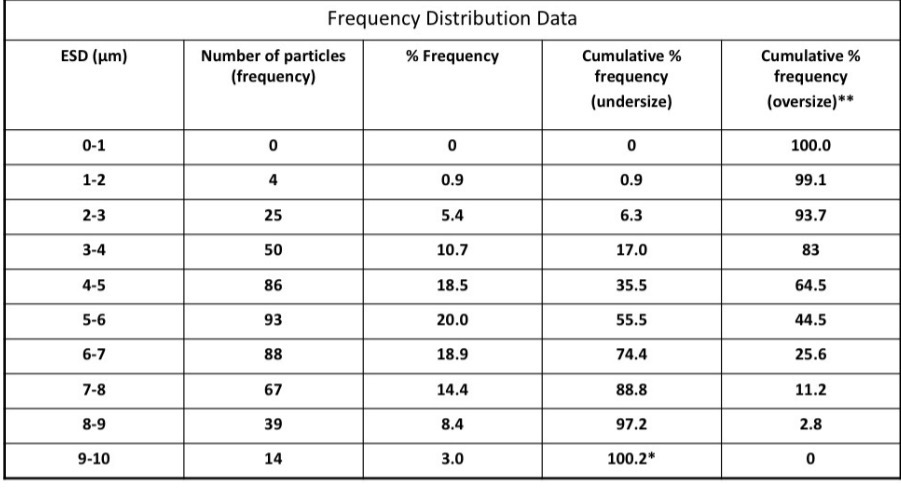
Can you explain what the cumulative % frequency undersized and oversized is from the table
Cumulative frequency undersize example
You add all the particles which are smaller than a certain number. E.g for 1-2 column, it is all the particles which are smaller than 2um
Cumulative frequency oversize is : 100 - the cumulative frequency undersized
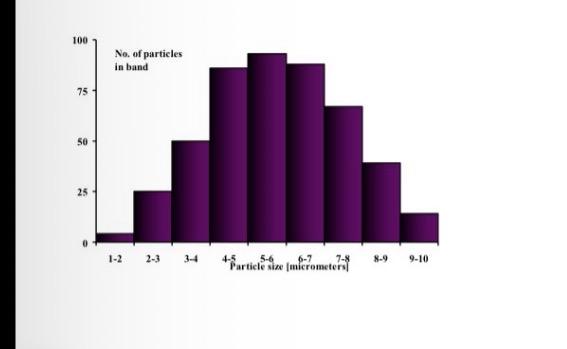
What are incremental histograms used for in particle size analysis
To show how many particles fall within a given size increment
This reflects the distribution of particle sizes
Presents an interpretation of the particle size distribution
Enables determination of the percentage of particles having equivalent diameters
Allows different particle size distributions to be compared
What are the three different types of distribution you can get from the histograms
Normal distribution
Skewed distribution: either positive skew or negative skew and that is determined by the tail, if the tail is to the left it is negative. If it is to the right it is positive
Bimodal : there are two peaks
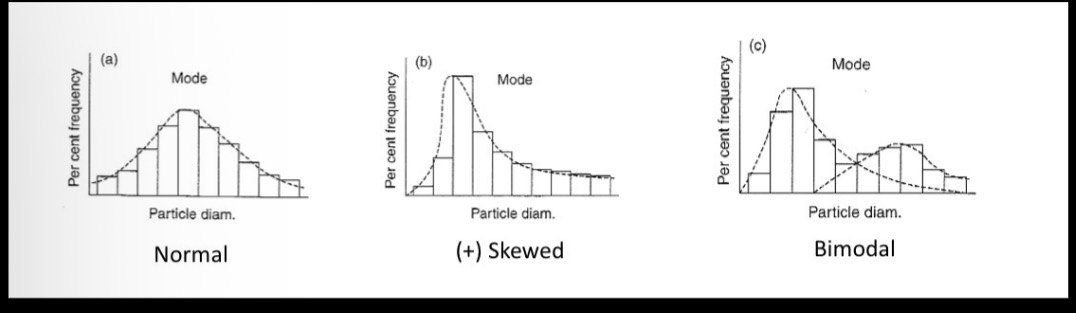
What are the two different shapes distributions can have
What is Kurtosis
What are the two different kurtosis
Distributions may have a pointed or rounded shape
Kurtosis focuses on the peak of the distribution
Leptokurtic: pointed, very distinct peak, shows that the distribution is narrow
Platykurtic : flattened shape for the histogram, you can’t really see where the peak is fr, not obvious
What is a cumulative size distribution
It shows the fraction of particles that are smaller or bigger than a certain particle sizs
depending on if it is undersized or oversized
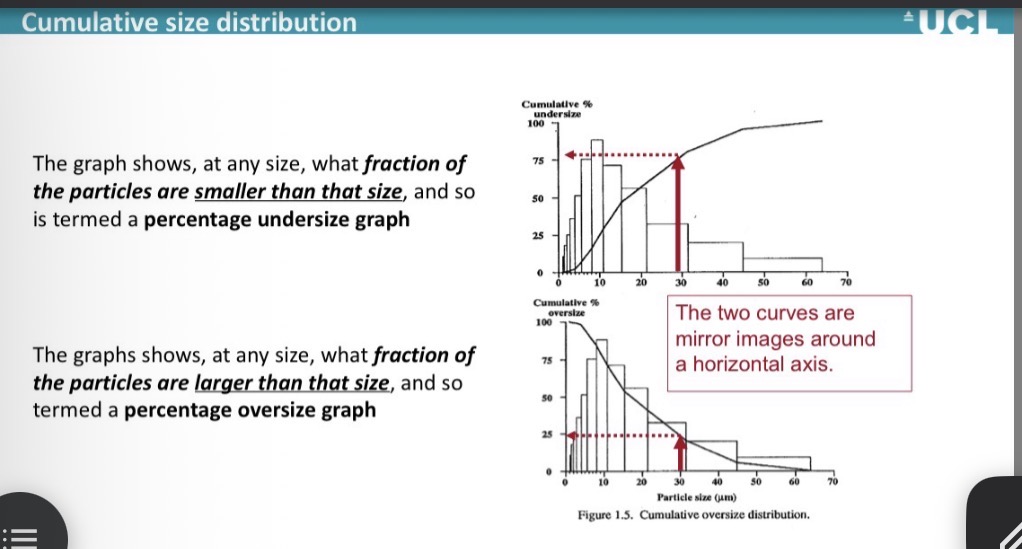
How do you get the median particle size on a cumulative graph
Look at the particle size at 50%
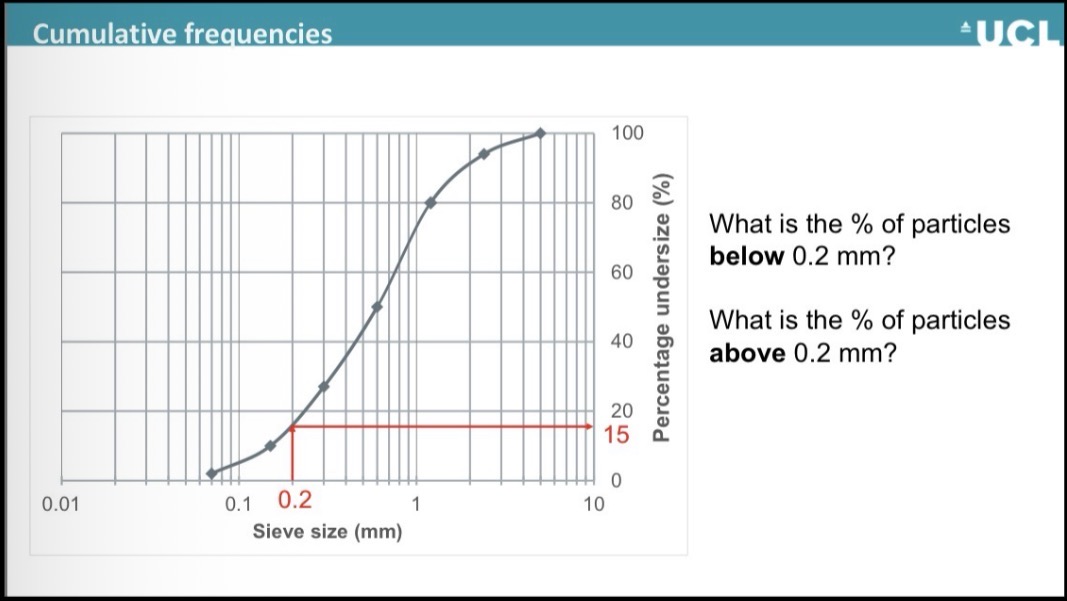
As it is a percentage undersize plot
The % of particles below 0.2mm is 15%
The % of particles above 0.2mm is 85%
What is the different between incremental and cumulative data
General distribution and quick info of the particle size, what % of the powder falls into a specific size increment : incremental
% of particles smaller or larger : cumulative
What is central tendency in histograms
The tendency of the particle size to cluster around a particular value. Such values are evident as a peak in the particle size distribution. These values are normally known as ‘averages) or ‘means’ of set of data
How do you perform sieve analysis
Weigh the powder and each individual sieve
Add the powder to the top sieve
Seal the sieve ( close the lid)
Move sieve to the sieve shaker which causes agitation, particles will go through the sieves they are able to travel through due to the gravitational pull
Separates by size
In what way is the sieve arranged
Arrange the sieve so the bigger apertures are on the top and smaller aperture are on the bottom
What is the sieve equivalent diameter (d_s)
Sieve equivalent diameter (d_s) :the minimum square aperture through which the particle will pass. This is a two-dimensional value
Why is sieving rarely complete
Sieving is rarely complete as some particles take a long time to orientate themselves over the sieve apertures to pass through.
What is the recommended time for sieving
It is recommended that sieving be continued until <0.2% of material passes a given aperture in any 5 minutes interval
Does sieving overestimate or underestimate particle size
sieving underestimates particle size
What size range is sieving used for
What type of diameter is measured
What type of distribution is it
How much of the sample is necessary
How long is the measurement time
5pum to > 5000 pum ; intended for use where at least 80% of the particles are larger than 75pum
Equivalent sieve diameter
Distribution by weight
0.5g to a few kg
5-30 mins for dry sieving
What are the advantages of sieving
inexpensive
Easy to perform
Well-established
What are the disadvantages of sieving
Time consuming
Problems of reproducibility
Humidity, static electricity and powder cohesivity can affect the results
Particles may break or agglomerate during sieving
2D measurements
What can microscopy give you additionally to the particle size
Microscopy can give you additional information e.g morphology ( shape and size)
What particle sizes can
Light microscopes allow you to see
Electron microscopes allow you to see
Light microscope (1-1000pum)
Electron microscope (0.01-1000pum) - staining/coating is required
(Sieve analysis is preferred for particles larger than 200pum)
What diameter do microscopes measure
Projected area diameter (equivalent circle diameter), also Feret’s diameter or Martin’s diameter
Can single particles and aggregated be distinguished in microscopes
Yes
How many particles are needed to be measured using a microscope
600 or more particles to be measured to get a statistical representative size
What type of distribution is being measured using a microscope
Distribution by size, computational tools are used to do it
What are the advantages for microscopes for particle sizes analysis (4)
inexpensive ( light microscope)
Small sample size
Individual particle sizes can be measured
Images can be captured
What are the disadvantages of microscopes (5)
Expensive (electron microscope)
Time consuming
Low throughput ( slow/little bit of data)
2D measurement
Operator dependent
How does sedimentation analysis work to distinguish particle size generally
The first few particles that are taken out of the pipette will be larger as the larger particles sediment faster, after time is passed the smaller particles will start to sediment
So it works y collecting samples at different time points
What diameter is being measured in sedimentation analysis + what do you actually measure
What do you assume about the particles
Stokes’ diameter, particles with different sizes settle at different velocities
The sedimentation velocity by measuring the time which particles require to settle
(Assume all particles have the same density)
What is the normal size range for sedimentation analysis
5-200 pum
What type of distribution is measured for sedimentation analysis
Distribution by weight
What type of formulations are usually measured by sedimentation analysis
suspensions or emulsions
What are the advantages of sedimentation analysis (2)
low cost
Useful for cases where sedimentation is key
What are the disadvantages of sedimentation analysis (4)
labour intensive
Particles must be insoluble in the dispersion medium
Temperature control is required
Particle shape also affects settling rate
When doing sedimentation analysis for particle size, what is important for the liquid medium the particles are in
It’s important the medium doesn’t dissolve the particles
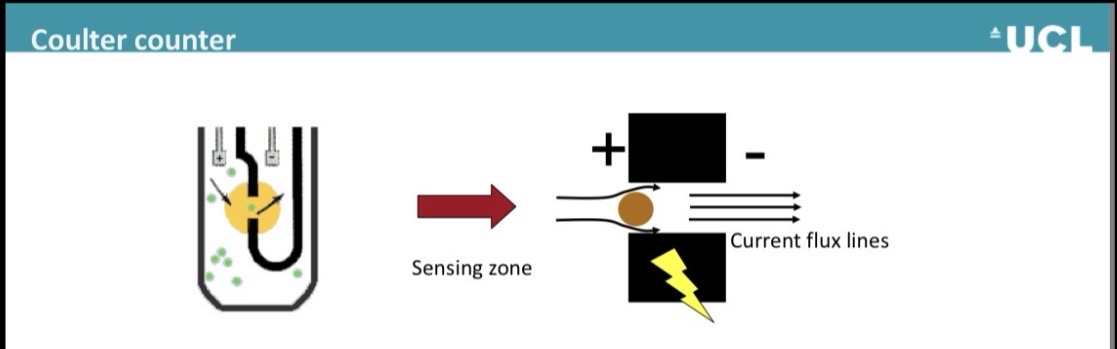
How does the coulter counter work
What type of measurement does it do
What happens to the particles as they pass through the aperture
It is a measurement by conductivity, a type of electrical sensing zone method
As particles pass through the aperture opening , they bend the current flux lines around the particles
This causes a longer length for the current to pass and a higher resistance to the current
The amplitude of this current pulse is directly proportional to the volume of the particle that produced it
What diameter is being measured in the coulter counter
The volume equivalent diameter
What is the size range for the coulter counter
0.5 - 1000pum (large size range)
What is the type of distribution
distribution by number
What it’s important for the liquid medium in a coulter counter
How much drug quantity do you need
liquid must be able to conduct electricity and it can’t dissolve the particles
You need mg to gram quantities depending on particle size
What are the advantages of the coulter counter (4)
rapid measurement
Large number of particles counted + reproducible and reliable
Simple to use
Wide range of sizes measured
What are the disadvantages of the coulter counter (5)
particles have to be suspended in an electrolyte liquid
Limited choice of liquid media
There can be blockage of the orifice by oversized particles
Needs calibration
Expensive
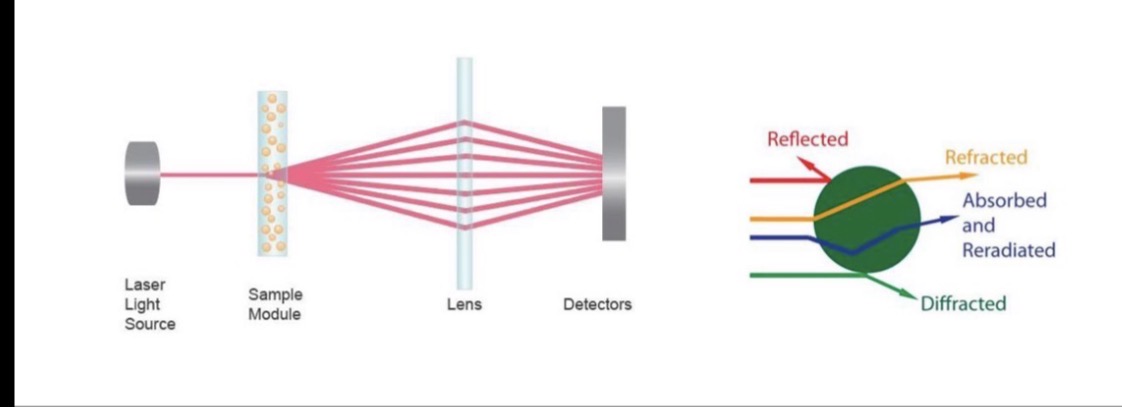
What is laser diffraction analysis
A technique based on laser diffraction to derive particle size information from patterns of angular light scattering of the sample
(Good for aerosols)
What type of diameter is being measured in laser diffraction
Equivalent volume diameter
What is the size range of particles used
0.01 to 3000pum
What do larger particles do to light (laser diffraction)
They scatter light at smaller angles with higher intensity
What do smaller particles do to light (laser diffraction)
They scatter light at bigger angles with lower intensity
What type of distribution does laser diffraction show
Distribution by volume
How much do you need in your sample to get a good measurement
Mg to gram quantities
What are the advantages of laser diffraction (6)
quick and simple
no calibration required
high reproducibility
testing is non-destructive and non-intrusive
the entire sample is measured
Suitable for a wide range of samples (in gas or liquid)
What are the disadvantages of laser diffraction
refractive index should be known
Refractive index difference is required between particles and the dispersion medium
Expensive
What is dynamic light scattering (DLS)
Photon correlation spectroscopy used to measure nanoparticles
It measures the fluctuations in the intensity of scattered light that are due to the random Brownian motion of particles suspended in a suspending medium
(Brownian motion depends on particle size)
For dynamic light scattering,
How does larger particles affect it
How do smaller particles affect it
Larger particles means the change of the scattering intensity is slower
Smaller particles means the change of the scattering intensity is faster
What are the advantages of dynamic light scattering (DLS) (6)
quick and simple
No calibration required
High reproducibility
Testing is non-destructive and non-intrusive
The entire sample is measured Suitable
Nanoparticle size range
What are the disadvantages of DLS
samples must be dispersed in liquid
Particle-particle interaction at increased concentration
Multiple scattering at increased concentration
Expensive
What diameter does DLS measure
What is the size range of the particles measured
What type of distribution is it
What formulations is it good for
hydrodynamic diameter - using stokes - Einstein equation
1nm to 3pum
Distribution by intensity
Suspension emulsions