A&P Test 3
 Call Kai
 Learn
Learn Practice Test
 Spaced Repetition
 Match
Match Flashcards
 Knowt Play
1/54

There's no tags or description
Looks like no tags are added yet.
Name | Mastery | Learn | Test | Matching | Spaced | Call with Kai |
|---|
No analytics yet
Send a link to your students to track their progress
55 Terms
A lymphatic capillary that picks up dietary lipids in the small intestine is called a(n):
lacteal
The force that drives fluids into lymphatic capillaries is:
hydrostatic pressure in the interstitial space
The lymphatic system's two main functions are to assist in:
immunity and fluid balance
Lymph is transported through a network of increasingly larger lymphatic passageways. What is the correct order of these, from smallest diameter to largest diameter?
capillaries, vessels, trunks, ducts
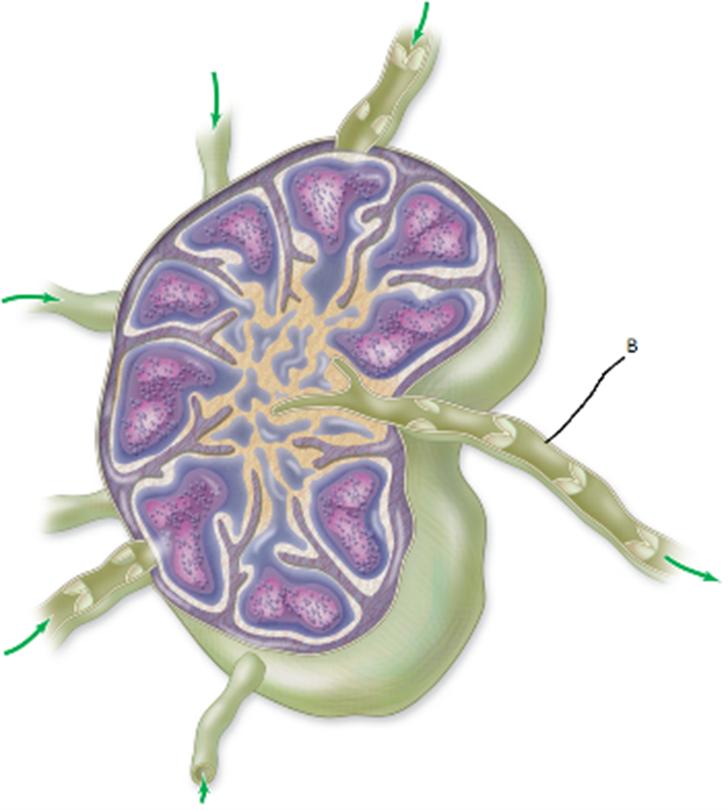
Name the structure "B" shown in the image-
efferent lymphatic vessel
Which organ generates a population of T cells capable of protecting the body from pathogens?
thymus
When women with breast cancer undergo surgery to remove the tumor or the entire breast, the axillary lymph nodes are often removed as well. Why?
The axillary nodes receive lymph from the breast and may contain cancer cells
The pharyngeal tonsils (adenoids) are located:
in the posterior wall of the nasopharynx
Where are pathogens filtered from lymph?
lymph nodes
The term "primary lymphatic structure" applies to which areas of the body?
to the red bone marrow and thymus
Hyperventilation occurs when the respiratory rate increases, as a result of this, carbon dioxide levels in the blood _____ and H+ levels in the blood _____.
decrease, decrease
The respiratory system does NOT function in:
blood cell production.
What is the function of the red pulp of the spleen?
house macrophages that destroy old erythrocytes
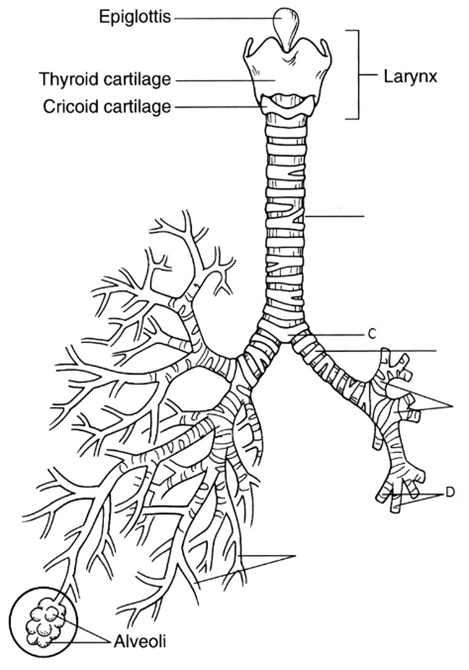
Name the respiratory structure shown in the Figure, labeled as C
Carina
What structure is commonly known as the "voice box"?
larynx
Obstruction of flow of lymph in lymphatic vessels can lead to accumulation of interstitial fluid in the tissues. This condition is characterized by pain and swelling and is called _____.(correct Spelling)
lymphedema
Pulmonary gas exchange occurs in the:
respiratory zone
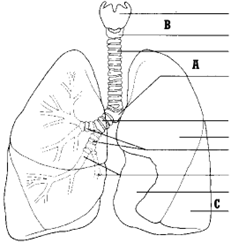
Identify the following structures on the lung diagram for A, B, and C
carina, cricoid cartilage, inferior lobe of left lung
The reason air flows out of the body during expiration is that during that time:
intrapulmonary pressure > atmospheric pressure
In what order does air inhaled through the nose travel, from superior to inferior?
nasopharynx, oropharynx, laryngopharynx
Which of the following structures would report changes in arterial PCO2 and arterial hydrogen ion concentration?
chemoreceptors
Gas exchange occurs at the respiratory membrane by
Simple diffusion
Which organ's position causes the left lung to be shaped differently from the right lung?
heart
What reduces friction around the lungs as they expand and contract?
pleural fluid
If a patient has an increase in the hydrogen ion concentration that is caused by a change in respiratory function, this process would be termed_____.
Respiratory acidosis
Which plasma protein contributes the most to colloid osmotic pressure?
Albumins
Which are the most numerous of the leukocytes?
Neutrophils
Which leukocyte type produces antibodies and kills virally-infected cells?
Lymphocyte
If there is not enough oxygen in the blood, the kidneys release ___ to stimulate red blood cell production.
Erythropoietin
Which of the following organs stores and concentrates bile?
Gallbladder
The ___ is located on the inferior surface of the liver
Gallbladder
Secretes pepsinogen
Chief Cell
Which of the following would not be a region of the stomach?
Cecum
Chyme would move from the cecum to the _____
Ascending colon
The liver is located in the ____ quadrant
Upper right
Glucose is converted to pyruvate during:
glycolysis.
The citric acid cycle occurs within the:
mitochondria
The function of red blood cells is to:
transport oxygen and carbon dioxide.
Since erythrocytes lack the cellular machinery to make repairs, they only live:
100-120 days.
Which organ traps older erythrocytes so they will be removed from circulation?
spleen
The ABO blood group is based on which antigen(s)?
antigens A and B
In which organ is chyme mixed with pancreatic juice and bile?
duodenum
Which organ functions to absorb significant quantities of water, electrolytes, and vitamins?
large intestine
What is the first process to occur in the digestive system?
ingestion
From deep (innermost) to superficial (outermost), the layers of the organs of the alimentary canal are:
1, 4, 2, 3
The portion of a tooth that is visible above the gum line is known as the:
crown.
The sum of the body's chemical reactions is known as:
metabolism.
The breakdown of carbohydrates into glucose in the body is classified as:
catabolism.
What is required for glucose catabolism to proceed beyond glycolysis?
oxygen
The process of storing glucose as glycogen is known as:
glycogenesis.
Name the respiratory disorder caused by an obstruction of air flow through the bronchioles.
Asthma
With respect to the lymphatic system, what do the letters in the acronym MALT stand for?
Mucosa-associated lymphatic tissue
Substances that lose electrons are said to be:
oxidized.
What is NOT required for glycolysis to occur?
mitochondrion
Under anaerobic conditions, what happens to pyruvate?
Pyruvate is reduced to lactate.