Lecture 18: Judgment, Decisions, and Reasoning (Ch. 13)
 Call Kai
 Learn
Learn Practice Test
 Spaced Repetition
 Match
Match Flashcards
 Knowt Play
1/33

There's no tags or description
Looks like no tags are added yet.
Name | Mastery | Learn | Test | Matching | Spaced | Call with Kai |
|---|
No analytics yet
Send a link to your students to track their progress
34 Terms
Judgments vs Judgment Heuristics
Judgments: the estimates that people make of important real-world quantities (height, weight, intensity, probability, etc.)
Judgment Heuristics: easy, natural strategies for making judgments
They provide answers that are often reasonable but systematically biased
Availability
One important quantity that people must estimate is the probability of events
People often estimate probability on the basis of examples of the event that are readily available in memory
But when we remember is not always more probable
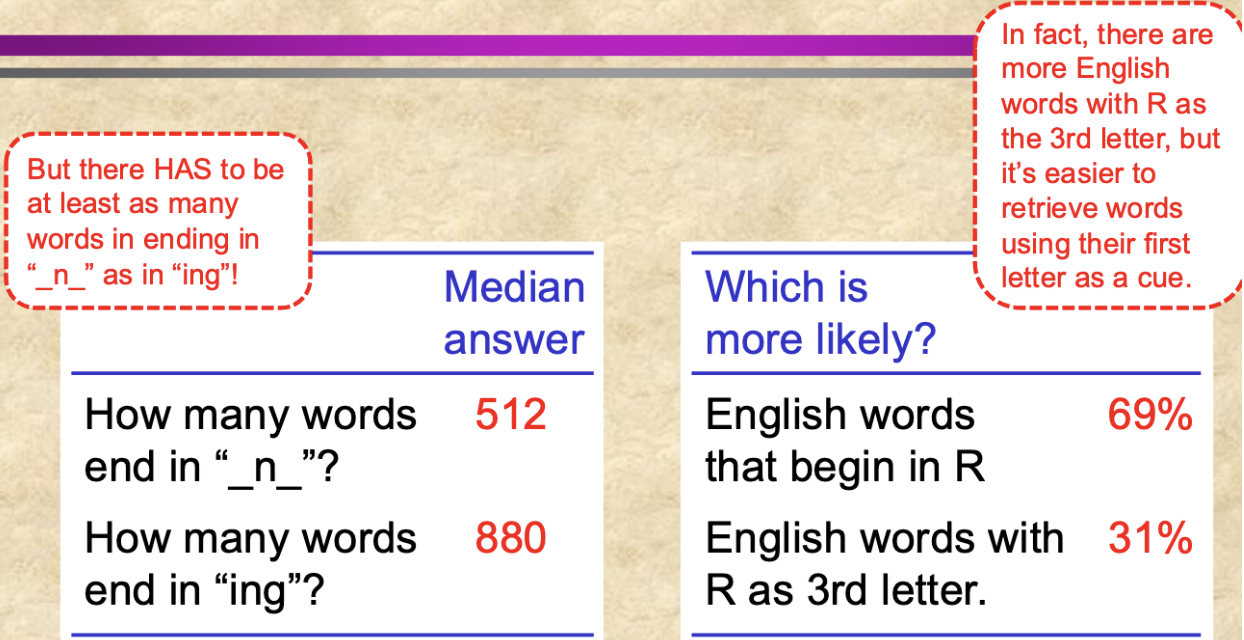
Accuracy of Human Risk Assessment (Lichenstein, Slovic, Fishhoff, Layman, & Combs, 1978)
Lichenstein et al. asked people to judge the rates of many causes of death (tornado, botulism, cancer, stroke, flood, car accident, etc.)
People overestimate the probability of rare events but underestimate the probability of common events
Judged vs Actual Mortality Rates (Hertwig, Pachur, & Kurzenhauser, 2005)
Dramatic events are overestimated (ex: flood, even though there hadn’t been a flood in Germany for years where the data had been collected)
Non-dramatic events are underestimated
Availability and Risk Assessment
People overestimate accidents and natural disasters
They are dramatic and receive a lot of attention (media coverage) and hence are available in memory (plane crashes, shark attacks, etc.)
This can lead people to make real-life decisions that are life-threatening
Availability and Risky Decisions (Gigerenzer, 2004)
In 2004, Gigerenzer analyzed patterns of travel after 9/11
In the following months there was a decrease in air travel
At the same time, there was a 2.9% increase in freeway driving that led to an increase in driving deaths
Availability ≠ Probability
We’ve seen that there are many factors that determine what we can remember
Semantic elaboration
Interference
Imagery (especially when vivid)
But factors that make something more memorable does not necessarily make it more probable
Representativeness
People often make judgments of probability on the basis of similarity or representativeness
Conjunction fallacy
Neglect of the law of large numbers
Base rate neglect
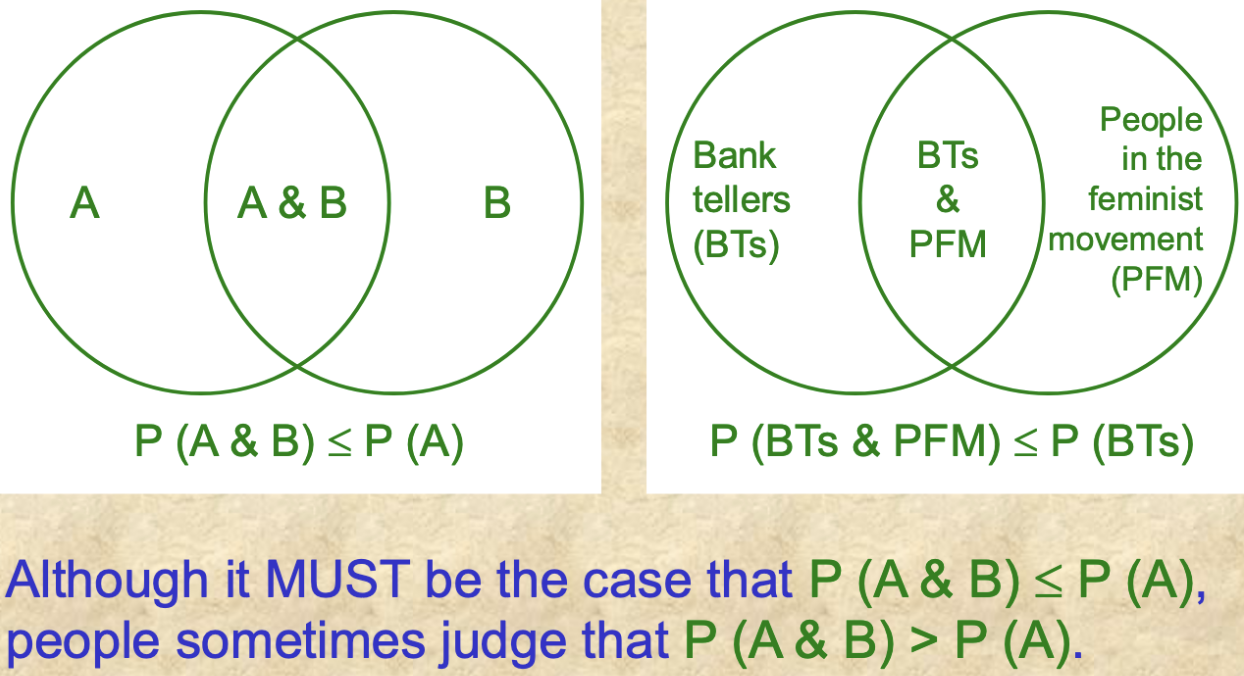
1. Conjunction Fallacy (Tversky & Kahneman, 1982)
People sometimes judge the conjunct as more probable
According to probability theory, the conjunction of two events cannot be greater than either of the events themselves
The conjunct is less probable but more representative of (or similar to) Linda:
Linda is a bank teller - more probable but less representative
Linda is a bank teller and active in the feminist movement - more representative but less probable
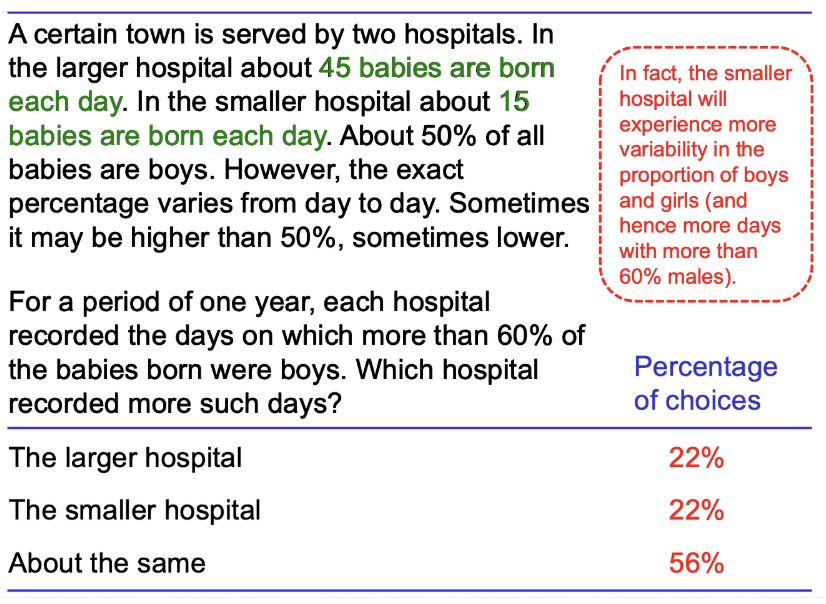
2. Neglect of the Law of Large Numbers (Tversky & Kahneman, 1974)
Larger samples provide stronger evidence than smaller ones
people often ignore sample sizes
3. Base Rate Neglect
When estimating the probability of an event given evidence, people often ignore the event’s base rate (the probability of the event in the absence of any evidence)
Base Rate Neglect (Tversky & Kahneman, 1973)
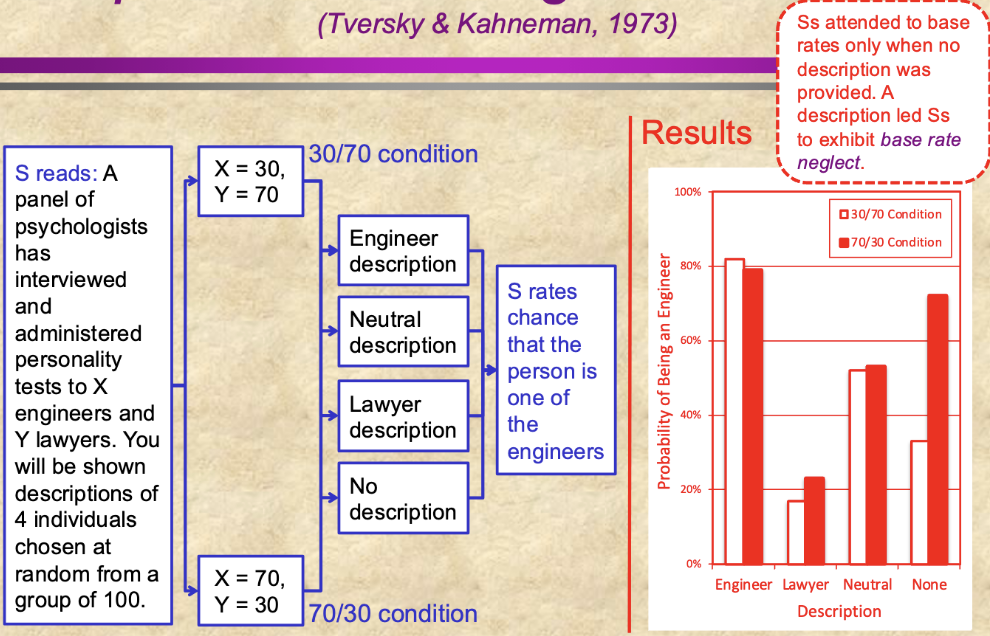
In 1973, Tversky and Kahneman asked subjects to identify an individual in a group of 100 as an engineer to a lawyer
The population’s distribution was specified
30/70 condition: 30 engineers, 70 lawyers
70/30 condition: 70 engineers, 30 lawyers
A description of an individual is provided (engineer, neutral, lawyer, none)
Subjects are asked if that individual is an engineer
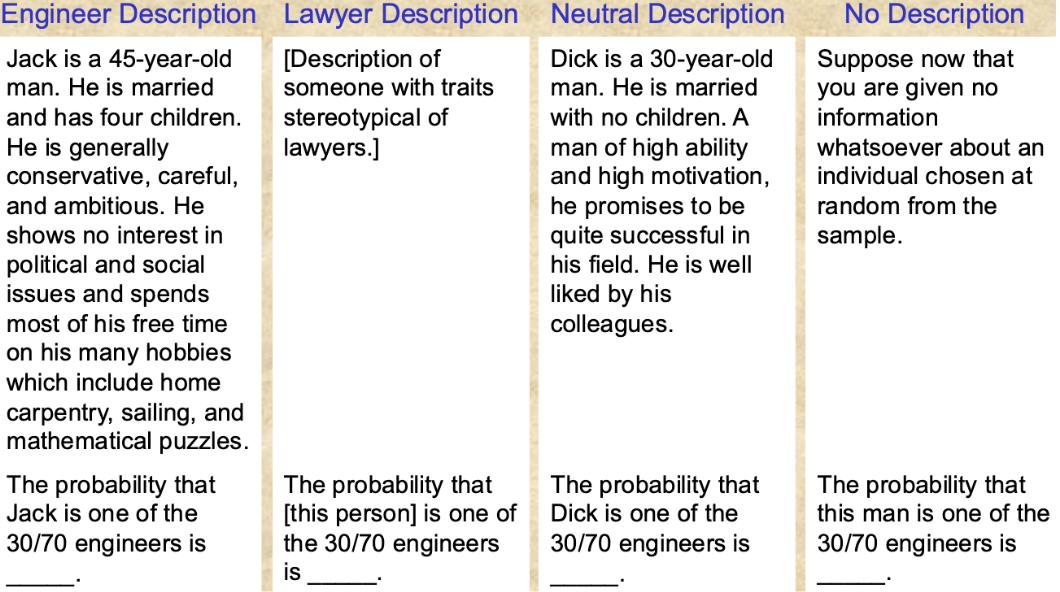
Experimental Design and Results (Tversky & Kahneman, 1973)
People completely ignore the condition and make their judgments purely on the description they read
Another Example (Tversky & Kahneman, 1982)
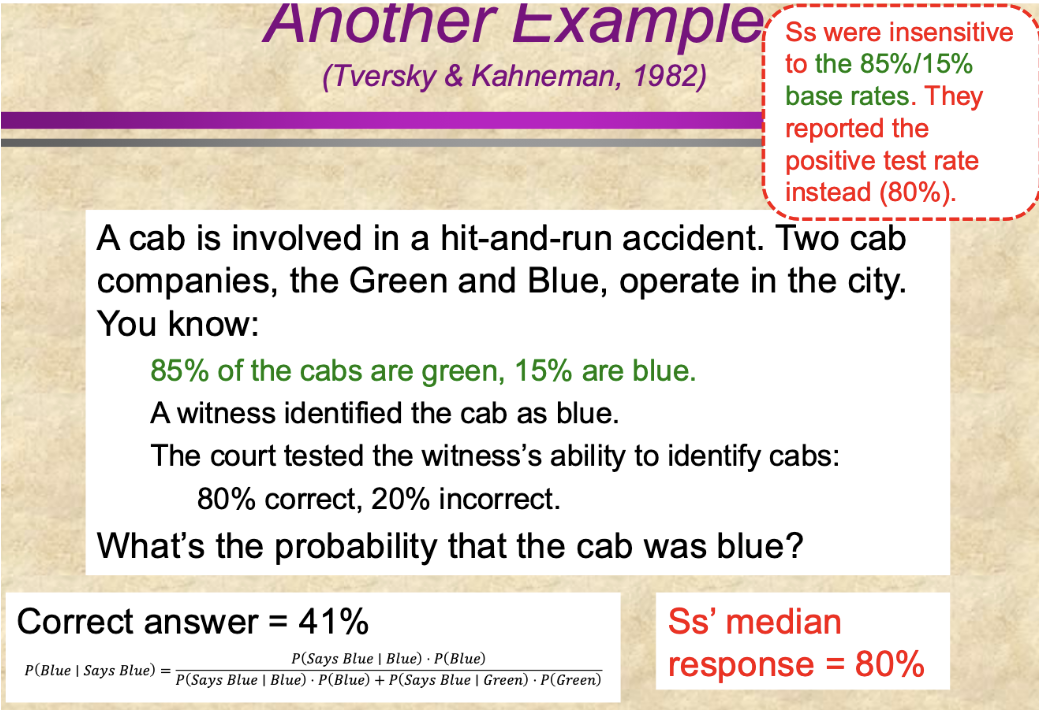
In order to make this judgment, you can’t ignore the distribution of blue and green cabs.
When you have info about the real world (base rates), you can’t just ignore that
Misdiagnosing Real Diseases (Eddy, 1982)
Chance of breast cancer:
Age 20-24: 1 in 110,000
Age 40-44: 1 in 790
Age 70-74: 1 in 215
Actual false positive rate: 10-33%
Harvard study in 1998 estimated 33%
There are documented cases where doctors have badly misjudged the probability of breast cancer by ignoring base rates
What’s Wrong?
Base rate neglect is one of the most common mistakes people make while reasoning probabilistically
Much research has investigated why people ignore base rates
Causal relevance of base rates in unclear
People are not good at reasoning with probabilities vs frequencies
1. Causal Relevance of Base Rates
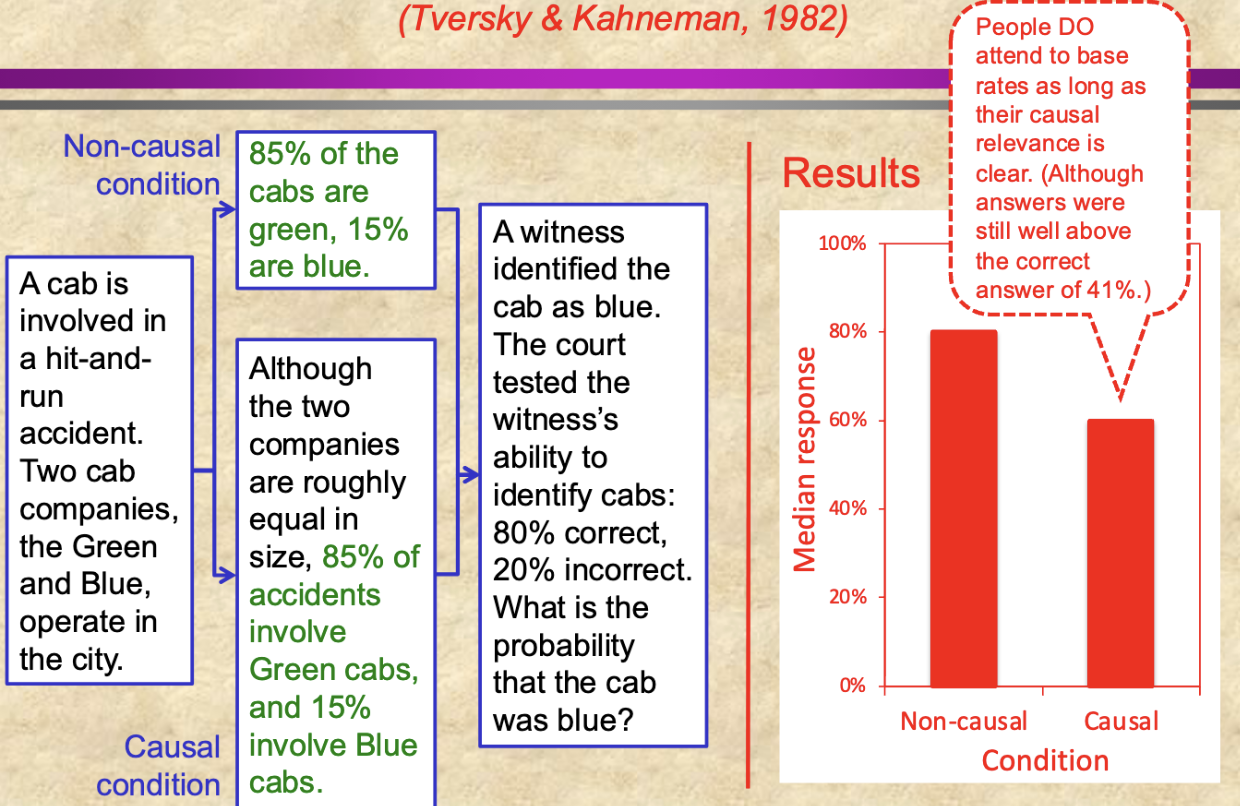
Tversky and Kahneman (1982) also presented a version of the “cab” problem in which the causal relevance of the base rates was emphasized
2. Base Rates as Frequencies (Gigerenzer, Hell, & Blank, 1988)
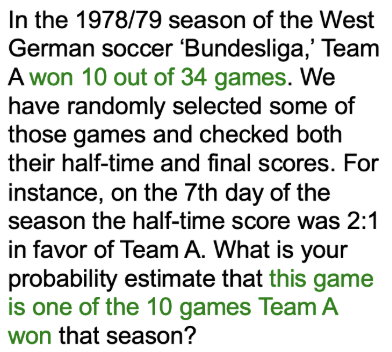
Gigerenzer et al. tested whether base rates are used when expressed as frequencies
Experimental Design and Results (Gigerenzer, Hell, & Blank, 1988)
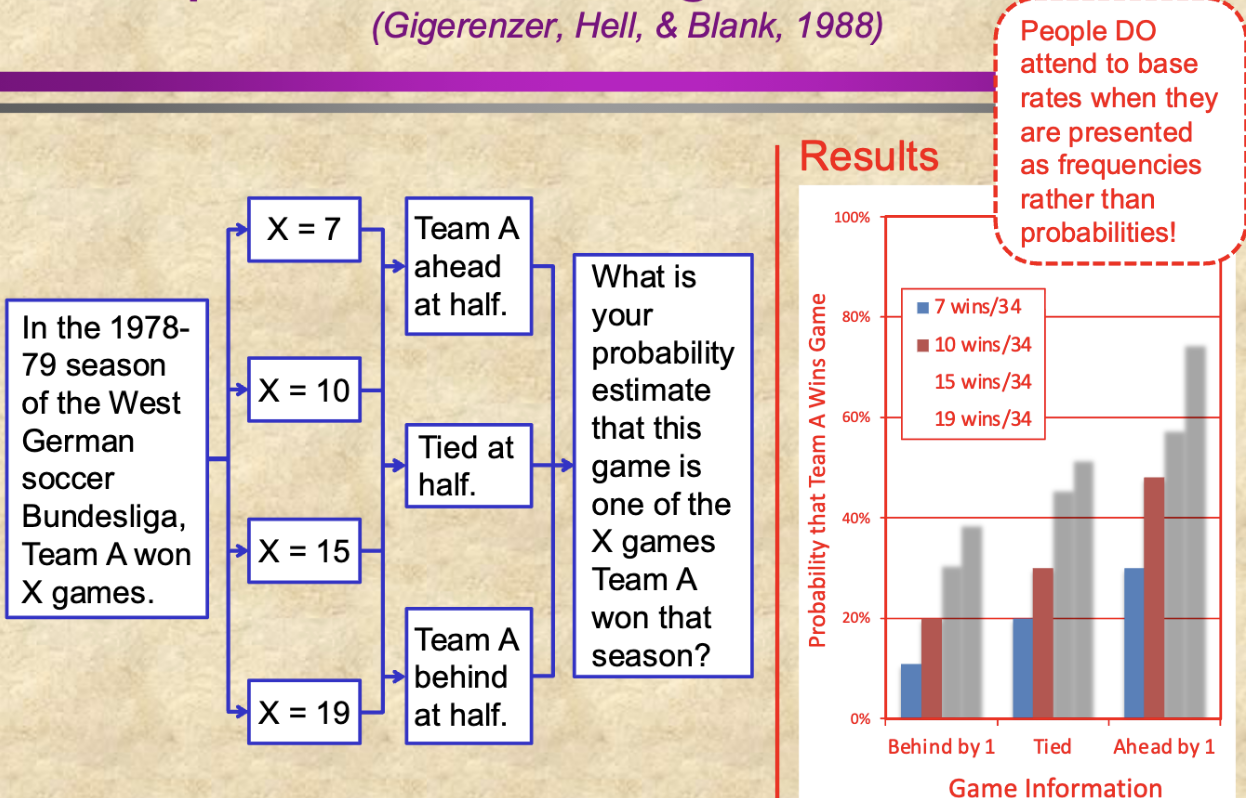
Probabilities vs Frequencies (Gigerenzer, Hell, & Blank, 1988)
Why are frequencies preferable to probabilities? According to Gigerenzer:
Evolution has prepared people to deal with the frequency of observed events
In contrast, the notion of probabilities are a relatively recent invention
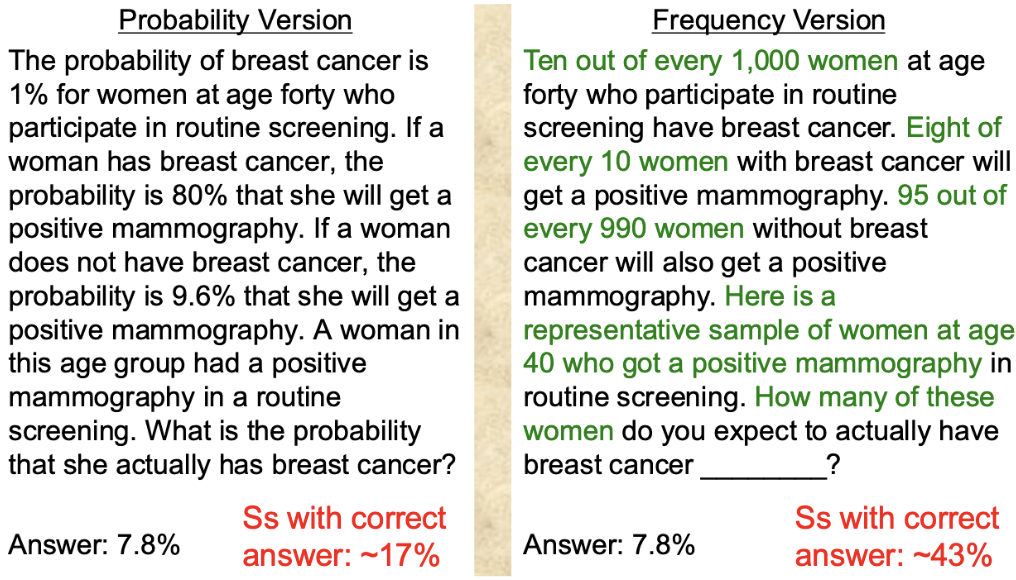
Summary of Base Rate Neglect
Base rate neglect is one of the most common mistakes people make while reasoning probabilistically
But use of base rates more likely when:
Individuating info is not present
Base rates are causally related to judgment
Base rates expressed as frequencies rather than probabilities
Interim Summary
These phenomena are sometimes referred to as cognitive illusions
Like perceptual illusions, they’re consistent and persistent discrepancies between a true state of affairs and its mental representation
Confirmation Bias
An unconscious tendency to process info in a way that supports one’s prior beliefs or values
There are numerous examples of people clinging to beliefs that should be revised or discarded
Types of Confirmation Bias
Biased information search
Biased evidence evaluation
1. Biased Information Search
Ideally, the evidence that people seek out to test their beliefs should lead to correct beliefs being adopted
In fact, people tend to seek out only evidence that is likely consistent with their existing beliefs
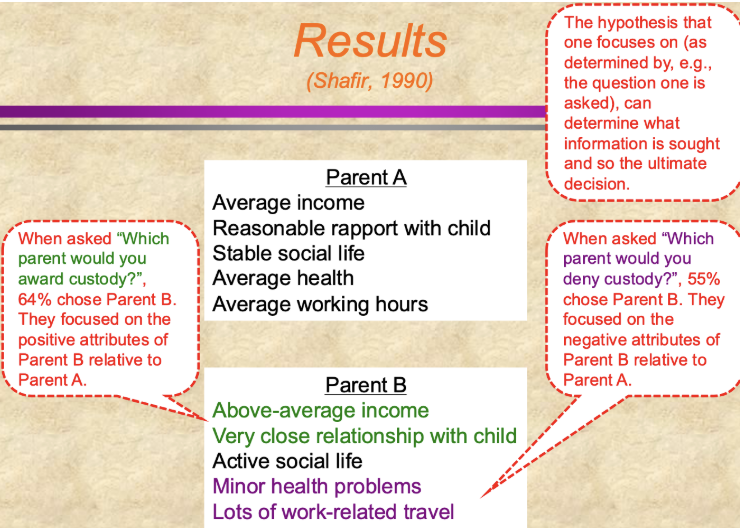
Real World Biased Search (Shafir, 1993)
In 1993, Eldar Shafir asked subjects to choose which parent should receive custody of a child
One parent’s had strong positive and negative features, the other’s features were neutral
The wording of the question was varied
Which parent would you award custody?
Which parent would you deny custody?
How would the wording affect subjects’ choice?
Results (Shafir, 1990)
2. Biased Evidence Evaluation
The evaluation of evidence should be independent of whether it agrees or disagrees
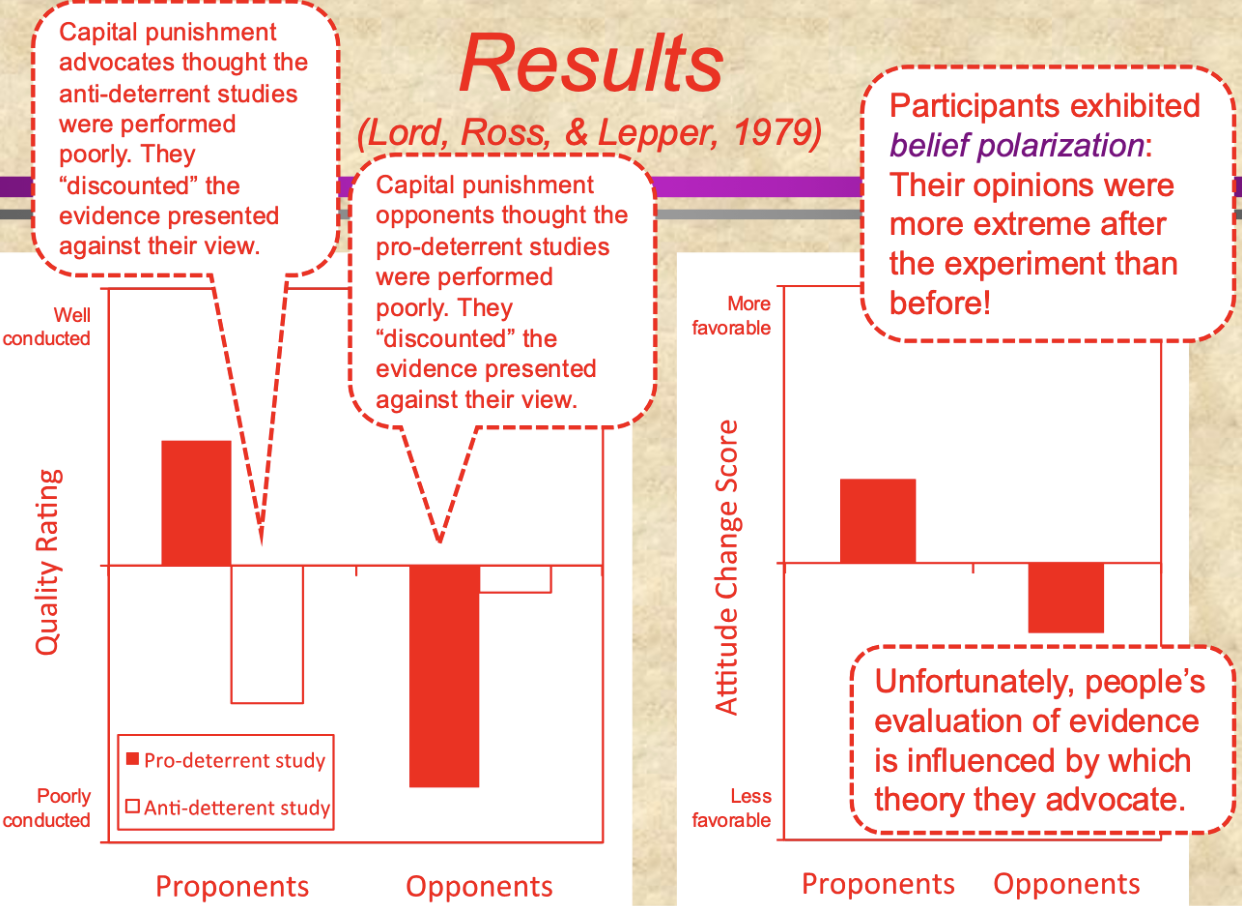
Myside bias: people tend to discount evidence they disagree with
Myside Bias (Lord, Ross, & Lepper, 1979)
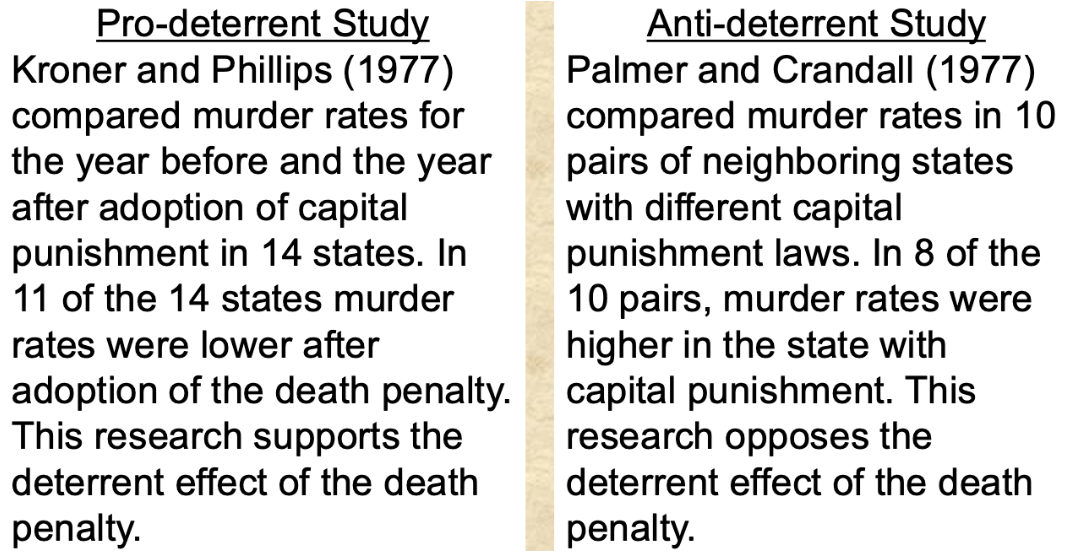
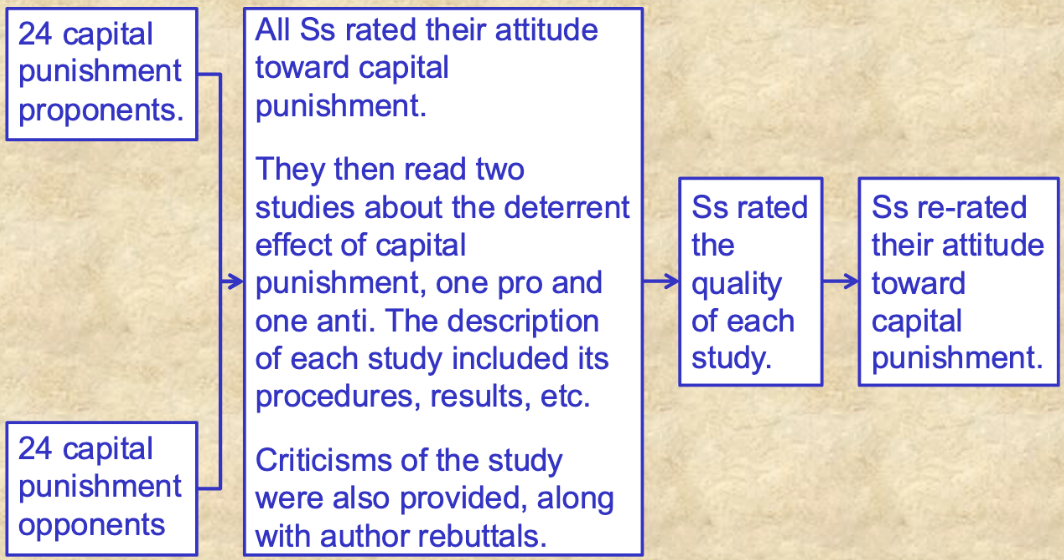
In 1979, Lord et al. presented subjects with (functional) studies about controversial topics (ex: capital punishment)
Subjects had strong prior attitudes
Proponents: in favor of capital punishment
Opponents: against capital punishment
Each subject read two studies, one supporting capital punishment, one not
The Two Studies (Lord, Ross, & Lepper, 1979)
Experimental Design (Lord, Ross, & Lepper, 1979)
Results (Lord, Ross, & Lepper, 1979)
Reasons for Confirmation Bias
Maintenance of self-esteem
Avoidance of cognitive dissonance
Simplified cognitive processing
Backfire effect: disconfirming evidence sometimes leads to a mistaken belief becoming stronger
Summary of Confirmation Bias
People are often biased in how they:
Test hypotheses: they tend to look for positive confirming evidence
Evaluate evidence: they’re more critical of evidence they don’t agree with
Everyone should remain open to the possibility that we’re sometimes wrong