Priming - Chapter 7
 Call Kai
 Learn
Learn Practice Test
 Spaced Repetition
 Match
Match Flashcards
 Knowt Play
1/15

There's no tags or description
Looks like no tags are added yet.
Name | Mastery | Learn | Test | Matching | Spaced | Call with Kai |
|---|
No analytics yet
Send a link to your students to track their progress
16 Terms
What are the two types of priming
WHAT
WHAT
What are the two types of priming
Perceptual / Repetition
Conceptual / Semantic
Perceptual / Repetition priming
A previous encounter with information facilitates later. performance on the SAME information (or the fragments of the original information), even unconsciously. (same stimulus)
Examples:
The “elephant experiment”
The word-fragment completion task
Conceptual / semantic priming
A previous encounter with information facilitates later
performance on SEMANTICALLY related information, even unconsciously. (new stimulus)
Examples:
You see the picture of a rabbit or hear the word “rabbit” first. Later you hear the sound “hair/hare.” When asked to write down the word that you heard, you are more likely to write down “hare” because “rabbit” and “hare” are semantically related words.
You fully understand what “negative reinforcement” means. But you choose the word “decreases” to fill in the blank of this statement: Negative reinforcement ____ the rate of responding.
Perceptual priming - Word-fragment task version 1
Participants see fragments of a word and try to fill in the missing letters to make the string of letters a word that they first think of.
People are more likely to think of “SHAPE” than “SHADE SHAME SHARE SHAKE” when they see SHA_E if they have seen the word SHAPE at an WHAT time.
Note: there should be a WHAT group or a WHAT to provide baseline measure of the likelihood that people will first think of the target word without previous exposure to that word.
Perceptual priming - Word-fragment task version 1
Participants see fragments of a word and try to fill in the missing letters to make the string of letters a word that they first think of.
People are more likely to think of “SHAPE” than “SHADE SHAME SHARE SHAKE” when they see SHA_E if they have seen the word SHAPE at an EARLIER time.
Note: there should be a CONTROL group or a NORM to provide baseline measure of the likelihood that people will first think of the target word without previous exposure to that word.
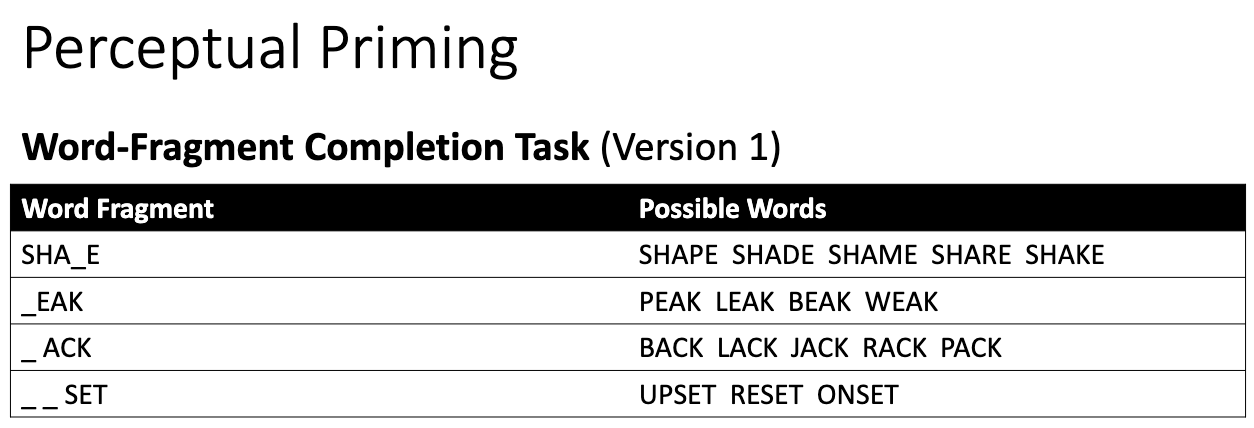
Perceptual priming - Word-fragment task version 2
Participants sees fragments of a word and tries to WHAT the word
Perceptual priming - Word-fragment task version 2
Participants sees fragments of a word and tries to GUESS the word
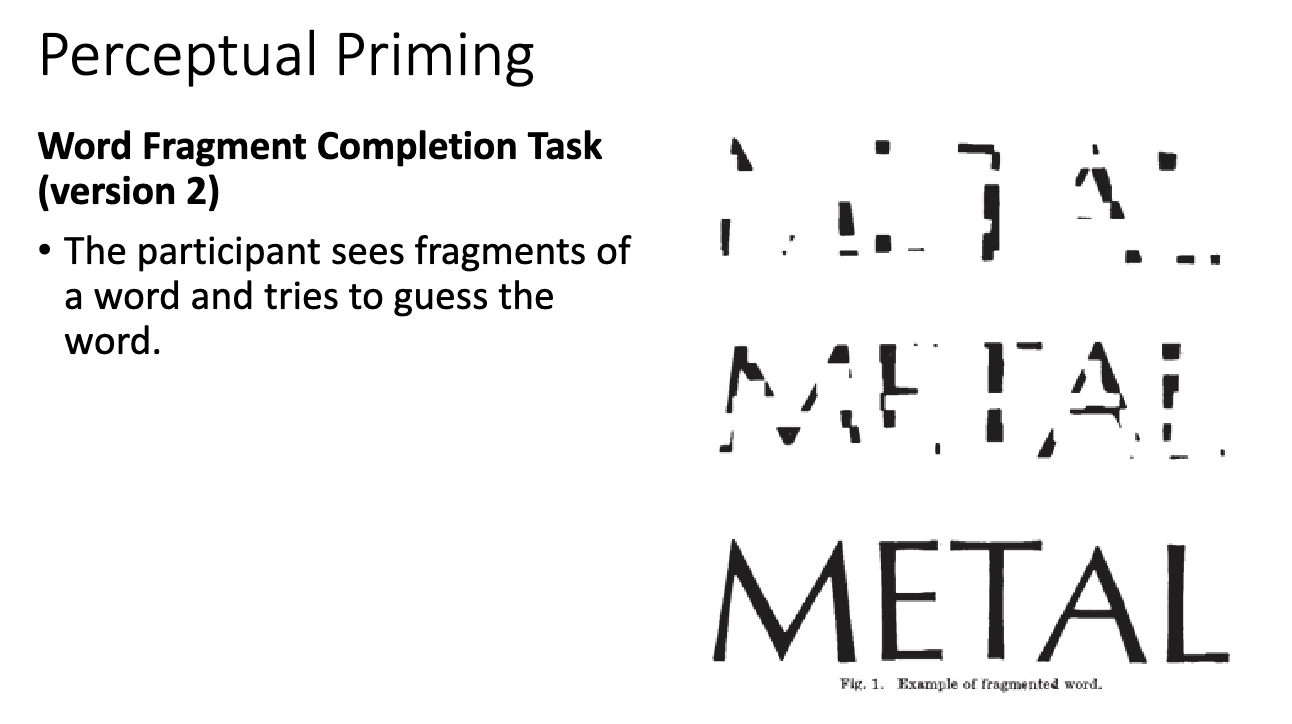
Word fragment = Cream
Free recall rate = WHAT
Word fragment = Cream
Free recall rate = 72%
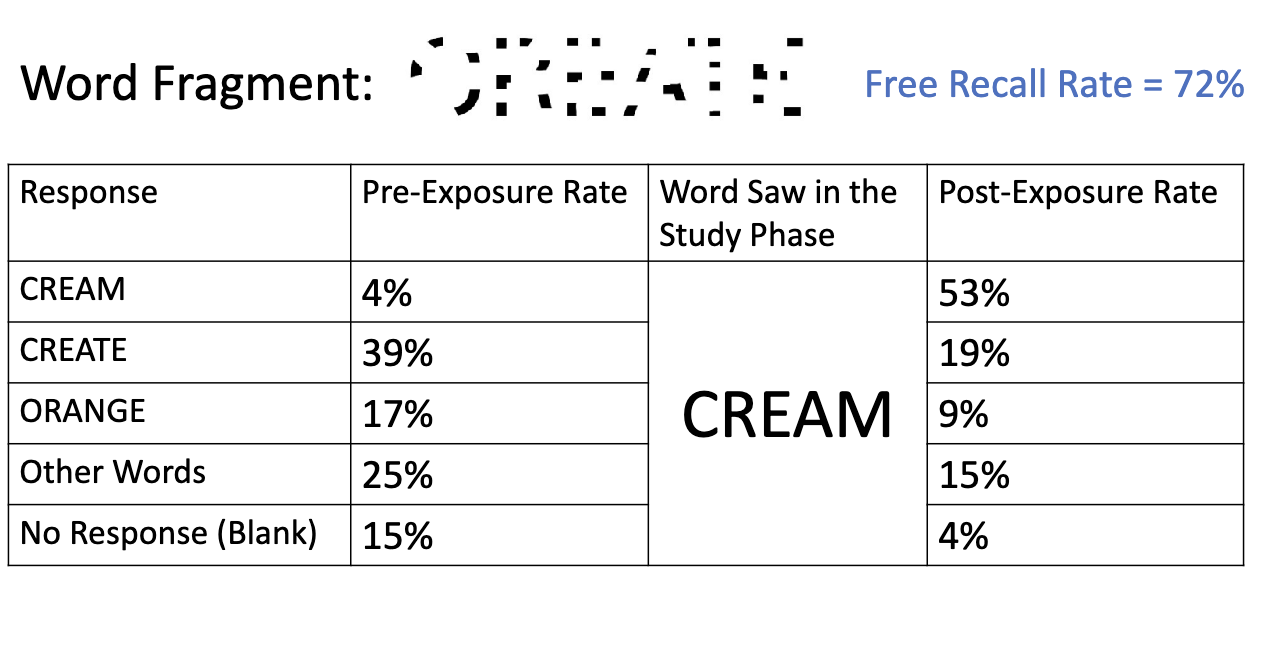
Word fragment = Dream
Free recall rate = WHAT
Word fragment = Dream
Free recall rate = 43%
Word fragment = Tapir
Free recall rate = WHAT
Word fragment = Tapir
Free recall rate = 59%
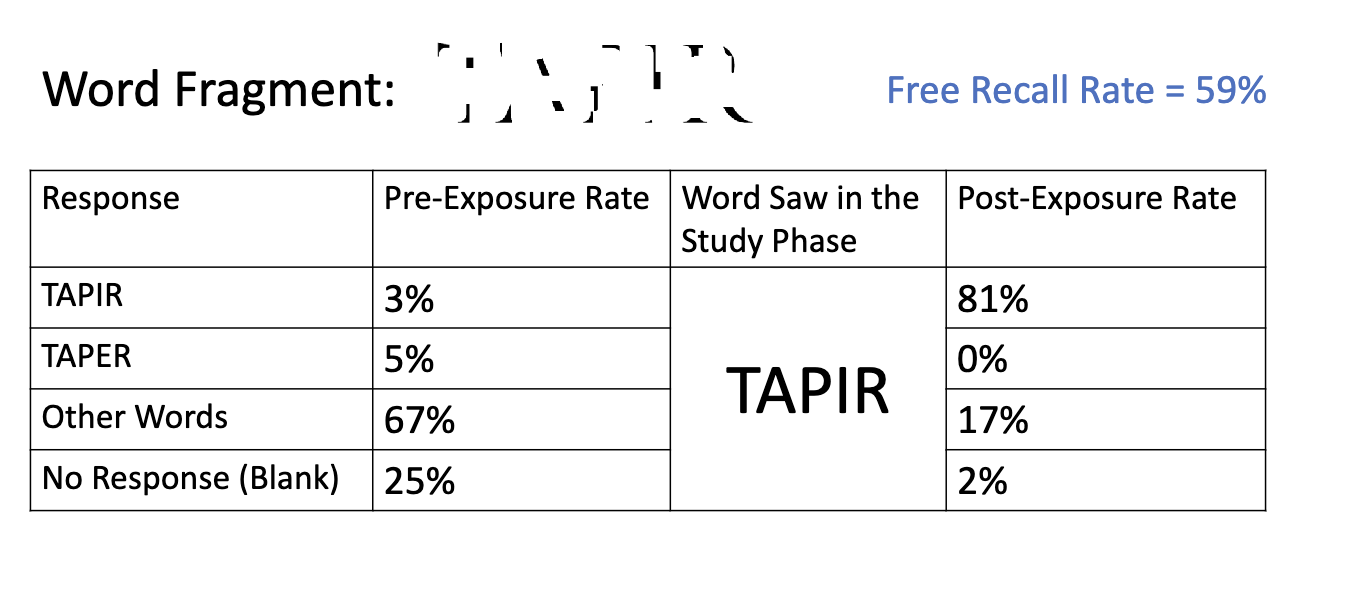
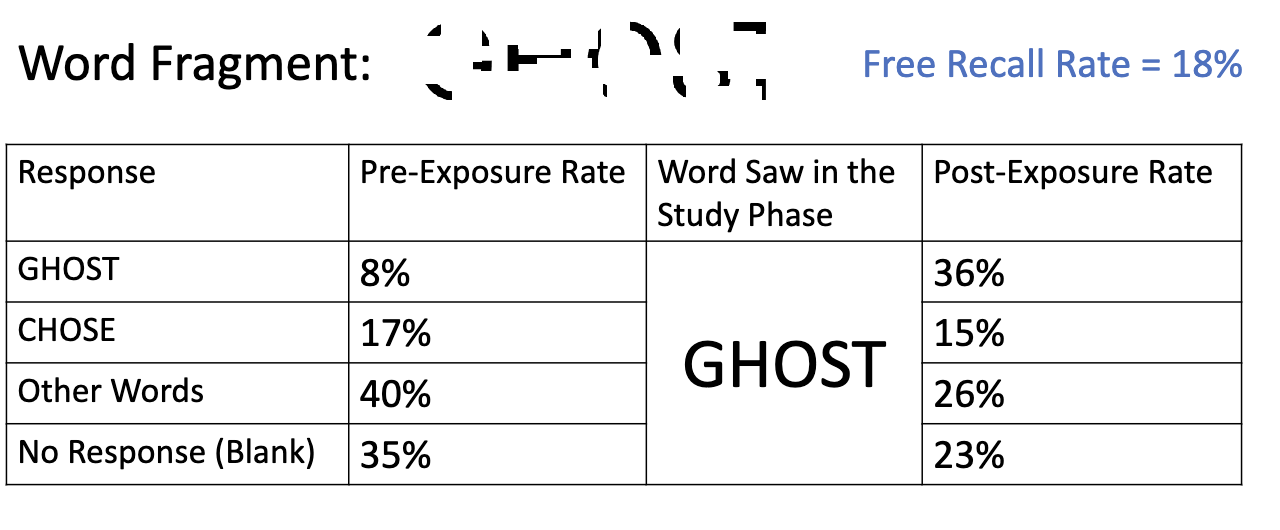
Word fragment = Ghost
Free recall rate = WHAT
Word fragment = Ghost
Free recall rate = 18%
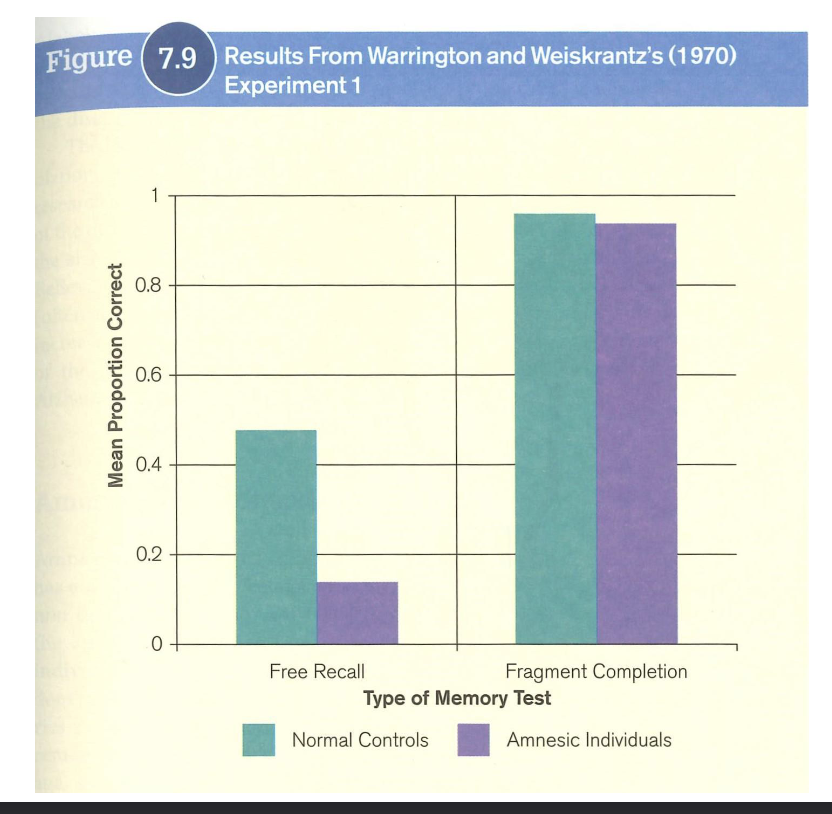
Warrington & Weiskrantz (1970) asked amnesic patients to read a list of words and then tested their WHAT and WHAT of the words.
The patients did WHAT than healthy individuals
Warrington & Weiskrantz (1970) asked amnesic patients to read a list of words and then tested their FREE RECALL and RECOGNITION of the words.
The patients did WORSE than healthy individuals
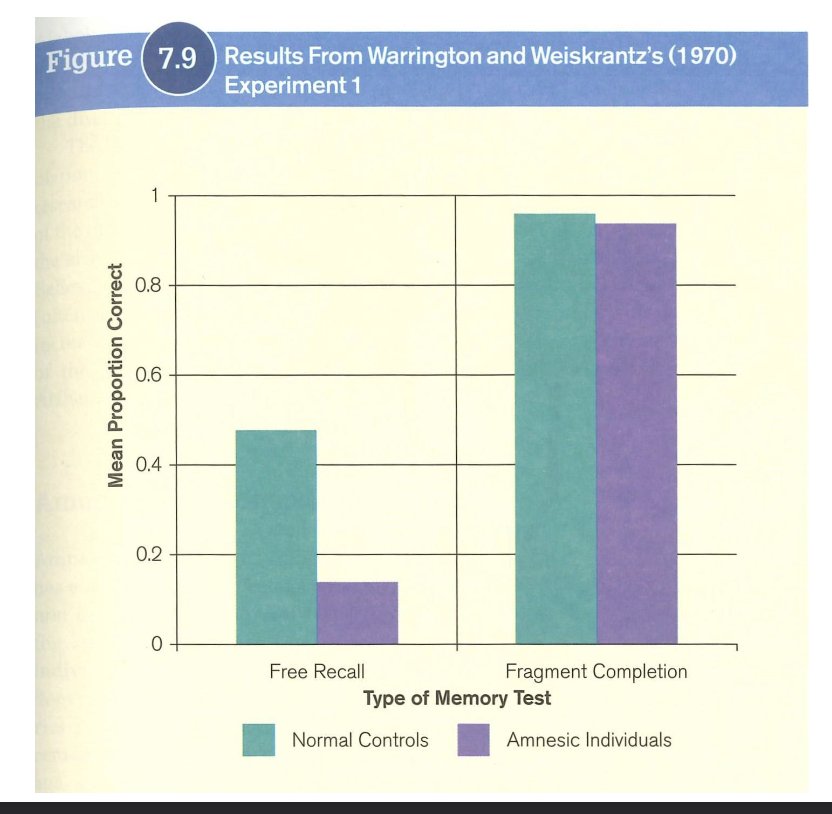
However, amnesic patients’ performance on the word fragment
completion task was the WHAT as healthy individuals (both groups of participants were WHAT likely to think of a previously read word when presented with its fragments).
However, amnesic patients’ performance on the word fragment
completion task was the SAME as healthy individuals (both groups of participants were EQUALLY likely to think of a previously read word when presented with its fragments).
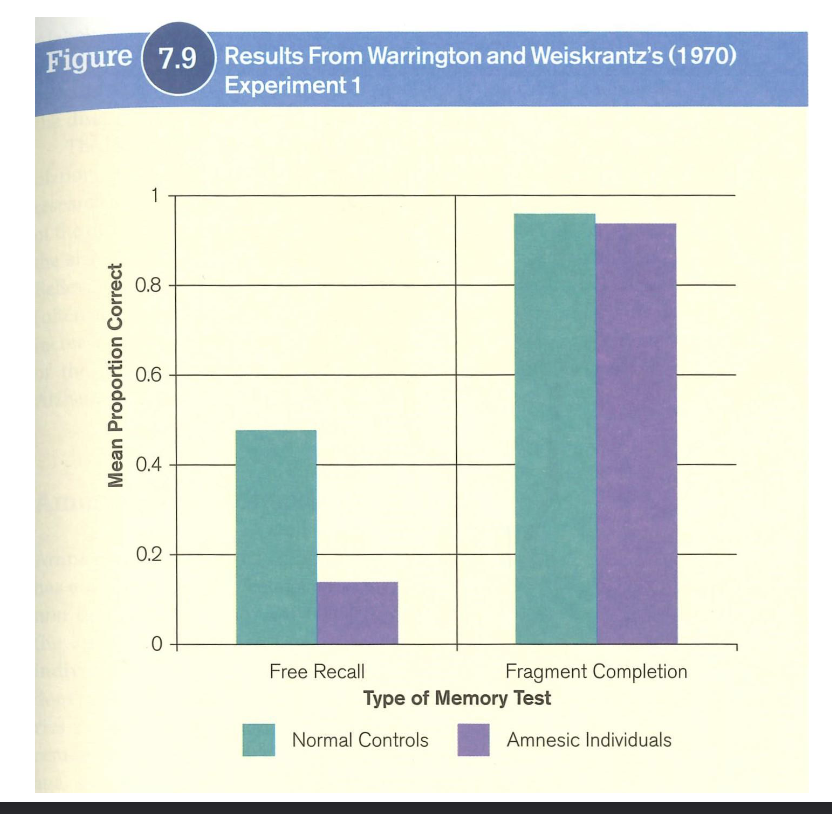
Amnesic patients did not have WHAT memory of the learned words but had WHAT memory of them.
Amnesic patients did not have EXPLICIT memory of the learned words but had IMPLICIT memory of them.
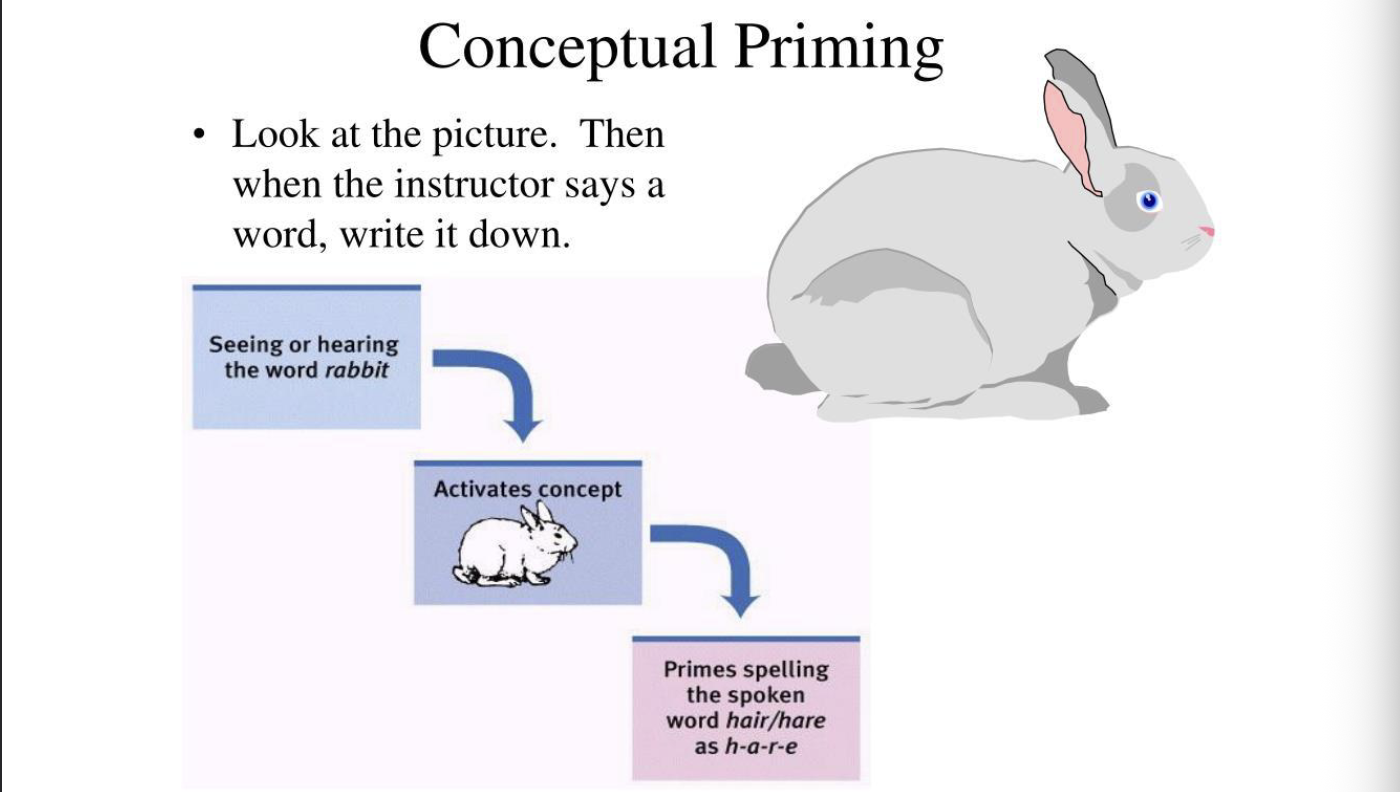
Conceptual / semantic priming
A previous encounter with information facilitates later performance on SEMANTICALLY related information, even unconsciously
Examples
You see the picture of a rabbit or hear the word “rabbit” first. Later you hear the sound “hair/hare.” When asked to write down the word that you heard, you are more likely to write down “hare” because “rabbit” and “hare” are semantically related words.
You fully understand what “negative reinforcement” means. But you choose the word “decreases” to fill in the blank of this statement: Negative reinforcement ____ the rate of responding.
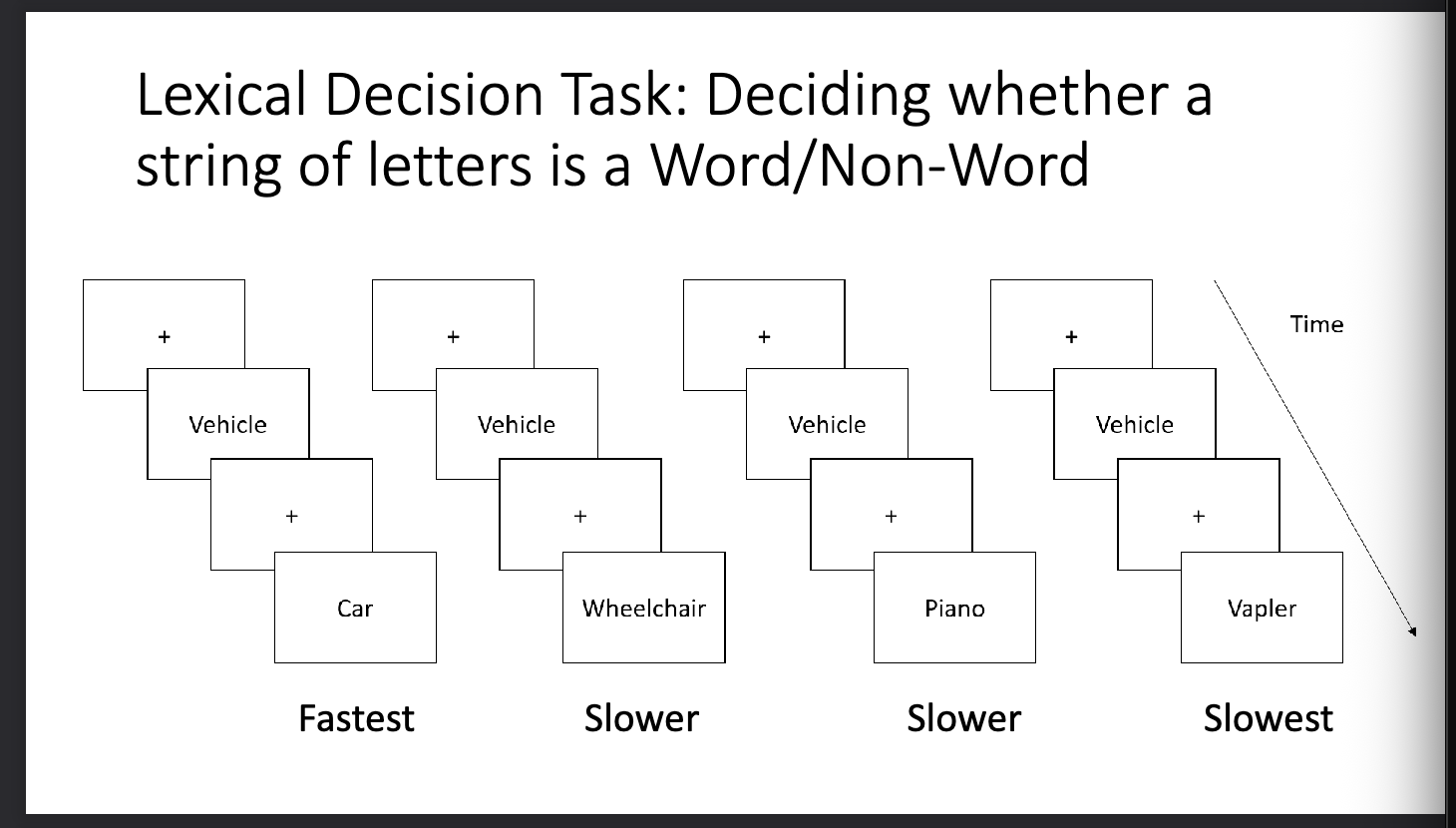
Lexical decision task
Deciding whether a string of letters is a word/non-word
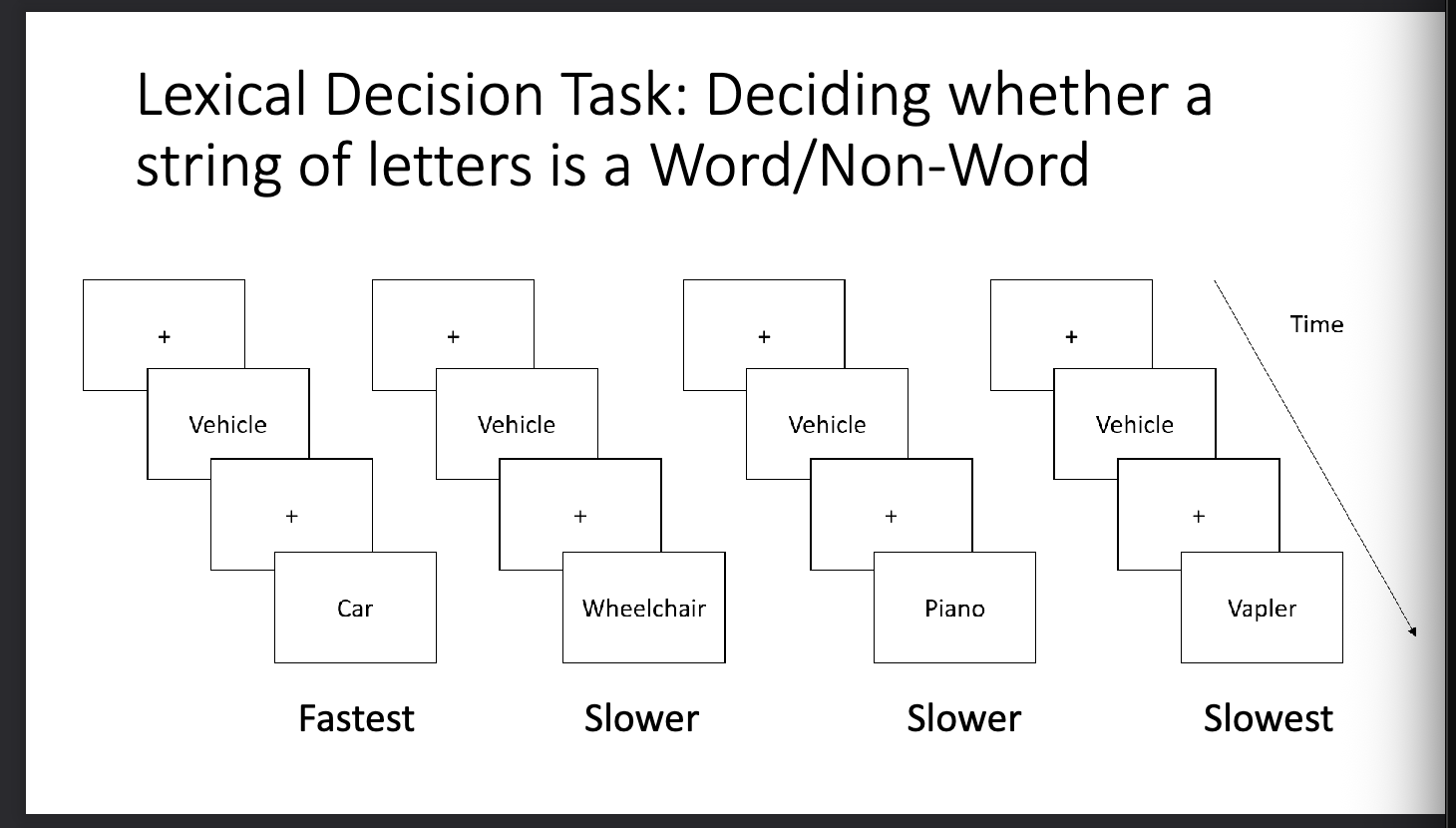
Lexical Decision Task: Demonstrating Conceptual Priming
Participants saw a categorical name (e.g., vehicle) that served as a WHAT. Immediately after the offset of the prime, the participants saw a word (e.g., car, wheelchair, piano) or a string of nonsense letters (e.g., vapler) as a target.
The target word is either a WHAT (car) of the primed category, a WHAT typical member (wheelchair) of the primed category, or a member that does WHAT belong to the primed category (piano).
Task for participants: Indicated whether the target was a WHAT or WHAT (a lexical decision task) as quickly as possible.
Dependent variable: WHAT
Lexical Decision Task: Demonstrating Conceptual Priming
Participants saw a categorical name (e.g., vehicle) that served as a PRIME. Immediately after the offset of the prime, the participants saw a word (e.g., car, wheelchair, piano) or a string of nonsense letters (e.g., vapler) as a target.
The target word is either a TYPICAL MEMBER (car) of the primed category, a LESS typical member (wheelchair) of the primed category, or a member that does NOT belong to the primed category (piano).
Task for participants: Indicated whether the target was a WORD or NONWORD (a lexical decision task) as quickly as possible.
Dependent variable: REACTION TIME
How do you know I know something that I don’t know I know
Answer from cognitive psychologists: Your WHAT
WHAT
WHAT
How do you know I know something that I don’t know I know
Answer from cognitive psychologists: Your BEHAVIOUR
You are faster to respond to a relevant cue or
You are better than chance to make a correct guess when presented with a relevant cue