Biochem Definitions
 Call Kai
 Learn
Learn Practice Test
 Spaced Repetition
 Match
Match Flashcards
 Knowt Play
1/28

Earn XP
Description and Tags
definitions
Name | Mastery | Learn | Test | Matching | Spaced | Call with Kai |
|---|
No analytics yet
Send a link to your students to track their progress
29 Terms
what is glycolysis
A metabolic pathway that converts 1 glucose into 2 pyruvate in the cytoplasm, producing ATP and NADH.
It is an anaerobic process that provides quick energy and is the first step in cellular respiration.
GLUT/GLUT2
GLUT proteins are membrane transporters that move glucose across cell membranes by facilitated diffusion.
GLUT2 is found in the liver and pancreas and allows glucose to move in or out of cells depending on blood glucose levels.
Gluconeogenesis
A metabolic pathway that synthesizes glucose from non-carbohydrate sources such as lactate, glycerol, and amino acids.
It occurs mainly in the liver and requires energy (ATP and GTP).
Hexokinase
An enzyme that catalyzes the phosphorylation of glucose to glucose-6-phosphate in the first step of glycolysis.
It uses ATP and traps glucose inside the cell.
Kinase
Enzymes that transfer a phosphate group from ATP to a substrate.
They play key roles in metabolism and regulation of cellular processes.
GAP dehydrogenase
(Glyceraldehyde-3-phosphate dehydrogenase)
An enzyme in glycolysis that converts glyceraldehyde-3-phosphate into 1,3-bisphosphoglycerate.
This reaction produces NADH through oxidation.
GAP = end of stage 1 of glycolysis
Fermentation pathway
A metabolic process that regenerates NAD⁺ from NADH when oxygen is not available.
It allows glycolysis to continue producing ATP under anaerobic conditions.
ethanol fermentation
A type of fermentation in which pyruvate is converted into ethanol and CO₂.
It occurs in yeast and some microorganisms under anaerobic conditions.
Acetyl CoA
A molecule formed from pyruvate by the pyruvate dehydrogenase complex before entering the TCA cycle.
It carries a two-carbon acetyl group into the citric acid cycle for energy production.
fructokinase
An enzyme that phosphorylates fructose to fructose-1-phosphate in fructose metabolism.
It is primarily found in the liver.
phosphofructokinase
PFK-1
A key regulatory enzyme in glycolysis that converts fructose-6-phosphate into fructose-1,6-bisphosphate using ATP.
It is the rate-limiting and highly regulated step of glycolysis.
Insulin
A hormone released from the pancreas that lowers blood glucose levels.
It promotes glucose uptake, glycogen synthesis, and fat storage.
Explain the basic steps of glycolysis
Stage 1
trap and prep phase
no ATP generated
3 steps
trap glucose in cell
form compound that’s readily made into phosphorylated 3-C units (fructose 1,6-bisphosphate
makes 2-C units readily convertible into DHAP and GAP
Stage 2
3-C fragments oxidized to pyruvate
ATP harvested
Net rxn of Glucose to pyruvate
Glucose + 2 Pi + 2 ADP + 2 NAD⁺ → 2 Pyruvate + 2 ATP + 2 NADH + 2 H⁺ + 2 H₂O
2 ATP in
4 ATP out
Net 2 ATP
How is NAD+ regenerated from pyruvate?
“NAD⁺ must be regenerated from NADH through fermentation or aerobic respiration so that glycolysis can continue producing ATP.”
1) Glycolysis requires regeneration of NAD⁺ to continue
NAD⁺ is reduced to NADH during the GAP dehydrogenase step, and cells have limited NAD⁺ supplies.
NAD⁺ must be regenerated to maintain redox balance and allow glycolysis to keep producing ATP.
2) In the absence of oxygen, pyruvate is metabolized by fermentation
Pyruvate is converted into lactate or ethanol, which regenerates NAD⁺ from NADH.
Fermentation is a redox-neutral process that allows ATP production without oxygen.
3) In the presence of oxygen, pyruvate is fully oxidized for maximum energy
Pyruvate is converted into carbon dioxide and water through the TCA cycle and electron transport chain.
Oxygen acts as the final electron acceptor, producing more ATP than fermentation.
Briefly explain the pathway for glucose to ethanol
Glucose is converted to pyruvate by glycolysis, producing ATP and NADH. In anaerobic conditions, pyruvate is converted to ethanol and CO₂. This regenerates NAD⁺ so glycolysis can continue.
1) Glucose is broken down into pyruvate through glycolysis
Glycolysis converts glucose into 2 pyruvate, producing 2 ATP and 2 NADH in the cytoplasm.
This process does not require oxygen.
2) In the absence of oxygen, pyruvate is converted into ethanol
Pyruvate is first converted into acetaldehyde, releasing CO₂, and then reduced to ethanol.
This occurs in yeast and some microorganisms during fermentation.
3) Ethanol fermentation regenerates NAD⁺ so glycolysis can continue
NADH is oxidized back to NAD⁺, maintaining redox balance.
This allows continued ATP production from glycolysis under anaerobic conditions.
Explain how fructose can enter glycolysis
Fructokinase converts fructose to fructose 1-phosphate in the liver, producing intermediates that enter glycolysis.
1) Fructose is primarily metabolized in the liver through the fructose 1-phosphate pathway
Fructokinase phosphorylates fructose to fructose 1-phosphate using ATP.
2) Fructose 1-phosphate is split into glycolytic intermediates
It is cleaved into glyceraldehyde and dihydroxyacetone phosphate (DHAP), which can enter glycolysis.
3) In other tissues, fructose can enter glycolysis by a different route
Hexokinase can phosphorylate fructose to fructose 6-phosphate, allowing it to enter glycolysis directly.
How does galactose enter glycolysis?
Galactose is phosphorylated, converted to glucose-1-phosphate via UDP intermediates, and then isomerized to glucose-6-phosphate to enter glycolysis.
1) Galactose is phosphorylated and activated for conversion to glucose
Galactokinase converts galactose into galactose-1-phosphate using ATP.
Galactose-1-phosphate then receives a uridyl group from UDP-glucose, forming an activated intermediate.
2) Galactose is converted into a glucose form through epimerization
UDP-galactose 4-epimerase converts UDP-galactose into UDP-glucose (C4 epimerization).
This allows galactose to be transformed into a glucose derivative.
3) The final product enters glycolysis as glucose-6-phosphate (G-6-P)
Glucose-1-phosphate is converted into glucose-6-phosphate by phosphoglucomutase.
G-6-P can then enter glycolysis or other metabolic pathways.
Explain how the glycolytic pathway is regulated
1) Glycolysis is regulated at irreversible enzyme steps that act as control points
The three main regulatory enzymes are hexokinase, phosphofructokinase (PFK-1), and pyruvate kinase.
These enzymes control the rate of conversion of glucose into pyruvate.
2) The primary signal regulating glycolysis in muscle is the ATP/AMP ratio (energy charge)
Low ATP and high AMP stimulate glycolysis, signaling that the cell needs more energy.
High ATP inhibits glycolysis, indicating sufficient energy is available.
3) Phosphofructokinase (PFK-1) is the most important regulatory enzyme
ATP and citrate inhibit PFK-1, while AMP and fructose 2,6-bisphosphate activate it.
This step is the major control point determining the rate of glycolysis.
4) Hexokinase and pyruvate kinase are regulated by feedback and feedforward mechanisms
Hexokinase is inhibited by its product, glucose-6-phosphate (G-6P).
Pyruvate kinase is inhibited by ATP and activated by fructose 1,6-bisphosphate (feedforward activation).
5) Regulation differs between muscle and liver based on function
Muscle regulates glycolysis mainly to meet energy demands for contraction.
Liver regulates glycolysis to maintain blood glucose levels, using fructose 2,6-bisphosphate as a key signal when glucose is abundant.
explain how Glycolysis Helps Pancreatic β Cells Sense Glucose
Insulin is a polypeptide hormone secreted by pancreatic β cells in response to increased blood glucose.
The function of insulin is to stimulate glucose uptake by tissues and lower blood glucose levels.
Glucose enters β cells through GLUT2, a transporter with a high KM, allowing glucose entry only when blood glucose is high.
This ensures insulin is released only when glucose is abundant.
The pancreas expresses glucokinase, which also has a high KM, allowing phosphorylation of glucose only at high glucose concentrations.
Glucose is metabolized through glycolysis and cellular respiration, producing ATP.
The increase in the ATP/ADP ratio causes ATP-sensitive K⁺ channels to close.
Closure of K⁺ channels leads to membrane depolarization.
Depolarization opens voltage-gated Ca²⁺ channels, allowing Ca²⁺ influx into the cell.
Increased Ca²⁺ triggers fusion of insulin-containing vesicles with the cell membrane.
Insulin is released into the bloodstream, promoting glucose uptake and restoring normal blood glucose levels.
Explain gluconeogenesis
1) Gluconeogenesis is the synthesis of glucose from non-carbohydrate precursors
These precursors include lactate, glycerol, and amino acids.
2) The primary site of gluconeogenesis is the liver, with smaller amounts in the kidney
Very little occurs in the brain, skeletal muscle, or heart.
3) The function of gluconeogenesis is to maintain blood glucose levels
It converts pyruvate into glucose-6-phosphate or glucose to supply energy to tissues such as the brain and muscle.
It is NOT a reversal of glycolysis.
explain gluconeogenesis from pyruvate to glucose
1) Pyruvate → Oxaloacetate (OAA)
Enzyme: Pyruvate carboxylase
Location: Mitochondria
Energy: Uses ATP
Requires: Biotin (vitamin B7)
Reaction type: Carboxylation (adds CO₂)
Regulation: Activated by acetyl-CoA
Purpose: Begins bypass of the irreversible pyruvate kinase step in glycolysis
2) Oxaloacetate (OAA) → Phosphoenolpyruvate (PEP)
Transport step:
OAA is reduced to malate by malate dehydrogenase
Malate crosses mitochondrial membrane
Malate is oxidized back to OAA in cytoplasm, producing NADH
Enzyme: Phosphoenolpyruvate carboxykinase (PEPCK)
Energy: Uses GTP
Reaction type: Decarboxylation and phosphorylation
CO₂ is removed
Phosphate is added
Result: Formation of phosphoenolpyruvate (PEP)
Purpose: Completes bypass of the pyruvate kinase step
(Between Steps 2 and 3)
Glycolysis runs in reverse from PEP to fructose-1,6-bisphosphate (F1,6BP)
Key reversible enzymes in this section:
Enolase
Phosphoglycerate mutase
Phosphoglycerate kinase
GAP dehydrogenase
Triose phosphate isomerase
Aldolase
3) Fructose-1,6-bisphosphate (F1,6BP) → Fructose-6-phosphate (F6P)
Enzyme: Fructose-1,6-bisphosphatase (FBPase)
Reaction type: Hydrolysis (removes phosphate)
Products: Fructose-6-phosphate + Pi
Role: Primary regulatory step of gluconeogenesis
Bypasses: The irreversible glycolysis step catalyzed by phosphofructokinase-1 (PFK-1)
Regulation:
Inhibited by: AMP, fructose-2,6-bisphosphate
Activated by: ATP
4) Only the liver and kidney have glucose-6-phosphatase.
Therefore:
Liver/kidney → can release glucose into the bloodstream
Most other tissues → gluconeogenesis ends at G6P
G6P is then:
Stored as glycogen, or
Used for biosynthesis (e.g., nucleotides)
define reciprocal regulation of gluconeogenesis and glycolysis
when glucose is abundant —> glycolysis predominates
rate of glycolysis is regulated by [glucose]
when glucose is scarce —> gluconeogenesis takes over
gluconeogenesis regulated by [lactate'] and ther glucose precursors
Key site in gluconeogenesis regulation is at F6P and F1,6BP
both reciprocally regulated at PEP and pyruvate in liver
how are glycolysis and gluconeogenesis regulated in the liver?
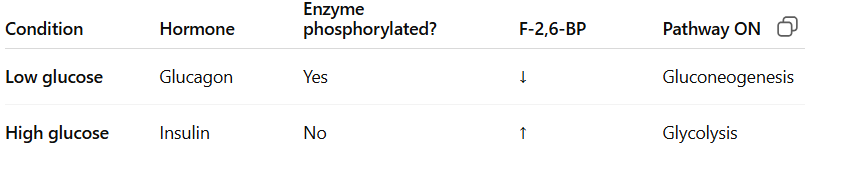
Fructose-2,6-bisphosphate (F-2,6-BP) determines whether glycolysis or gluconeogenesis predominates in the liver
Control of F-2,6-BP Levels — Bifunctional Enzyme
The concentration of F-2,6-BP is regulated by a bifunctional enzyme containing both:
PFK-2 (kinase activity)
FBPase-2 (phosphatase activity)
These two activities are reciprocally controlled by phosphorylation of a single serine residue.
When Blood Glucose Is Low → Gluconeogenesis Predominates
Hormone: Glucagon
Glucagon triggers a cAMP signaling cascade.
Protein kinase A (PKA) phosphorylates the bifunctional enzyme.
FBPase-2 is activated and PFK-2 is inhibited.
The concentration of F-2,6-BP decreases.
PFK activity decreases and FBPase activity increases.
Gluconeogenesis predominates to raise blood glucose.
When Blood Glucose Is High → Glycolysis Predominates
Hormone: Insulin
Insulin activates a protein phosphatase, which dephosphorylates the bifunctional enzyme.
PFK-2 is activated and FBPase-2 is inhibited.
The concentration of F-2,6-BP increases.
PFK activity increases and FBPase activity decreases.
Glycolysis predominates to lower blood glucose.
what is the Cori cycle?
Muscle produces lactate during anaerobic glycolysis.
Lactate travels to the liver and is converted into glucose by gluconeogenesis.
Glucose returns to muscle to provide energy.
Define the pyruvate dehydrogenase complex
The pyruvate dehydrogenase complex is a multi-enzyme complex in the mitochondrial matrix that converts pyruvate into acetyl-CoA through oxidative decarboxylation.
This irreversible reaction links glycolysis to the citric acid cycle and produces NADH and CO₂.
Contains 3 enzymes and 5 cofactors
How is acetyl CoA formed from pyruvate?
Converts pyruvate into acetyl-CoA so it can enter the citric acid cycle (TCA cycle).
Links glycolysis to the TCA cycle.
Occurs in the mitochondrial matrix under aerobic conditions.
Three Main Steps of the Reaction
1) Decarboxylation
Pyruvate loses CO₂.
Catalyzed by pyruvate dehydrogenase (E1).
Requires TPP.
2) Oxidation
The remaining 2-carbon fragment is oxidized.
Electrons are transferred through lipoic acid and FAD.
Energy is captured.
3) Formation of Acetyl-CoA
The acetyl group is transferred to CoA.
Produces acetyl-CoA, ready for the TCA cycle.
Catalyzed by dihydrolipoyl transacetylase (E2).
NAD⁺ is reduced to NADH by dihydrolipoyl dehydrogenase (E3)