Topic 2: Biological Molecules
 Call Kai
 Learn
Learn Practice Test
 Spaced Repetition
 Match
Match Flashcards
 Knowt Play
1/175

There's no tags or description
Looks like no tags are added yet.
Name | Mastery | Learn | Test | Matching | Spaced | Call with Kai |
|---|
No analytics yet
Send a link to your students to track their progress
176 Terms
What is macromolecule?
A large biological molecule.
What are the examples of macromolecules?
Carbohydrates: starch, glycogen & cellulose
Proteins: collagen, cellulose
Lipids: triglycerides, phospholipids, steroids, cholesterol
Nucleic acids: DNA, RNA
What is a polymer?
Polymer is a large molecule made by joining many monomers together by repeated condensation reactions (also known as polymerization).
What is a monomer?
Monomer is a relative small, simple molecule (used as building block for polymers).
How are monomers joined together?
By covalent bonds
What is the monomer and polymer of carbohydrates?
Monomer: monosaccharides
Polymer: polysaccharides
What is the monomer and polymer of proteins?
Monomer: amino acids
Polymer: polypeptides
What is the monomer and polymer of nucleic acids?
Monomer: nucleotides
Polymer: polynucleotides
Why are lipids not considered as polymers?
They are not made from repeating monomer subunits.
What is condensation?
A chemical reaction involving formation of a covalent bond which joins together two molecules by removal of a water molecule.
What is hydrolysis?
Hydrolysis is a chemical reaction involving breaking of a covalent bond in a complex molecule to form simpler ones by addition of a water molecule.
What is covalent bond?
A bond formed when atoms share their electrons.
What is the maximum number of covalent bonds for a carbon atom?
4 covalent bonds
What is the maximum number of covalent bonds for a hydrogen atom?
1 covalent bond
What is the maximum number of covalent bonds for an oxygen atom?
2 covalent bonds
What is the maximum number of covalent bonds for a nitrogen atom
3 covalent bonds
What are carbohydrates made up of?
Carbon, hydrogen & oxygen
What is the general formula of carbohydrates?
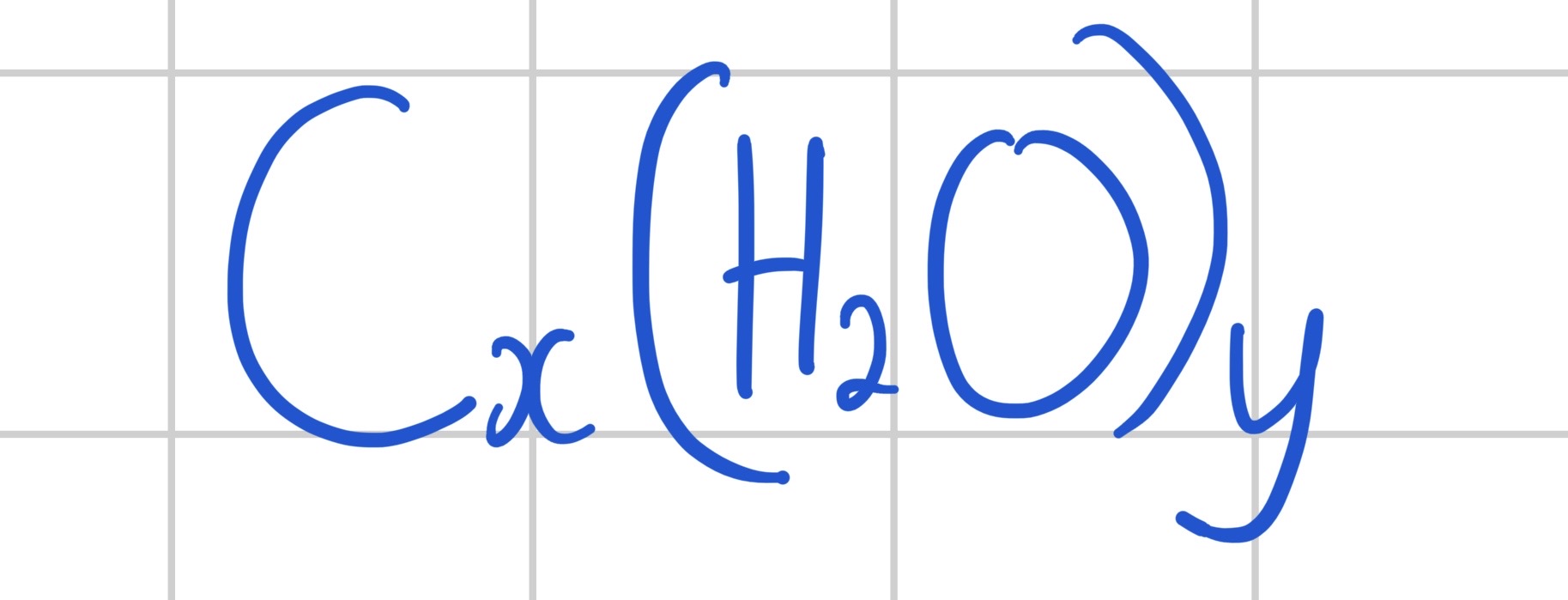
Carbohydrates are divided into 3 types. What are they?
Monosaccharides, disaccharides & polysaccharides.
What is a monosaccharide?
Monosaccharides is a simple/single sugar.
All monosaccharides are reducing sugars. True or false?
What is a disaccharide(double sugar)?
Made up of two monosaccharides joined together by glycosidic bond formed in a condensation reaction.
What is a polysaccharide(complex sugar)
Made up of many monosaccharides joined together by glycosidic bonds formed in repeated condensation reactions.
What is the molecular formula of monosaccharides?
CnH2nOn
If the number of C atoms of a monosaccharide is 3C, what is the name & molecular formula? Give one example also
Name: trioses
MF: C3H6O3
Example: glyceraldehyde
If the number of C atoms is 5C, what is the name and molecular formula? Give some examples also
Name: pentoses
MF: C5 H10 O5
Example: Ribose (deoxyribose C5 H10 O4 = removal oxygen atom by 1)
If the numbers of C atoms is 6C, what is the name and molecular formula? Give some examples also.
Name: hexoses
MF: C6 H12 O6
Examples: Glucose, galactose & fructose (tip: Glu Gal Fruc)
Monosaccharides have several different isomers. What are they?
i) A straight C-chain with either an aldehyde or ketone group.
ii) A ring form of either five-sided or six-sided.
iii) Isomers of ring form, either α or β form.
Describe α-glucose.
OH of C1 is below the plane of C ring
H of C1 is above the plane of C ring.
Describe β-glucose.
OH of C1 is above the plane of C ring.
H of C1 is below the plane of C ring.
List out the functions of monosaccharides.
1) As a source of energy, i.e used as a substrate in respiration (preferred substrate: glucose)
2) For synthesis of energy carriers/currency i.e ATP (Adenosine Triphosphate)
3) For synthesis of polysaccharides
4) Fructose: A constituent of nectar and sweetens fruits to attract animals (aid in dispersal process).
5) Ribose & deoxyribose: important component of nucleic acids
6) For synthesis of electron carriers in respiration (NAD) and photosynthesis (NADP).
What is the molecular formula of disaccharides?
Cn(H2O)n-1
There are three types of disaccharides. What are they?
Maltose, sucrose & lactose
What is the component of maltose?
α-glucose + α-glucose
Where can maltose be found?
In germinating seeds
What are the functions of maltose?
As a respiratory substrate.
Used in brewing of alcoholic drinks.
What is sucrose made up of?
α-glucose + fructose
Where can sucrose be found?
In sugar cane
What are the functions of sucrose?
As a respiratory substrate
As a form of storage material in some plants e.g. in fruits
Sucrose is unreactive, so it is the preferred form of carbohydrate for transport in phloem from photosynthesizing parts of a plant (source) to other parts of the plant (sink).
What is the component of lactose?
α-glucose + galactose
Where can lactose be found?
In milk of mammals (‘milk sugar’)
What are the functions of lactose?
As a respiratory substrate
As the main source of carbohydrate in suckling mammals.
What is the main function of disaccharides?
As a respiratory substrate
Is maltose a reducing sugar or non-reducing sugar?
It is a reducing sugar
Is sucrose a reducing or non-reducing sugar?
Non-reducing sugar
Is lactose a reducing or non-reducing sugar?
Reducing sugar
Sucrose is a non-reducing sugar. Hence, what would be the result of the Benedict’s test?
Negative Benedict’s test
How does condensation reaction between monosaccharides occur?
Occurs between two nearest OH groups of two monosaccharides. Remove H of OH of first sugar AND OH of second sugar
Covalent bond formed: C-O-C (glycosidic bond)
Naming based on: - Type of sugar molecules joined together (α or β ) - C atoms involved (1,4, 1,6 etc.)
List out the main types of polysaccharides.
starch, glycogen & cellulose.
What are the monosaccharides of starch & glycogen?
α-glucose
What is the monosaccharides of cellulose?
β-glucose
What is the molecular formula of polysaccharides?
-[C6 H10 O5]n-
What polysaccharides does starch form?
Amylose & amylopectin
What is the structure of amylose?
Long, unbranched polysaccharide chains.
Glucose molecules are linked together by α1,4-glycosidic bonds.
The chain is coiled into a helical structure and is maintained by internal H-bonds.
In every single turn of the helix, there are six α-glucose molecules.
What is the iodine test for amylose?
Yellow to blue-black
What is the structure of amylopectin?
Long, branched polysaccharide chains.
Glucose molecules are linked together by α1,4-glycosidic bonds and α1,6-glycosidic bonds.
More compact.
What is the iodine test for amylopectin?
Yellow to red-brown
What is the main function of starch?
As a storage materials in plant cells.
Structure of glycogen is similar to amylopectin.
True
What is the only exception of glycogen that makes its structure different to amylopectin?
Glycogen polysaccharide chains have more branches, which are shorter in length.
What is the main function of glycogen?
As a storage material in animal cells (also in fungi).
What makes starch and glycogen ideal storage materials?
They are large in size and relatively insoluble.
They have compact shapes. Therefore, a cell can fit in a lot of starch/glycogen molecules.
They are relatively inert/unreactive. Therefore does not affect the cellular activities.
They can be easily hydrolysed to their monomers (glucose), which are then used as a source of energy (substrate oof respiration).
Starch and glycogens are large. Why does this structure makes them ideal for storage materials?
Once the starch/glycogen are formed, they cannot move out of cells through plasma membrane (too big to pass through channel proteins and between phospholipid molecules).
Starch and glycogen are relatively insoluble. Why does this structure makes them ideal for storage materials?
They do not affect the water potential of cells.
In starch/glycogen, hydrolysis is done by what?
Either by enzymes(amylase, maltase), OR
Hormones (glucagon)
What is the structure of cellulose?
Made up of monomers: β-glucose.
Glucose molecules are linked together by β1,4-glycosidic bonds to form long, unbranched and linear polysaccharide chain.
This polysaccharide chain is a cellulose molecule.
Within the chain, every 2nd turn of the glucose molecule is rotated by 180o
Cellulose molecules are arranged parallel to each other.
Many polar -OH groups pointing outwards = Formation of many H-bonds between the molecules.
A bundle of cellulose molecules cross linked by H-bonds to form cellulose microfibril.
A bundle of cellulose microfibrils held together by H-bonds to form cellulose fibre.
What are the functions of cellulose?
As a structural carbohydrate i.e. a component of plant cell wall.
Prevents osmotic damage of plant cells
Cellulose fibres provides support and gives shape to plant cells = they are strong & rigid (high tensile strength, stabilized by cross linkages/ H-bonds between cellulose molecules and cellulose microfibrils).
Why is cellulose fully permeable?
Cellulose fibres are arranged criss-crossing each other = presence of pores in the cell wall and molecules can pass through it.
How does cellulose prevents constipation?
Cellulose is hydrophilic(many OH groups)
It helps to retain water in the faeces.
This soften the faeces.
Hence, faeces is easier to be removed.
How does cellulose prevents constipation?
Cellulose is hydrophilic(many OH groups)
It helps to retain water in the faeces.
This soften the faeces.
Hence, faeces is easier to be removed.
Test for Non-reducing sugars is only carried out after the sample yielded a negative Benedict’s test. What are the steps in test for NRS?
1) Acid Hydrolysis: Add an excess of HCL (3cm3) to the sample (2cm3) and heat in a hot water bath for 5 minutes.
2) Cool the test tube (put under running water).
3) Acid Neutralisation: Add a pinch of sodium hydrogen carbonate powder until no more bubbles / fizzing seen.
Carry out normal Benedict’s test after this step.
What are the aims of HCL in test for NRS?
It hydrolyses the glycosidic bonds, thus, releasing the monosaccharides which are reducing sugars (glucose & fructose=reducing sugars).
This will give a positive Benedict’s test.
What are the aims of NaHCO3 (sodium hydrogen carbonate powder)?
To neutralise the HCL before running a Benedict’s test. Otherwise, the acid will render the Benedict’s test ineffective i.e. negative result.
What is a dipole?
A dipole is an equal distribution of charge in a molecule.
What are the examples of functional groups which are dipoles?
-O-H, -C=O, -N-H
What happens to the atoms in dipole?
Some of the atoms are slightly negative (δ-)
Some of the atoms are slightly positive (δ+)
What are polar molecules?
Molecules containing groups with dipoles.
Examples of polar molecules.
Sugars(monosaccharides, disaccharides) & water.
What are hydrogen bonds?
Attraction between slightly positively charged atom of one polar molecule and slightly negatively charged atom of another polar molecule.
Is water a polar or non-polar molecule? Why?
Water is a polar molecule because it has two dipoles.
Why are polar molecules referred to as hydrophilic (water loving) and are soluble in water?
Polar molecules are attracted to water as they can form hydrogen bonds (H-bonds) with water.
Molecules with dipoles = Polar molecules = Able to form H-bonds with water = Hydrophilic =Water soluble
True
Molecules without dipoles are polar or non-polar molecules?
Non-polar molecules.
Why are non-polar molecules not soluble in water?
They are not attracted to water molecules
As they cannot form H-bonds with water = Hydrophobic(water hating).
Therefore, these molecules are not soluble in water.
What are lipids made up of?
Carbon, hydrogen & oxygen.
Is the molecular formula of lipids similar to carbohydrates?
Yes, but H and O atoms are not 2:1.
There is less O atoms in lipids than in carbohydrates.
There are three main types of lipids. What are they?
1) Triglycerides
2) Phospholipids
3) Lipids derived molecules such as steroids (reproductive hormones; cholesterol)
What are the components of triglycerides?
One glycerol & three fatty acid molecules.
How does a lipid is formed?
An ester compound is formed in condensation reaction between an acid and an alcohol.
What is the bond formed in the formation of lipids?
Ester bonds
What is the structure of fatty acid?
One carboxyl group (acidic, polar = hydrophilic)
Attached to a long hydrocarbon chain (non-polar = hydrophobic).
Head = carboxyl group
Tail = long hydrocarbon chain
True
Fatty acids may be unsaturated or saturated. True or false?
True
What is the structure of an unsaturated fatty acid?
Presence of one or more C=C within the hydrocarbon tail.
This results in a ‘kink’ or bending within the hydrocarbon tail
Form unsaturated lipids
Where can unsaturated fatty acids be found?
Found in plants
Liquid in nature (oils) (liquid at room temperature).
What is the structure of a saturated fatty acid?
Presence of C-C
This results in a straight hydrocarbon tail
Forms saturated lipids
Where can saturated lipids be found?
Found in animals
Solid in nature (fats) (solid at room temperature)
How to know if unsaturated fatty acids are mono- or poly-?
Mono: Only one C=C
Poly: Many C=C
There are three possible structures of triglycerides. What are they?
1) Saturated fats
2) Monounsaturated fats
3) Polyunsaturated fats