Week 2A: Structure and function of cells in NS
 Call Kai
 Learn
Learn Practice Test
 Spaced Repetition
 Match
Match Flashcards
 Knowt Play
 Podcast
1/43

Earn XP
Description and Tags
Flashcards covering the vocabulary for neurobiology, including neuron structure, glial cells, membrane potentials, and synaptic transmission.
Name | Mastery | Learn | Test | Matching | Spaced | Call with Kai |
|---|
No analytics yet
Send a link to your students to track their progress
44 Terms
Soma
The cell body of a neuron which contains the nucleus and is responsible for life-sustaining functions.
Dendrites
The branched structures of a neuron that act as the main receiver of incoming information from other neurons.
Axon
The long, thin, cylindrical structure that conveys information from the soma of a neuron to its terminal buttons.
Terminal buttons
The buds at the end of an axon branch that form synapses with other neurons and send information to them by releasing neurotransmitters.
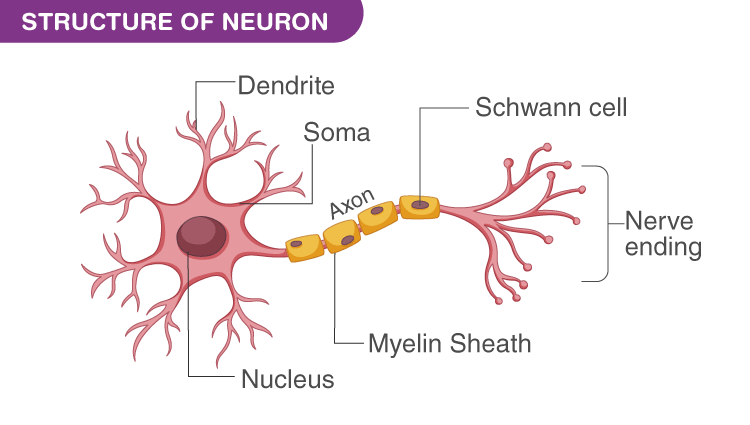
Structure of neuron
The structure of a neuron includes the cell body (soma), dendrites for receiving signals, and an axon for transmitting impulses (with terminal buttons).
Neurons also have myelin sheaths which insulate the axon to enhance signal transmission.
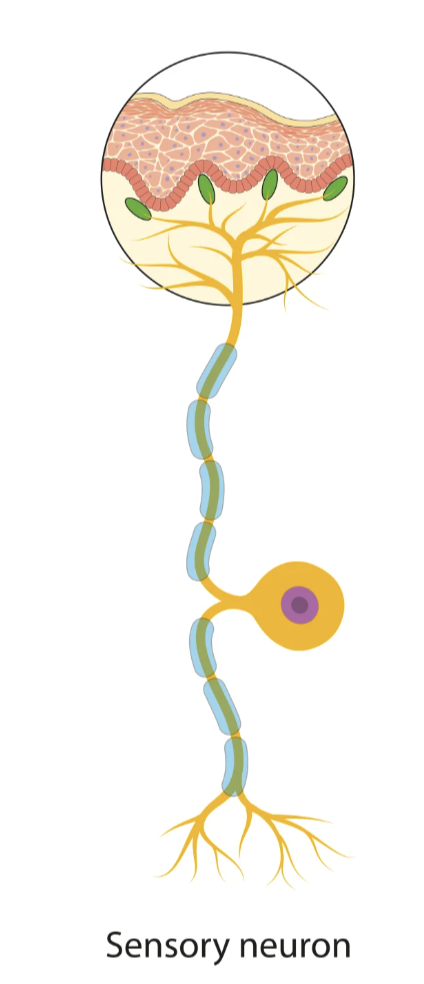
Sensory neurons
Neurons that detect changes in the external and internal environment and send information about these changes to the CNS.
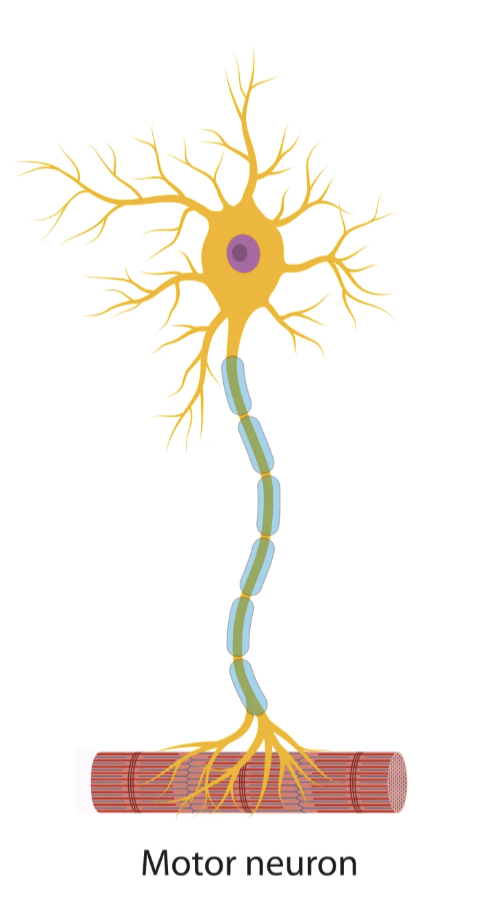
Motor neurons
Neurons located within the CNS and PNS that control muscle contraction and gland secretion.
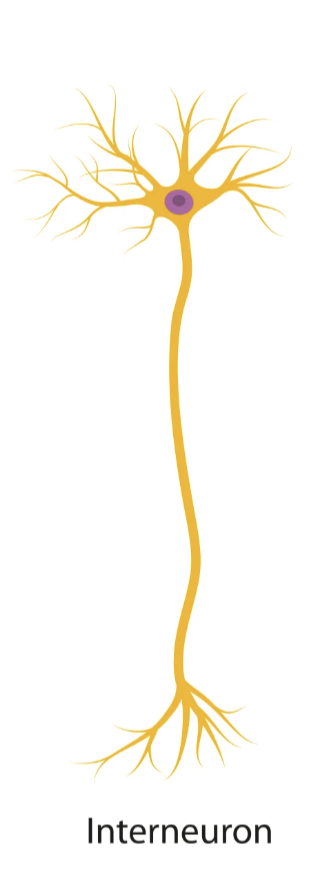
Interneurons
Neurons that lie entirely within the CNS and are involved in cognition, including perceiving, learning, and decision making.
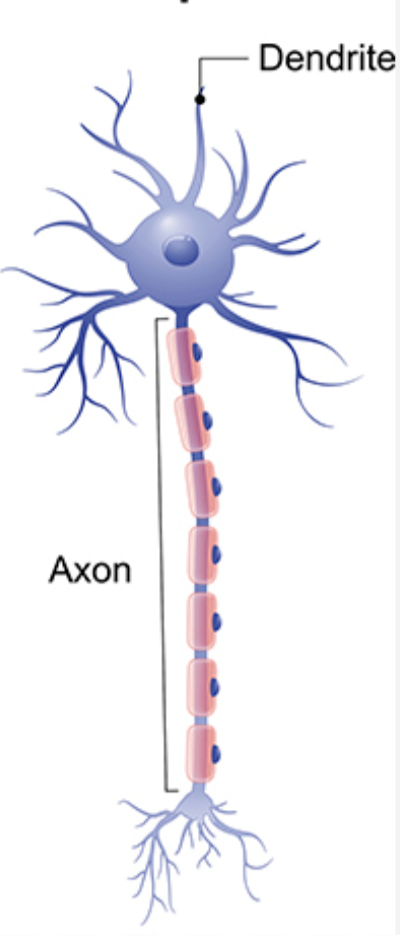
Multipolar neuron
A neuron with one axon and many dendrite trees attached to its soma.
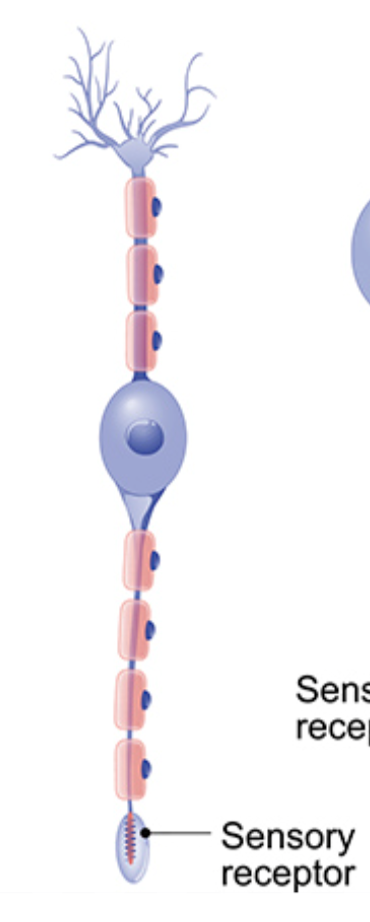
Bipolar Neuron
A neuron with one axon and one dendrite tree attached to its soma.
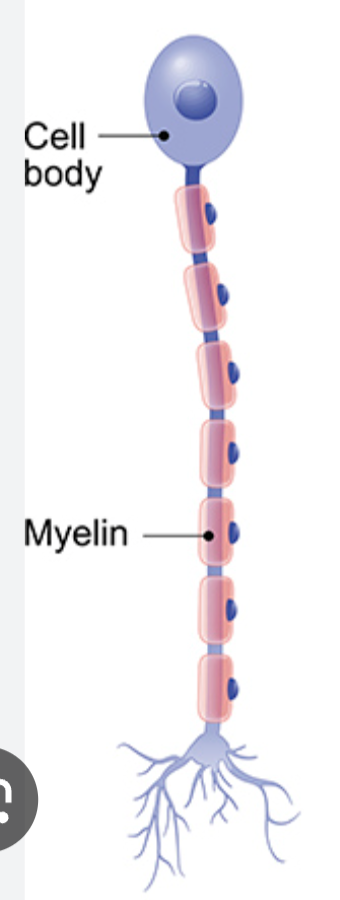
Unipolar Neuron
A neuron with one axon attached to its soma; the axon divides, with one branch receiving sensory information and the other sending it into the CNS.
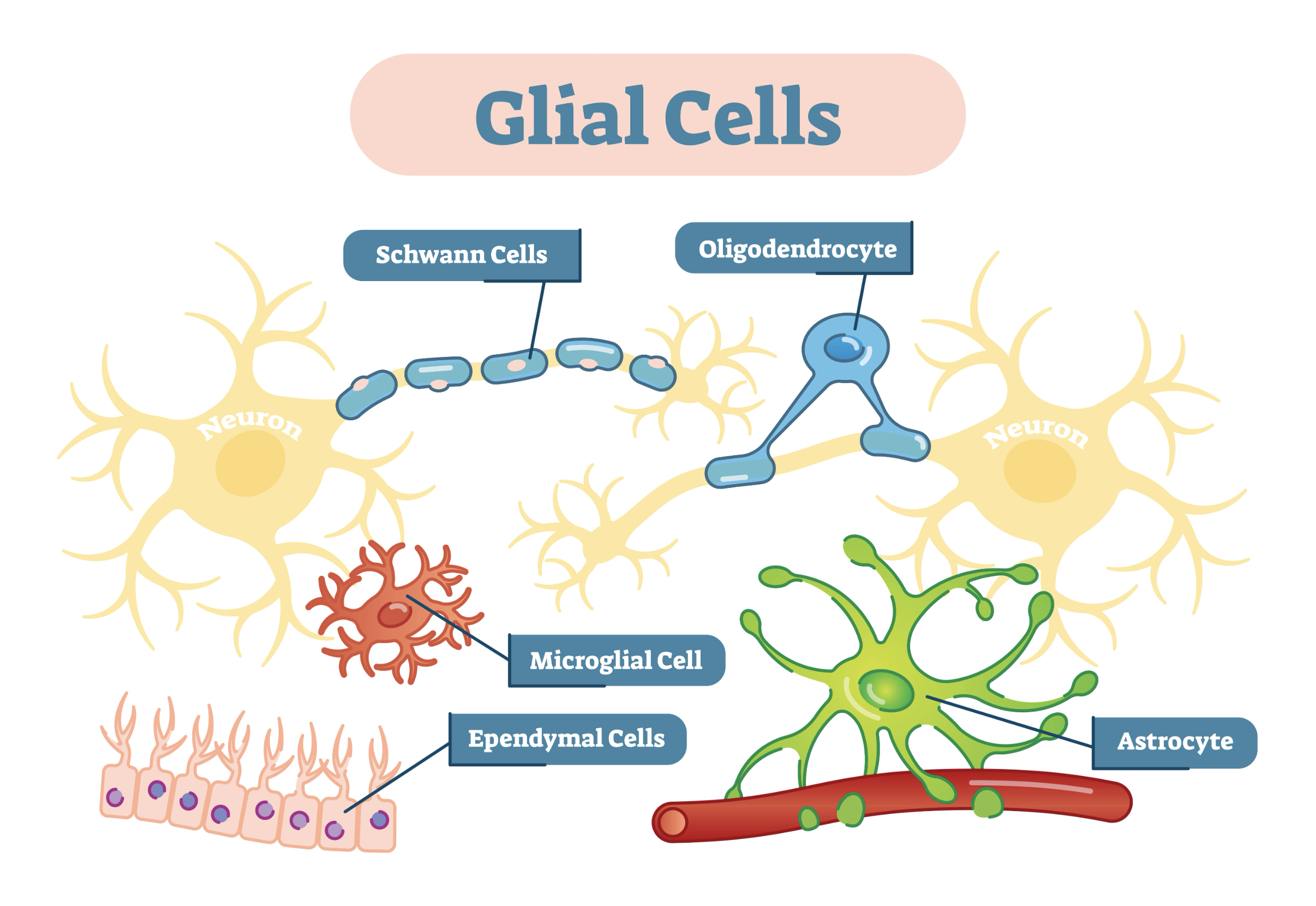
Glia cells
Supportive cells in the nervous system that provide structure, nutrients, and protection for neurons. They play a critical role in maintaining homeostasis and modulating neuronal activity.
Astrocytes
Star-shaped glial cells that provide physical support, nourishment, and chemical regulation of the fluid surrounding neurons.
Oligodendrocytes
Cells in the central nervous system that support axons and produce the myelin sheath.
Microglia
Modified immune cells that act as scavengers, protecting the brain from invading microorganisms.
Schwann cells
Supporting cells in the peripheral nervous system (PNS) that wrap around a single axon to form a myelin sheath.
Nodes of Ranvier
The bare, unmyelinated portions of an axon between adjacent myelin-producing cells.
Blood-Brain Barrier
A semipermeable barrier between the CNS and the circulatory system that regulates the flow of nutrient-rich fluid into the brain.
Area Postrema
A region of the medulla where the blood-brain barrier is weak, allowing toxins to stimulate the area and initiate vomiting.
Membrane Potential
The difference in electric charge across a cell's membrane, which is essential for the generation of action potentials in neurons.
Resting Potential
The membrane potential of a neuron when it is not being altered by excitatory or inhibitory postsynaptic potentials, usually approximately −70mV.
Action Potential
A rapid and brief depolarization of a neuron's membrane that propagates along the axon, leading to the transmission of an electrical signal.
Depolarization
A reduction of the negative charge toward zero of the membrane potential from its normal resting potential.
Hyperpolarization
An increase in the membrane potential of a cell relative to its normal resting potential.
Threshold of Excitation
The specific value of the membrane potential that must be reached to produce an action potential.
Electrostatic pressure
The force exerted by the attraction of oppositely charged ions or the repulsion of similarly charged ions. Na+ and Cl- ions
Sodium-Potassium Pump
An active mechanism in the membrane that pushes three Na+ ions out of the cell for every two K+ ions it transports in.
Intracellular fluid
The fluid found inside cells, consisting of water, ions, and various molecules that support cellular processes.
Extracellular fluid
The fluid found outside cells, which includes interstitial fluid and plasma, and is essential for transporting nutrients and waste products.
All-or-None Law
The principle that once an action potential is triggered in an axon, it is propagated without decrement to the end of the fiber.
Rate Law
The principle that variations in the intensity of a stimulus are represented by variations in the rate at which the axon fires. (not size)
Saltatory conduction
The conduction of action potentials by myelinated axons, where the impulse appears to jump from one node of Ranvier to the next.
+Economy: less energy used by the Na-K pump
+Speed: conduction much faster in a myelinated axon
Synaptic cleft
The narrow gap of approximately 20nm between the presynaptic and postsynaptic membranes.
Synapse = junction
Pre-synaptic neuron = neuron sending impulse
Post-synaptic neuron = neuron receiving impulse
Neurotransmitter
Made by the pre-synaptic neuron and is stored in synaptic vesicles. Function to transmit signals across synaptic cleft.
Neuroreceptors
Chemical-gated ion channels. These have specific binding sites for neurotransmitters. The cemical messengers fit the binding site with a lock and key mechanism.
Ionotropic receptor
A receptor that contains a binding site for a neurotransmitter and an ion channel that opens when the neurotransmitter attaches.
Metabotropic receptor
A receptor that contains a binding site for a neurotransmitter and activates an enzyme that begins a series of events, often involving a G protein, to open an ion channel.
Reuptake
The process by which neurotransmitters are recycled and reabsorbed by the presynaptic neuron after being released into the synaptic cleft, terminating the signal.
Excitatory Postsynaptic Potential (EPSP)
Excitatory depolarization of the post synaptic membrane
An increase in the likelihood of a neuron firing, caused by the influx of positively charged ions after neurotransmitter binding.
Inhibitory Postsynaptic Potential (IPSP)
Inhibitory hyperpolarization of the post synaptic membrane.
A change in the neuron's membrane potential that makes it less likely to fire, resulting from the influx of negatively charged ions following neurotransmitter binding.
3 Major types of ion channels:
Na+, K+ and Cl-
Neuronal integration
The process by which inhibitory and excitatory postsynaptic potentials summate to control the rate of firing of a neuron.
Temporal summation
Occurs when a single presynaptic neuron fires repeatedly in rapid succession. Because the changes in membrane potential last longer than the impulses themselves, the consecutive signals "stack" on top of one another to reach the firing threshold.
Spatial summation
Occurs when multiple presynaptic neurons release neurotransmitters at different synapses onto the same postsynaptic neuron at the exact same time. The simultaneous signals combine their effects to cross the threshold.