Bio Final
 Call Kai
 Learn
Learn Practice Test
 Spaced Repetition
 Match
Match Flashcards
 Knowt Play
1/106

There's no tags or description
Looks like no tags are added yet.
Name | Mastery | Learn | Test | Matching | Spaced | Call with Kai |
|---|
No analytics yet
Send a link to your students to track their progress
107 Terms
______ help to maintain pH levels.
Buffers
The backbone structure of a polypeptide is made of ______ and/or _______ with __ _____ attached.
nitrogen, carbon, R groups
Energy in biochemistry is capacity for change in _________ _________.
chemical composition
C6H12O6 + 6O2 —> 6CO2 + 6H2O
What’s being reduced?
What’s being oxidized?
Reducing agent?
Oxidizing agent?
O2, glucose, glucose, O2
In the complete glycolysis pathway, for every 1 mole of glucose, ______ moles of ATP are made. (Hint: the net total of ATP)
2
In glycolysis, for every 1 mole of glucose, _____ moles of NADH are made.
2
Where in the cell does glycolysis occur?
Cytoplasm
What type of regulation does this describe: When an activator or inhibitor binds to a non-active site which regulates if the enzyme is in the "on" or "off" conformation
Allosteric
Anabolic reactions ______ energy and are therefore ________.
require; endergonic
More access to ______ means the molecule is more ________.
hydrogens, reduced
______ is the first catabolic pathway in glucose oxidation.
Glycolysis
An individual is going on a run and their muscle cells run out of oxygen. To generate enough ATP for muscle contractions, muscle cells will rely on ______ and _______. After the individual has finished running, muscle cells have enough oxygen and will convert ______ into _______.and resume the citric acid cycle.
glycolysis, fermentation, lactate, pyruvate
An individual would need to eat more frequently to maintain proper glucose levels if they can’t synthesize the polysaccharide _______.
glycogen
Primary structure only contains _______ bonds in amino acids.
covalent
Alpha helices are a form of _______ structure.
secondary
In DNA, A matches with ___ and C matches with ___, and U replaces ___.
T, G, T
5’-TGCGTCATC-3’ is the template strand, name the other 2 strands
Coding: 3’-ACGCAGTAG-5’
mRNA: 3’-ACGCAGUAG-5’
Equation to solve for pH
pH = -log[H+]
What are some polar bonds carbon is involved in?
CO, CN
What are some nonpolar bonds carbon is involved in?
CH, C2
What are some polar bonds oxygen is involved in?
CO, OH, ON, PO
Is NH polar or nonpolar?
Polar
________ fats have a double bond leading to a _____ shape and are ______ at room temp.
Unsaturated, bent, liquid
_________ forces are between molecules while _________ forces are inside molecules.
Intermolecular, intramolecular
Bonds between glycerol and fatty acids are called ______ bonds.
ester
_________ bonds link a nucleotide with another nucleotide
Phosphodiester
Fatty acids and glycerol undergo a _________ reaction to form a _________.
condensation, triglyceride
In neurospora, each _____ encodes for one _______.
gene, polypeptide
Methyl is written as ______
CH3
Keto group is written as _____
CO
Carbon is double bonded with oxygen in aldehyde and carboxyl but what’s the difference between the two functional groups?
It’s bonded with hydrogen in aldehyde and OH in carboxyl.
Daughter chromosomes are formed in ________ of mitosis.
anaphase
The spindle is attached to the kinetochores in __________ of mitosis.
prometaphase
The cell that releases and receives the signal uses _______ signaling.
autocrine
Cells exchanging signals while in physical contact with each other use ________ signaling.
juxtacrine
Nearby cells not physically touching use _______ signaling
paracrine
________ is what keeps the sister chromatids together until anaphase.
Cohesin
T or F: Prokaryotes divide only when conditions are favorable and don’t rely on signals.
True
An individual with the genotype EeAa will form what gametes?
EA, Ea, eA, ea
Plant cells use ______ in cytokinesis as a precursor to the _______.
vesicles, cell wall
_____ is made by adenylyl cyclase in the cell membrane
cAMP
Adenylyl cyclase turns ____ into cAMP
ATP
__________ remove phosphate groups when regulating signal transduction
Phosphatases
_____ convert GTP to GDP when regulating signal transduction
GTPases
_________ convert cAMP to AMP when regulating signal transduction
Phosphodiesterases
Spindles are made of _______
microtubules
What amplifies signals between receptors and target molecules?
second messengers
Each kinase activates how many additional proteins in amplification?
Two
The p21 protein prevents cyclins from binding to CDK, which therefore cannot phosphorylate RB. What happens as a result?
The cell cycle is stopped
Homologous pairs exchange genetic material in _______
Prophase I
What does the S phase checkpoint check for?
Errors/damage in DNA replication
________ is when one or more chromosome is missing or present in excess.
Aneuploidy
What phase has the checkpoint for required materials for cell division?
G2 phase
What phase has the checkpoint checking if the sister chromatids are correctly attached to the microtubules?
M phase
Are gametes haploid or diploid? Are zygotes haploid or diploid?
haploid, diploid
What phase is short and is when the cell prepares for the M phase?
G2 phase
The spindles form after the ______ separate.
centrosomes
The _____ forms on the centromere of the chromosome and is where the spindle attaches.
kinetochore
In animal cell cytokinesis, a ________ forms which cinches the cytoplasm between the nuclei.
contractile ring
RNA has a _____ molecule at the 2’ carbon while DNA has ____ at the 2’ carbon.
OH, H
The nitrogenous base of the DNA molecule is at the ____ carbon.
1’
The phosphate group attaches to the ____ carbon of a DNA molecule.
5’
The next nucleotide is added at the ____ carbon.
3’
ATP in glycolysis is produced through ________ _______ phosphorylation.
substrate level
Change in entropy ___ 0 and change in enthalpy ____ 0 = always spontaneous
>, <
Change in entropy ___ 0 and change in enthalpy ___ 0 = Spontaneous at low temperatures
<,<
True or false: Complex II contributes to the H+ gradient.
False
Fatty acids are broken down via _____ ___________ where NAD+ and FAD are _______.
beta oxidation, reduced
T or F: The amount of energy in glucose bonds is less than the 32 moles of ATP produced in glucose catabolism.
False
Glycolysis produces a net ____ ATP.
2
________ bonds form between amino acids in a peptide chain.
Peptide
mRNA is made in the ________.
nucleus
If a cell goes to an endomembrane organelle or cell membrane it’s made in the _______ and if it goes to another organelle it’s made in the __________.
rough ER, cytoplasm
Proteins going to the nucleus have what kind of signal sequence?
Nuclear localization signal (NLS)
Where in the cell is RNA made?
Nucleus
Change in free energy equation
Change in enthalpy - (temperature x change in entropy)
Proteins start and end at what terminus’
N-terminus, C-terminus
_________ structure involves bonds between R groups in the same polypeptide chain.
Tertiary
A disulfide bridge between two polypeptide chains is an example of what structure?
Quaternary structure
The extracellular matrix is made up of _____
Proteins and proteoglycans
The ______ ______ gives structure to the nucleus.
nuclear lamina
_______ ______ and ________ _______ are permanently bound to the enzyme while ________ are only bound during the reaction
prosthetic groups, inorganic cofactors, coenzymes
Where in the cell does glycolysis occur?
Cytoplasm
What process uses ATP but later has a net gain in ATP?
Glycolysis
When a phosphate is removed from something in the glycolysis pathway, what is produced?
ATP
When something in the glycolysis pathway is phosphorylated, what is usually used?
ATP
Glycolysis net outputs
2 ______
2 ______
2 ______
pyruvate, ATP, NADH
The citric acid cycle takes place where in the cell?
Mitochondrial matrix
Citric acid cycle net outputs
4 ______
6 ______
2 ______
2 ______
CO2, NADH, FADH2, ATP
Pyruvate gets oxidized into ________
Acetyl CoA
If NAD+ is the oxidizing agent in pyruvate oxidation, what are the outputs?
2 Acetyl CoA and 2 NADH
Sister chromatids vs. daughter chromosomes
Anabolic reactions are ______ _____ while catabolic reactions are ________ ______.
breaking down, building up
What are the two pathways for electrons in the ETC complexes?
I—>III—→IV
II—>III—>IV
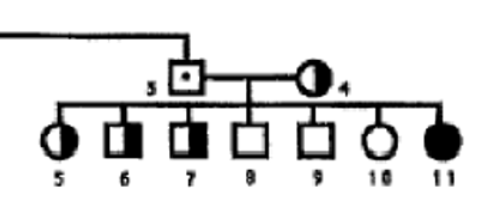
Is the trait dominant or recessive?
Recessive
Glucose to pyruvate is _________
Glycolysis
Pyruvate to acetyl CoA is ___________
pyruvate oxidation
Glucose catabolism goes in the following direction:
Glucose—>_______——>Acetyl CoA—→________
pyruvate, ETC
What is between acetyl CoA and ETC in glucose catabolism?
Citric acid cycle
T or F: Fermentation is used as a way to produce ATP
False