acid base balance
 Call Kai
 Learn
Learn Practice Test
 Spaced Repetition
 Match
Match Flashcards
 Knowt Play
1/12

There's no tags or description
Looks like no tags are added yet.
Name | Mastery | Learn | Test | Matching | Spaced | Call with Kai |
|---|
No analytics yet
Send a link to your students to track their progress
13 Terms
pH and acid base balance
• pH = measured as -log10[H+] or log 1/[H+]
• Neutral pH is 7.0
• Acid is below 7, Alkaline above 7
• Acid donates protons, alkali (base) can accept
• Stronger the acid → greater % molecules separate to free H+ and anions
• Cell pH of about 7 is necessary for normal cell function
Enzyme functions in body are highly sensitive to hydrogen ion concentration ([H+]). Slight deviations change:
• protein structure
• enzyme activity
• nerve excitability
determinants of pH
Blood pH depends only on the ratio of [HCO3-] to [H2CO3]
H2CO3 = carbonic acid
– Weak acid, a portion dissociates into H+ and HCO3-
– Can form from either CO2 + H2O or from H+ + HCO3-
HCO3- = bicarbonate ion
– H2CO3 part-dissociates into HCO3- and H+
– CO2 combines with OH- (forming HCO3-, by carbonic anhydrase)
– carbonate (CO32- combines with H+)
CO2 + H2O H2CO3 H+ + HCO3-
changes in pH
Alterations in body pH can occur due to:
• Metabolism in all tissue – continuous production of CO2
• Breakdown of food – protein, other organic minerals etc (phosphorus and sulphur – phosphorus and sulphuric acid)
• Metabolic intermediaries – lactic acid in exercise
How does the body deal with such changes? Existence of a buffering system
• Bicarbonate buffer system – MAJOR SYSTEM!
• The phosphate buffer system
• Heamoglobin buffer system
• Plasma and cell protein buffer system
regulation of blood pH
• Tightly regulated process primarily involving the kidney and the lungs
• Lungs – releasing CO2
• Kidneys – regulation of HCO3-
• Pathology of the respiratory and renal system will lead to acid base imbalance
role of renal system in pH balance
Regulation of pH by the renal system is done by:
• Reabsorbing filtered bicarbonate (HCO3-)
• Synthesis of new bicarbonate (HCO3-)
• Tubular secretion of H+
bicarbonate reabsorption in the nephron
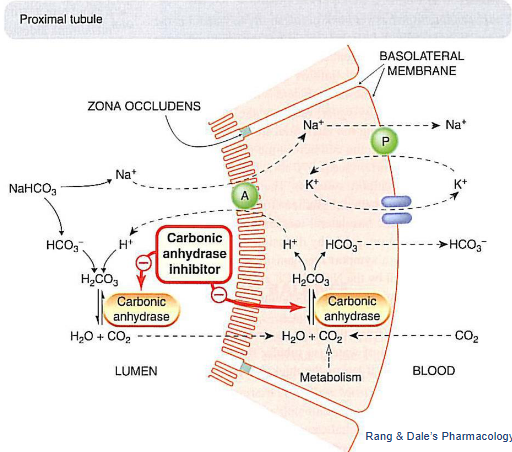
first pic
• Tubular cells normally reabsorb all the filtered HCO3-
• Mostly at the proximal tubule (about 80%)
• Remainder in the loop of Henle and distal loop (about 20%)
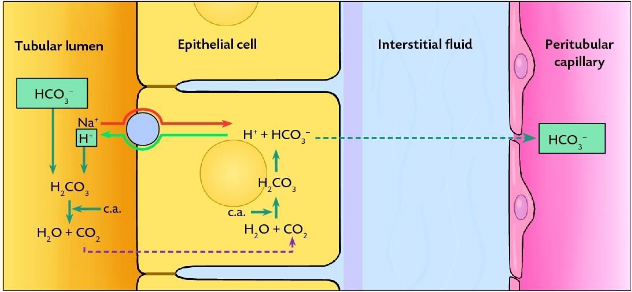
second pic
• Once reabsorbed HCO3- is in the interstitial space
• Need to be reabsorbed back into the peritubular capillaries
Occurs via
• Na+/ HCO3- co transporters (proximal tubule)
• Cl-/ HCO3- exchanger (collecting tubules)
bicarbonate synthesis
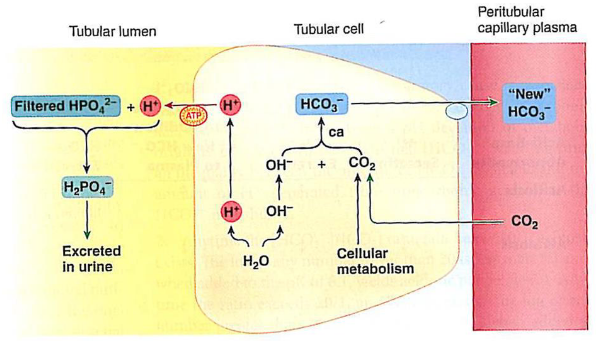
This diagram shows how the kidneys generate "new" bicarbonate (HCO₃⁻) to balance body pH while excreting acid (H⁺) using a phosphate buffer.
Inside the Tubular Cell (Synthesis)
Water splits: H₂O inside the cell dissociates into H⁺ and OH⁻.
Carbon dioxide sources: CO₂ enters from cellular metabolism or blood plasma.
Bicarbonate formation: Carbonic anhydrase (ca) combines CO₂ and OH⁻ to form HCO₃⁻.
Blood absorption: This "new" HCO₃⁻ moves directly into the peritubular capillary blood to buffer systemic acidity.
In the Tubular Lumen (Acid Elimination)
Active transport: An ATP-driven pump actively pushes the remaining H⁺ ion out of the cell and into the urine filtrate.
Phosphate buffering: The secreted H⁺ binds with filtered monohydrogen phosphate (HPO₄²⁻).
Excretion: This forms dihydrogen phosphate (H₂PO₄⁻), safely trapping the acid to be excreted in urine.
H+ secretion
• Most excreted H+ gains entry to tubular system from being actively secreted
• H+ is secreted into the tubular filtrate by the proximal, distal and collecting tubules
• H+ secretion increases when pH is low (or CO2 is high) and decreases when pH is high.
• No mechanism of reabsorption of H+
secretion of H+
Electrogenic H+ pump
• ATP-driven H+ pump (CD)
Na-H+ exchanger
• Proximal tubule, DT, CD
• H+ secreted in exchange for Na+
H+ - K+ exchanger
• Electroneutral pump exchanging H+ for K
excretion of bicarbonate
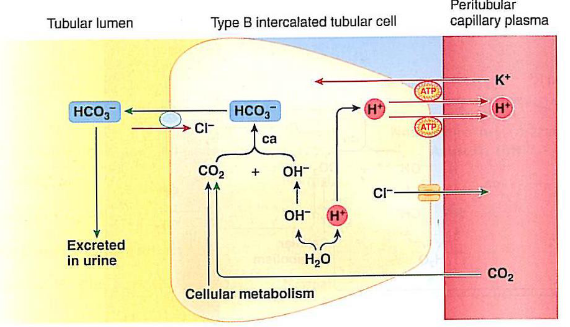
This diagram shows how Type B intercalated cells secrete excess bicarbonate (HCO₃⁻) into urine during alkalosis while reabsorbing acid (H⁺) back into the blood.
1. Inside the Intercalated Cell (Synthesis)
Water splits: H₂O inside the cell dissociates into H⁺ and OH⁻.
Carbon dioxide sources: CO₂ enters from cellular metabolism or blood plasma.
Bicarbonate formation: Carbonic anhydrase (ca) combines CO₂ and OH⁻ to form HCO₃⁻.
2. In the Tubular Lumen (Base Elimination)
Anion exchange: A transporter exchanges intracellular HCO₃⁻ for luminal Cl⁻.
Bicarbonate excretion: The HCO₃⁻ enters the urine filtrate for elimination.
3. In the Peritubular Plasma (Acid Reabsorption)
Active proton pumping: ATP-driven pumps push H⁺ out into the blood.
Potassium reabsorption: One pump exchanges H⁺ for incoming K⁺ ions.
Chloride shift: Cl⁻ leaves the cell through channels into the blood.
acidosis and alkalosis
Acidosis is an abnormal process that produces acidaemia – Low pH
• Respiratory acidosis – this is a low pH where primary defect is an increase in the pCO2
• Metabolic acidosis – this is a low pH where the primary defect is a decrease in plasma HCO3-
Alkalosis is an abnormal process that produces alkalaemia – High pH
• Respiratory alkalosis – this is high pH where primary defect is a decrease in pCO2
• Metabolic alkalosis – this is high pH where primary defect is an increase in plasma HCO3
acidosis
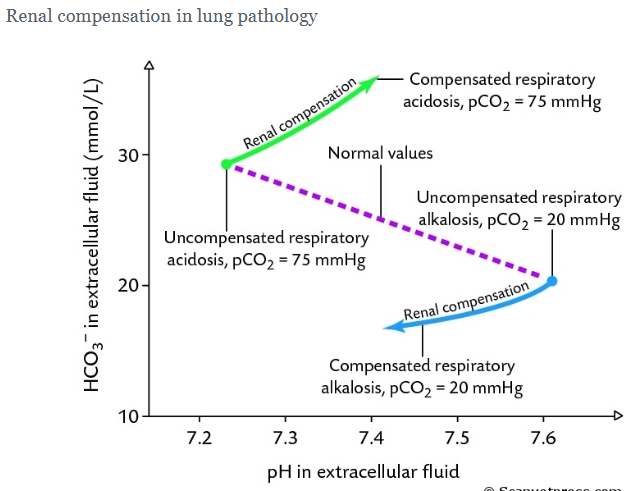
Compensatory response in respiratory acidosis
• pCO2 has increased and therefore blood pH has fallen
• Kidneys will attempt to bring about an increase in plasma HCO3-
• Known as renal compensation
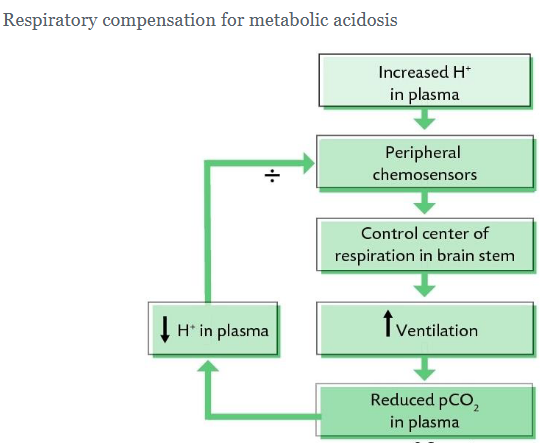
Compensatory response in metabolic acidosis
• Plasma HCO3- has decreased and therefore blood pH has fallen
• Lungs will increase ventilation, rate of breathing leading to a decrease in pCO2
• Known as respiratory compensatio
alkalosis
Compensatory response in respiratory alkalosis
• pCO2 has decreased and therefore blood pH has risen
• Kidneys will decrease in H+ secretion
• Only some HCO3- is reabsorbed but rest excreted. Tubular synthesis of HCO3- is decreased.
• This is renal compensation
Compensatory response in metabolic alkalosis
• HCO3- has increased and therefore blood pH has increased
• Lungs will increase level of pCO2 by reducing rate of breathing and ventilation.
• This is respiratory compensation