Transport in plants
 Call Kai
 Learn
Learn Practice Test
 Spaced Repetition
 Match
Match Flashcards
 Knowt Play
1/22

There's no tags or description
Looks like no tags are added yet.
Name | Mastery | Learn | Test | Matching | Spaced | Call with Kai |
|---|
No analytics yet
Send a link to your students to track their progress
23 Terms
The need for transport systems in multicellular plants
Large size means many cells are far from the surface, so diffusion is too slow.
As size increases, the surface area to volume ratio (SA:V) decreases, reducing the rate of exchange with the environment.
Plants have metabolic demands and need water, mineral ions, and sugars transported efficiently.
Vascular system in herbaceous dicotyledonous plants
The vascular system consists of xylem and phloem.
Xylem transports water and mineral ions from roots to leaves.
Phloem transports sugars and other organic substances around the plant.
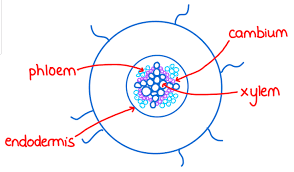
Roots
Xylem: central star/X-shaped structure.
Phloem: found between the arms of the xylem.
Cambium: forms between xylem and phloem (in older roots), producing new vascular tissue.
Cortex (parenchyma): large region surrounding the vascular tissue; stores starch and allows movement of water.
Epidermis: outer layer with root hairs for absorption.
Stems
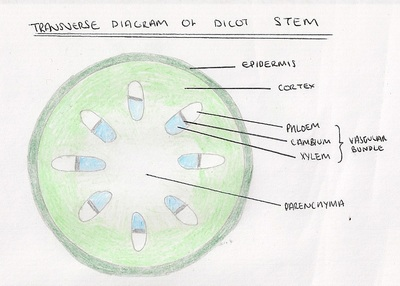
Vascular bundles arranged in a ring near the outside of the stem.
Xylem: on the inner side of each bundle.
Phloem: on the outer side of each bundle.
Cambium: thin layer between xylem and phloem; meristematic tissue that produces new xylem and phloem.
Pith (parenchyma): central region for storage.
Cortex (parenchyma): between epidermis and vascular bundles; storage and support.
Leaves
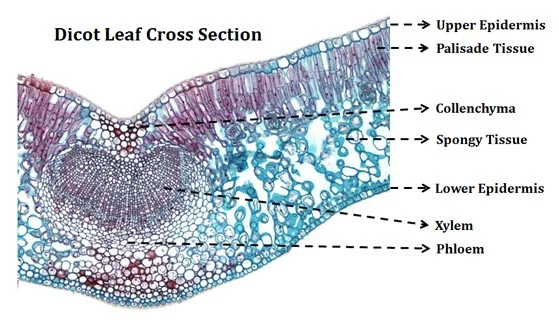
Xylem: located in the upper part of the vein.
Phloem: located in the lower part of the vein.
Cambium: usually absent or not active in mature leaves.
Palisade mesophyll (parenchyma): tightly packed, elongated cells beneath the upper epidermis; main site of photosynthesis.
Spongy mesophyll (parenchyma): loosely packed cells with air spaces for gas exchange.
Xylem
Dead cells joined end-to-end.
Form long, hollow tubes with no cytoplasm and end walls, reducing resistance to water flow.
Cell walls are thickened with lignin, making them waterproof and strong, lignin provides adhesion.
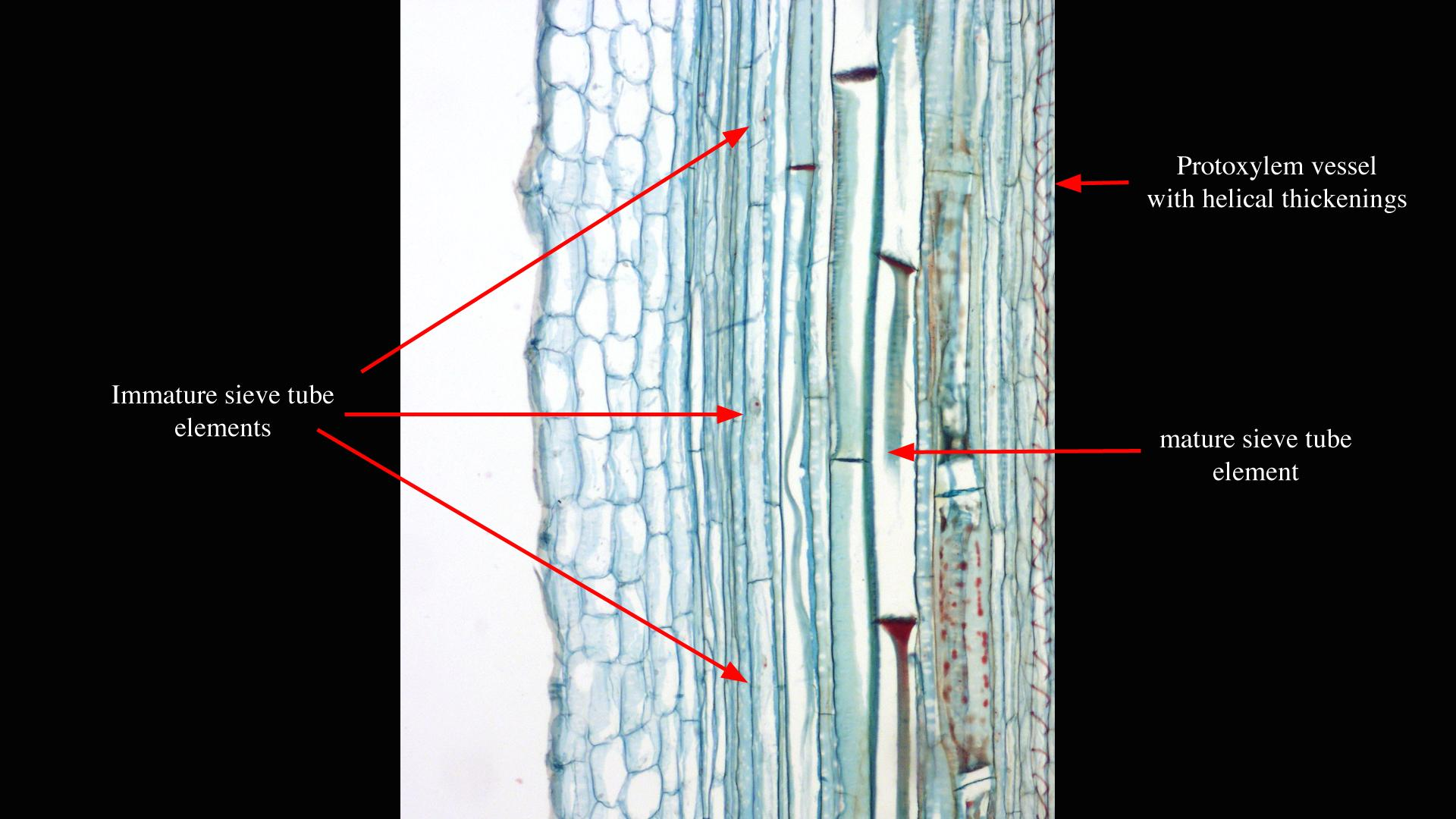
Lignin is often deposited in spirals, rings, or networks, allowing support while preventing collapse under tension.
Pits (unlignified regions in the walls) allow lateral movement of water between adjacent xylem vessels and surrounding tissues.
Sieve tube elements (phloem)
Long living cells joined end-to-end.
End walls form sieve plates with pores that allow movement of sap.
Have very little cytoplasm and no nucleus at maturity, reducing resistance to flow.
Transport sucrose and other organic substances by translocation.
Companion cells (phloem)
Located alongside sieve tube elements.
Contain a nucleus, many mitochondria, and dense cytoplasm.
Connected to sieve tube elements by plasmodesmata.
Provide energy (ATP) and metabolic support for active loading and unloading of sugars into the phloem.
Dicot stem transverse
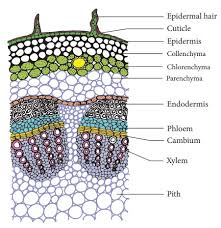
Longitudinal stem dicot
Transpiration
Transpiration is the loss of water vapour from the aerial parts of a plant, mainly through the stomata of leaves, by diffusion.
Water is absorbed by root hair cells from the soil by osmosis, down a water potential gradient.
Water moves through the cortex and enters the xylem.
Water is transported up the xylem in the transpiration stream.
In the leaf, water moves from the xylem into mesophyll cells by osmosis.
Water evaporates from the moist cell walls of mesophyll cells into the leaf air spaces.
This evaporation lowers the water potential of the mesophyll cells.
Water vapour accumulates in the air spaces and then diffuses out through the stomata down a concentration gradient (or water vapour concentration gradient).
The loss of water from the leaf creates tension (negative pressure) in the xylem.
Cohesion between water molecules maintains a continuous column of water, pulling more water upward (transpiration pull).' choesion tension theory
Adhesion to lignin aids not moving down under gravity
Environmental Factors
Light Intensity ↑
Stomata open wider for photosynthesis.
Increased diffusion of water vapour out of the leaf.
Transpiration rate increases.
Temperature ↑
Increased kinetic energy of water molecules.
Increased rate of evaporation from mesophyll cells.
Faster diffusion of water vapour.
Transpiration rate increases.
If too high guard cells loose tugor and stomata close and transpiration decreases
Humidity ↑
Reduces the water vapour concentration gradient between leaf and air.
Less diffusion of water vapour.
Transpiration rate decreases.
Wind Speed ↑
Removes humid air around the leaf.
Maintains a steep water vapour concentration gradient.
Faster diffusion.
Transpiration rate increases.
Practical Investigation, estimating Transpiration Rate
Principle:
A potometer estimates transpiration rate by measuring water uptake, since most water absorbed is lost through transpiration.
Method:
Fill potometer with water.
Cut a leafy shoot underwater and attach it.
Ensure apparatus is airtight.
Introduce an air bubble into the capillary tube.
Measure how far the bubble moves in a set time.
Transpiration rate = distance moved by bubble / time
Apoplast Pathway
Water moves through the cell walls and intercellular spaces.
Water does not cross cell membranes, so movement is relatively fast.
At the endodermis, the Casparian strip (waterproof suberin) blocks the apoplast pathway.
Water is forced through a cell membrane and into the symplast before entering the xylem.
Symplast pathway
Water moves through the cytoplasm of living cells.
Water passes from cell to cell via plasmodesmata (cytoplasmic connections between cells).
Water crosses a cell membrane (partially permeable so removes substances) once when it first enters the symplast.
Movement is controlled by the cells because it occurs through living cytoplasm.
Mechanisms of Water Movement
Water moves into roots by osmosis, down a water potential gradient (from higher water potential in the soil to lower water potential in root cells).
Transpiration causes water to evaporate from mesophyll cells and diffuse out through stomata, lowering the water potential in the leaf.
This creates a water potential gradient from the roots to the leaves, causing water to move upwards through the xylem.
Water molecules are attracted to each other by cohesion, forming a continuous column of water in the xylem.
Water molecules are attracted to the xylem walls by adhesion, helping maintain the water column and resist gravity.
The evaporation of water from the leaves creates tension (negative pressure) in the xylem, pulling the continuous water column upwards.
This movement of water from roots to leaves through the xylem is called the transpiration stream.
Adaptations xerophytes
Cacti
Thick, fleshy stem stores water.
Leaves reduced to spines → reduced surface area and transpiration.
Thick, waxy cuticle → reduces water loss.
Few/sunken stomata → reduce diffusion of water vapour, traps water vapour increases hunmidity
Extensive root system → maximises water uptake.
Marram Grass
Leaves roll inwards → traps humid air, reducing water vapour concentration gradient.
Sunken stomata → reduce transpiration.
Hairs inside rolled leaf → trap moisture.
Thick waxy cuticle → reduces water loss.
Hydrophytes adaptations
Large, broad leaves → maximise light absorption.
Stomata mainly on upper surface → lower surface is in contact with water.
Large air spaces (aerenchyma) → buoyancy and gas exchange.
Thin cuticle → little need to prevent water loss.
Reduced roots/xylem → water is readily available.
Translocation
Translocation is the transport of assimilates (mainly sucrose) in the phloem from sources to sinks.
Source: produces or releases sucrose (e.g. leaves during photosynthesis).
Sink: uses or stores sucrose (e.g. roots, fruits, developing tissues, meristems).
Translocation mechanism source
Photosynthesis produces glucose, which is converted to sucrose.
Companion cells use ATP to power H⁺ pumps, actively transporting hydrogen ions out of the companion cell.
This creates a high concentration of H⁺ outside the cell.
H⁺ ions move back into the companion cell through co-transport proteins, carrying sucrose with them (secondary active transport).
Sucrose moves from companion cells into sieve tube elements via diffusion through plasmodesmata .
The high sucrose concentration lowers the water potential of the phloem.
Water enters the sieve tubes from the xylem by osmosis.
This increases hydrostatic pressure at the source.
Mass Flow in the Phloem
The high hydrostatic pressure becuase sucrose lowers phloem water potential at the source which means water transports via osmosis down water potential gradient from xylem to phloem and lower pressure at the sink create a pressure gradient.
Phloem sap (water + dissolved sucrose) moves through the sieve tube elements by mass flow.
Sieve plates contain pores that allow movement between sieve tube elements.
Translocation mechanism sink
Sucrose is removed from the phloem into sink cells.
This may occur by active transport or facilitated diffusion, depending on concentration gradients.
Sucrose is:
used in respiration,
converted to starch for storage,
used for growth and synthesis.
Removal of sucrose raises the water potential in the phloem.
Water leaves the phloem and enters the xylem by osmosis.
Hydrostatic pressure at the sink decreases.