3a. motion perception
 Call Kai
 Learn
Learn Practice Test
 Spaced Repetition
 Match
Match Flashcards
 Knowt Play
1/27

There's no tags or description
Looks like no tags are added yet.
Name | Mastery | Learn | Test | Matching | Spaced | Call with Kai |
|---|
No analytics yet
Send a link to your students to track their progress
28 Terms
how do we detect motion
cells in the V1 area love motion and respond to bars of moving light
they start firing when they see downwards motion because they love this the most
explain motion after effect
viewing loads of downwards motion causes reduced firing of downwards detectors (because we just get used to it)
when we stop viewing this downwards movement, we have higher activation of upwards detectors - making us perceive upward motion that isn’t real
what is local motion
motion of smaller elements on a smaller part of the retina
what is global motion
grouping many elements of motion to perceive a bigger complex pattern of global motion (i.e. someone running)
how do we process global motion/build a global motion detector
pool together the visual fields of loads of cells tuned to the same direction of motion, so when the cells fire, the global motion detector fires
explain motion coherence paradigm and what the level is for humans
the minimum amount of dots moving in the same direction for us to recognise it as global/coherent motion
we need 10% to recognise the pattern, 5% if practiced
what does the motion coherence paradigm suggest about global motion
since we only need a tiny proportion of dots to be moving coherently to detect a global motion pattern, it suggests our brain is secretly looking out for global motion
which area of the brain is involved in motion processing
Middle temporal (MT) area / V5
how do we know the MT is involved in motion processing
most cells in the MT are tuned in to respond to motion of preferred directions
Explain a study that used artificial stimulation
directly (artificially) stimulating cells in the MT that have the same preferred direction (i.e. down) made monkeys perceive random motion of dots as downward motion
what did tootell et al find in their fMRI study
when we view motion and then a stationary object, the MT stays active and we experience motion in the opposite direction
explain what lesion studies found about the MT?V5
monkeys with MT lesions needed 80% of movement to be coherent to detect global motion, compared to the normal 5%
what is optic flow
patterns of retinal motion produced when we move, all motion emanates from one point
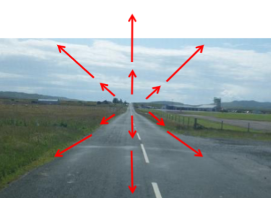
what is optic flow expansion
created by forward movement
all motion comes from a central point called the focus of expansion
objects closer to the centre move slower than things closer to us
explain contraction in optic flow
everything seems to move towards an inwards point
created by backwards movement
what is horizontal (constant speed) optic flow
all objects move across the retina at the same speed regardless of depth when we rotate our head/eyes
what is horizontal (parallax) optic flow
created by lateral movement (moving sideways)
things closer to us move quicker, things further away move slower
what is roll in optic flow
creates a spiral field of vision - happens when we roll
what are complex motions optic flow
happens when we have multiple different patterns of motion going on at the same time
i.e. forward moving and head turning
creates a combined image of movement on retina
explain what duffy and wurtz found from single cell recording
the MST and MT’s neurons respond preferentially to global optic flow patterns
what did smith et al find in their study of mst and mt
MST is more specialised for processing global optic flow because it likes structured motion
and the MT just likes all motion
what is optic flow used for
balance (postural stability), to tell us where we are heading
explain the swinging room experiment
floor is fixed but the walls of the room move side to side
simulates the same optic flow someone would experience from swaying side to side
toddlers would compensate for the optic flow and lean in the direction the room is swaying in - making them sometimes fall over lol
what are the 2 sources of retinal motion
self-motion
object motion
how to calculate retinal motion when perceiving object motion during self-motion
object motion + self motion
explain the flow-parsing hypothesis
when we are moving and also witnessing object movement, subtracting self-movement leaves the remaining movement attributed to the object
explain biological movement
we are particularly well adapted to perceiving biological movement (the movement of another person’s body)
what part of the brain is involved in processing biological movement
superior temporal sulcus