Fascial Layers and Anatomical compartments of the neck
 Call Kai
 Learn
Learn Practice Test
 Spaced Repetition
 Match
Match Flashcards
 Knowt Play
1/57

There's no tags or description
Looks like no tags are added yet.
Name | Mastery | Learn | Test | Matching | Spaced | Call with Kai |
|---|
No analytics yet
Send a link to your students to track their progress
58 Terms
What is an anatomical space
continuous area or expanse within the body which is free, available or unoccupied
Give an example of an anatomical space
-bony spaces or fossae
What are the 2 categories of anatomical spaces
true anatomical spaces
potential anatomical spaces
true anatomical spaces
demonstrable and occur normally
potential anatomical spaces
do not exist normally
creates as a result off pathologies creating spaces or openings that didn’t exist before
What is the most abundant tissue type
fascia
What is fascia
the body’s connective tissue matrix
all-encompassing and interwoven system of fibrous connective tissue found throughout the body
Where in the body does the fascia span
head to toe
inside to out
outside to in
Why is fascia important?
-provides a framework that organises, supports and protects muscle groups, organs and tissue units of the body
Functions of the neck
joins the head to the rest of the body
site for controlled passage of food and gases between cavities of the head, thorax and abdomen
In terms of mobility why is the neck relevant
The neck has a lot of mobility
Why is the neck divided into fascial compartments?
-allow for ease of movement during breathing and swallowing
-formation of natural planes (pre existing layers) for tissue packing (how structures are arranged and held in place)
-determination of spread of infection
What are the generic tissue layers enveloping any body surface from superficial to deep
-skin
-superficial fascia
-deep fascia
-muscles
-bones
-organs
function of superficial fascia
binds skin to the rest of the tissues of the body
function of deep fascia
-encloses organs
-divides muscles into compartments
-consists of the intermediate layer of deep fascia
What are the 2 main classes of fascia in the neck
-superficial fascia
-deep fascia
What are the tissue layers of the neck from superficial to deep
-skin
-superficial fascia (which contains the subcutaneous fat)
-platysma muscle
-deep cervical fascia
Why is the platysma muscle significant
-all other muscles are found deep to the deep fascia except the platysma muscle
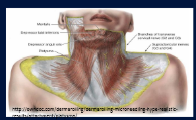
How many layers of superficial cervical fascia are there and what does it enclose
1 layer
encloses the platysma muscle
How many layers of deep cervical fascia are there
3 distinct layers
What are the 3 layers of deep cervical fascia
-investing fascia
-pretracheal fascia
-prevertebral fascia
What is the 4th layer of deep cervical fascia
the carotid sheath
Why isn’t the carotid sheath considered to be a distinct fascial layer
as it is a condensation of the 3 layers (created from the existing deep fascia layers that fuse together)
Role of the carotid sheath
-supports organises and separates viscera, muscles, vasculature and deep lymph nodes
Where does the carotid sheath extend from
extends from the cranial base of the skull to the first rib and sternum T1/T2
Attachments of the carotid sheath
attachments are shared with other layers of deep cervical fascia
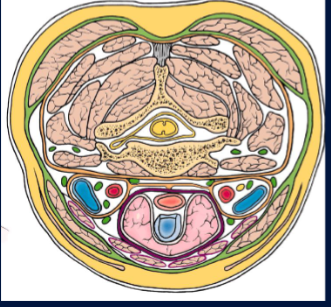
Label the different fascial layers
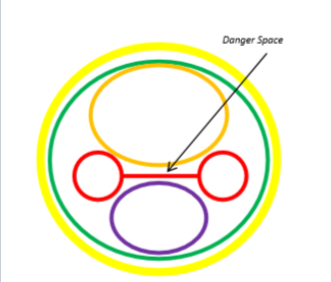
yellow- supercicial cervical fascia
green- investing fascia
dark purple- pretracheal faschia
dark orange- prevertebral fascia
red- (2 circles with the line joining them) carotid sheaths
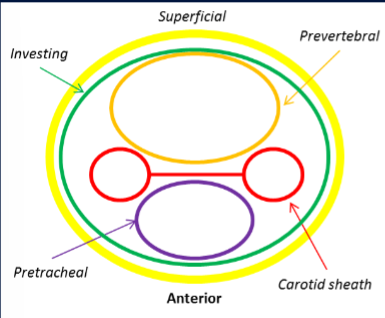
What are cleavage lines
natural lines of tissue separation
How are cleavage lines formed
formed by fascial planes
Why are cleavage lines useful in surgery
allow for blood-free tissue exploration
useful for surgical investigation fo the neck region
Which layer is the most superficial layer of the deep cervical fascia
investing layer
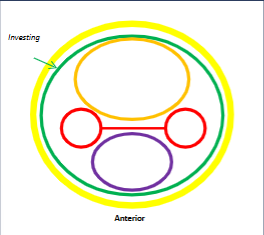
What des the investing layer enclose
trapezius muscle (posteriorly)
sternocleidmastoid muscle (laterally)
submandibular gland
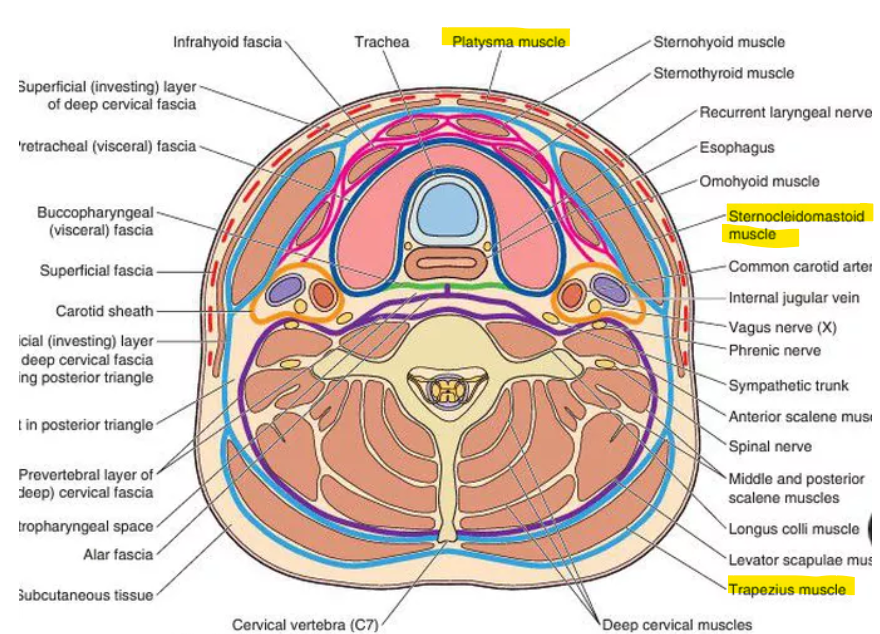
What are the attachments of the investing layer
superior and inferior bony attachments (attached to specific bones superiorly and inferiorly)
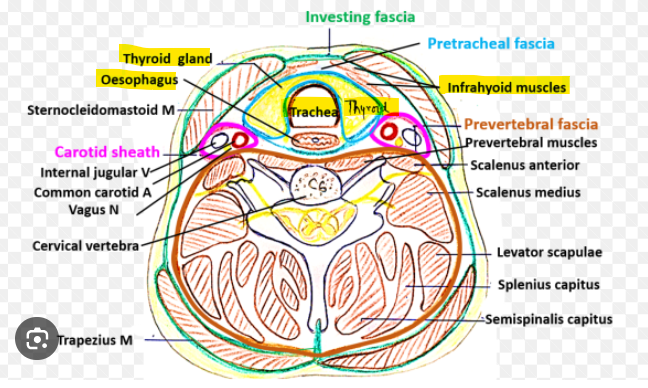
What is the pretracheal layer also known as
the visceral layer
Where does the pretracheal layer span from
spans from the hyoid to the thorax
What are the contents of the pretracheal layer
infrahyoid muscles
trachea
oesophagus
thyroid gland
What is another name for the prevertebral layer
muscular later
What does the prevertebral layer enclose
vertebral column
muscles of the paravertebral region
Attachments of the prevertebral layer
-cranial base (superior)
-endothoracic fascia (inferior)
What is the axillary sheath
-a continuation of prevertebral fascia that continues tot he axilla (armpit)
Are there usually anatomical spaces present between adjacent fascial compartments
no, adjacent fascial compartments of the neck are normally very close to each other and adhere to one another
What can causes potential anatomcial spaces to arises in the fascial planes of the neck
-blood from perforated vessels or pus from infections in the neck can collect as tissue mass in between fascial planes creating potential anatomical spaces
Where are the fascial spaces of the body most exaggerated
-head region
-neck region
-limb regions
How many fascial spaces are in the head and neck region
16
What are the 4 subtypes of fascial spaces of the head and neck
fascial spaces of the face- 5
suprahyoid facial spaces- 5
infrahyoid fascial spaces-1
fascial spaces of the neck- 5
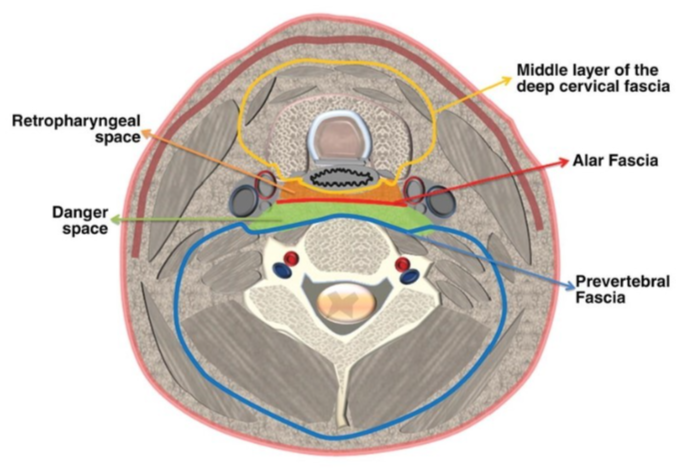
What is the alar fascia
thin fascial membrane that joins the 2 carotid sheaths
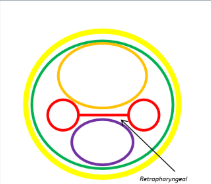
What does the alar fascia lie between
-lies between the muscular and visceral compartments of the neck
What is the prevertebral space
-potential space between the prevertebral fascia and the anterior surface of vertebral bodies of the cervical spine
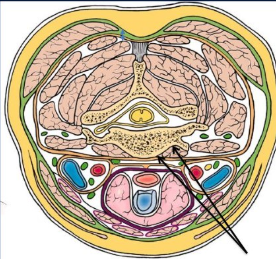
What si the retropharyngeal space
potential space between the alar fascia and the pretracheal fascia
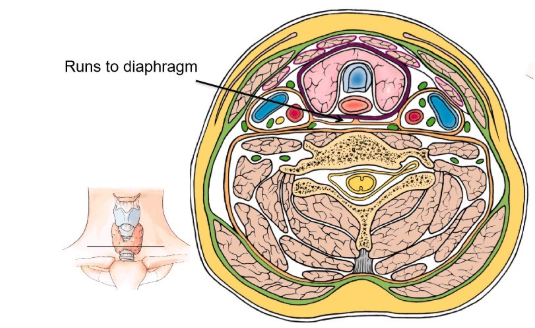
What is the danger space
potential space between the alar fascia and the prevertebral fascia
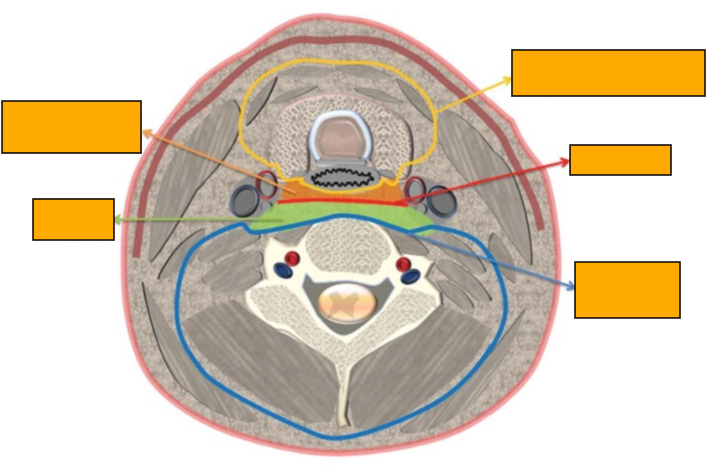
Label clockwise
middle layer of deep cervical fascia- pretracheal fascia
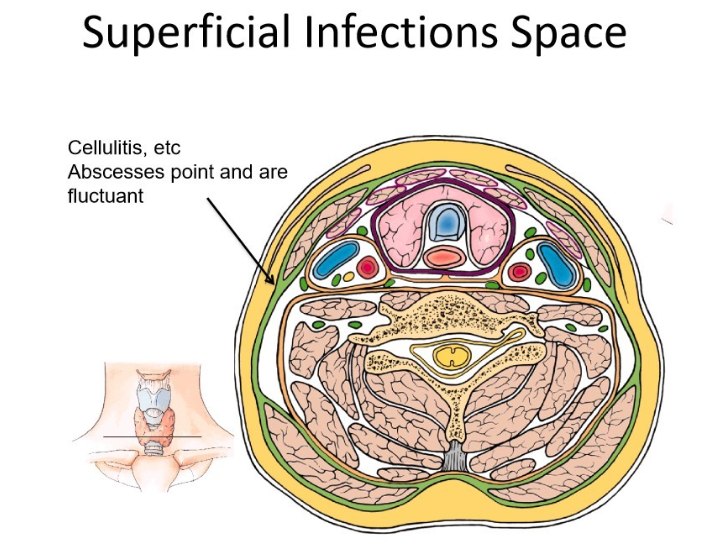
Superficial infections space
potential space in the neck that lies just under the skin, above the deep cervical fascia
Parapharyngeal space
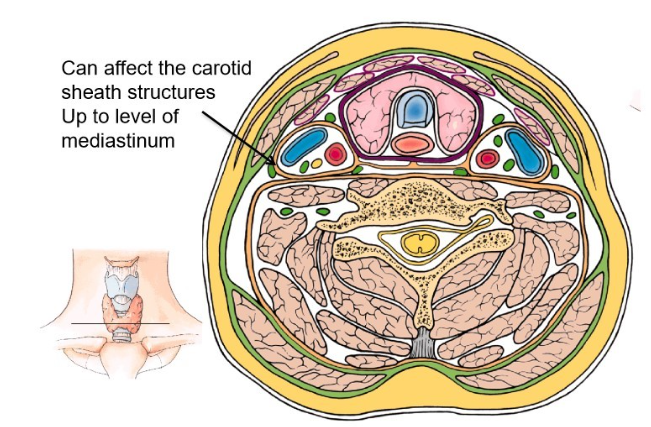
immediately lateral to the oro and nasopharynx
Importance of the investing layer in relation to infection transmission
-encircles the entire neck and acts as a barrier to superficial abscesses helping to contain infections
Why is an infection between the investing and pretracheal fascia dangerous
-can spread to the thoracic cavity
-can cause mediastinitus
Risks of an abscess posterior to the prevertebral layer
-may extend laterally to the sternocleidomastoid muscle
Risk of an abscess in the retropharyngeal space
-can spread to the superior mediastinum
Risks of infections in the head
-may descend posterior to the oesophagus through the danger space and into the posterior mediastinum