FMST exam
 Call Kai
 Learn
Learn Practice Test
 Spaced Repetition
 Match
Match Flashcards
 Knowt Play
1/89

There's no tags or description
Looks like no tags are added yet.
Name | Mastery | Learn | Test | Matching | Spaced | Call with Kai |
|---|
No analytics yet
Send a link to your students to track their progress
90 Terms
Psychoanalytic Theories
Development and behavior are the result of interplay of inner drives, memories, and conflicts we are unaware of and cannot control.
Freud’s Psychosexual Theory:
Behavior is driven by unconscious impulses outside our awareness.
Erikson’s Psychosocial Theory:
Included the role of the social world in shaping our sense of self
Eriksen’s Psychological Stages
Believed that there is stages during life and development that cause conflict that we need to resolve
Behaviorist and Social Learning Theories
Development and behavior are influenced by the physical and social environment.
Behaviorism:
Examines only observable behavior
Social Learning Theory:
People actively process observable information, and their thoughts and feelings then influence their future behavior
Pavlov’s Classical conditioning:
Person or animal comes to associate environmental stimuli with physiological responses
Skinner’s Operant conditioning:
Behavior becomes more or less probable depending on its consequence
Social Learning Theory (Albert Bandura)
Observational learning: People learn through observing and imitating model
Cognitive Theory
Development and behavior are the result of thought or Cognition.
Piaget’s Cognitive-Developmental Theory:
Children and adults use their ability to think to better understand their environment
Organization of learning results in Cognitive schemas or concepts, ideas, and ways of interacting with the world
Systems Theory
Emphasizes the role of social context in development
People are inseparable from the familial, neighborhood, and societal contexts in which they live
Bronfenbrenner’s Bioecological Systems Theory:
Addresses both the role of the individual and that individual’s social interactions
Development is the result of interactions among biological, cognitive, and psychological changes within a person and their changing context.
Individuals are embedded in, or surrounded by, a series of sociocultural contexts, affecting behaviour and development
Macro, exo, meso, micro systems
Evolutionary Developmental Theory
Applies principles of evolution and scientific knowledge about the interactive influence of genetic and environmental mechanisms to understand development.
Genetic programs and biological predispositions interact with physical and social environments to influence development.
Dominant
Only requires one copy of the dominant allele to be physically expressed. The dominant gene "overrides" or "masks" the recessive gene
Dominant Traits: Brown eyes, freckles, the ability to roll your tongue, and conditions like Huntington's disease.
Recessive
Requires two copies of the recessive allele (one from each parent) to be expressed. If you inherit only one recessive allele, the dominant allele will mask it, making you an unaffected "carrier"
Traits: Blue eyes, red hair, and conditions like cystic fibrosis or sickle cell anemia
Maternal Characteristics and Behaviors: Nutrition
Fresh fruits and veggies
Lean protein
They need to be able to give babies the right amount of food and nutrients
Maternal Characteristics and Behaviors: Maternal Illness
Effects depends on when person was pregnant
Ex: measles cause miscarriage, baby can be born premature, LBW, brain damage, blind, deaf, might die before first year
Chicken pox, cica, mumps
Maternal Characteristics and Behaviors: Emotional Well-Being
Unsafe living conditions, domestic violence, living during moments of war
Stress hormones elevate heart rate, causing fetus to have heart high rate
Stress travels into the umbilical cord/placenta
Maternal Characteristics and Behaviors: Age
When individuals are older, children are more likely to have down syndrome
chromosomal risks the more you get older
high blood pressure and gestational diabetes comes with age, inhibiting ability to provide nutrition to baby
Maternal Characteristics and Behaviors: Prenatal care
Prenatal vitamins
Regular visits to health practitioners
Blood tests
Ethnic and SES Disparities
lots of people with low SES don’t have access to prenatal care, affecting child development
Biological Influences on Pubertal Timing
Genetics
The age a parents went through puberty is about when a child will go through puberty
Contextual Influences on Pubertal Timing: Weight and Nutrition
Leptin: produced by fat cells. More leptin= more fat cells
This can trigger early menstruation
Fast Food
has links to children having an early puberty
Contextual Influences on Pubertal Timing: Stress
Repeated exposure to stress increases likeliness of early menstruation
Contextual Influences on Pubertal Timing: SES
Lower SES is correlated with early menstruation + puberty because they’re more likely to be exposed to ACES
Higher SES is correlated with normal to delayed menstruation
When youth are exposed to higher chronic stressors (resource scarcity, instability, psychosocial stress) during early life, the body "programs" itself to mature and reproduce earlier to cope with harsh environments
Off-timed Puberty
Early: Before 8 (girls) or 9 (boys)
Late: After 13 (girls) or 14 (boys)
Psychosocial/Emotional Consequences of early maturation
Body image concerns
Girls are more susceptible to depression, anxiety, and heightened level of self-consciousness
Boys look more physically mature (broad shoulders and muscle definition), which can grant them a higher social status, more popularity, and a temporary boost in self-confidence among peers
Behavioral Consequences of early maturation
Hang out with people who are older bc they look way older than they really are
Start doing age inappropriate activities for their age
Brain and body mismatch with prefrontal and limbic system
Synaptogenesis:
the formation of new synapses
Happens during infancy and toddlerhood
New synapses are created when infant’s environment is being stimulated
Synaptic Pruning:
loss of unused neural connections
Too many synapses slow things down, so if there’s a synapse that you don’t use, the brain gets rid of it
Kind of like how we have to delete apps on our phone bc it fills up storage and slows phone down
It’s so important for infants to be regularly stimulated because if they aren’t, synapses will be pruned and when they’re older they won’t be able to handle things because they weren’t exposed to it. Limits their opportunities
Child Maltreatment – Risk Factors for Child Abuse – Parent Characteristics
Not having much knowledge of normal child development
Usually thinking that they’re being stubborn to hurt or annoy the parent, causes parents to want to control the child
Not good coping/problem solving skills (why younger parents who don’t have a fully developed PFC are more likely to commit child abuse)
Physically violent partners
Common Substance Used by Teens and Young Adults: Marijuana Use
Canada Statistics
Avg. age at first consumption using THC is 14 years old
Survey results for THC consumption is that 25% people from ages 18-25 have used THC in the past 3 months
Males are more likely to use it and they perceive it as less risky, more likely to drive after consumption than women
Assimilation:
Integrating a new experience into a preexisting schema
Learning that a great dane is the same species as a chihuahua
Accommodation:
Modifying or creating a schema in light of new information
Learning that dogs and cats are different
Guided Participation:
More skilled partner is attuned to needs of the child and guides her to accomplish more than she could do alone
They know what the child knows, and know that they are ready to learn more
A type of scaffolding
Like swim coaches: they’ll only let you advance to the next level of swimming if they see that you’re ready
Zone of Proximal Development:
The gap between a child’s competence level (what she can do alone) and what she can do with assistance
Skilled partner, using guided participation, guides child through this zone
Sensory Memory:
Holds incoming sensory information in its original form
But you don’t remember every detail you’re exposed to, just the ones you pay attention to
Attention:
Awareness of information
Working Memory:
Holds and processes information that is being “worked on”: manipulated, encoded, or retrieved
Figures out what sensation it is you saw, stores it, and remembers it for later
Has Central Executive
Has Executive Function
Central Executive
Control processor that directs the flow of information and regulates cognitive activities such as attention, action, and problem-solving
Decides what to do with new info and tells exec function to execute it
Executive Function
Cognitive process of understanding information, making decisions, and solving problems
Sees something, pays attention, moves into working memory, tells the exec function to do something with it to make it make sense. Exec function either encodes and puts it into long term memory, or retrieves smt from long term memory and merging the new info with the old to make sense of it
Long-Term Memory:
Unlimited store that holds information indefinitely
Doesn’t really do any work except storing info
Adolescent decision making
capable of making rational decisions
Risk taking behaviors
limbic system is the main reason why adolescents make rash decisions because it uses emotions to make them
Flynn Effect
An effect where Iq scores throughout the generations keeps going up
We’re smarter than the pop’n from 1950
Goes up 3 pts every decade
Why is there a flynn effect?
With each successive decade, more individuals are finishing/graduating school. More schooling you get, higher iq score is going to be
Expectations of generations increase because we have to learn so much about the world just to get by
Back in the 1950s, they didn’t have to learn how to do a lot to be successful
Group and Contextual Differences in IQ: Socioeconomic Status
Accounts for most racial/ethnic differences in IQ scores
Differences based on SES are not inborn
When infants are tested, SES hasn’t affected them yet so it could be genetic
When the kids get older and have experience in their environment, SES affects their iq scores
SES contributes to IQ through differences in culture, nutrition, living conditions, school resources, intellectual stimulation, and life circumstances
Phonology:
Knowledge of sounds used in a given language
Learning how to detect, discriminate and produce speech sounds
Know what something sounds like but don’t know what it means
Morphology:
Understanding the ways that sounds can be combined to form words
Infants learn that sounds can be combined in meaningful ways
Semantics:
Meaning or content of words and sentences
Growing vocabulary signals an increase in semantic knowledge
Ex: there, their, and they’re
Syntax:
Knowledge of the structure of sentences
Rules by which words are to be combined to form sentences
Pragmatics:
Understanding how to use language to communicate effectively
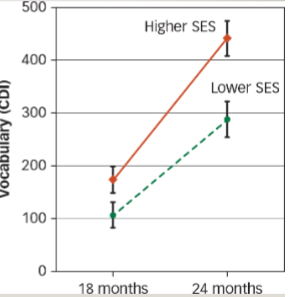
Contextual Influences on Language Development: Poverty
Before 18 months, children’s language knowledge are relatively the same. But after, higher SES children’s language knowledge increases and lower SES is significantly lower
Bowlby’s First Stage of Attachment Formation
Indiscriminate Social Responsiveness (birth to 2 months)
Associate caregiver with release of distress
Any caregiver will do as long as they relieve stress, they don’t have an attachment or care who it is
Bowlby’s Second Stage of Attachment Formation
Discriminating Sociability (2 through 6–7 months)
Prefer the familiar caregivers that always take care of them rather than just anyone
Bowlby’s Third Stage of Attachment Formation
Attachments (7–24 months)
Attachment has formed for that familiar caregiver
Bowlby’s Fourth Stage of Attachment Formation
Reciprocal Relationships (24–30 months and onward)
Not only does caregiver reach out to keep relo going, but the toddler is also reaching out to caregiver to continue interactions
Strange situations experiment (recall from psyc)
If we learn in childhood that you’re worthy of love and can be relieved from stress, you’re able to create secure attachments
Significance of Attachment in Adulthood
Securely Attached
desire emotional closeness and intimacy
Likely to form a secure attachment with children
Insecurely Attached
Lower internal working model
Don’t desire closeness as it makes them uncomfortable bc they don’t trust that closeness is possible
Self concept
The way we describe ourselves
Our assessment of our abilities, traits, and characteristics
The way we see ourselves – which may not be in line with how others see us
an ever-changing process, becoming more complex over our lifespan
Self esteem
Based on evaluation
How do you FEEL about your identity, looks, and the things you’re good/bad at?
Feelings of self-worth, self-acceptance, and self-respect
Relies on cognitive development and a sense of self that emerges over the course of childhood
Ex: “I’m not good a sports (description + self concept) but I don’t rlly care because I like art better (self esteem)
They understand that there’s things you can be good at or things you can’t be good at and it’s okay
Care Orientation:
Desire to maintain relationships and responsibility not to cause harm
Women most likely to develop this
Justice Orientation:
Based on abstract principles of fairness and individualism
More focused on human rights
Felt like men did a justice orientation reasoning
Found people reason in the same two ways (Care and Justice)
Androgyny
Integrating masculine and feminine characteristics
Way of behaving, thinking, communicating, being
More mature
Report higher satisfaction with work life and relationships
Score high on all satisfactions
Linked with positive adjustment
Emerging sexuality
Normal for toddlers/preschoolers to self-stimulate
Teen pregnancy protective factors
Knowledge of normal child development/parenting class
family + community support
stable living environment
parental involvement
Sexual Activity in Adulthood
Frequency of Sexual Activity Is Highest in Young Adulthood
Cohabiting household statistics
Increased 4 times as many cohabiting households than 20 yrs ago
Canada has the highest cohabitation rate in the G7
23% of the majority now, 6% of the majority 20 yrs ago
Cohabiting household: who cohabits?
Lots of people in Quebec bc they’re very liberal (they detached themselves from the Catholic church) and their relationship with France, who has a very high cohabitation households
Typically, people who have lower education and income are more likely to cohabit. Also seen in the US
Single-Parent Families – Children’s Experiences – Protective Factors
Reduce number of changes/influence that affects child development: child support, father involvement, matching parental styles, parents continuing to communicate after separation
Perceived Control: Self Efficacy
Gender
Men report that they have more of this than women
Women take on childcare, household chores, jobs, so they have less of this
SES & Race/Ethnicity: influence/reduces control based on where you are
Non POC and minority + high SES: correlates to High Perceived Control: better lifestyle, health, better adaptability to stress
Parenting Styles: Authoritative → Type of parenting and outcomes for children
Warmth and Control
High on both
Seen as parenting style that has best outcome for children
Provide consistency, routine, stability, structure
Children are well aware of the structure and expectations of behaviour
Rules are open to negotiation
Outcomes for Children
Most positive outcomes
Highest academic achievement
Very cooperative children with everyone, not just parents
Are able to seek help from parents
Parenting Styles: Authoritarian → Type of parenting and outcomes for children
Warmth and Control
High on control, low on warmth
They don’t explain the rules and why they have them, so the children grow up not understanding cause and effect
Rules aren’t open for negotiation
Outcomes for Children
Lower academic achievement
Tendency to be more dependent on others
Make bad decisions bc their parents always made the decisions for them without negotiation
Lack compromise skills
Parenting Styles: Permissive→ Type of parenting and outcomes for children
Warmth and Control
High on warmth, low on control
Love children unconditionally and form secure attachment
But there’s no routine or structure, no expectations or consequences
Children are spoiled in permissive households
Outcomes for Children
Lower academic achievement
Don’t get along with others
Don’t have good social skills
Have tendency to lack impulse control and self regulation because they could do whatever they wanted
As adults, they’re terrible partners, roommates, etc.
Parenting Styles: Uninvolved→ Type of parenting and outcomes for children
Warmth and Control
Low on both
Do minimum amount possible
Want to expend as little energy as they can on children
Either very wealthy bc smo else is raising them, or, they’re parents that are absent bc they’re abusing drugs and alcohol/significant mental health issues that prevent them from raising children
Outcomes for Children
Poor outcomes for psychosocial and emotional development
No rules or structure, don’t feel loved
Poor academic achievement and IQ
Aggressive kids, bullies, behavioural problems in school, often suspended or expelled
Early drug and alcohol use, early sexual activity, higher drop out rate, high likeness of criminal activity
Concerted Cultivation: For middle and upper class
they spend a lot of time and money cultivating a child's talent to optimize a child's future success, like good schools, achieving career aspirations, etc.
Accomplishment of Natural Growth: For working and under class (poverty)
let children naturally develop any talents they have
Inductive Discipline
Discipline method based on reasoning and guidance
Lay out expectations so they know what they can and can’t do
Provide enormous amount of guidance so they know what’s expected of them
Ex: saying “hey, I don’t want you running around at the restaurant because you might hurt yourself or trip the servers” before they go out to eat
Children almost all the time follow those guidances
Ineffective Forms of Discipline: Parents who Use Physical Discipline
Likely younger parents
Likely to use authoritarian parenting style
Mothers spank more than fathers bc moms spend more time with kids than dads
95% of parents justify spanking, and a lot of the times it’s out of anger, their parents have done it before, and they don’t know what else to do
Parental Contributions
Positive
Be authoritative parents
Parents role modeling healthy relationships and get along with each other
Parents have strong relo’s with siblings
Facilitating conflict resolution
Negative
Not forming secure attachment
If parents fight all the time
If parents fight with siblings
Not facilitating conflict resolution
Favoring one child over the other
Physical and Socioemotional Benefits of Play
Helps children learn rule making and boundaries
Aids in gross motor skills, improving muscle strength and physical control
Allows children to learn cooperation and emotional expression
Importance of Mastering Reading and Mathematics in Primary School
If you have early reading challenges, it affects every other subject. You need reading skills to understand sciences, maths, history, etc.
Those who have reading deficits struggle throughout primary and secondary school
Reading deficits increases chances of high school dropouts
Math is a foundation of everything, also increases likeness of high school dropouts
Achievement Motivation
The willingness to persist at challenging tasks and meet high standards of accomplishment
Infants + Achievement motivation
Lies in their earliest activities
Infants seem to be motivated to do things, interact with the world, and do new things
Infants are trying and wanting to learn and do new things
So something is motivating them to do new things INTERNALLY without motivation from parents and caregivers
Mastery Motivation
Begins with an infant’s drive to explore, understand and master their environment
Fostered by engaging and nurturing environments in which infants, toddlers, and young children have an opportunity to exert control over stimuli and interactions
Mastery Motivation influences many aspects of development
Better self concept
Better self regulation
Better prepared for primary school
Better perceived control
Contextual Influences on Achievement Motivation: Parents
Parenting approach to Erikson’s stages
Availability of opportunities and resources
Higher SES families can get tutors, private coaches, etc.
Lower SES families who have kids who need extra help can’t afford it
Parental Influences on Occupational Choice
Social class, low or high SES
Work to live or live to work- this lifestyle teaches children how they should view life and careers
Work to live: work is a necessity for survival, not a passion
Live to work: work is a passion to cultivate, not just for survival
Paid vs. Unpaid Work
Women are doing 17.5 hours of hard labour without pay at home, like cleaning, doing the laundry, cooking, etc, which is a daily chores
Men do 10.5 hours bc their labour a lot of the times are sporadic or monthly chores
But we don’t see this trend in lesbian and gay couples, so they divide it more evenly
Sexual Coercion/Sexual Assault: Contextual Influences
Rape myths like blaming for the way women dress, and perpetrators believing in that myth
Gender role stereotyping that encourages male dominance, aggression, and competition
Including things like expectations of and social rewards for hyper masculinity and toxically masculine behaviors (“Man Up”)
We see higher rates of perpetrators in male groups that value hyper masculinity, like athletes, military, fraternities