Anthro 2B Final
 Call Kai
 Learn
Learn Practice Test
 Spaced Repetition
 Match
Match Flashcards
 Knowt Play
1/102

There's no tags or description
Looks like no tags are added yet.
Name | Mastery | Learn | Test | Matching | Spaced | Call with Kai |
|---|
No analytics yet
Send a link to your students to track their progress
103 Terms
Macro Evolution
Evolution that results in new species over long time
Micro Evolution
small genetic changes in a population in a short period of time
Speciation
organisms evolve into distinct, separate species
Extrinsic Reproductive Isolating Mechanism
external factors that spot organism from breeding like geographic isolation
Pre-zygotic Reproductive Isolating Mechanism
biological barrier that prevents breeding like behavioral isolation
Postzygotic reproductive isolation
biological barriers prevent a hybrid zygote from developing into a healthy, fertile, and reproducing adult. EX: zygote created from egg and sperm but once zygote grows up, cant reproduce.
Anagenesis
single species grows over time to become new form. No splitting
Cladogenesis
Species splits
Phyletic Gradualism
proposes speciation happens in slow rate
Punctuated Equilibrium
long periods of no evolution than sudden rapid change
Adaptive Radiation
single species rapidly splits
Homology
similar structure from common ancestor. EX: bats and humans have similar limbs from common ancestor
Analogy
noncommon ancestor but similar structure.
Convergence
analogy in drastically unrelated organisms
Parallelism Analogy
analogy in similar organisms from similar environments
Primitive Traits
traits retained from ancestor
Derived traits
modification from ancestral form
shared derived traits
species with common ancestor have similar derived traits.
Post Orbital Bar
bone that protects top of eye
Post-Orbital Partition (Septum/Closure)
bone that protects back of eye
Auditory Bulla
tiny bones of middle ear arc
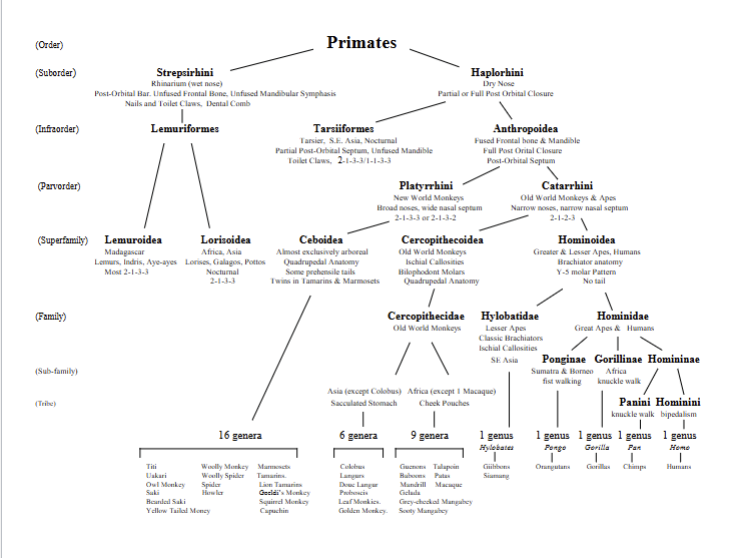
Strepsirrhini
to lemuroidea and lorisoidea
Haplorrhini
to Tarsiformes
Anthropoidea
Platyrrhini and Catarrhini
Platyrrhini
down to Superfamily
Catarrhini
Cercopithecoidea and Hominoidea
Cercopithecoidea
down to family
Hominoidea
down to genus
Dental Formula
#incisors: #canines: #premolars: #molars of upper quadrant
#incisors: #canines: #premolars: #molars of lower quadrant
Mandibular Symphasis
where two halves of jaw combine
Dental Comb
incisors jut out horizontally
Rhinarium
wet nose
Toilet Claw
one enlongated nail in primates
Twin Births
common in Small Ceboids like Tamarins and Marmosets
Canine Diastema
gaps between teeth for animals with canines so mouth closes
CP3 Complex
large canines used for agression
Sectorial Premolar
special molar ins some primates for cutting and slicing food
Bilophodont Molar Pattern
2 Ridged tooth, 4 cups
Y-5 Molar Pattern
5 cusps on each molar, low peaking, no ridges, best for grinding
Hominoid vs Quadraped (Hominoid section)
wide and shallow thorax, scapula on back, full shoulder rotation, can flex wrist toward inside of body
Hominoid vs Quadraped (Quadraped section)
narrow and deep thorax, scapula on side, limited shoulder rotation, limited wrist flex
Fist Walking in Hominoids
Orangutan
Knuckle Walking in Hominoids
Chimps and gorilla
Locomotion-Body Size Relationship
small primates run on top of branches, bigger ones hang underneath
Intermembral Index (IMI)
over 100: longer arms. less than 100: shorter arms
Forms of Primate Locomotion
Quadrapedalism (Semi-Brachiate) for 100 IMI, Suspensory (Brachiation) for over 100 IMI, Bipedalism for IMI less that 100
Polyandrous Group
one female with multple adult males, males take care of offspring
Home Range
area where species lives
Territory
part of Home Range that individuals in species fight for
Primate Socio- Ecology Positives
increased knowledge, increased protection, increased mate availability
Primate Socio- Ecology Negatives
increased mate competition, increased resource competition, increased parasite load
Variability of Resources
Resources in clusters that are widely spread supports monogamy. Resources that are closer together supports formation of groups
Predation Pressure
low amount of predators: supports single male groups
high amount of predators: supports multi male groups
Dominance Hierarchies
ranked statuses sustained by hostile behavior. Dominance equals more food and mate more
Chimpanzee and Human Split
7-10 years ago
What it Means to Be 98% Chimpanzee and genetic similarity
chimp used as link between man and nature
What it Means to Be 98% Chimpanzee and genetic difference
are differences between ourselves due to differences in genetics of culture
Science: Accuracy & Authority
science is a part of culture and makes assumptions. It produces knowledge in turn producing culture
Scientism
uncritical acceptance of scientifical claims
Genetics naturaling the social world
our culture unconsciously is used to shape our natural behaviour
Scientism of Eugenics
forced sterilization and removal of those thought to have low IQ
Human Genome Diversity Project
companies try to patent the DNA of indigenous populations
Paleospecies
using anatomical differences to see if species breeded or not
Molecular Clock
Humans and Chimpanzees split 7-10 mya
Nucleotide Sequencing
compare same strip of DNA. Count of nucleotide difference between homologous chromosomes. Make array and tree topology
Taphonomy
Study of what happens to organic remains after death
fossil
replaces organic matter with inorganic
Stratigraphy (Relative Dating Method)
sequential layering of geological deposits, each layer is a stratum
Isotopic Dating
unstable nucleus fires off some of itself to become stable
half life: time it takes for half of nucleus to fire off itself
Potassium-Argon Dating
goes from Potassium to Argon gas.
Material: previously molten rock
Half-life: 1.3 billion years
Temporal Range: beginning of earth to 100,000 years ago
Carbon 14 dating
Carbon to Nitrogen gas
material: organic material (once living)
half-life: 5700 years
temporal range: 70,000 to now
Paleocene Epoch
primate like mammals. prehensile hands and feet, not binocular vision
Eocene Epoch
primates.
post orbital bar, forward facing eyes, nails, auditory bulla fused
Oligocene Epoch
north east africa, first anthropoids, full post orbital closure
Cataarhine/Platyrrhines
Aegytopithecus: example of Catarrhine
Miocene Epoch
In africa then spread out
Hominoids and few Cerupithocoids
Proconsul: Africa, Early Miocene
Sivapithecus: Asia, orangutan ancestor
Late Miocene and Early Pilocene
Hominins
Sahelanthropus: Central Afrcia,candidate for oldest human fossil
Ardipithecus: East Africa, ape like features
Australopithecus: east Africa, bipedal, extreme sexual dimorphism
Ardipithecus kadaba
Ardithecus sub species
large canines and short legs
Australopithecus afarensis
East Africa, 3 mya,
ape brain, large teeth, long arms and toes, bipedal, could climb
Robust
big muscles
Australopithecus garhi (Gracile)
east africa, stone tool for meet