PBL semester 1
0.0(0)
Studied by 0 people Call Kai
 Learn
 Practice Test
 Spaced Repetition
 Match
 Flashcards
 Knowt Play
Card Sorting
1/164

Earn XP
Description and Tags
165 Terms
1
New cards
Advantages of working in groups (5)
1. Better decision making
2. Superior resources
3. Enhanced learning
4. Enhanced creativity
5. Member satisfaction
2
New cards
Disadvantages of working in groups (3)
1. Conflict potential
2. People problems
3. Requires more time, energy and resources
3
New cards
Synergy
A state where the collaboration of group members produces better results than what would have been expected by the sum of the skills of the individuals
4
New cards
Components of group communication (3)
1. Theory: clear, systematic, and predictive explanation of a phenomenon (helps understand why there is success/failure)
2. Strategy: method/guideline/technique used for dealing with problems that arise
3. Skill: specific ability that helps group engage to achieve common goal (requires communication skills)
Effective strategies and skill is based on theories.
5
New cards
Stages of group development (5)
1. Forming
2. Storming
3. Norming
4. Performing
5. Adjourning
6
New cards
What are group norms?
* Expectations concerning what is acceptable/unacceptable
* Express ethical standards
* Help group function efficiently
* Enhance productivity
* Ensure group survival
* Express ethical standards
* Help group function efficiently
* Enhance productivity
* Ensure group survival
7
New cards
Explicit vs. Implicit norms
Explicit norms = written or stated verbally and shared with all members
Implicit norms = rarely communicated but still expected, harder to understand
Implicit norms = rarely communicated but still expected, harder to understand
8
New cards
Categories of norms (4)
* interaction (how members communicate i.e using words like “we”)
* Procedural (how group operates i.e silencing phone)
* Status (level of influence/power among members + how it is earned i.e leader sits at table head)
* Achievement (Quality/quantity of work expected i.e everyone shows up on time)
\
* Procedural (how group operates i.e silencing phone)
* Status (level of influence/power among members + how it is earned i.e leader sits at table head)
* Achievement (Quality/quantity of work expected i.e everyone shows up on time)
\
9
New cards
Constructive vs non constructive conformity
Constructive = alerts to problems that may prevent group from meeting goal
Deconstructive = resistance to norms without regard for group interest.
Deconstructive = resistance to norms without regard for group interest.
10
New cards
Categories of motivation (4)
1. Meaningfulness (shared feeling of pursuing worth task)
2. Choice
3. Competence
4. Progress
11
New cards
Group member needs (3)
1. Inclusion
2. Control
3. Affection
12
New cards
Group Task roles (7)
1. Coordinator
2. Info provider
3. Opinion provider
4. Questioner
5. Clarifier
6. Analyzer
7. Implementer
13
New cards
Group Social maintenance roles (5)
1. Harmonizer
2. Motivator
3. Supporter
4. Gatekeeper
5. Team builder
14
New cards
Best group members have:
Flexibility, assertiveness
15
New cards
Disruptive group behaviours (6)
1. Dominator
2. Obstructionist
3. Attacker
4. Egoist
5. Support seeker
6. Non-participant
16
New cards
Steps of the PBL process (6)
1. Problem presented to group, terms reviewed and hypothesis generated
2. Learning issues and information sources identified by group
3. Information gathering and independent study
4. Knowledge acquired is discussed and debated critically
5. Knowledge applied to problem in a practical way and hypotheses confirmed or refuted
6. Reflection on the content and process of learning occurs
17
New cards
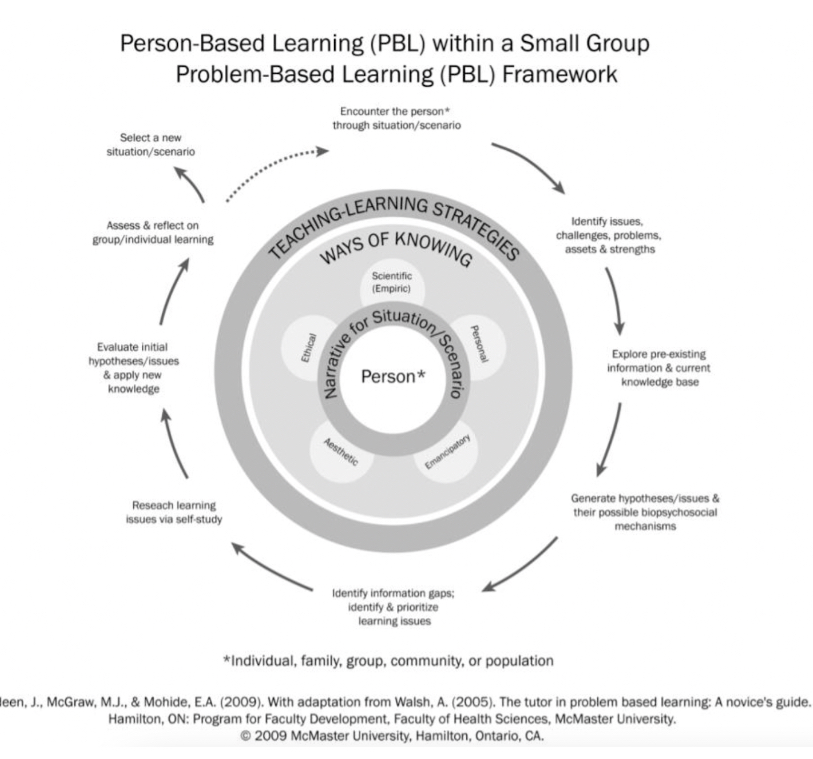
PBL framework
H
18
New cards
Concept mapping
* organize information
* contain links
* cluster data
* visually demonstrate relationships between data.
* contain links
* cluster data
* visually demonstrate relationships between data.
19
New cards
How does concept mapping help nursing students?
If nurses can visually see a plan that organizes thoughts and actions they do much better in responding or reacting.
* guide for critical thinking
* Logical flow of thought and planning
* guide for critical thinking
* Logical flow of thought and planning
20
New cards
What are narratives?
Stories, experiences, feelings, worries and perspectives of individuals
21
New cards
Narrative competence
Ability to acknowledge, absorb, interpret and act on stories and plights of others
22
New cards
Narrative medicine
Medicine practical with narrative competence (humane and effective medical practice.)
23
New cards
Ways to deal with a troublesome group member
* Accept
* Confront
* Exclude
* Confront
* Exclude
24
New cards
Extrinsic vs intrinsic motivation
Extrinsic = comes from external sources
* boss, teacher coach friend family member or role model
Intrinsic = rewards that come from internal sources inherent in a particular way
* pride, personal accomplishment.
* boss, teacher coach friend family member or role model
Intrinsic = rewards that come from internal sources inherent in a particular way
* pride, personal accomplishment.
25
New cards
5 fundamental patterns of knowing
* Emancipatory knowing
* Ethical knowing
* Personal knowing
* Aesthetic knowing
* Empirical/scientific knowing
* Ethical knowing
* Personal knowing
* Aesthetic knowing
* Empirical/scientific knowing
26
New cards
Emancipatory knowing
* human capacity to be aware and critically reflect on the social, cultural and political status quo
* How it came to be that way
* Inequities embedded in social and political institutions
* Changes needed for fair and equitable conditions for all
* How it came to be that way
* Inequities embedded in social and political institutions
* Changes needed for fair and equitable conditions for all
27
New cards
Ethical knowing
* focused on matters of obligation
* What ought to be done
* Moment to moment judgements
* What is good right and responsible
* Morally behaving in practice
* Importances, loyalties and priorities
* What ought to be done
* Moment to moment judgements
* What is good right and responsible
* Morally behaving in practice
* Importances, loyalties and priorities
28
New cards
Personal knowing
* inner experience of becoming whole, aware genuine self
* Knowing self and self in relation to others
* Knowing self and self in relation to others
29
New cards
Aesthetic knowing
* deep appreciation of the meaning of a situation
* Inner resources that transform experience
* Expressed through actions, bearing, conduct, attitudes, narrative, and interactions
* Inner resources that transform experience
* Expressed through actions, bearing, conduct, attitudes, narrative, and interactions
30
New cards
Empirical knowing
* grounded in science
* Objective truths
* Scientific competence
* Competent action grounded in scientific knowledge including theory
* Objective truths
* Scientific competence
* Competent action grounded in scientific knowledge including theory
31
New cards
Knowing refers to…
Ways of perceiving and understanding the self and the world.
* ontological
* Dynamic
* Changing
Process
* ontological
* Dynamic
* Changing
Process
32
New cards
Praxis
All patterns of knowing integrated in a way that supports social justice
33
New cards
Patterns gone wild
Distortion when knowledge is not integrated within whole of knowing
* knowledge developed in isolation without consideration of all patterns of knowing = uncritical acceptance, narrow interpretation, partial use of knowledge
* emancipatory removed = extreme political standpoint unjustly imposed on others
* Empirics removed = control and manipulation
* Ethics removed = rigid doctrine and insensitivity to rights of others
* Personal knowing removed = isolation and self distortion
* Aesthetics removed = indulgence in self serving expressions, lack of appreciation for fullness of meaning in context.
* knowledge developed in isolation without consideration of all patterns of knowing = uncritical acceptance, narrow interpretation, partial use of knowledge
* emancipatory removed = extreme political standpoint unjustly imposed on others
* Empirics removed = control and manipulation
* Ethics removed = rigid doctrine and insensitivity to rights of others
* Personal knowing removed = isolation and self distortion
* Aesthetics removed = indulgence in self serving expressions, lack of appreciation for fullness of meaning in context.
34
New cards
How can information be analyzed?
* The order it was originally produced in (Primary, secondary, tertiary)
* By person providing info (author)
* Based on audience
* By person providing info (author)
* Based on audience
35
New cards
How can information be organized?
* fiction or non fiction
* Subject (math, English etc.)
* Based on media (DVD, CD etc.)
* Subject (math, English etc.)
* Based on media (DVD, CD etc.)
36
New cards
URL
An address unique to every article, document, media file etc.
* tells the audience what the info is about
* tells the audience what the info is about
37
New cards
Domain names
3 letter endings on the URL that indicate which organization is sponsoring the article
(.com .ca .gov .edu etc.)
(.com .ca .gov .edu etc.)
38
New cards
Popular, scholarly and trade resources
Popular:
* magazines, popular books etc. intended to entertain the audience
Scholarly:
* journals etc. created/formed by professionals for academic and research purposes
Trade:
* combination of both popular and scholarly resources that can benefit practitioners wanting to improve their business
* magazines, popular books etc. intended to entertain the audience
Scholarly:
* journals etc. created/formed by professionals for academic and research purposes
Trade:
* combination of both popular and scholarly resources that can benefit practitioners wanting to improve their business
39
New cards
Primary resource
* the original copies that have not been altered
* I.e evidence in a crime scene
* I.e evidence in a crime scene
40
New cards
Secondary resource
* summarize the original
* Interpret + analyze the information
* I.e scholarly papers, journals, and magazines
* Interpret + analyze the information
* I.e scholarly papers, journals, and magazines
41
New cards
Tertiary resource
* things like the index that is being used to organize the primary and secondary resources
* Do not provide any additional information or interpretation.
* Do not provide any additional information or interpretation.
42
New cards
How is asking a question beneficial to research?
1. Questions require answers
2. Give a way of evaluating answers (helps to decide which information will be useful)
3. Clear open ended question calls for research and thinking (makes research and writing more meaningful.)
43
New cards
Brainstorming
Method of shared problem solving in which all members of a group spontaneously contribute ideas.
44
New cards
Concept mapping
A process focused on a topic, in which group or individual brainstorming produces a visual graphic that represents how the creators thinks about a subject topic
45
New cards
Strategies to narrow a concept
* specify time
* Specify place
* Specify population
* Specify viewpoint
* Specify place
* Specify population
* Specify viewpoint
46
New cards
Database
Collection of data arranged for ease + speed of search + retrieval
47
New cards
Records
Building blocks of databases
* describes information sources
* describes information sources
48
New cards
Fields
Building blocks of records sections
* sections of records where info started
* sections of records where info started
49
New cards
For keyword searching, more info = ?
And less info = ?
And less info = ?
More info = less precision
Less info = more precision
Less info = more precision
50
New cards
Catalog
Systematic list of books, merchandise or the like that is available in or from a source
51
New cards
categories of publishers
* commercial
* University presses
* Associations, societies, businesses, industries
* Governments and intergovernmental (United Nations)
* Web publishers
* University presses
* Associations, societies, businesses, industries
* Governments and intergovernmental (United Nations)
* Web publishers
52
New cards
Determining usefulness of a source
1. Objectivity: goals for the publication, any biases, is it valid
2. Quality: organization, grammar and spelling, graphic use accurate information
3. Coverage/currency: date of publication, current info, revised
4. Relevance: answers research question, appropriate for research topic
53
New cards
CRAAP tool
Currency, relevance, authority, accuracy, purpose
54
New cards
Plagiarism
Using the words or ideas of someone else as your own without citing the source
55
New cards
When to cite
1. When using a sources factual information or data
2. When quoting someone’s words
3. Summarizing, paraphrasing or using ideas and opinions of others
4. Using a sources structure, strategy, method or procedure
5. Mentioning another persons work.
56
New cards
How to build an essay
* outline
* Intro
* Body paragraphs
* Conclusion
* Intro
* Body paragraphs
* Conclusion
57
New cards
Elements of an effective thesis
* concise
* Clear
* Specific
* Arguable
* Clear
* Specific
* Arguable
58
New cards
Income + social status and health
* lower income = poorer health
* Material deprivation, psychological stress, poor coping behaviours and lack of support
* Material deprivation, psychological stress, poor coping behaviours and lack of support
59
New cards
Social support networks and health
* practical, informational, emotional, affirmational
* Strong social support linked with positive health outcomes
* Strong social support linked with positive health outcomes
60
New cards
Education + literacy in health
* direct = not being literate, can’t read safety instructions
* Indirect = not using the right resources lack of awareness and lack of info
* Poor health literacy
* Indirect = not using the right resources lack of awareness and lack of info
* Poor health literacy
61
New cards
Employment + working conditions and health
* unemployment and job insecurities can lead to material and social deprivation, psychological stress and turning to coping behaviours.
62
New cards
Physical environment and health
* Built and natural environment
* Directly effects health
* Directly effects health
63
New cards
Biological and genetic factors of health
* Hereditary can be influenced by other factors the determine how genetic factors express themselves.
64
New cards
Individual health practices and coping skills
* Risk behaviours can be coping strategies used to deal with living circumstances
65
New cards
Healthy child development and health
* early childhood development plays an important role is SDoH
* Shapes future behaviours, health, well-being, skill development.
* Shapes future behaviours, health, well-being, skill development.
66
New cards
Health services
* like quality and accessible primary care, hospital care, long-term care, home care, public health services all have and impact on the health status of an individual
67
New cards
Race and health
* Gender and race based inequality
* Experience many disadvantages compared to non Racialized groups
* Experience many disadvantages compared to non Racialized groups
68
New cards
Culture and health
* cultural factories influence access to and understanding of health promotion and illness management
* Culture and immigration can affect multiple other SDoH
* Culture and immigration can affect multiple other SDoH
69
New cards
Gender and health
* Gender is the socially determined roles
* Influences all social determinants of health
* Influences all social determinants of health
70
New cards
Levels of prevention
1. Primary prevention
2. Secondary prevention
3. Tertiary prevention
71
New cards
Primary prevention
Activities that protect against a disease before signs and symptoms occur (prepathogenesis stage of disease)
* i.e immunizations, reduction of risk factors such as smoking
* i.e immunizations, reduction of risk factors such as smoking
72
New cards
Secondary prevention
Activities that promote early detection of disease once pathogenesis has occurred so that prompt treatment can be initiated.
* i.e preventative screening for cancer (pap test, testicular self-examination)
* i.e preventative screening for cancer (pap test, testicular self-examination)
73
New cards
Tertiary prevention
Activities that are initiated in the convalescence stage of disease and are directed towards minimizing residual disability and helping people to live productively with limitations.
* i.e a cardiac rehabilitation program after myocardial infarction or eye exercises/physical therapy after eye surgery.
* i.e a cardiac rehabilitation program after myocardial infarction or eye exercises/physical therapy after eye surgery.
74
New cards
Health promotion
Directed towards increasing the level of well-being and self-actualization
* enabling people to increase control over and improve their health
* enabling people to increase control over and improve their health
75
New cards
Health promotion from nursing perspective (5)
* Health promotion addresses health issues in context
* Supports holistic approach
* Requires long term perspective
* Is multisectoral
* Draws on knowledge from social, economic, political, environmental, medical, and nursing sciences
* Supports holistic approach
* Requires long term perspective
* Is multisectoral
* Draws on knowledge from social, economic, political, environmental, medical, and nursing sciences
76
New cards
Passive vs. Active health promotion
Passive: public health efforts to maintain clean water systems
Active: depends on individual becoming personally involved in adopting a proposed program of health promotion
Active: depends on individual becoming personally involved in adopting a proposed program of health promotion
77
New cards
3 approaches to health promotion
1. Medical approach
2. Behavioural approach
3. Socioeconomic approach
78
New cards
Medical approach to health promotion
* stability orientation to health
* Mostly dominated by western perspective
* Health problems are primarily psychological risk factors
* Ensures populations remain healthy through medical intervention of physiological risk factors
* Disease fighting
* Mostly dominated by western perspective
* Health problems are primarily psychological risk factors
* Ensures populations remain healthy through medical intervention of physiological risk factors
* Disease fighting
79
New cards
Behavioural approach to health promotion
* focuses on decreasing behavioural risk
* Change in lifestyle (i.e smoking)
* Primarily impacted by Lalonde
* Advocates for health promotion and disease prevention
* Includes more preventative and healthy behaviours
* Change in lifestyle (i.e smoking)
* Primarily impacted by Lalonde
* Advocates for health promotion and disease prevention
* Includes more preventative and healthy behaviours
80
New cards
Socioeconomic approach
* states that health is closely linked to socioeconomic factors, such as workplace environment and other SDoH
* Upstream health promotion
* Other factors to address before the person gets sick
* Tied to social structures, i.e poverty
* Unhealthy physical and social environments
* Upstream health promotion
* Other factors to address before the person gets sick
* Tied to social structures, i.e poverty
* Unhealthy physical and social environments
81
New cards
Disease
* failure of persons adaptive mechanisms to counteract stimuli and stresses adequately
* Leads to a functional and structural disturbance
* Diagnosable disorder
* Can cause physical symptoms (doesn’t need to)
* Specific prognosis and treatment plan
* Not a social construct (testable/provable)
* I.e flu, Alzheimer’s, cancer, diabetes
* Leads to a functional and structural disturbance
* Diagnosable disorder
* Can cause physical symptoms (doesn’t need to)
* Specific prognosis and treatment plan
* Not a social construct (testable/provable)
* I.e flu, Alzheimer’s, cancer, diabetes
82
New cards
Illness
* disease or period of sickness affecting body or mind
* Physical condition of feeling unwell
* Subjective condition
* Unlike disease, it is not diagnosable and is based on social constructs
* Physical condition of feeling unwell
* Subjective condition
* Unlike disease, it is not diagnosable and is based on social constructs
83
New cards
Evidence-informed decision making (EIDM)
* using best available research evidence into decision making process
* Research applied and interpreted into each clinical judgement and care scenarios
* Research applied and interpreted into each clinical judgement and care scenarios
84
New cards
Evidence based medicine (EBM)
Supports client care decisions with best available evidence
85
New cards
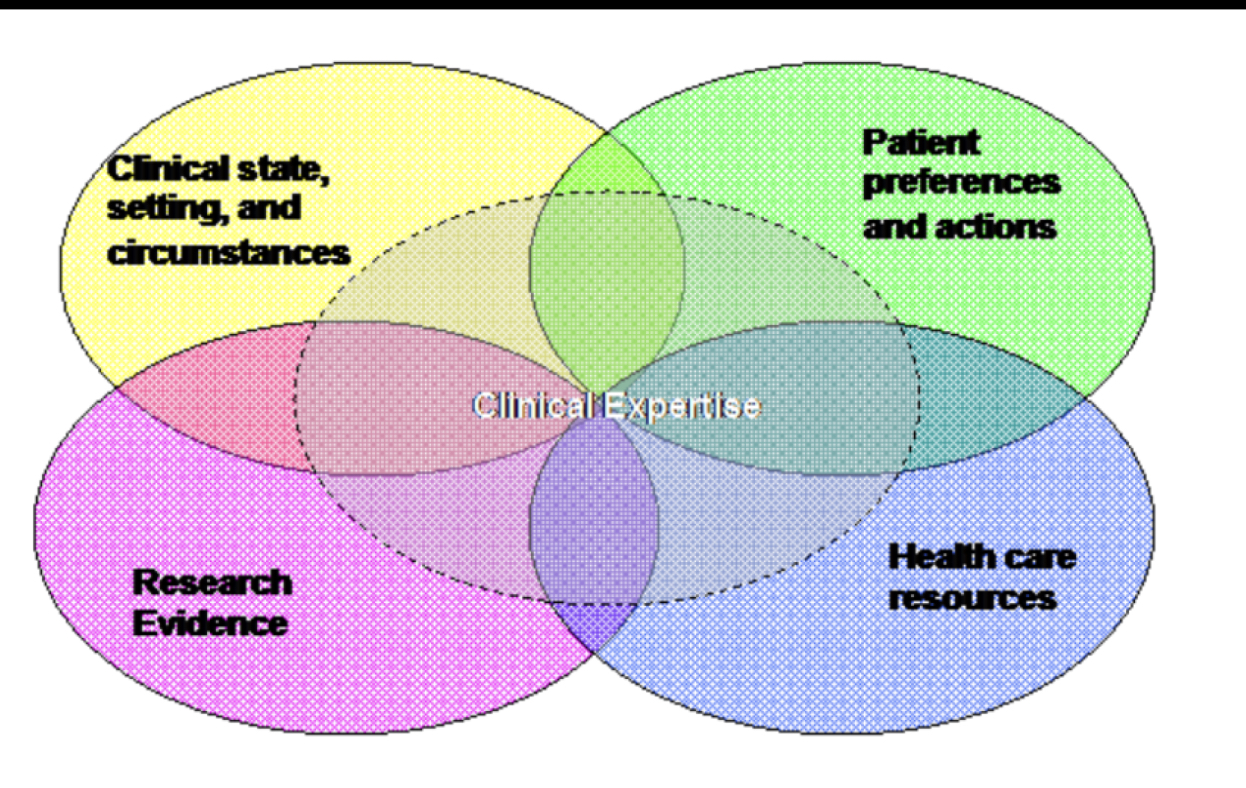
Model for evidence informed decision making
4 factors determine clinical expertise
1. Clinical state, setting and circumstances
2. Patient preferences and actions
3. Research evidence
4. Health care resources
These plus clinical expertise make up the sources of evidence
1. Clinical state, setting and circumstances
2. Patient preferences and actions
3. Research evidence
4. Health care resources
These plus clinical expertise make up the sources of evidence
86
New cards
Evidence from research
* most relevant, high quality quantitative or qualitative evidence available.
* Research findings from a variety of disciplines and sectors
* Research findings from a variety of disciplines and sectors
87
New cards
Clinical state, setting and circumstances evidence
* severity of the illness/disease
* Setting (acute care, public health)
* Setting (acute care, public health)
88
New cards
Patient preferences and actions as evidence
* clients views about health care options (related to personal values and experiences, culture, degree of aversion to risk, health care insurance and resources, accuracy of information at hand, and family)
89
New cards
Health care resources as evidence
* financial resources
* Human Resources (personnel/staff)
* Materials
* Human Resources (personnel/staff)
* Materials
90
New cards
clinical expertise
* clinical skills
* Past experiences
* Past experiences
91
New cards
Steps of EIDM
1. Define
* create a focussed answerable question from practice situation, based on information needs)
2. Search
* use pre-processed research evidence that’s trustworthy and relevant
3. Appraise: thoroughly evaluate research sources
4. Synthesize: determine and interpret recommendations from literature for practice
5. Apply: integrate and apply research results to patient/target population
* also think about other parts of EIDM model
6. Implement: decide and plan on how to implement the research into practice
7. Evaluate: effectiveness of the implementation efforts.
92
New cards
PICO questions
Are used to be very specific about the question we want to ask. It is very useful in preparing nurses to conduct a search of research evidence
PICO stands for
* Patient or Population
* Intervention
* Comparison
* Outcome
Used for quantitative questions
PICO stands for
* Patient or Population
* Intervention
* Comparison
* Outcome
Used for quantitative questions
93
New cards
PS questions
When context or experience questions are best answered by qualitative research
PS stands for
* Patient/Population
* Situation
PS stands for
* Patient/Population
* Situation
94
New cards
Background question
* general, fills in gaps in knowledge
* I.e how does the brain work?
* I.e What is type 2 diabetes? How is type 2 diabetes managed?
* I.e how does the brain work?
* I.e What is type 2 diabetes? How is type 2 diabetes managed?
95
New cards
Foreground questions
* Specific question
* How is visual information processed for a partially blind patient
\
* How is visual information processed for a partially blind patient
\
96
New cards
Tips to tell the difference between qualitative and quantitative data
Qualitative:
* broader title
* Uses statistics more-so to support rather than as its prime evidence
Quantitative:
* narrowed title
* Uses terms such as “random sampling” “control group”
* Contains numbers in results sections
* broader title
* Uses statistics more-so to support rather than as its prime evidence
Quantitative:
* narrowed title
* Uses terms such as “random sampling” “control group”
* Contains numbers in results sections
97
New cards
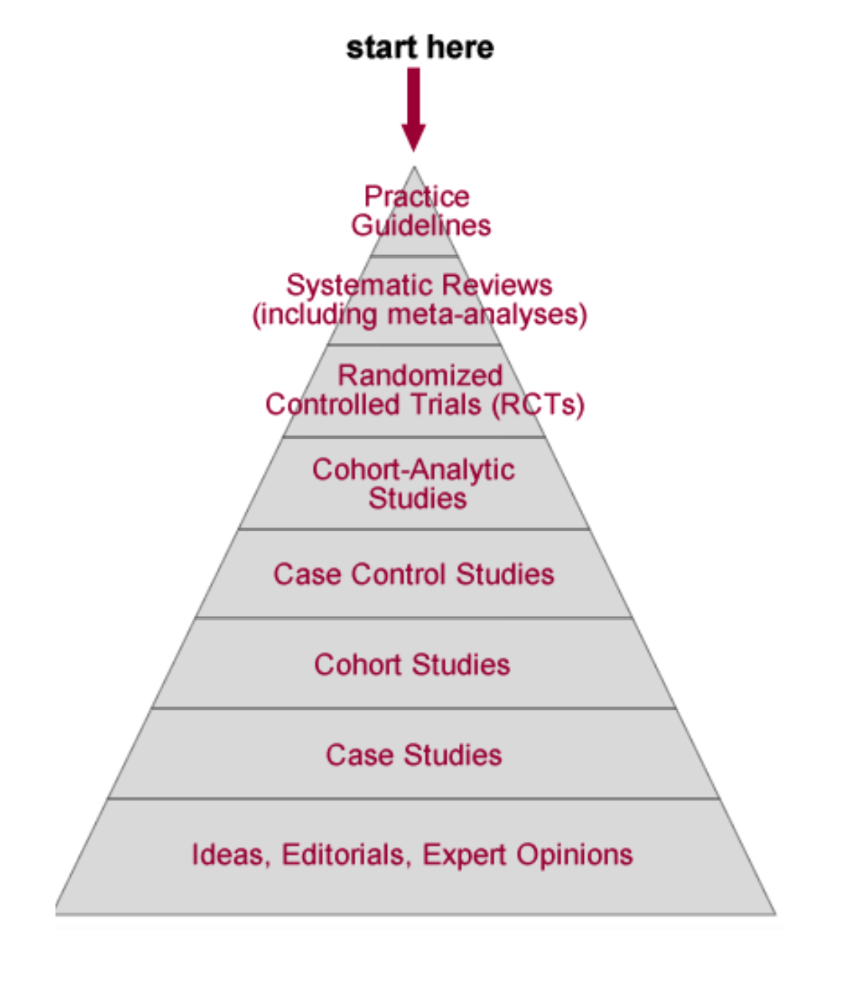
Hierarchy of quantitative research
Starts at top of pyramid:
1. Practice guidelines
2. Systematic reviews (including meta analyses)
3. Randomized controlled trials (RCTs)
4. Cohort-Analytic studies
5. Case control studies
6. Cohort studies
7. Case studies
8. Ideas, editorials, expert opinions
1. Practice guidelines
2. Systematic reviews (including meta analyses)
3. Randomized controlled trials (RCTs)
4. Cohort-Analytic studies
5. Case control studies
6. Cohort studies
7. Case studies
8. Ideas, editorials, expert opinions
98
New cards
Purpose of the 6s pyramid
To find the best research evidence with the least amount of time and effort.
99
New cards
Pieces of the 6S pyramid
By starting at the top of the pyramid you find the highest quality and synthesized research evidence first
1. Systems
2. Summaries
3. Synopses of syntheses
4. Syntheses (systematic reviews)
5. Synopses of single studies
6. Single studies
1. Systems
2. Summaries
3. Synopses of syntheses
4. Syntheses (systematic reviews)
5. Synopses of single studies
6. Single studies
100
New cards
Systems (6S pyramid)
Electronic systems that can be sophisticated enough to link patient records and to prompt practitioners about guidelines for care.
* not accessible unless in an institution
* Full database and policies and procedures as outlined by the hospital that is being looked at
* not accessible unless in an institution
* Full database and policies and procedures as outlined by the hospital that is being looked at