Lecture 6-8 Climate History
 Call Kai
 Learn
Learn Practice Test
 Spaced Repetition
 Match
Match Flashcards
 Knowt Play
1/46

There's no tags or description
Looks like no tags are added yet.
Name | Mastery | Learn | Test | Matching | Spaced | Call with Kai |
|---|
No analytics yet
Send a link to your students to track their progress
47 Terms
What is the K/T boundary?
Where the major extiction event happened, wiped out dinos and made way for mammals
Between cretaceous and paleocene
How is climate/temperature history reconstructed?
Materials that preserve the climate signal
Methods to determine the age of the material
What material is a good indication of climate history?
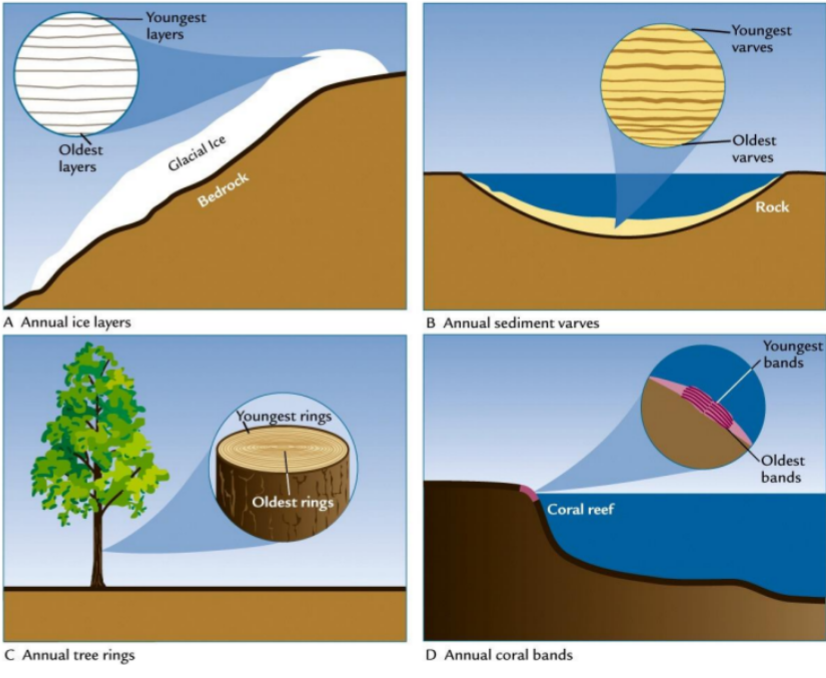
Sediment e.g., from lakes, ice, tree rings, oceans (deeper the better, well preserved) and corals (calcium carbonate banding)
Pollen can give an idea of the species living in the area, and give an idea of the climate based on what is needed to support the species
How is deep sea sediment collected?
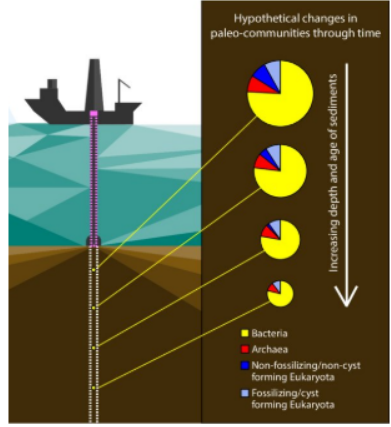
Long pole drilled down into sediment
Ice core from continental ice sheet compared to glaciers?
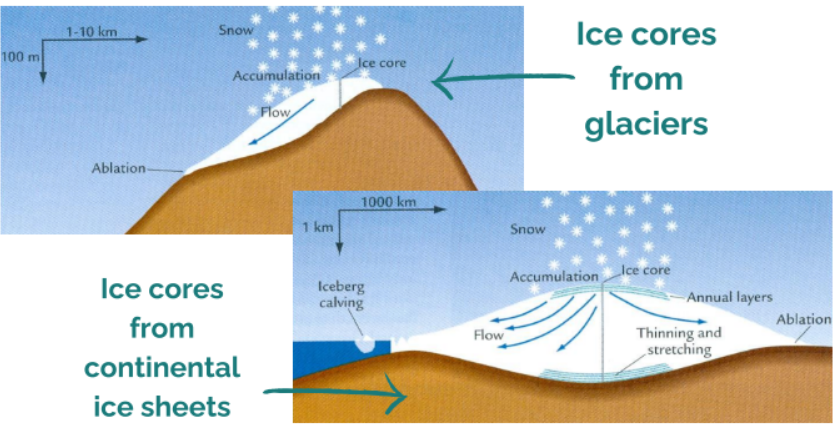
Glaciers only go back 1,000’s years where as ice sheets go back 100,000’s years as they are thicker
Taken by using cores
Can lock in marine organisms
How do we know the age of the material?
Radioactive decay: Look at the half-life of radio isotopes
Scientists use multiple archives that complement one another
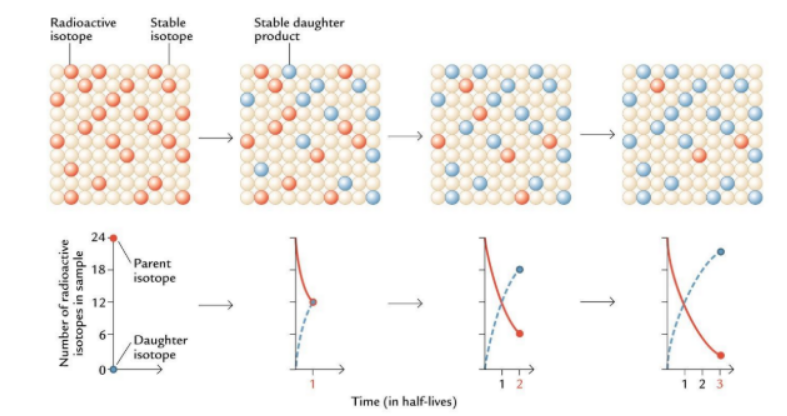
What are radio isoptopes?
Unstable forms of atoms that decay at a predictable rate, used like a clock to measure the time from the sediment where they are found
How are radio isotopes used to age material?
Release radiation and energy, causing them to shed matter (particle) = daughter isotope
Original = parent isotope
Shed to become more stable
Look at the relative abundance in a sample of parent to daughter isotopes and follow the trends to work out the length of half-life
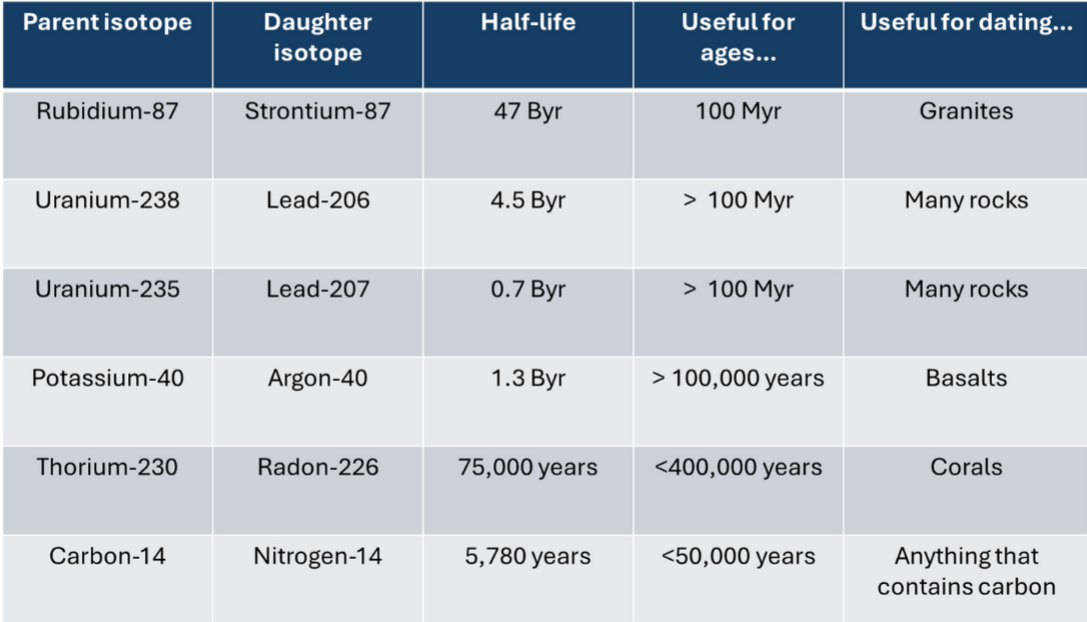
What is the half life?
Time taken from decay of parent isotope to daughter isotope
What is a proxy indicator of climate in the ocean?
Shelled plankton
What are the 4 common types of shelled plankton?
Foraminifera - CaCO3 shells
Coccolithophores - CaCO3 shells
Diatoms - SiO2 shells
Radiolaria - SiO2 shells
Why are calcium carbonate shells used more than silicone dioxide for aging?
Silicone dioxide is found in river mouths and coastal areas, whereas calcium carbonate is non-coastal, meaning it is well preserved on the shallow seafloor
What do shelled plankton tell us about the past climate?
Calcereous shells are made from CaCO3; one of the oxygen atoms comes from water
Natural stable oxygen isotopes in water molecules are Oxygen-16 and Oxygen-18 (heavier, more neutrons)
Can look at the difference in the ratio between the two isotopes of oxygen - both stable so don’t decay
Oxygen tells us about climate conditions
How to use oxygen isotopes to look at past climate?
Within seawater, the ratio (δ (delta) Oxygen-18) between oxygen-16 (light) and oxygen-18 (heavy) changes with the climate (both stable)
Depends on changes in the temperature
Driven by differences in evaporation and condensation relative to each other
Oxygen-16 (light) evaporates more readily than oxygen-18 (heavy)
Oxygen-18 condenses and rains out of the atmosphere more readily than oxygen-16
Seawater = higher proportion of oxygen-18
How does oxygen16/18 fit into the atmospheric air circulation patterns?
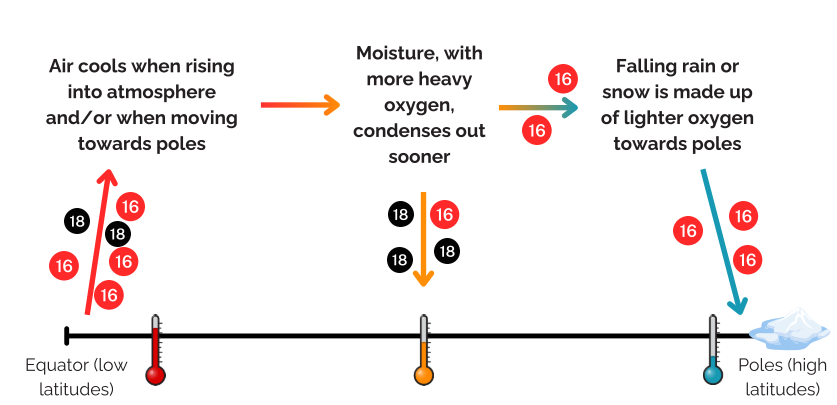
Equator = more solar radiation, water evaporates more readily taking up more oxygen-16 with it and some oxygen-18
As it gets higher in the atmostphere the water vapour will cool and move towards the poles
As it gets closer to the poles it cools, so everything condenses and rain forms
Oxygen-18 conseses out at a lower latitude
Near the poles (higher latitude) where it is really cold, water vapour = oxygen-16
Rain or snow near poles = oxygen-16, falls as snow and gets locked up as ice in the higher latitudes
More pronounced at colder temperatures
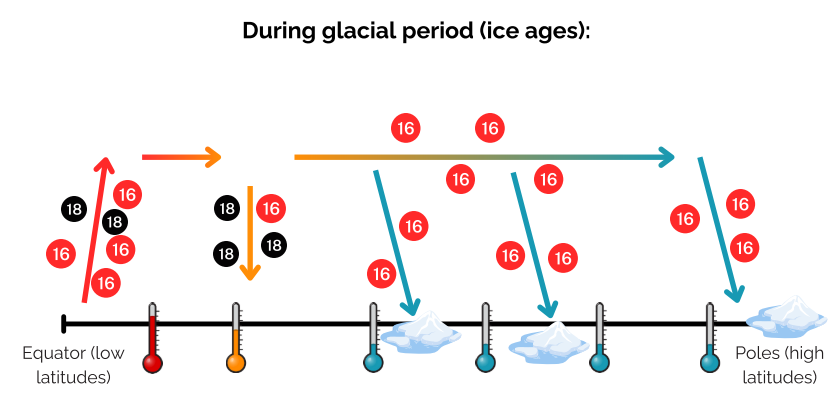
What happends to the oxygen isotopes during the glacial period (ice ages)?
Oxygen-16 will consendse out as snow at lower latitudes due to the cooler climate, causing more ice/snow and an increase in oxygen-16
What happens to oxygen isotopes as temperatures rise?
Melting glaciers (high latitudes) return water rich in oxygen-16 back to the ocean surface water. Water becomes less skewed towards oxygen-18
Which oxygen isotope do the plankton shells formed during the glacial period contain more of?
Higher Oxygen-18 than shells formed during inter-glacial periods
What other evidence can be used to gain information about the climate?
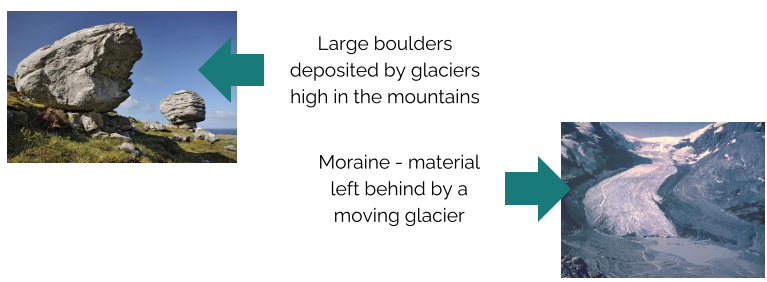
Large boulders deposited by glaciers high in the mountains - when glaciers retreated they moved the boulders along
Moraine (rock, sediment, dust) - material left behind by moving glacier
What did Louis Agassiz (Switzerland) do?
Pioneered the idea of the ice age
What did James Croll (Scotland) do?
Proposed changes in Earth’s orbit to explain the glacial-interglacial cycle
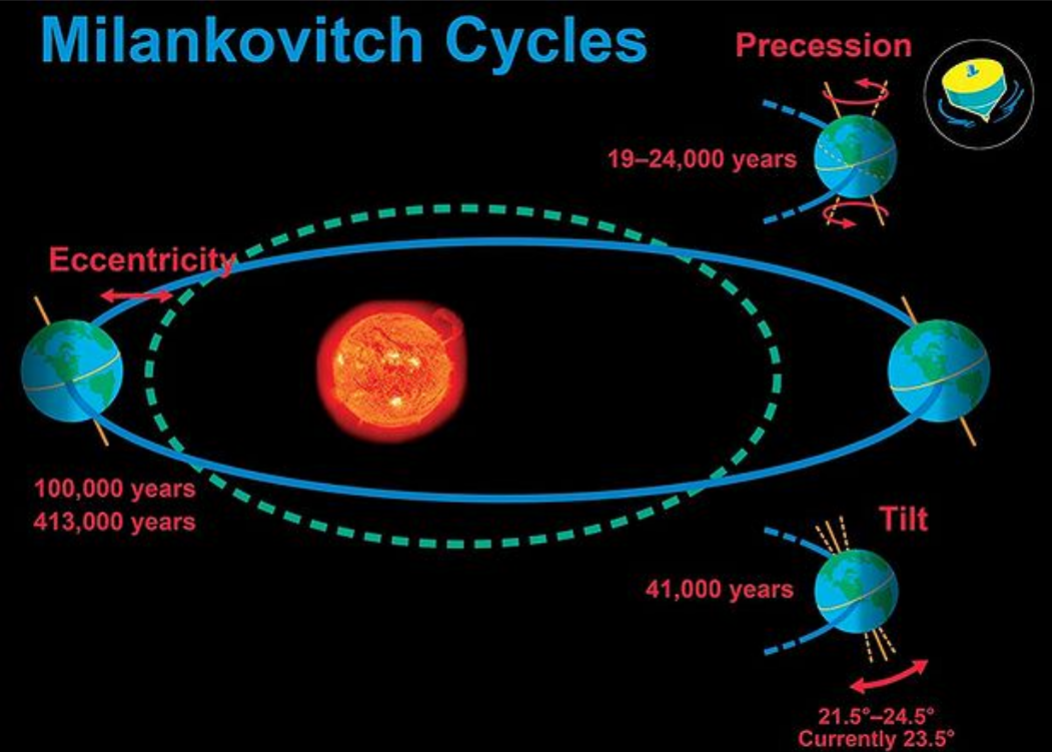
What is the Milankovitch cycle?
Mathematical description of orbital changes
3 Changes:
Eccentricity - change in the Earth’s orbit (Circular → Eliptical)
Precession - wobbling on the rotational axis
Tilt - angle change (amount Earth is tilted as it moves around axis), causes changes in solar radiation
Combination of 3 components used to determine the amount of solar radiation that would reach the Earth on different parts of its surface
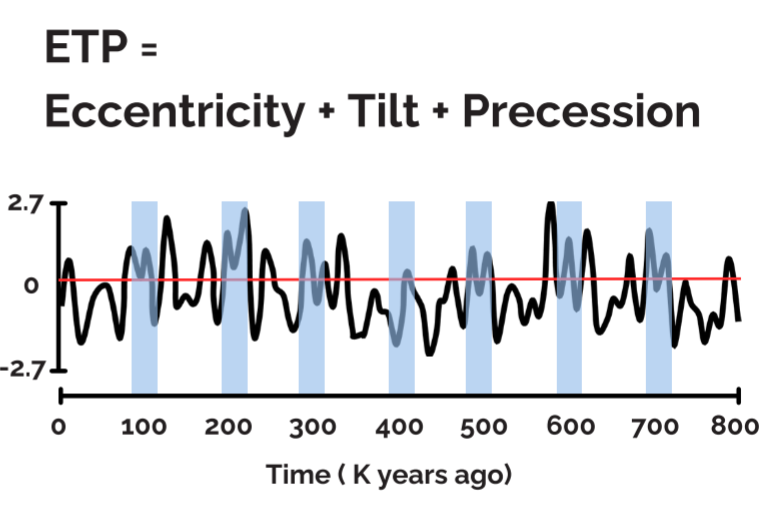
What does an ETP curve show?
Eccentricity + Tilt + Precession
How it effects earths tilt and, as a result, temperature
When glacial cycles occurred (blue markers, photo) - 100,000 year glacial-interglacial cycles
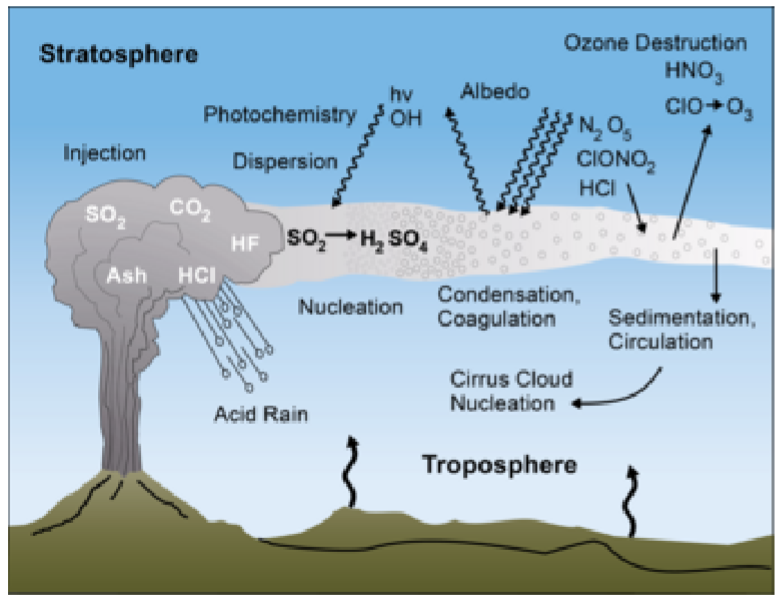
Volcanic Activity
Emit large amounts of materials that block sunlight, then get an albedo effect, which cools the temperature of the Earth for months
How do you reconstruct atmospheric conditions of the past?
Temperature based on delta-oxygen-18
CO2 based on gas bubbles trapped in ice
Dust trapped in ice (includes matter released from volcanoes)
Oxygen (16/18) isotopic ratio
Graph = ice core data, spikes = glacial period
Data is collected by extracting older materials
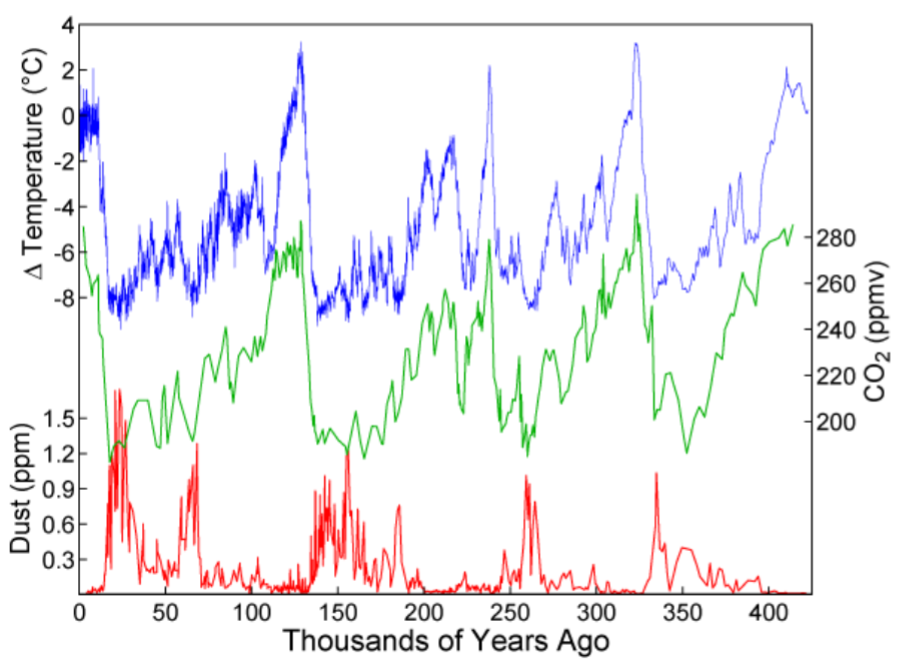
Do geological shifts match climate changes?
Yes
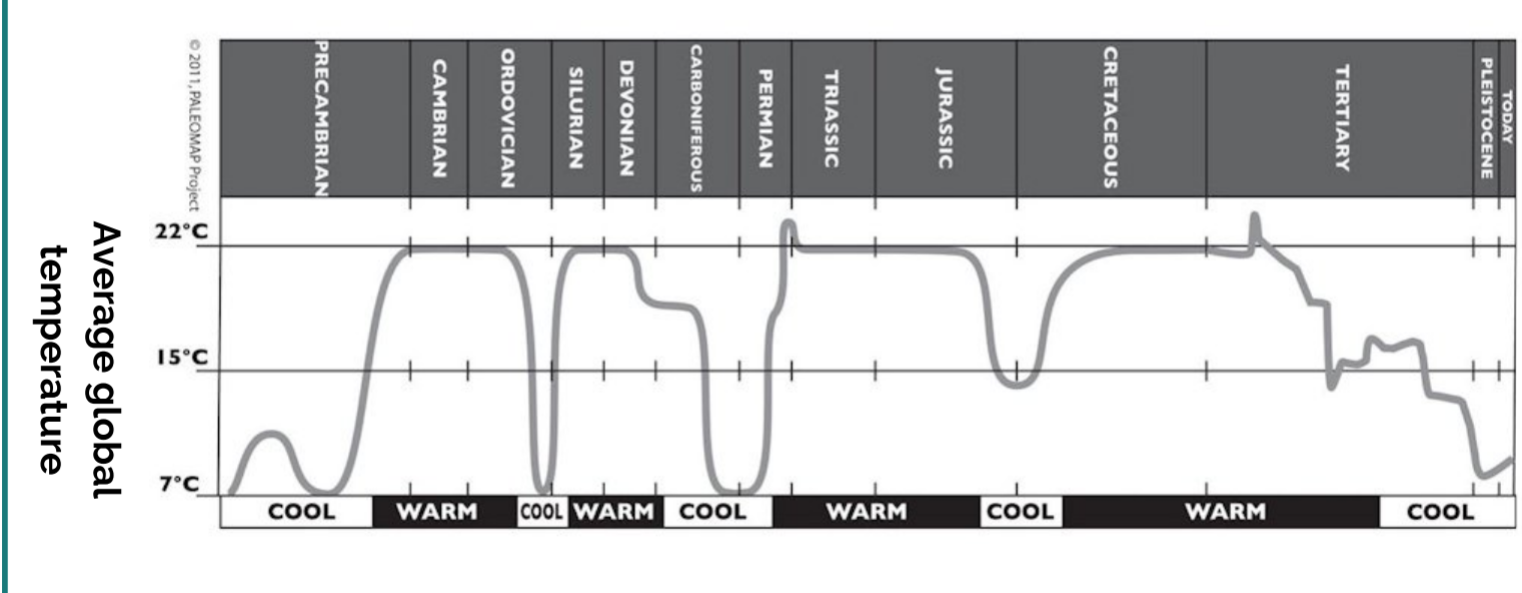
What was the Younger Dryas Event?
Temperature was on the rise since the last glacial period, and there was a sudden dip in temperature, this dip is the event
Caused an abrupt climate change
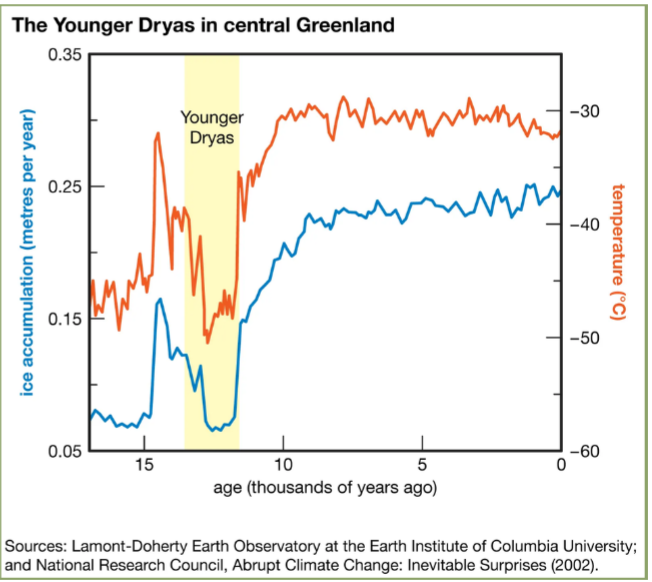
When was the Younger Dryas Event?
~12,000 years ago
What was the duration of the Younger Dryas Event?
~1,000+ years
What triggered the Younger Dryas Event?
Increase in freshwater flux to the ocean, due to the melting of glaciers at the end of the last glacial period
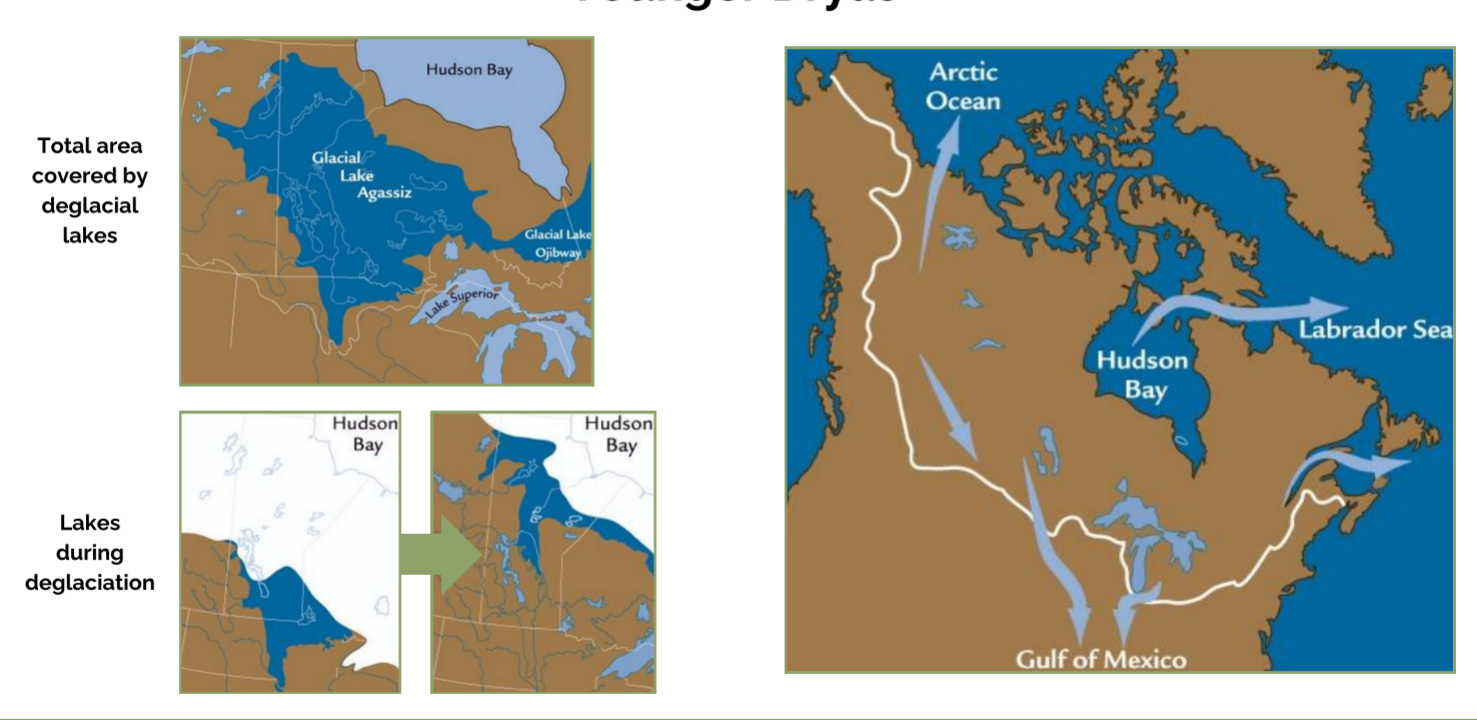
What happened during the Younger Dryas Event?
Glaciers halted their retreat and readvanced
Much of the North Atlantic experienced cold temperatures
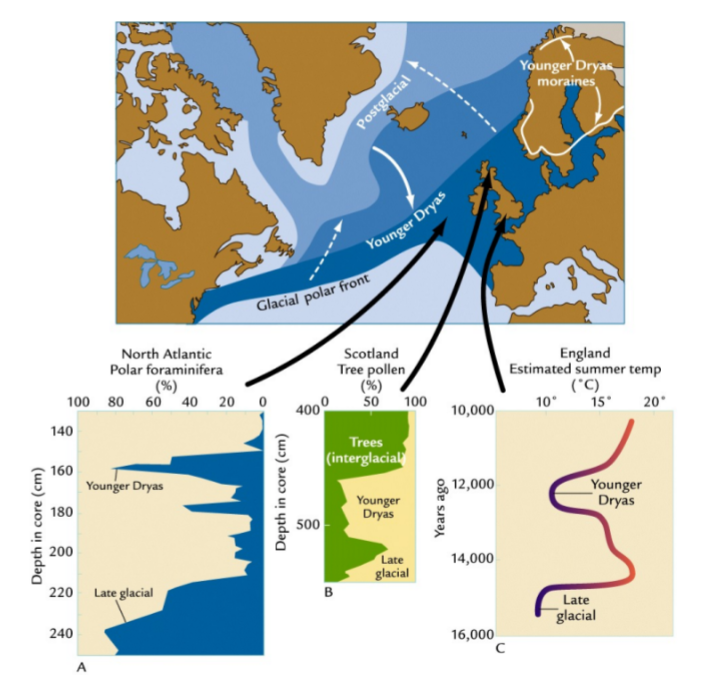
How do we know what happened during the Younger Dryas Event?
Polar Foraminifera (plankton) in sediments, found in the Atlantic, increased
Scotland tree pollen in soil, decreased
England summer temp, decreased to lower than usual
All showed dramatic cooling
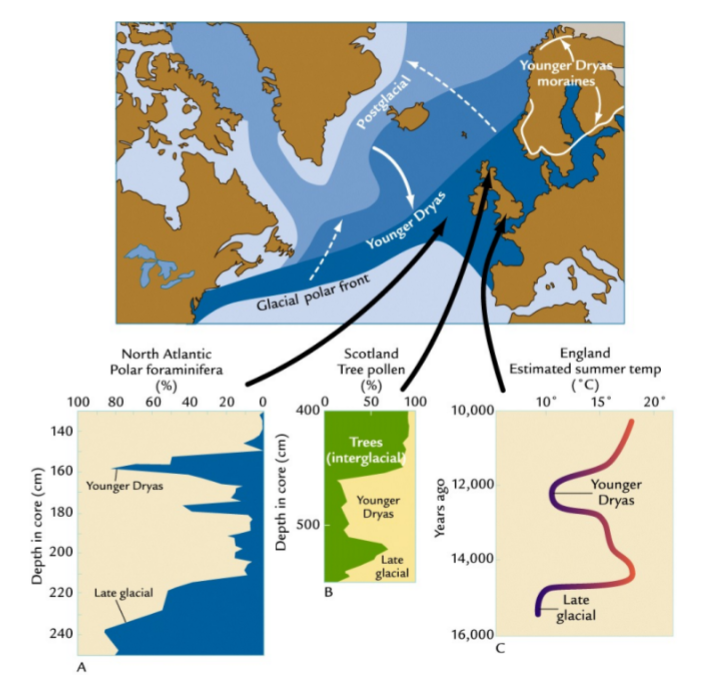
What happened to the freshwater during the Younger Dryas (YD)?
Retreating glaciers released freshwater into marine environment
Melting of lake Agassiz injected a large amount of freshwater into the North Atlantic
Interrupted the Thermohaline Circulation system and the heat redistribution to the North Atlantic
Colder Northern climate
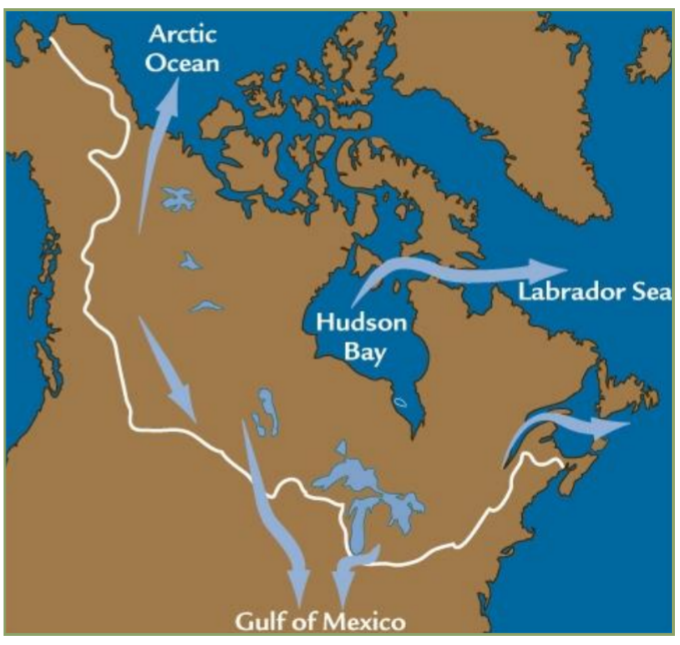
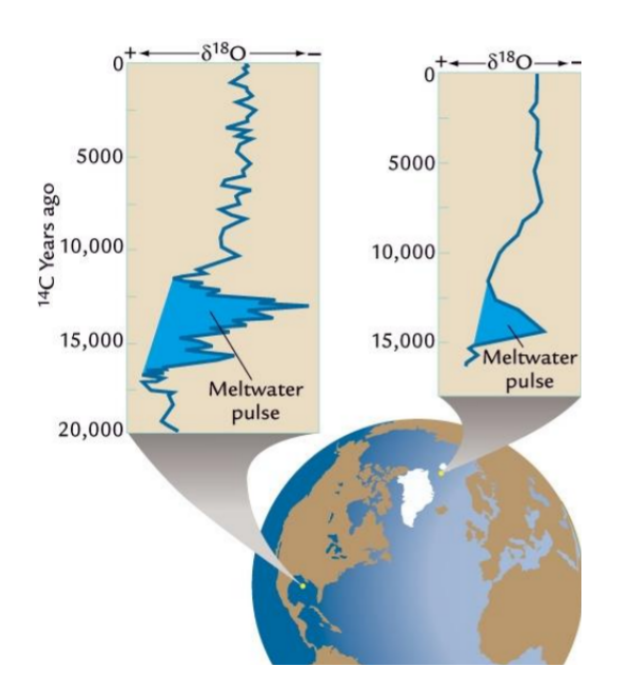
What evidence is there that a disruption of THC was the cause of the YD?
Terrestrial meltwater returns Oxygen-16 to the ocean (ratio of 18 to 16 decreases in marine sediment)
Marine sediment samples from Gulf of Mexico and near Greenland show decreased Oxygen-18 during YD, indicating influence of terrestrial meltwater
What were 2 recent events with a strong influence on human history?
Medieval Warm Period
Little Ice Age
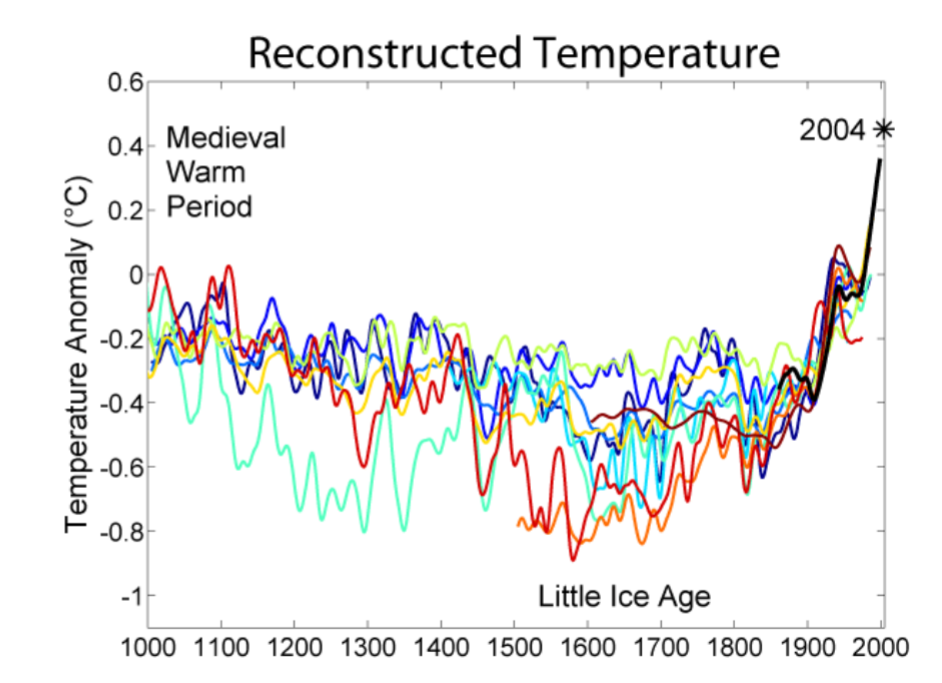
When was the Medieval Warm Period?
~1,000 years ago
How long was the Medieval Warm Period?
~300 years (900 - 1200 AD)
What happened during the Medieval Warm Period (MWP)?
Northern Europe experienced slightly warmer than usual climate
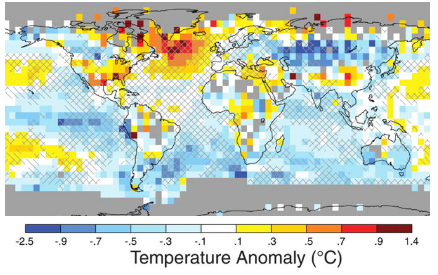
What was the evidence for the MWP?
Ice cores, tree rings, oxygen-18 ratio, coral cores, lake sediments, glacial/geological evidence, borehole temperature history, historical documents
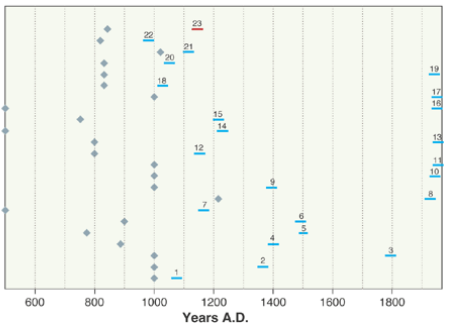
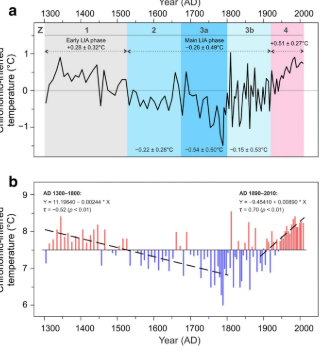
How long was the Little Ice Age?
~1250 - 1860 AD
When was the Little Ice Age?
~ 8,000 years ago
What was the Little Ice Age?
Coldest period of the last 8,000 years
Not a true ice age (no build up of polar ice caps)
Mostly evident in winter - summers still warm and dry
Not global; mainly limited to Northern Hemisphere
Temperature was 1-1.5 deg C colder than ‘normal’
What was the impact of the Little Ice Age on society?
Decrease in food production in Europe; widespread famine
Wine harvest ceased in England
Malnutrition and infectious diseases
Effects of e.g. black death possibly exacerbated by crop production reduction
What were the causes of the Little Ice Age?
Increased volcanic eruptions
Weak solar irradiance (low sunspot activity = less energy reaching Earth)
Resulting drop in temperature thendisrupted thermohaline circulation