Health, Human Rights and Intervention
 Call Kai
 Learn
Learn Practice Test
 Spaced Repetition
 Match
Match Flashcards
 Knowt Play
1/199

There's no tags or description
Looks like no tags are added yet.
Name | Mastery | Learn | Test | Matching | Spaced | Call with Kai |
|---|
No analytics yet
Send a link to your students to track their progress
200 Terms
What is the definition of development in the context of 21st Century life?
Development refers to the essentials of life such as access to clean water, electricity, services, and opportunities.
What are the traditional measures of development?
Economic and social factors, including GDP, GDP per capita, life expectancy, literacy rate, and infant mortality rate.
How does GDP per capita relate to development?
GDP per capita measures wealth and mean wealth through income, but can be skewed by very rich minorities.
What does life expectancy indicate in terms of development?
Life expectancy estimates how long a person will live based on predicted advances, current services, and disease risks.
Why is literacy rate an important measure of development?
Literacy rate reflects the quality of education, which correlates to economic output and personal life outcomes.
What does the infant mortality rate indicate about a society?
It reflects the quality of healthcare and societal attitudes towards children, highlighting vulnerability to disease and malnutrition.
How have technology and interdependency affected the measurement of development?
They have changed the way we measure development, highlighting that different societies interpret development differently.
What is the Happy Planet Index?
It links life expectancy, wellbeing, and equality with ecological footprint impact, excluding economic components.
What does the KOF Index of Globalisation measure?
It measures the strength of links between countries using economic, social, and political criteria.
How does globalisation relate to development?
Countries prioritizing globalisation tend to have better infrastructure, education, and economic resources.
What does the World Happiness Index measure?
It measures social support, generosity, and corruption based on population feelings about government transparency.
What are the top five countries on the Human Development Index (HDI)?
Norway, Switzerland, Australia, Ireland, and Germany.
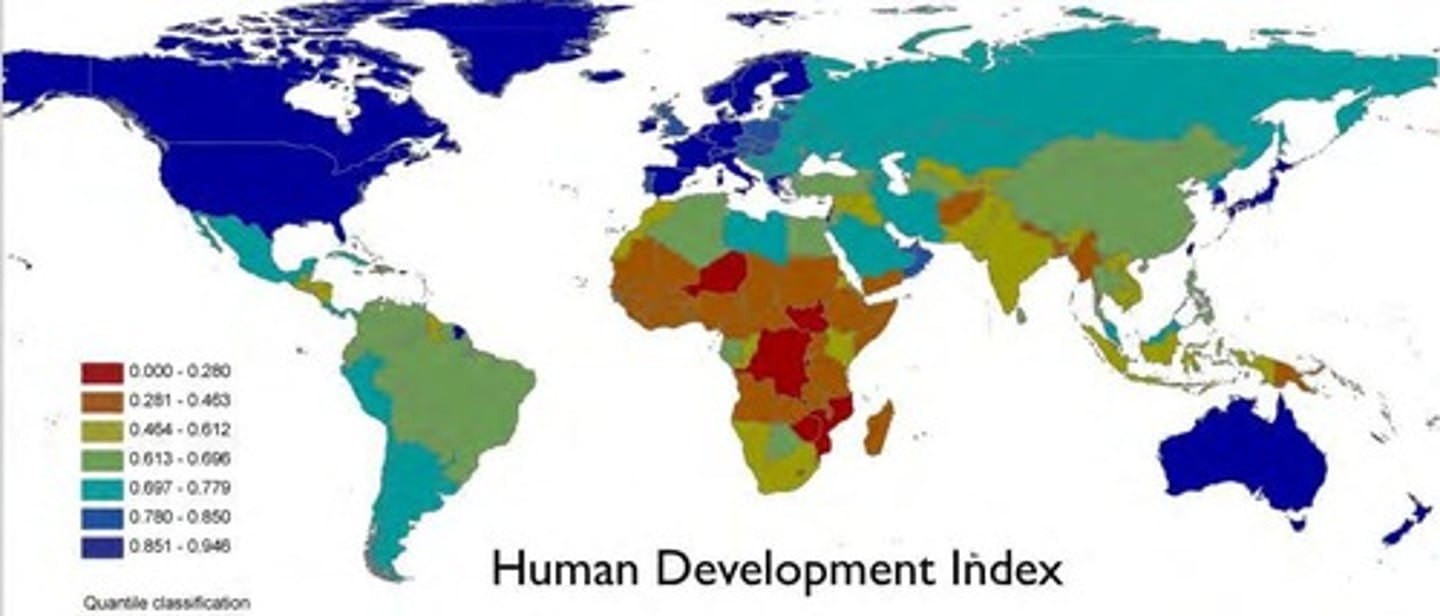
What is the HDI score of Norway?
0.953.
What are the bottom five countries on the Human Development Index (HDI)?
Niger, Central African Republic, South Sudan, Chad, and Burundi.
What is the HDI score of Niger?
0.354.
What factors contribute to the high HDI scores of developed countries?
Large economies, advancing technology, strong infrastructure, and free education systems.
What role does infrastructure play in development?
Well-structured cities and towns with strong infrastructure provide essential services like clean water and electricity.
Why is free education important for development?
It provides opportunities for progression into further education and employment.
What is the significance of the Human Development Index (HDI)?
It provides a composite measure of development based on health, education, and income.
How can different measures of development lead to varied country rankings?
Using different indices can result in countries being ranked differently for development.
What is a potential criticism of the World Happiness Index?
Its validity can be questioned as opinions may be influenced by media.
What is the relationship between literacy rates and economic output?
A well-educated workforce tends to earn higher wages, impacting economic productivity.
What is the Happy Planet Index (HPI)?
A measure that evaluates countries based on their ecological efficiency in delivering long, happy lives to their citizens.
Which country has the highest HPI score?
Costa Rica with a score of 44.7.
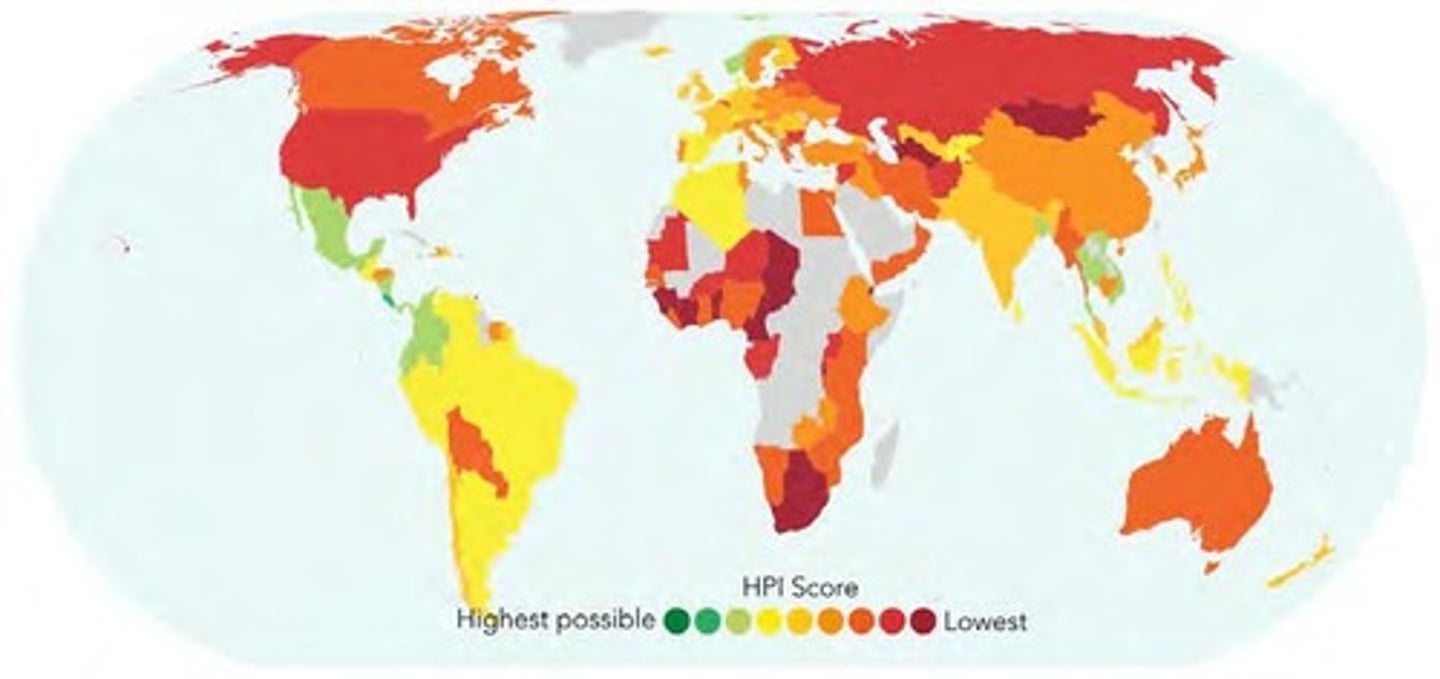
What are the bottom two countries on the Happy Planet Index?
Chad (12.8) and Luxembourg (13.2).
Why do high HPI scores not correlate with high Human Development Index scores?
Countries like Mexico and Costa Rica score high on HPI despite lower HDI scores due to variations in lifestyle, geography, and governance.
What unique approach has Costa Rica taken that contributes to its high HPI score?
Abolished its army and redirected defense spending to education, health, and pensions, while taxing fossil fuel use to protect rainforests.
How does Vietnam achieve a relatively high life expectancy compared to Gambia?
Through large investments in education and public services that have reduced inequality and poverty.
What is notable about Norway's performance on the Happy Planet Index?
It is the highest scoring European country, providing free education, healthcare, and public pensions, but has a high ecological footprint.
What are the top five countries with 100% literacy rates?
Andorra, Finland, Luxembourg, Poland, and Cuba.
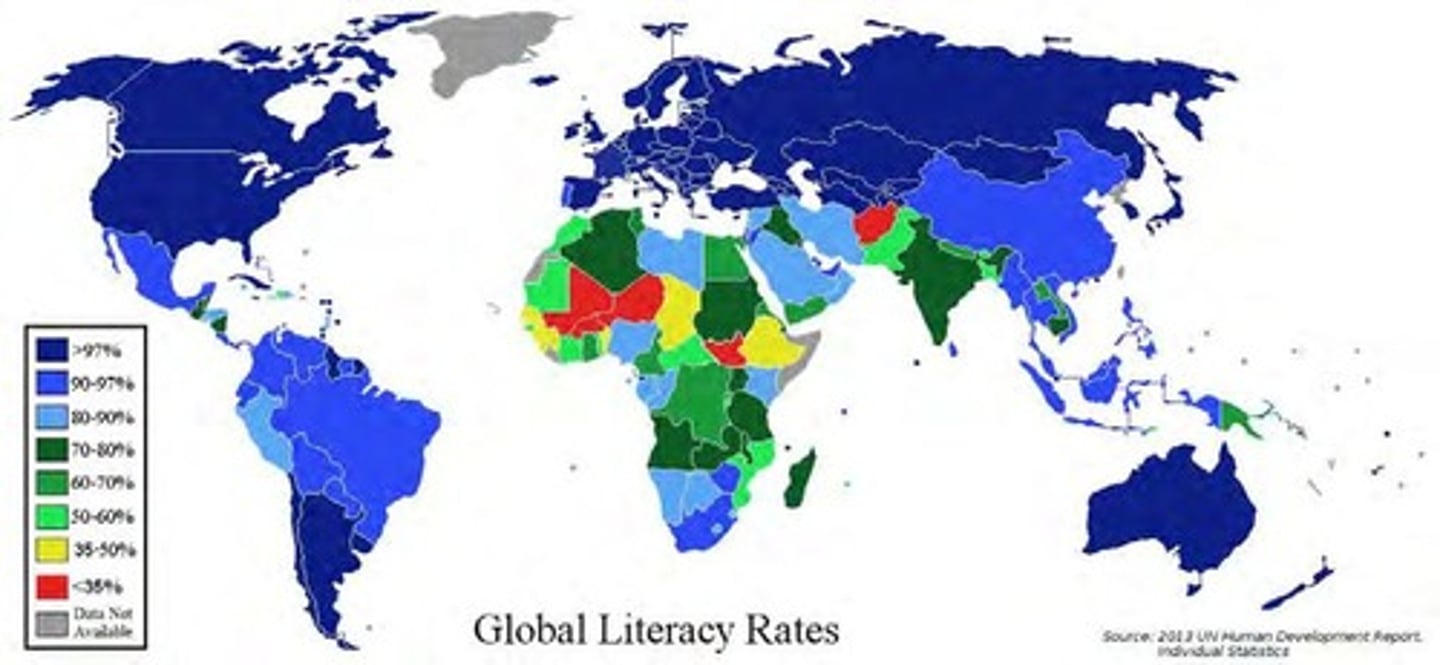
Which countries have literacy rates below 40%?
Niger, Mali, Guinea, Afghanistan, and Chad.
Why might literacy rates reported by countries be unreliable?
Countries may inflate their literacy rates to appear more successful and avoid intervention.
What historical link exists between development and a country's wealth?
Wealthier countries can afford better infrastructure, education, and health, leading to higher development.
What correlation does Rosling suggest exists in relation to development?
Health and life expectancy directly correlate with a country's level of development.
What is the Westernisation model in terms of governance?
A model based on democracy and capitalism, emphasizing equal rights in governance and private ownership of industry.
What is democracy?
A system of government where the population has equal rights in decision-making and elects representatives.
What is capitalism?
An economic system where industries are owned by private businesses aiming for profit, leading to potential wealth inequality.
What are some characteristics of capitalist economies?
They tend to be the most wealthy and successful globally, exemplified by countries like the USA, UK, and Germany.
What is a common focus for different countries' development strategies?
Sustainability, economic growth, religious laws, and reducing inequality.
What does the term 'ecological footprint' refer to?
The consumption of resources, greenhouse gas emissions, and the protection of habitats and wildlife.
How does Norway's ecological footprint compare to a sustainable footprint?
Norway's ecological footprint is three times greater than what is considered sustainable.
What is the significance of GapMinder in relation to global health and development?
It highlights inequalities in health and wellbeing across the world.
What role does education play in Vietnam's development?
Large education provisions have significantly reduced inequality and improved life expectancy.
What is the impact of government strategies on development?
Different governance styles and strategies can lead to varying focuses on sustainability, growth, and social equity.
What is the relationship between literacy rates and the Human Development Index?
Literacy rates are one of the measures considered in calculating the HDI, showing similar trends.
What does it mean when a country is described as capitalist?
It means that the country primarily supports private ownership of industry, but not all industries may be privatized, as seen with the Royal Mail in the UK until 2013.
What is a key difference between the healthcare systems in the US and the UK?
The US has a private healthcare system, while the UK has the National Health Service (NHS), which is publicly funded.
What is 'Western development' characterized by?
It is characterized by equal rights, democracy, and capitalism, which are seen as successful in promoting development.
Why might some governments resist adopting Western governance and values?
They may feel that these values contradict their traditions, culture, and way of life.
What are some environmental criticisms of Western lifestyles?
Western lifestyles are considered unsustainable due to high energy and water consumption and significant greenhouse gas emissions.
How do religious views in many Western countries influence laws?
Many Western countries have a large proportion of atheists or relaxed religious views, which can lead to laws that may contradict religious laws, such as those regarding abortion and divorce.
What is Sharia Law?
Sharia Law is a model of non-secular governance where laws are based on Islamic principles, intertwining law and religion.
Which countries are known for implementing Sharia Law?
Countries like Saudi Arabia and Iran implement Sharia Law.
How does Sharia Law differ from Western laws regarding women's roles?
Sharia Law has strict interpretations that can lead to controversial views on women's treatment and rights compared to more liberal Western laws.
What is the Law of Mother Earth in Bolivia?
It recognizes the rights of nature and mandates the government to protect it, focusing on sustainability and environmental balance.
What are the responsibilities outlined in the Law of Mother Earth?
The government must protect nature, reduce resource consumption, and restore any damage done to the environment.
What is the primary goal of communism as a governance model?
To reduce wealth inequality by having prominent industries state-owned, thereby reducing competition.
What are some criticisms of communist states?
They often experience little economic growth, controlled wages leading to inequality, and restrictions on freedom of speech and human rights.
How has China managed to grow economically while maintaining a communist government?
China has opened itself to globalization and foreign direct investment, leading to rapid economic growth despite its communist governance.
What is the definition of authoritarian states?
Authoritarian states, sometimes called totalitarian, are characterized by decisions made by the government or an individual without democratic processes.
What is a significant challenge faced by countries adopting the Law of Mother Earth?
These countries must adapt their economic structures and rethink traditional development models, which many are hesitant to do.
What is a common feature of authoritarian governance compared to democratic governance?
In authoritarian governance, power is concentrated in the hands of a few, often leading to limited political freedoms.
What does the term 'totalitarian' refer to in the context of governance?
Totalitarian refers to a form of governance where the state recognizes no limits to its authority and seeks to regulate every aspect of public and private life.
What is one of the main criticisms of the implementation of communism historically?
Historically, communist states have struggled with economic growth due to lack of competition and foreign investment.
How does the interpretation of Sharia Law vary among Islamic countries?
The severity of interpretations of Sharia Law varies, with some countries like Saudi Arabia having stricter interpretations than others.
What impact does Saudi Arabia's oil wealth have on its global significance?
Despite its different form of government, Saudi Arabia remains a central figure in the world economy due to its oil wealth.
What is the relationship between democracy and authoritarianism?
Democracy promotes participation and representation, while authoritarianism centralizes power and limits individual freedoms.
How does the concept of sustainability manifest in Bolivia's governance model?
Bolivia's governance model emphasizes environmental protection and sustainability as central to its development strategy.
What are some human rights abuses reported in North Korea?
Persecution of dissenters without fair trial, execution and torture of prisoners, and restrictions on travel and communication with foreign countries.
Who inherited power in North Korea?
Kim Jong Un inherited power from his father as the Supreme Leader.
What is the situation of the Rohingya Muslims in Myanmar?
They face persecution, forcing many to migrate to escape torture or murder.
What limitations do journalists face in Myanmar?
Limited freedom of speech, with journalists often imprisoned for negative portrayals of the government.
What are some health-related problems faced by developing countries?
Poor healthcare access, malnutrition, lack of clean water, climate-related diseases, and overcrowding.
How does poor healthcare affect developing countries?
Low investment in healthcare and education leads to fewer healthcare professionals and inadequate facilities.
What impact does malnutrition have on health in developing countries?
Malnutrition increases vulnerability to diseases.
What are the consequences of poor access to clean water in developing countries?
Prevalence of waterborne diseases such as cholera.
How does climate affect health in developing countries?
Tropical and semi-arid climates promote diseases like Malaria, requiring expensive medical attention and protective measures.
What is the impact of overcrowding on health in rapidly growing cities?
Increased spread of diseases due to close proximity of housing and inadequate infrastructure.
Which groups are most affected by diseases in developing countries?
Vulnerable members of society, including young children, elderly people, and pregnant women.
What are the implications of high infant and maternal mortality rates in developing nations?
They indicate poor health conditions and access to healthcare.
How does good health contribute to a country's development?
Healthy populations are more productive, leading to better economic outcomes.
What is the typical access to clean water in developed countries?
Most developed countries have excellent access to clean water.
How does disposable income affect health in developed countries?
It allows populations to invest in lifestyle improvements, reducing illness risk and extending life expectancy.
What factors contribute to the longevity of Japanese people?
Their lifestyle and diet are considered significant factors.
What health issues do developed nations face despite their advantages?
Lifestyle choices such as smoking, alcohol consumption, and high saturated fat intake contribute to health problems.
What specific health issues are prevalent in America and the UK?
Obesity, type 2 diabetes, and cancer affect a large portion of the population.
How does population density in large cities affect health?
High population density increases susceptibility to infectious diseases.
What extreme weather events can heighten illness and isolate vulnerable individuals?
Long-period heatwaves and blizzards.
What is a significant factor contributing to variations in health within a country?
Inequality.
What is the average difference in life expectancy across the UK?
There is a ten year difference.

Where are the highest life expectancies typically found in the UK?
In the South.
What has contributed to improved life expectancy in most boroughs of the UK?
Changing employment, increasing wealth, and fewer risks to life due to health and safety regulations.
How has changing employment affected life expectancy in the UK?
More people are employed in tertiary and quaternary industries, leading to fewer physically demanding jobs.
What impact does increasing wealth have on life expectancy?
Households can spend more on improving lifestyles, leading to higher life expectancies.
What factors have reduced risks to life in the last decade in the UK?
Stricter health and safety regulations, increased vaccination programs, and improved knowledge of hazards.
What economic issue can lead to lower life expectancies in certain UK communities?
Economic decline due to deindustrialization.
How does culture affect health in certain communities?
Cultural practices, such as excessive drinking and smoking, can negatively impact health.
Why are densely populated cities vulnerable to infectious diseases?
The large net movement of people, including tourists and business people.
What are some reasons for health inequality within populations?
Variations in health can occur due to gender, ethnicity, and socio-economic groups.
How does gender inequality affect health in some countries?
Men may be exposed to more hazardous occupations, leading to lower life expectancy.