BIOM 1060 (Module 2)
 Call Kai
 Learn
Learn Practice Test
 Spaced Repetition
 Match
Match Flashcards
 Knowt Play
1/25

There's no tags or description
Looks like no tags are added yet.
Name | Mastery | Learn | Test | Matching | Spaced | Call with Kai |
|---|
No analytics yet
Send a link to your students to track their progress
26 Terms
Describe the divisions of the nervous system.
The nervous system is divided into two:
Central nervous system → Composed of the brain and spinal cord
Peripheral nervous system → Composed of spinal, cranial nerves and ganglia
From here the PNS divide’s into Afferent (sends out sensory impulses to the CNS) and Efferent (motor commands from the CNS to the effectors)
The Efferent is further split into somatic (voluntary movement, motor signals from the CNS to skeletal muscles e.g walking or stretching) and Autonomic (controls the involuntary movement, regulates heart rate and digestion)
And finally from her the Autonomic splits into Sympathetic (Fight or flight, increased heart rate, breathing) and parasympathetic (Rest and digest, decreased heart rate, and conservation of energy)
Name and describe the parts of the neuron
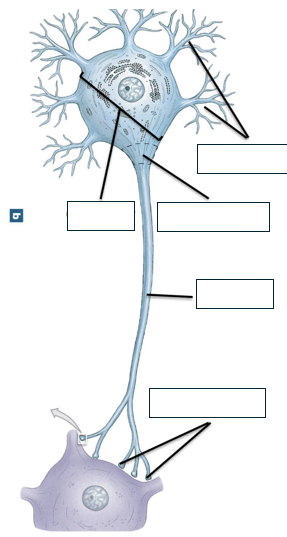
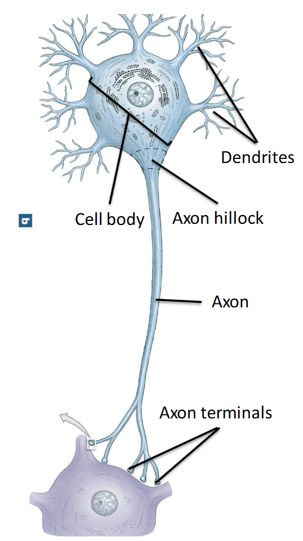
Cell body (soma)
Nucleus, organelles
Dendrites
Receive information
Axons
send information as electrical signals (action potentials)
Axon hillock
Where an action potential starts
Axon terminals
Releases neurotransmitters to communicate with other cells
Myelination
Myelin protects and electrically insulates the axon, making it increase the speed of electrical signals
Created by:
Schwann cells (PNS)
Oligodendrocytes (CNS)
Neurons classified by functions
Sensory/Afferent
Neurons sending sensory info to the CNS
Motor/Efferent
Neurons sending motor info from the CNS
Interneurons
Link sensory & motor neurons (mostly CNS) → enabling rapid reflexes that protect the body without waiting for brain processing.
What is RMP
The resting membrane potential (RMP) is the electrical potential difference across a neuron’s membrane when it is not transmitting an impulse, typically around −70 mV.
Describe how the movement of Na+ and K+ across the plasma membrane as well as the Na+-K+ pump results the RMP.
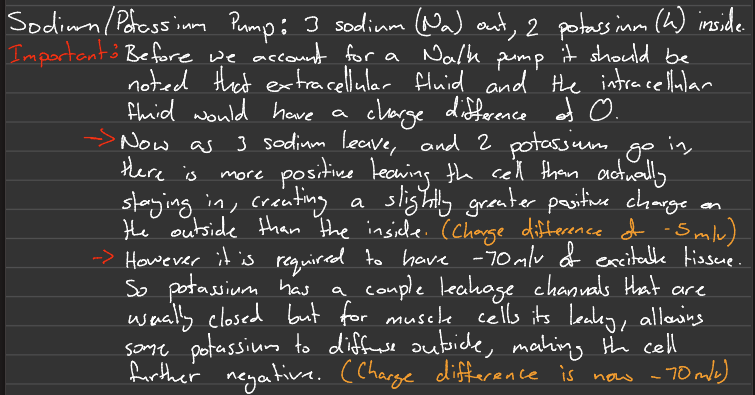
Leakage channels
Always open and allows the cell when necessary to become more negative, seen in muscle cells during RMP
Gated channels
Chemically gated:
Only open when met with a appropriate neurotransmitter
Voltage gated:
Open in response to changes in membrane potentials
Graded Potentials
Short lived, localised changes in membrane potentials
Can be depolarisation or hyperpolarisation
Triggered by a stimulus that opens a chemically gated ion channels
Postsynaptic graded potentials will occur when a neurotransmitter binds to a chemically gated ion on a postsynaptic neuron
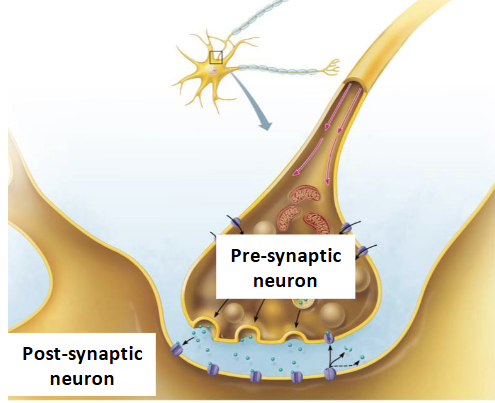
Depolarisation
Decrease in membrane potential. inside of the cell becomes less negative than RMP
Opening of gated Na+ channels (enters) → opposite of what happens in RMP
Hyperpolarisation
Increase in membrane potential. Inside of the cell becomes more negative than RMP
Opening of K+ channels (leaves) or Cl- channels enters → opposite of what happens in RMP
Action potentials
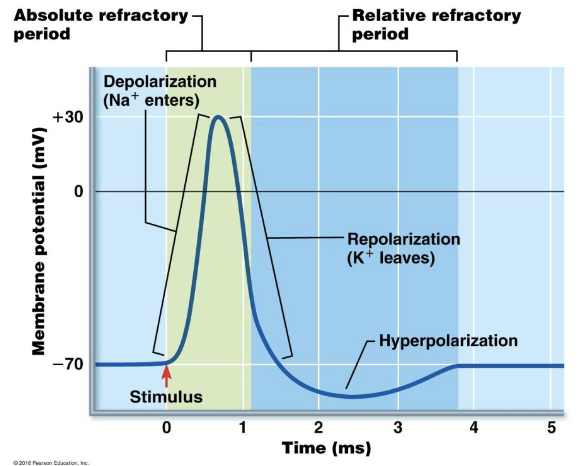
Brief reversal of membrane potential (-70mV to +30mV in neurons)
Do not decay over distance
Involves special voltage-gated channels
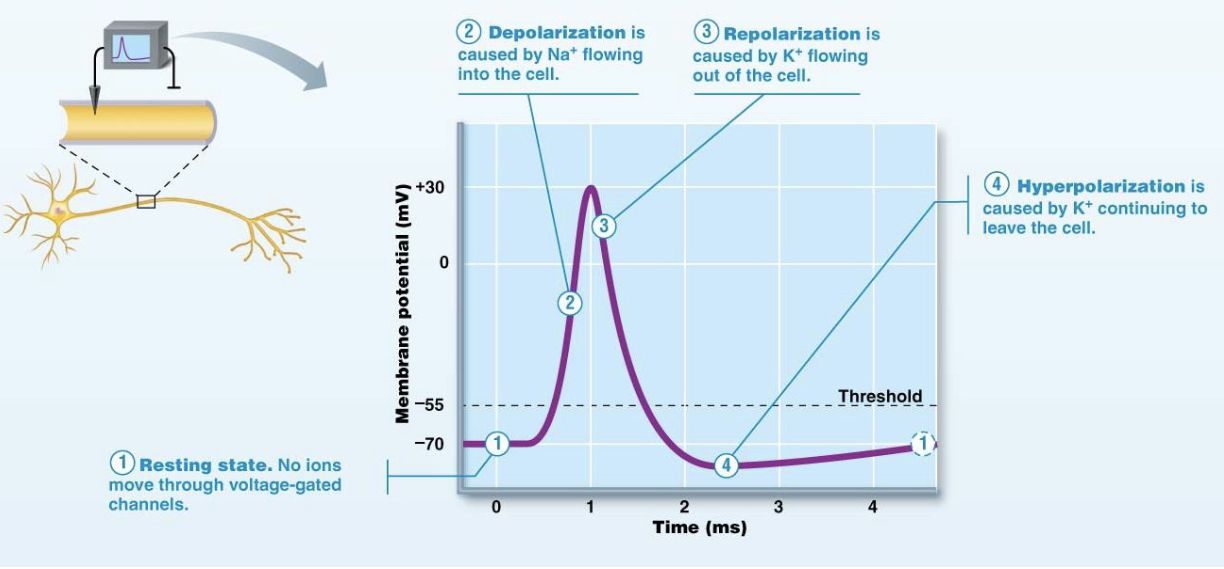
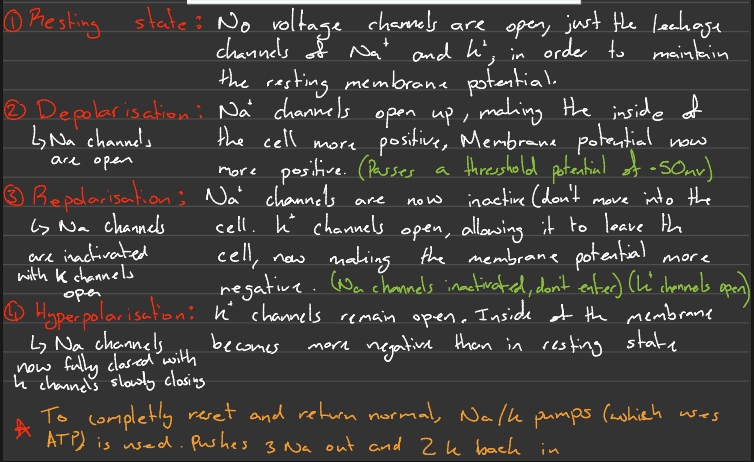
Stages of action potentials
Important:
The threshold must be reached in order for an action potential to even occur
Compare and contrast graded potentials and action potentials.
Similarities
Both are changes in membrane potential
Both involve movement of Na⁺ and K⁺ ions
Both are used for neuronal communication
Differences
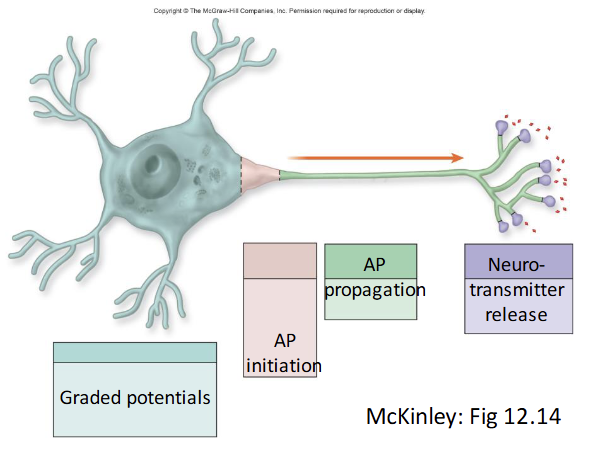
1. Location
Graded: dendrites & cell body
Action: axon
2. Type of channels
Graded: chemically-gated (stimulus-controlled)
Action: voltage-gated
3. Direction
Graded: spreads in multiple directions
Action: one direction along axon
4. Type of signal
Graded: can be depolarising OR hyperpolarising
Action: always follows the same pattern (depolarisation → repolarisation)
5. Distance
Graded: short, decreases with distance
Action: long, does not decrease
Refectory period and types
Time in which a region of a neuron cannot trigger another action potential time in which a region of a neuron cannot trigger another action potential.
Types:
Absolute refractory period: (Tends to be during depolarisation and repolarisation)
Sodium channels are open or inactivated making it physically impossible for another action potential (enforces on way transmission)
This is due to it already being in use
Relative refractory period: (Tends to be during hyperpolarisation)
Sodium channels now closed (reset and ready)
Action potential can occur however requiring a strong stimulus as the membrane is still very negative due to K+ still leaving (e.g a lot more neurotransmitters released)