biliogy exam
 Call Kai
 Learn
Learn Practice Test
 Spaced Repetition
 Match
Match Flashcards
 Knowt Play
1/31

There's no tags or description
Looks like no tags are added yet.
Name | Mastery | Learn | Test | Matching | Spaced | Call with Kai |
|---|
No analytics yet
Send a link to your students to track their progress
32 Terms
what is DNA?
DNA is a speacial molecule that is found in the nucleus of all cells. It stands for deoxyribonucleic acid.
where is DNA found?
most DNA in a cell is found in the nucleus which is the control centre of all cells. DNA is stord in chromosomes and contains the instructions for how the cell works and what characteristics an organism has. small amount found in mitochondria.
describe the role of DNA?
DNA carries the instructions for making proteins. Proteins control how the body grows and works and deermines characteristics such as eye colour and height.
nucleotide?
they are organised in a way that makes a double helix shape. The sugar/phosphate makes up the backbone and the nitrogen base makes the rungs which looks like a twisted ladder.
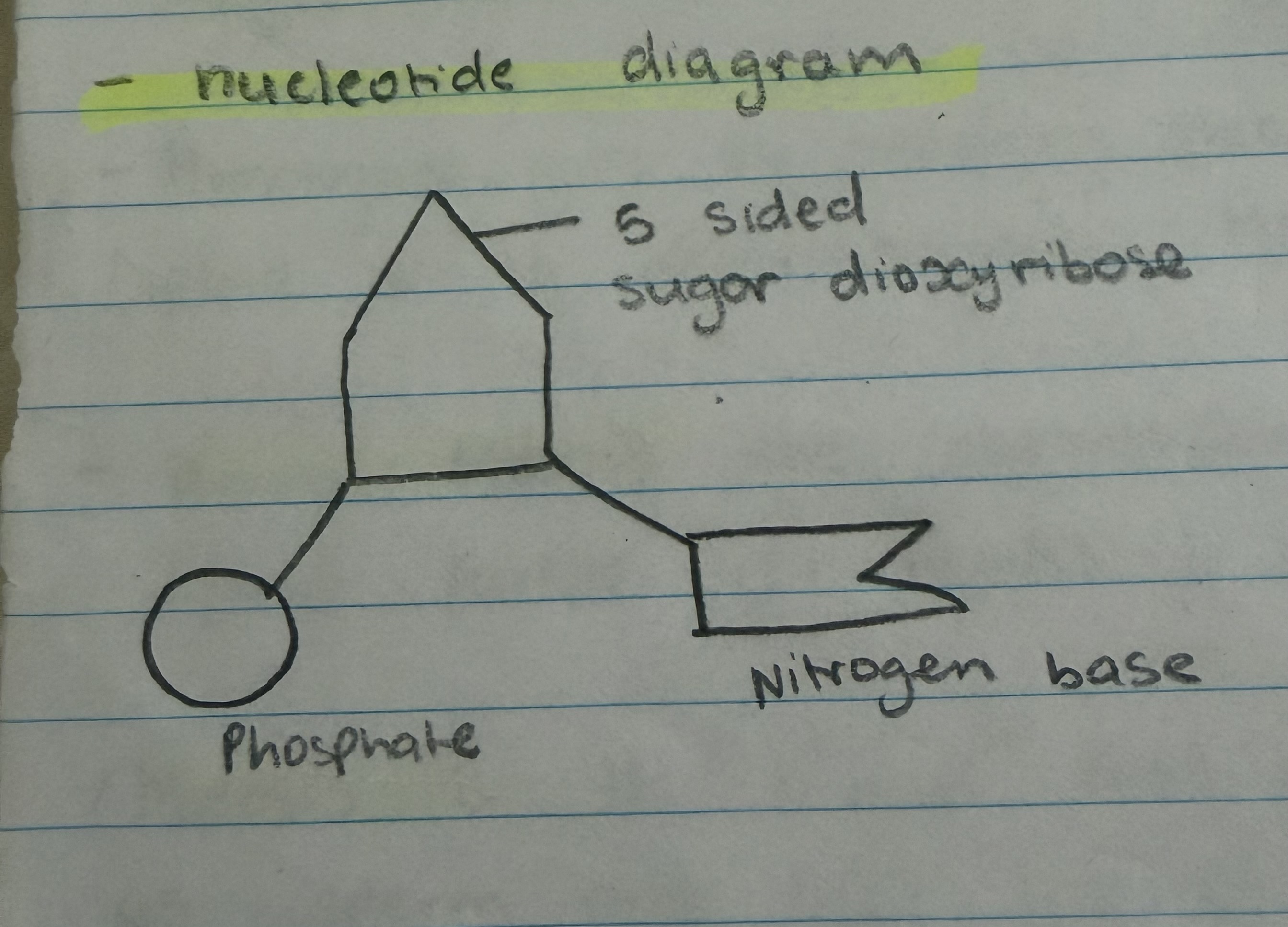
4 nitrogen bases?
Adenine, Thymine, Guanine, Cytosine
A-T
G-C
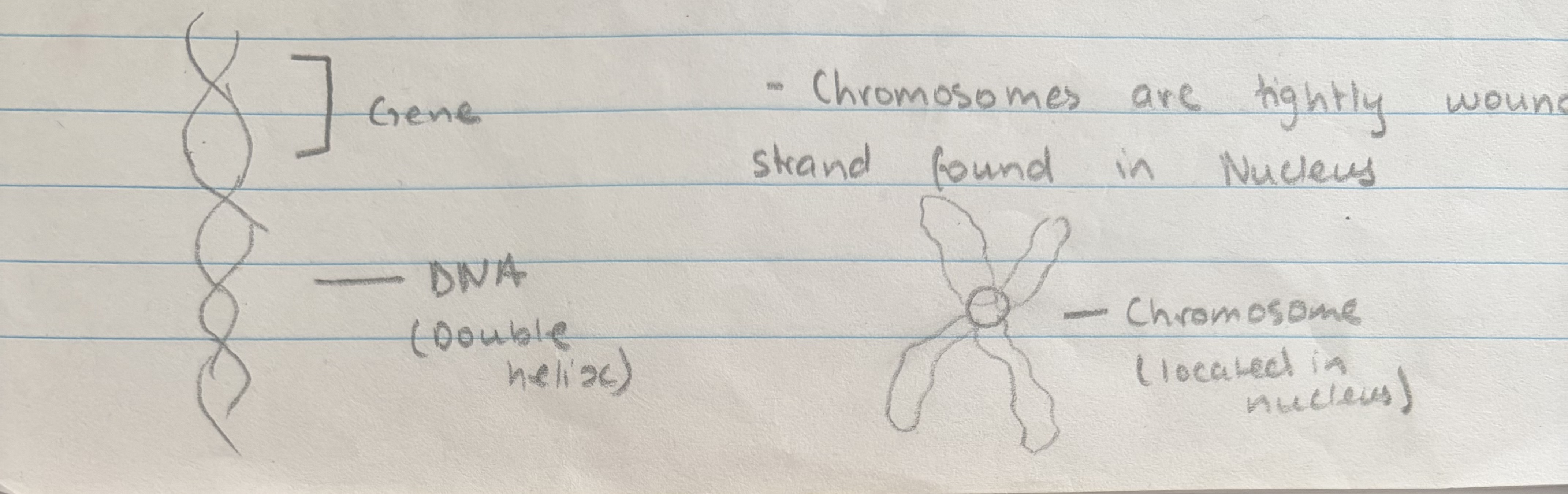
DNA, chromosomes and gene?
DNA- is a special molecule that contains genetic information
gene- is a small section of DNA that codes for a protein
chromosomes- are tightly wound DNA strand found in nucleus.
what is DNA replication?
DNA replication is the process where DNA copies itself to make two identical DNA molecules. The DNA double helix opens up which is done by helicase. New bases join onto each other A with T and G with C. Two identical molecules are made.
what is mitosis?
mitosis is the process where somatic(body cells) divide for growth and repair. One cell dividesinto two identical daughter cells.
stages of Miitosis? IPMAT
interphase- cell grows in size and the chromosmes replicate to form two chromatids joined at the centromere.
prophase- the chromosomes condece and spindle fibres formin the cytoplasm.
metaphase- the chromosomes allign in the centre of the cell and spindle fibres attatch to the centromere in preperation to split apart
anaphase- chromatids seperate and move to opposite ends of the cell, ensures each cell contains identical chromosomes after spliting.
telophase- two new nuceli form around each set of chromosomes, they decondece and the cell begins to split from each other
cytokenesis- the cytoplasm of the parent cell spilts into two identical daughter cells
what are gametes?
gametes are sex cells used in reproduction, male gametes are sperm and female gametes are eggs. gametes hace 23 chromosomes.
descibe fertilisation?
fertilisation occurs when a sperm cell joins with an egg cell. the nuclei combine to form a zygote with a full set of chromosomes. The zygote then grows into a new organism
what is meiosis?
meiosis is the process that makes gametes such as sperm and eggs. It is important for sexual reproductionn as it cuts chromosomes in hald, dip-hap.
how does meiosis lead to genetic variation?
Meiosis creates genetic variation so that offspring are not exactly the same as their siblings. One way this happens is through crossing over, where homologous chromosomes exchange sections of DNA, creating new combinations of genes. Another way is through independent assortment, where chromosomes are separated randomly into gametes. As a result, each gamete receives a different combination of chromosomes, leading to genetic variation
mitosis vs meiosis
mitosis meiosis
body cells gametes
1 division 2 divisions
identical cells different cells
dip-dip dip-hap
growth and repair reproduction
what are mutations
mutations are sudden parmanenent changes in DNA(genes). they can create new allels (diffrent virsions of a gene) which can change traits for eg a mutation could change hair color
physical mutagens?
uv radiation- can cause skin cancer
x rays- damage DNA strands
chemical mutagens?
found in smoke, pollution and some foods, can change DNA bases or cause errors in replication
cigarettes smoke- causes lung cancer
biological mutagens
viruses like HPV can insert their DNA into your cells which can disrupt normal genes and cause diseases
what is inheritance?
inheritance is when genetic information is passed from parents to offsprings through gametes during fertilisation. you get one allele from mum and one from dad
is prdigree ressesive or dominanat?
ressesive
skips generation
dominant
doesnt skip generation
autosomal or xlinked?
autosomal dominanat(no skipping generations)
males and females affected equally
affected offsprong as at least one affected parent
autosomal recessive(may be carriers)
males and females affected equally
affected offspring may have unaffected parents
X linked dominant(no skipping generation)
more females are affected
affected father passes all traits to daughters
affected mum can pass traits to both
X linked ressesive(may skip gens)
more males are affected
all sons of an affected mother will be affected
evolution
before evolution was accepted, many people believed in creationism which is an idea or belief that’s god created all living things
larmarc theory (wrong)
organisms change during their lifetime; these changes are caused by use and disuse. traits gained are passed to offsprings. e.g. giraffes stretch their necks- necks get longer- babies inherit long necks. this is wrong because acquired traits are not inherited.
darwin theory(correct)
variation already exists in population, some traits give a survival advantage, thos individuals survive and reproduce more and overtime the population changes. eg some giraffes have naturally longer necks- survive better- pass genes on. this is correct and is called natural selection
artificial selection
artificial selection is when humans choose traits in an organism. humans selest individulas with des traits and breed them together, over generations traits become more common. eg dogs bread for size and looks while plants bred for bigger fruit sizes
natural selection
it is the main mechanism of evolution
variation- not all memebers of the species are exacly the same
overproduction- more offsprings are produced than that can survive
competition- organisms compete for resources
slelection- those with helpful traits survive
reproduction- survivors pass on theor genes
over time species become better adapted
mutation and its role
a mutation is a rndom change in DNA. it creates new allels, can be beneficial harmful or neutral.
role in evolution
it provides genetic variation, without mutation- no new traits- no evolution
speciation(how new species form)
1- A species starts as one population living in the same area.
2- The population becomes separated by a geographical barrier (such as a mountain, river, or climate change), preventing the groups from breeding with each other.
3- The separated populations experience different environmental conditions and selection pressures.
4- Mutations occur within each population, creating genetic variation.
5- Individuals with advantageous traits are more likely to survive and reproduce, passing these traits on to their offspring.
6- Eventually, the two populations become so genetically different that they can no longer interbreed and produce fertile offspring. At this point, a new species has formed.
population genetics
gene pool- the total genetic information within a population
gene flow- movement of alleles onto or out of the population
gene frequency- is the proportion of a specific allele in a population compared to all alleles for that gene.
what are fossils?
Fossils are the preserved remains or traces of organisms that lived in the past.
1- An organism dies and is quickly buried by sediment (such as mud, sand, or ash).
2- The hard parts (bones, teeth, or shells) are protected from decay and scavengers.
3- Over time, more layers of sediment build up and compress into rock.
4- Minerals gradually replace or fill the tissues, preserving them.
5- After millions of years, the remains become fossils.
conditions needes for fosiliation?
Rapid burial by sediment
Low oxygen levels to slow decay
Presence of hard body parts (bones, shells, teeth)
Long periods of time and mineral-rich groundwater
how diffrent evidence supports evolution?
comparative anatomy- similar structures in diff specie can be evidnece of shared ancestory. eg A whale tail and a human hand have similar bone structures but different functions.
embroyology- study of dvevelopment structre and fuction of embryos. embryos show similariyes in the ealry tsages of development.
vastigial organs- functionless sturctures found in organisms eg wisdom teeth and appendix